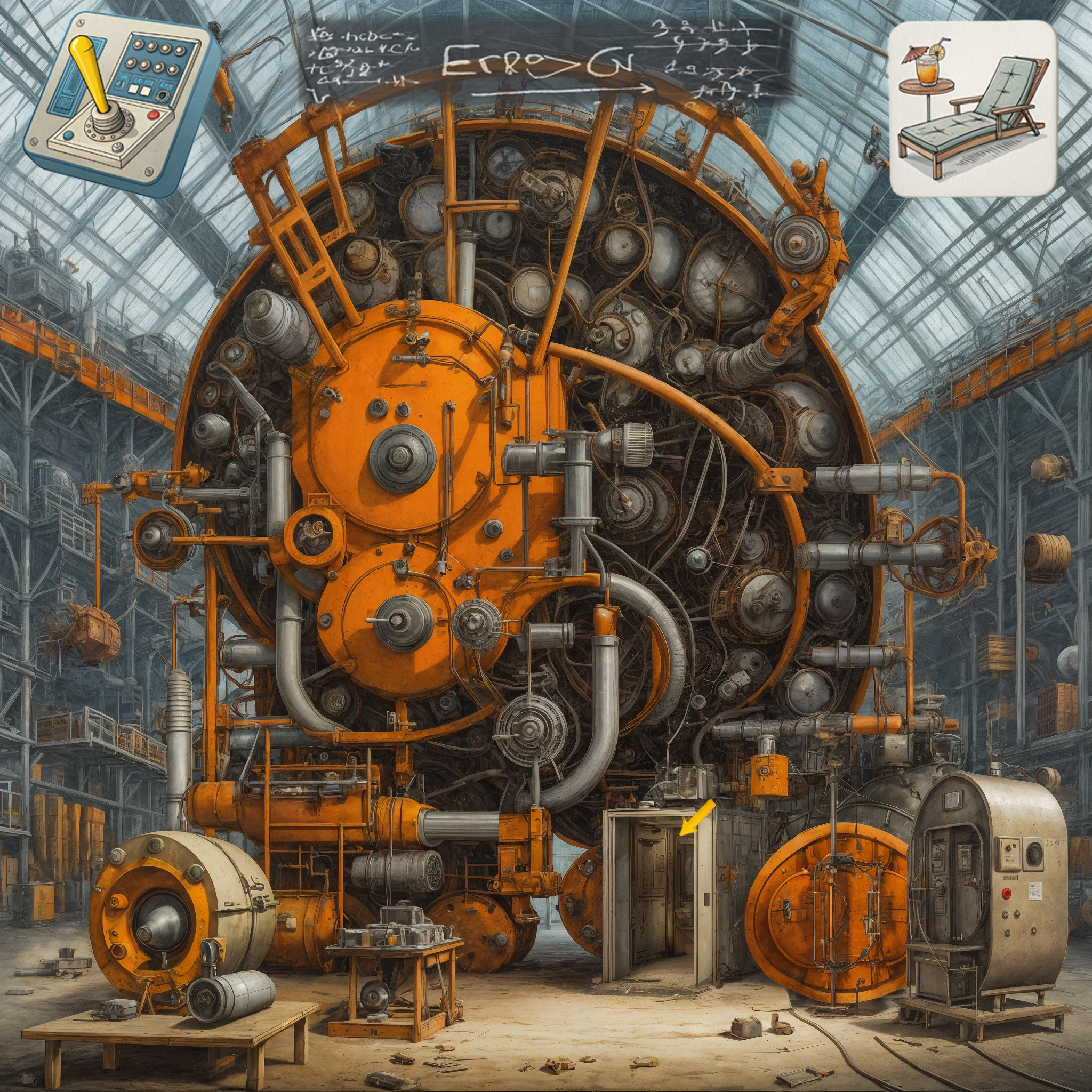
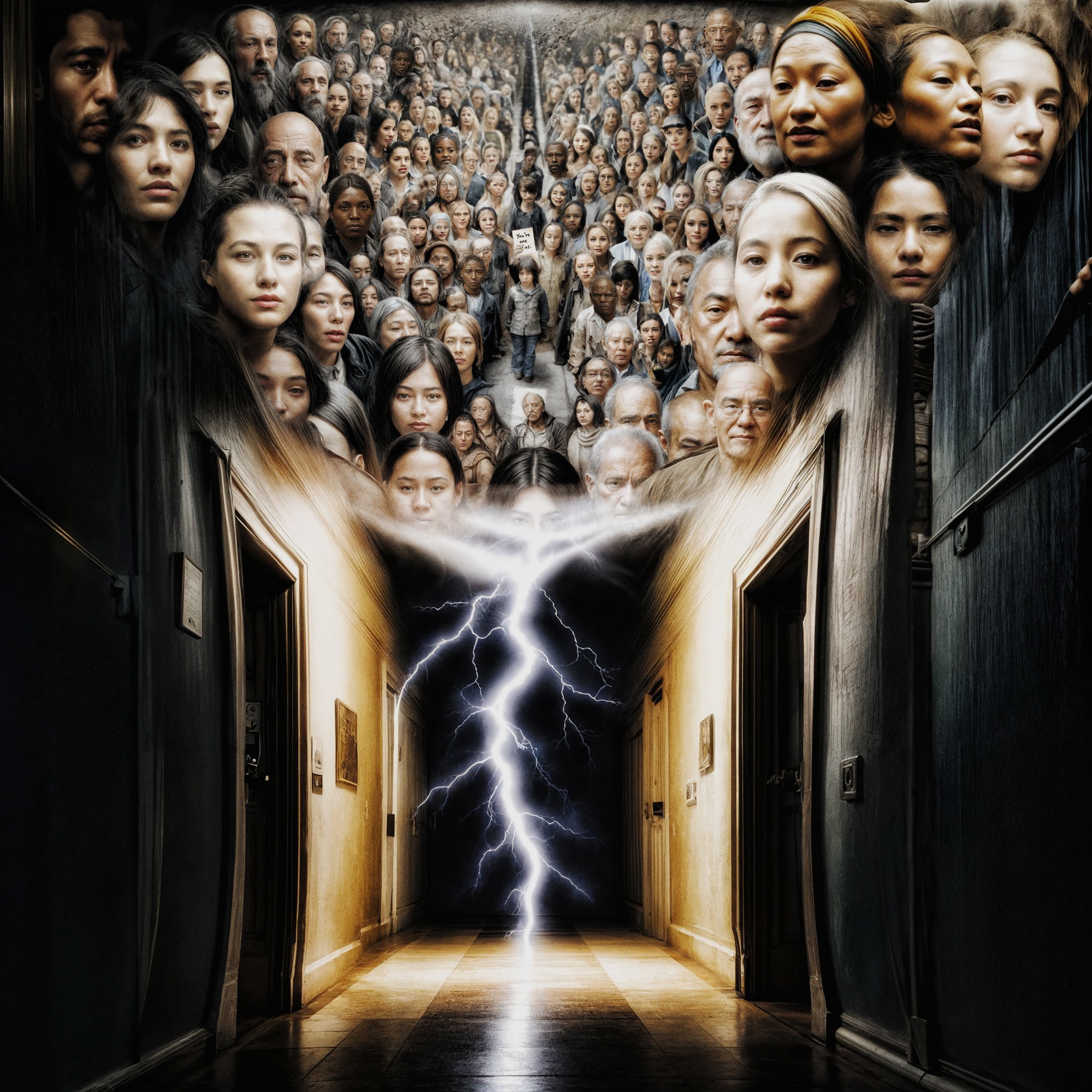
I enter the corridor. Professor Ceril calls the thing a “Leisure Machine,” but to me, it’s once again a towering structure of hallways, chambers, and connecting shafts, filled as always with an unpleasant energy that tingles on my skin and makes my hair crackle.
The professor’s latest theory goes like this: True civilizational progress only happens during leisure time, since that’s when the pressure of career and profit vanishes, and people—presumably inventors like himself—can let their thoughts wander freely and focus on things that actually interest them. This way, fire, the wheel, writing, dental floss, and the snooze button were invented. At least, that’s Ceril’s version.
We need more leisure time—that’s his motto. Not for himself, since he’s already (thanks to my father’s sponsorship) an independent scholar and thus a full-time leisure researcher, but for everyone. By everyone, he doesn’t just mean the population of planet Earth, but all the undiscovered, unnoticed, and unreachable civilizations in the entire galaxy. However, for our neighboring galaxies or the whole universe, he says his machine would have had to be larger than our solar system, reaching all the way out to Neptune’s orbit. That’s obviously unfeasible, hence his atypical self-restriction to the Milky Way—including, not to forget, all parallel Milky Ways in multidimensional quantum reality, which, as we all know, allows every possibility and probability to become real, on whichever of the infinite dimensional planes.
At least, that’s Ceril’s take.
At the end of the corridor, I find a control panel with large, color-coded levers, behind which there’s a busy hum, scrape, and throb. This time, it’s simple: I’m supposed to pull the yellow lever. It will activate a complicated mechanism that—as I gather from the professor’s convoluted explanations—soaks up and eliminates mundane tasks and routine work. These, his (leisure!) research has revealed, consist mostly of a specific kind of subtle elementary particles he calls ergons.
With my hand on the yellow lever, it suddenly hits me that my parents wouldn’t have to work anymore either.
Hmm, that would be bad.
Even now, their scant free time is consumed with grooming their teenage prodigy for a brilliant career as a genius and constantly bossing me around. If they had more free time, things could get pretty annoying for me.
I drop my hand and leave the lever in its starting position.
“Well?” the professor asks enthusiastically as I step out of his machine, relieved not to have gotten lost in the maze of shafts and hallways, or worse, gotten sucked up myself. I nod. As expected, Ceril thinks he can already feel the effects. “Don’t you feel it, too? Aren’t there fewer ergons around us already?” I nod again. “Finally, a desirable form of unemployment and a leisure-based society!” he exclaims excitedly. But a glance at his gauges gives him pause. “Hmm. The concentration is dropping much slower than I calculated.” He looks at me, brow furrowed.
“Couldn’t new ergons be constantly generating?” The professor scratches his chin, pulls the relevant formulas from his index card box, and starts scribbling a mess of numbers and variables onto his graph paper. “Entropy! Darn it! I should have known…” he mutters. Whether it’s ergons or entropy, I don’t care—as long as someone keeps my parents off my back.
(Then my parents suddenly came up with entirely new plans for me, their prodigy, but that’s another story.)
I enter the corridor. A uniformed officer I’ve never seen around here before steps up to me. “I’m here to see Albo,” I say, and follow him down the hallway until he knocks on a door.
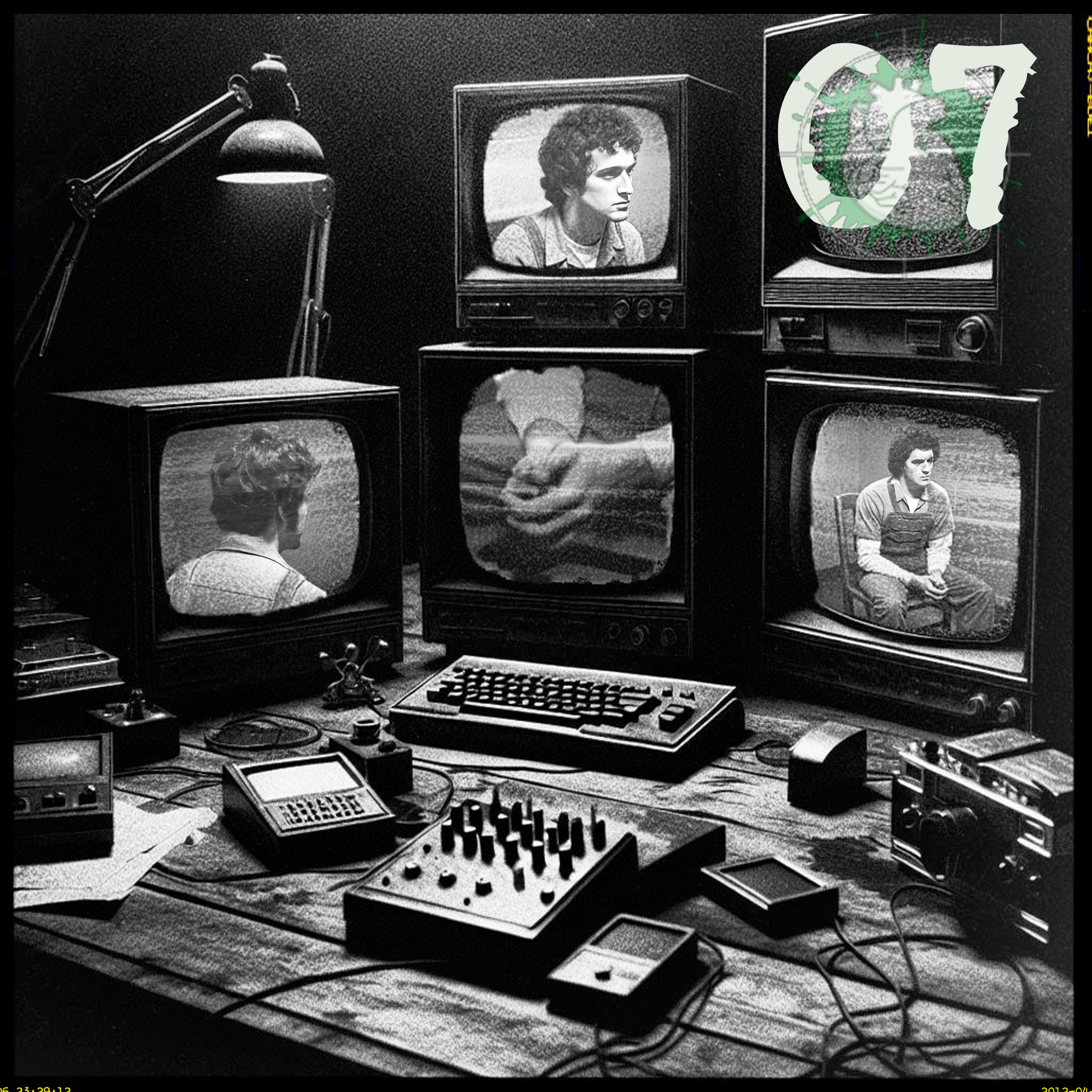
Inside, the detective sits in front of several monitors showing the interrogation room. Sitting alone at a plain wooden table in there is a man. He’s wearing handcuffs with his hands flat on the table.
“We got him,” Albo says, looking up at me. “And I definitely want you in that room with me for the interrogation.”
Maybe it would’ve been nice to hear an apology first for dragging me out to precinct headquarters in the middle of the night. But that’s just not Albo’s style. His call yanked me out of a dead sleep, and I still feel seasick, like the world is wrapped in cotton wool.
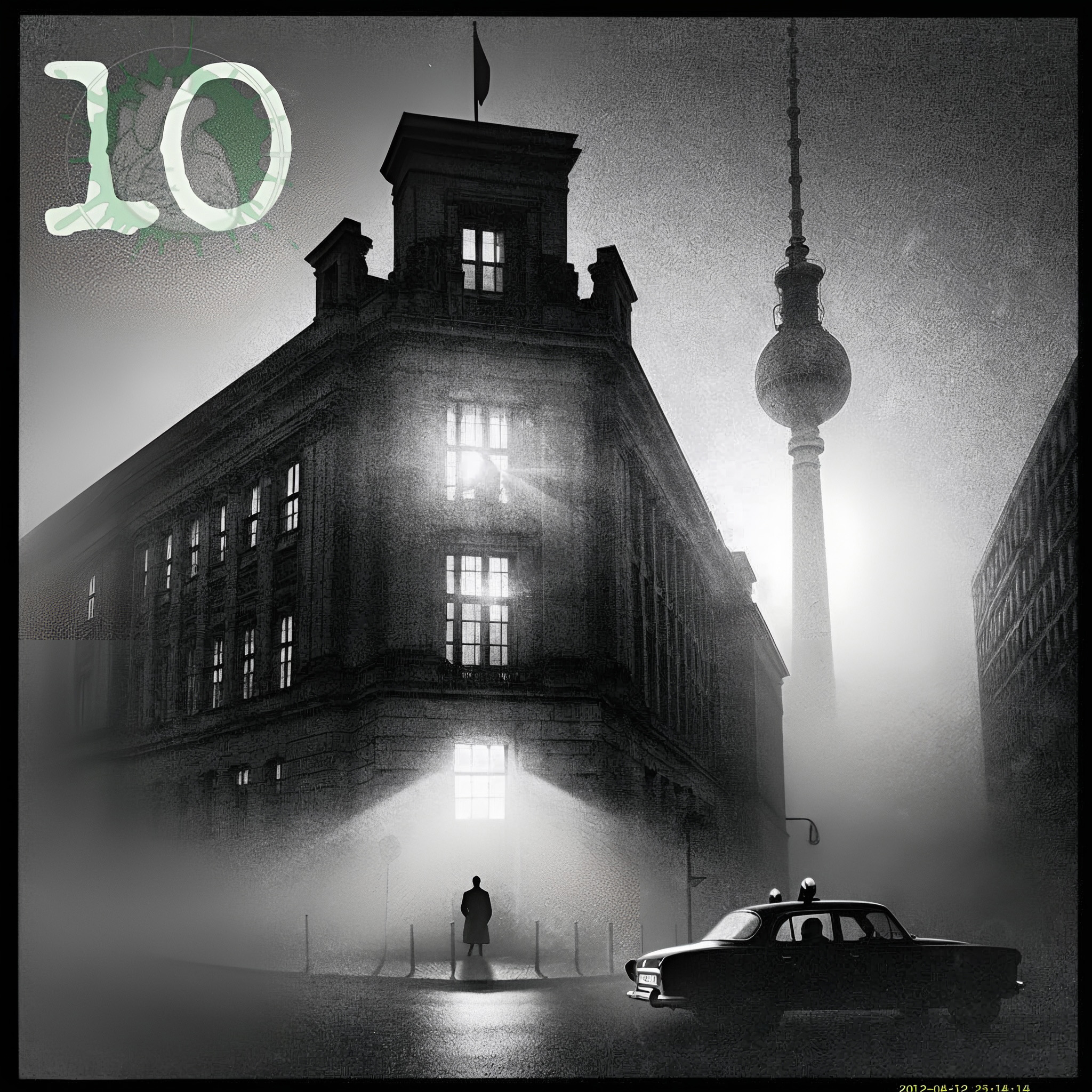
“He tried to break into the Alex. The TV tower,” he adds unnecessarily.
“Was he trying to… put another heart in a corridor up there?”
It’s a young guy with messy blonde hair. I can see dried blue paint on his hands and coveralls.
Albo scratches his eyebrow and shakes his head. “He disguised himself as a painter, complete with overalls and a paint bucket, but he got busted when he tried to head up the emergency stairs.”
“So, no heart,” I say with relief. “What about texts?”
“Zip,” Albo says. “That would’ve been too early anyway. He just wanted to scout out the next corridor. I’ve had my guys step up patrols around the city’s major landmarks the last night or two.”
“Did he say anything? Confess?” I try to size up the guy on the monitor. His eyes seem to be staring into nothingness, though the camera feed might be deceiving. He’s young. Way too young, really. Wet behind the ears.
“Can’t get a word out of him,” Albo says, though he still looks a little proud and relieved. He gives me a jovial punch on the thigh. “I’m hoping you can crack him for me. Before I have to resort to my own methods.”
“And what if he’s not the guy?” I ask.
Albo shifts restlessly on his stool. “What else would he be doing at the Alex?”
“Suicide,” I say. “A bet with his buddies, a grand gesture for his girlfriend…”
Albo dismisses it with a wave of his hand.
I don’t drop it. “I seriously doubt the guy knows what the Many-Worlds Interpretation is.”
“Many-Worlds Interpretation?” Albo asks.
“Text number63″ I say. “And I doubt he knows how to spell ‘Megalithic cultures,’ number 97, or…”
Albo stands up. “How about you figure out how we get a confession out of him instead!”
“Uwe, man, face facts: this isn’t the guy we’re looking for. But if your team finds fifty typewriters in his apartment, call me—even in the middle of the night—and I’ll crawl back here on my knees and apologize to you.” Sometimes you have to wave a fence post in Albo’s face—or better yet, hit him over the head with it—for him to realize he’s barked up the wrong tree.
He visibly deflates. “I was so sure.”
“You’re overworked. If I can give you a piece of friendly advice: take a few days off, head out to the cottage by the lake, sit in the sun, and stare holes into thin air.”
Albo gives a sour smile.
“I’m sorry,” he says, and I can tell the words are practically being dragged out of him, “for dragging you out of bed. I was a bit quick on the trigger, I guess. Coffee?”
I shake my head. “Come on then,” he says, “I’ll drive you home.” I know how that goes. Screaming through red lights with the siren blaring. Never again. I’d rather call a cab.
The cab takes its time getting here, so I pop into the painter’s room after all.
“Hey,” I say, not waiting for an answer. “Maybe I can get you a permit for a graffiti piece on the TV tower. You just gotta know the right people. Is it a good quote?”
He stares at me like he’s seeing a ghost. Finally, his mouth opens and moves a few times like a fish gasping for air before he answers: “It was supposed to be our logo.”
“Ah,” I say. “A company logo?”
“No, no: ours, mine and my girlfriend’s.” Wrong order, pal, I think. You two aren’t gonna last. I’m about to ask him what kind of logo it is, but the officer who brought me to Albo steps in and whispers in my ear: “Your cab’s here.”
“Well, have fun,” I say, raising my hand. The guy actually raises his hand back, like we’re buddies. Ah, sweet innocence! This generation probably can’t think two cents’ worth because pfennigs were abolished. Everything’s going down the drain.
The taxi driver wants to chat about some soccer games. Albo would say, “Shut up and drive.” I give it a try myself—and look at that, it works like a charm.
I enter the corridor, the only thing that feels familiar in the whirlwind of colors and shapes enveloping me and making me dizzy. It’s comforting to feel solid ground beneath my feet. But is it truly solid ground? Everything here is strangely soft and doughy, the corridor’s walls yielding, like silk stretched over memory foam.
“Everything okay in there?”
Who is speaking? Is this a test? An experiment? An April Fool’s prank? Or has American intelligence picked me up again?
“Speak up, man, I don’t have all night.”
The voice sounds like that of a teenager. I can’t pinpoint its location as I stumble along the corridor. Is it coming from the front? The corridor is curved, its end unseen. “Hello? Is someone there?”
“Tom. Nǐhǎo. I’ve got a few questions, Cory.”
Cory? Yes, Cory. But who is Cory? My memories contradict each other. I am simultaneously a journalist, the student of a Buddhist master, the Minotaur, a xeno-linguist… How is that possible?
“You’re a clever guy. Written a lot. And I need your help now. It’s about the ‘Decline of European Postmodernism: A Literary Blog Example from 2012.’ I need some input.”
What is he talking about? The corridor just never ends, and the voice stays with me. A dream? No: Whenever this suspicion arises in a dream, it transforms into a lucid dream. But it doesn’t work this time. I don’t wake up, not in the dream, not in bed. Yet it feels unreal.
“Can you make sense of that, Cory? ‘Decline of Postmodernism’?” The voice becomes more urgent.
“The Korridorium…”
“Yeah, that’s what I’m talking about. Gotta write a term paper about it.”
“The Korridorium…” I attempt again, but I fall silent because suddenly, I realize that I’ve written the Korridorium and all the stories within it. I am not it; I have imagined it. Yes, that must be it. Hence the conflicting memories: stories I’ve concocted in my mind.
“Where am I?” I ask into the curved corridor. There are doors—did I not notice them before? They bear numbers, like in a hotel. However, it feels more like a library, like the corridor between bookshelves, and it smells like one too. A hotel that smells of books. Not bad, actually. The door reads 398. I press the handle down, but it’s locked.
“Everywhere and nowhere. You’re a Yōulíng with the task of helping me with the term paper. ‘Postmodernism,’ the Teach is trippin’.”
The next door is locked. And the next. And so on. Each bears the same number. 398. Maybe I’ve gone mad? Or dead.
“Now spill it: What’s postmodern about your scribbling, and how does it reflect the decline?”
“What is ‘Teach’?”
“My German teacher. But that’s irrelevant. She’ll never know you existed. I reconstructed you using your texts. Private Yōulíngs are forbidden according to the Jīngshén Rights Charter, but this is, so to speak, an emergency.”
“Yeah. Took a blank mind from my dad’s Lab-Táishì, fed it with your texts, and had it fetch secondary literature. Plus the essential data from the early millennium, the zeitgeist package from 1970 to 2012. The rest is handled by the stem.”
“Blank mind?”
“Nobody gives a Benz, man. That’s all after your time. I’m not here to explain the world to you.”
“The world from when?”
“67. I already said it: Long after your time.”
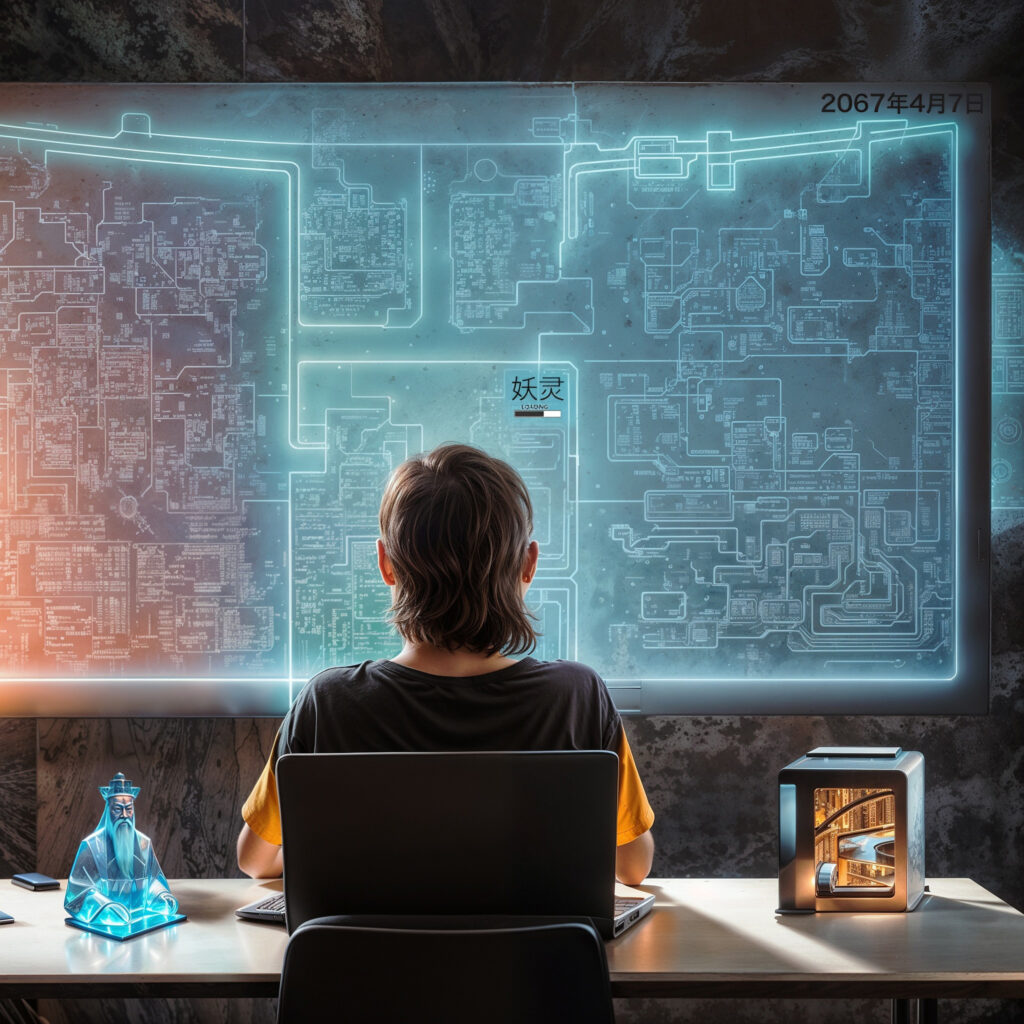
“2067?”
“Yeah, bingo.” His voice sounds annoyed.
2067. How is that possible? I vaguely remember dying. The tunnel into the light. Or else, the sword in my back. But those are probably just stories, stories upon which I was reconstructed. Hence, I can only know what’s in the texts—nothing about my death, the author’s death, whose reconstruction I am. His — or her — stories, however, are contradictory. They seem designed to stay vague. How should I know who I am, not even if I’m a man or a woman or if I’m even a human being when that was precisely the search game, the puzzle? When everything appears pluridimensional and fractally shattered? But no, doesn’t everything surprisingly dissolve at the end of the blog, revealing who Cory is and what all these stories are about?
But I can’t follow that thought any further; I’m interrupted. “Okay, man, so the Korridorium: 400 blog entries, equivalent to a medium-sized novel. Somewhere in there must be something about the decline of postmodernity—or something postmodern that illuminates the decline. So get started, after all, you’re a scribe.”
“There are 398 texts. Not 400. Three hundred ninety-eight!”
“Whatever.”
“And they shouldn’t be postmodern but post-postmodern. You get it? Integral.”
“Listen, this isn’t a math class.”
I get angry. Someone reconstructs me in 2067 by feeding a blank consciousness with my texts, and some computer extracts the spirit of the author, meaning me. Yet, it’s not a literature scholar, not a historian, not even a lover of quirky short prose, but just some ignorant punk forced to write about me for school, too lazy to read a single line of it!
“Now, you listen to me, you ignoramus! You must have misunderstood something: I transcended postmodernity; the notion of decline is nonsense. Postmodernity can only be succeeded and integrated into the next cultural stage, the integral perspective! Modernity didn’t ‘decline,’ did it?”
“No, on the contrary: After postmodernity came the Remodernity, and then the Prenaissance. Déle. It’s all after your time, and now let’s finally write the term paper.”
My head is spinning. Postmodernity with all its achievements is supposed to have failed and vanished without a trace? Surely not—because of me?!
“Did the Korridorium cause the decline?”
“Hardly. I’ve researched what this Corri-Dōngdōng is all about, but there’s nothing to be found. It probably went unnoticed, and I guess it’s thanks to the German literature quota that the Teach dug it up. Oh man! Twenty thousand characters minimum, including spaces—would have preferred to write about Chinese literature!”
“But there must be a Wikipedia entry for the Korridorium!”
The voice laughs. A brief, annoyed laugh. “That’s probably the postmodern narcissism the Teach talks about: always revolving around itself. No, Wikipedia is long gone; the Jeeceebee turned it into Sùzhìpedia after the meltdown.”
“Meltdown?”
“2030. After your time. And in the Sùzhìpedia…”
“What is the meltdown?” I interrupt him.
“No one gives a Benz. Do you want to know if there’s anything about you in the Sùzhìpedia or not?”
“Sùzhì like Sushi?”
“Not Japanese! That’s Chinese and means ‘quick knowledge.’ ”
“You speak Chinese?”
“Just Mandarin. Anyway, there’s nothing about the Korridorium in there. Only some footnote. Just one.”
“After that meltdown, things went downhill fast, didn’t they? I mean, ‘Remodernity’ sounds like regression. And with the ‘Prenaissance,’ it seems humanity was suddenly thrust back into the darkest Middle Ages.”
“Well, isn’t that rich? The Teach is right. The main characteristic of postmodernity: its abominable hubris, alongside its fatal relativism, of course.”
“And who Cory is? Did you research that?”
“Nobody gives a flying Benz. Stop gonging me already. I’m the one asking the questions! Who else could Cory be? Just Cory. You.”
“What’s with the ‘Benz’? What are you talking about?”
“That’s Chinese. Pik.”
“ ‘Benz’ is supposed to be Chinese? And what is ‘pik’?”
“Well, pik. Piquant. In your time, they probably would’ve said ‘cool.’ ”
“In my time… You just reconstructed me. I only know some stories from back then. The real Cory, on the other hand—did anyone ever find out who’s behind the pseudonym?”
“What’s there to find out? It’s just some postmodern hide-and-seek. You should know who you are.”
I can remember an award ceremony. Wasn’t it even the Nobel Prize in Literature? Apparently, just one of the stories. I can’t trust my memories. If only I could think about myself in peace! And how to get out of this endless corridor… I realize that my heart is pounding, and I’m gasping for breath. It feels like I’ve just finished a marathon. Or am I just angry? I’m not sure—also not sure if I even have a pulse or if I’m breathing. I’m just a simulation, composed of words. Can they bring them all back with this method? Joyce, Homer, Kafka, Goethe?
“You know what, man?”
I lean, breathing heavily, against one of the corridor walls. What would Cory do now?
“I’ll give all this stuff to my mom. Reconstructing you was a crappy idea. Mā thinks I need top grades for the future, career and all, and then she can do something for it. The term paper is a piece of cake for her.”
“And what about me?”
“What’s the big deal? I’ll just delete you.”
“You can’t do that!”
“We’ll see.”
“Wait!” What was his name again? “I can help you, Tom.”
He takes his time with the answer. I feel sweat breaking out.
“There’s this story,” I shout into the empty corridor, “about the Chinese: they shrink themselves until all of them fit into the Forbidden City. A satire.” I have to improvise. A trial balloon, but I can’t think of anything better.
“Very bad. The Jeeceebee won’t like this. Funny that it slipped past the Teach.”
“Who is this Jeeceebee?”
“Our Great Imperial Benefactor. The one on the Dragon Throne.”
I lower my voice and put emphasis on every word: “But that could be a clue to the downfall of postmodernity, you know?!”
“Hm. Not bad. I could work with that.” Tom seems to be taking the bait.
“Hubris, you know? Postmodern, narcissistic megalomania. That’s how we all were back then.”
Maybe I exaggerated because Tom hesitates now. Eventually, he says slowly, “Didn’t you say you were… integral.”
“Yes, of course, that’s the megalomania: to think you can comprehensively encompass and integrate all aspects sustainably, replace power hierarchies with competence hierarchies, find pluridimensional-comprehensive solutions to the most complex problems, extol the decay of values as a new value. That had to lead to downfall, especially given what was developing in China at my time.”
“Developing in China?”
“Well, the Remodernity. Or maybe already the Prenaissance. The Jeeceebee and the — what was the new Human Rights Charter called?”
“Jīngshén Rights Charter.”
“Yeah, man, whatever that is: the downfall of European postmodernity — it’s all in the Korridorium. I can tell you a lot about it.”
“Then shoot. You dictate, and Bàs Táishì writes it down. But nice and structured, with footnotes, you hear? I’ll put my feet up in the meantime.”
Would Cory have done that? Talked about her or his life and revealed everything, the hope, longing, insights, and struggle for something worth writing and fighting for, just not to be deleted immediately? This must be how Scheherazade felt.
“You know, Cory, I just want to re-breed tigers later.”
“Re-breed tigers, really?”
“The Great Chinese Benefactor in Zhongguancun has over a thousand researchers working on it, but they just can’t figure it out, despite DNA and everything. If I manage to do it, I’m a made man. You can’t imagine what they’d pay for tiger dicks there. As Afrosidia… diasi…”
“Aphrodisiac.”
“Yep.” And after a short pause, “You’re not as much of an idiot as I thought, Cory.”
And so I begin, delivering an extensive lecture on the decline of postmodernity as mirrored in 398 eccentric short stories—a labyrinthine game of hide-and-seek where monstrous hubris and that equally abominable, fatally relativist narcissism constantly peek through, ultimately ushering in the glorious age of Remodernity, the Prenaissance, and, of course, our Great Imperial Benefactor on the Dragon Throne: the Jeeceebee.
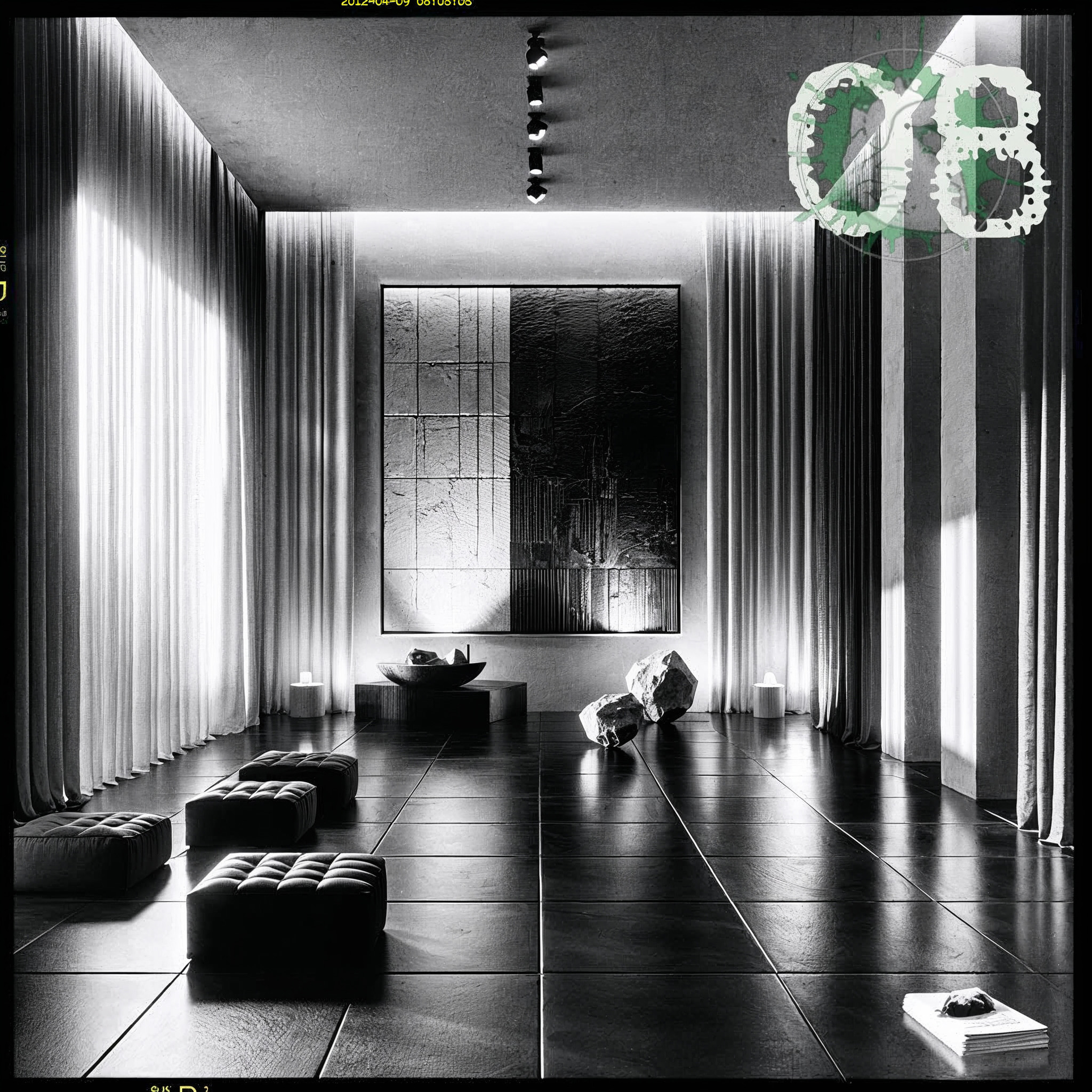
I enter the corridor leading to the “Room of Silence” inside the Brandenburg Gate. Before Uwe Albo called me, I had no idea a place like this even existed. “Silence” is written on the wall in various languages. A pretty fitting place for Easter, really, but I already have a bad feeling about what’s waiting for me here.
Everything is cordoned off. Albo’s colleagues recognize me and wave me through. The detective himself stands in the small, unadorned meditation room like a lumberjack in a perfume shop. My gaze immediately drops to the floor, and sure enough, right on cue: in the middle of the room lies a stack of paper, topped with a bloody lump of meat.
“Another heart,” Albo says when he sees me. “Number three.”
A sharp wave of his hand scatters the young officers. We’re alone. “This room is locked at night. Yet this morning, the heart was sitting right here.” Albo grabs my arm. I can clearly see the whites of his eyes. “That bastard scares me, you know? He writes a story every day on one of his typewriters, and whenever he finishes his run of fifty typewriters, he calmly drops another one of his hearts somewhere in Berlin—without us getting an inch closer to catching him!”
I can smell Albo’s breath; he’s standing that close. Is this a cry for help? Is he cracking? Is he at the end of his rope? But Albo relaxes his grip, lets go, and clenches both fists. His eyes narrow to slits as he says, menacingly low, “I’m gonna nail him with these bare hands, and once I’ve got him, he can play all the hide-and-seek he wants in the cell where he’ll spend the rest of his life.”
He looks at me, as if looking for backup. I give him a stern nod. That seems to satisfy him. “Come on, let’s move. Forensics can handle the rest.”
Later in Albo’s office, we study copies of the new texts. Familiar themes, new twists—the playful, compulsive streak shines through again and again.
“I paid the Integralists a visit,” I say. Albo looks up, intrigued, having clearly forgotten he asked me to infiltrate Berlin’s Integral scene in the first place. “Decent people across the board who think they’ve found the Philosopher’s Stone—a kind of cut crystal with a whole range of facets that all need to be accounted for when looking at humanity and the world.”
“Facets?” Albo asks, frowning.
“Yeah, just like the killer’s texts. Everything can be viewed from different angles and perspectives…”
“Which I can then conveniently pick and choose from.”
I shake my head. “No, no—the whole point of the integral approach is that it’s holistic. You don’t just limit yourself to single aspects.”
“In other words: you felt right at home with them.”
“Point is, it’s a philosophy that values life in all its forms. It doesn’t breed killers, if that’s what you’re asking.”
Albo scratches his stubble. “So where do we find him then?” I rap my knuckles against my stack of copies. Our only lead.
A uniformed officer with a goatee and ponytail knocks on the open door to grab our attention. Albo steps over to him. I immerse myself in the pages in front of me. There’s mention of a twin. Interesting. A lead to the victims, the first two of whom were apparently identical twins? “Then get back to work!” I hear Albo bark.
Snorting, he comes back into the office, waving a thin folder. “The heart’s got the same DNA as the other two.”
“A third identical twin?” I ask, surprised. “Is that even a thing? Identical triplets?”
Albo slams the file onto his desk with a loud bang. “They’re so rare that every single one of them is registered. But none of this makes sense, quite apart from the fact that no pair of triplets has been reported missing.”
I let his “pair of triplets” slide. “Then they must be unregistered triplets. Or the lab made a mistake…”
Albo nods, looking suddenly exhausted. “Told them the same thing. They need to recheck everything, step by step.”
“—Or,” I continue, “they’re clones.”
Albo stares at me. “Those were three hearts from adult human beings,” he says hoarsely. I nod.
Albo leans heavily on his desk and looks me dead in the eye, worn out. “Officially, human clones don’t exist—and certainly not adults.”
I nod again. “Officially,” I say.
“Man,” Albo groans, slumping into his office chair. “Houston, we have a problem.”
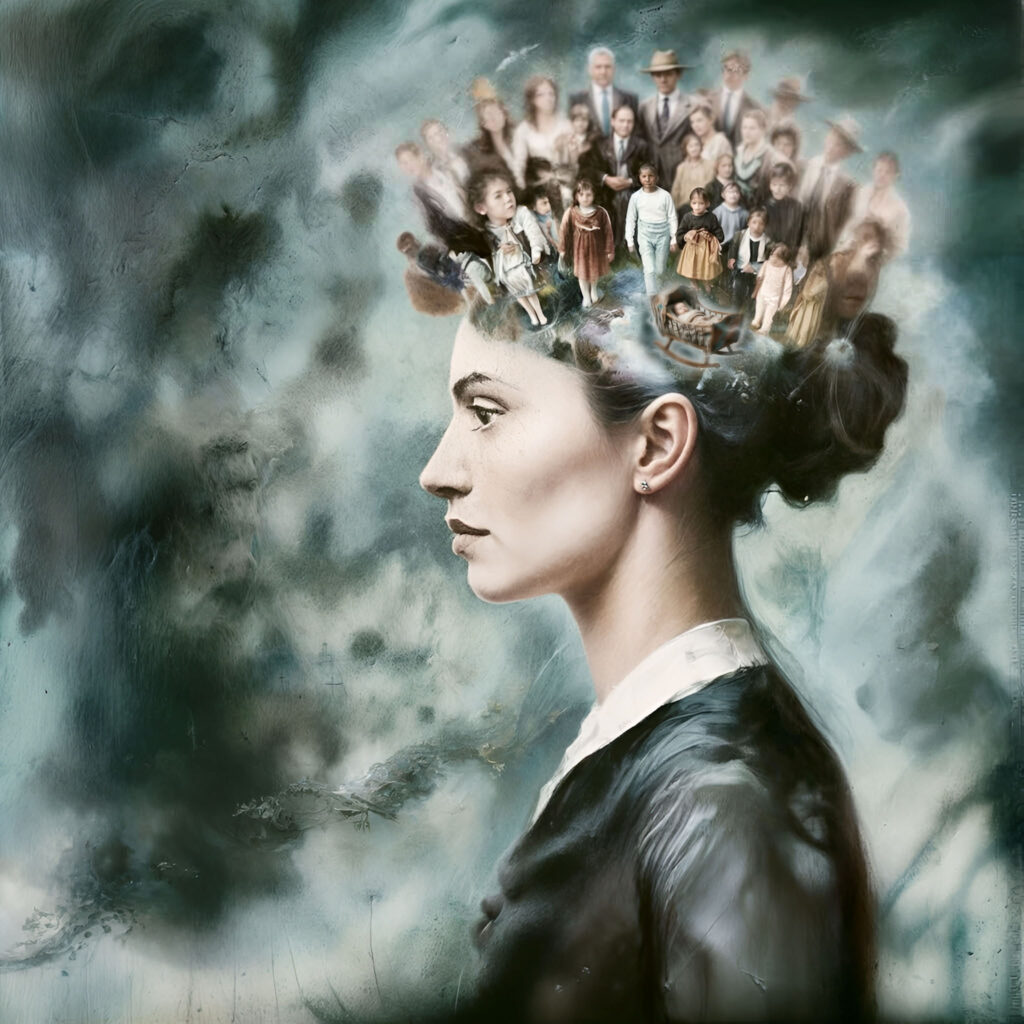
I enter the corridor, completely unsuspecting, when suddenly I’m struck by a blinding flash of a vision: Simultaneously with me, thousands, even tens of thousands of people around the world enter a corridor. For some reason, I suddenly sense them, feel their emotions, think their thoughts. I am, at the same time, old and young, sad and happy, relaxed and stressed, man and woman—it’s all there, all at once, in countless corridors.
An indigenous child runs down a hallway with a toy airplane, making loud vrooming noises. A janitor prepares to get the boot outside the executive’s office at the property management company. A plumber searches for the correct nameplate; a requested massage therapist looks for the right room number in a motel. Inside the mind of a young Chinese violinist on her way to her lesson, a Mozart sonata soars, and an English literature professor with a thrown-out back on his way to his lecture hall silently recites a Shakespearean sonnet. A sense of reverential wonder creeps over a Buddhist pilgrim in a gold-adorned temple, a Russian cosmonaut floats through the station with a screwdriver in hand, and a midwife in Hawaii, almost running late, hears the screams of pain from a woman in labor…
Colleagues help me up. “Are you feeling okay?” “Should I call an ambulance?” “You look so pale!” I shake my head to wave them off. My knees are still completely wobbly, and I can barely stand on my own. “You passed out briefly. What happened?”
“We entered the corridor,” I mutter tonelessly, without any of the bystanders hearing me. Although all of this only lasted for a split second, it has become indelibly etched into my mind. I retreat to the restroom down the hall, where I splash cold water on my face until I feel like myself again, and only myself.
I enter the corridor at the station, clutching the stack of copies containing the writings of the triple murderer—texts literally stained with blood. The blood of illegal clones?
Albo is engrossed in his files. I skip the pleasantries: “Is there such a thing as identical quadruplets?”
Albo looks up. “Just had some in Leipzig recently. Damn rare, but not impossible.”
I grab a coffee. No sugar left.
Albo keeps his eyes on me. “Why do you ask?”
“Because then it might finally be over.”
Albo laughs bitterly. “Over? I have to catch a killer, regardless of what happens in fifty days!”
“—Forty-eight,” I correct him. Albo gives me a look that wouldn’t pass daytime TV censorship.
“Ray Bradbury,” he says then. I look at him, slightly confused. “American author,” I say.
Albo nods. “Any Friend of Nicholas Nickleby’s Is a Friend of Mine.”
I shrug. Albo tosses me a thin, worn paperback: Ray Bradbury’s I Sing the Body Electric! “Any Friend of Nicholas Nickleby’s…” is one of the stories listed in the table of contents.
“You read stuff like this?” I ask, surprised.
Albo shakes his head. “One of our forensic guys put me onto it. There’s a guy in there who thinks he’s Charles Dickens but can’t put anything worthwhile on paper. He buys six dozen typewriters and writes like a madman…” With that, he stands up, walks over, and takes the slim volume back from my hand. He flips it open, finds the spot, and quotes: “The poem. The essay. The play tragique. The farce. The short story. And it was all bad.”
“What are you trying to tell me, Albo?”
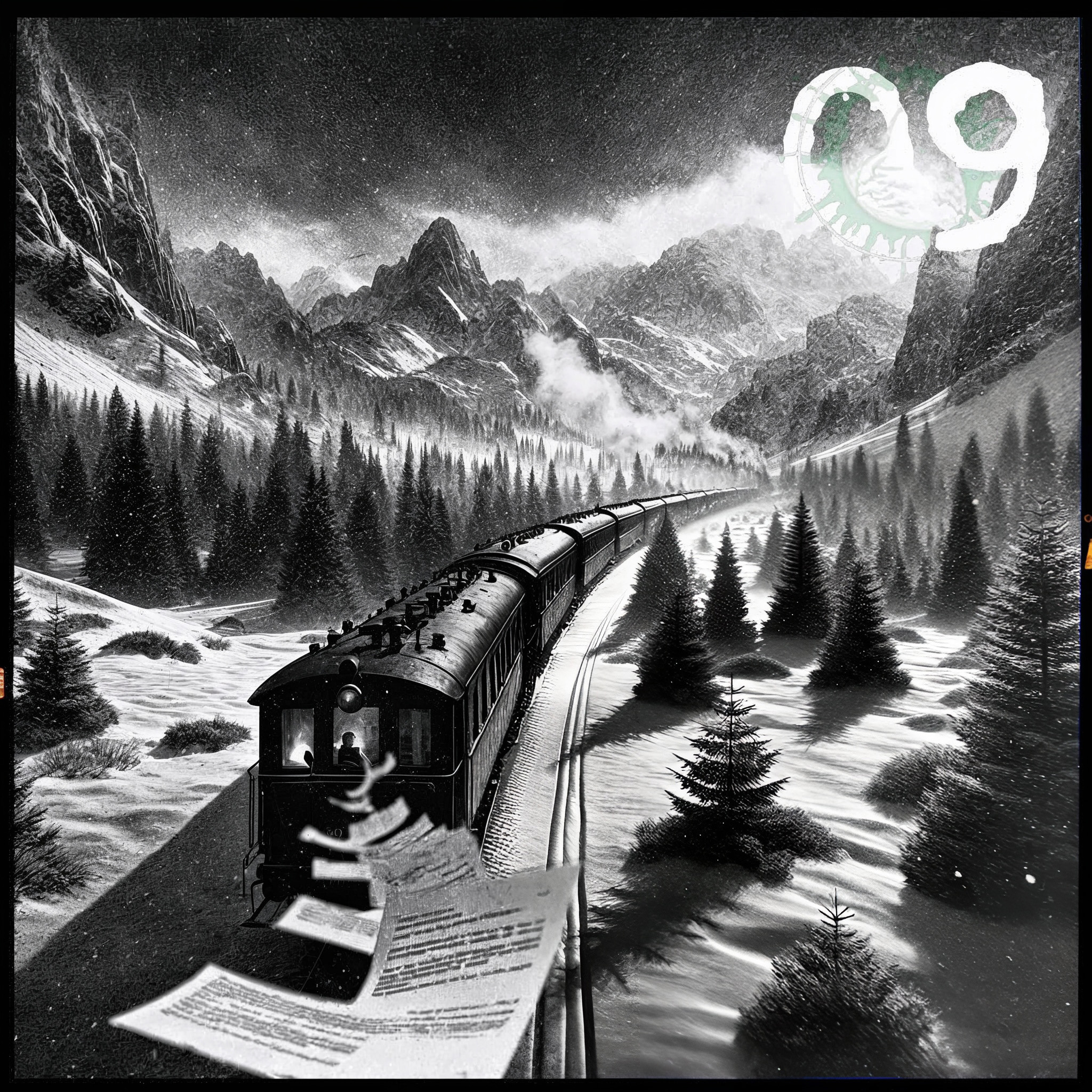
“That’s him, don’t you see? The typewriters, the different texts. And then he sits…” Albo taps the booklet. “…at the back of a train and throws all the pages out one by one, and they flutter away. Thousands of them.”
“But that’s just a story, Albo. We have three dead bodies and a serial killer.”
Albo slams the book onto his desk. “Just a story, you say? But these are all stories, too! The typewriters—don’t you get it? He knows the Bradbury story and identifies with it!”
“Take it down a notch, Albo. He identifies with everything and nothing. That’s precisely our problem. He’s a shape-shifter, and we can’t get a grip on him. One minute he’s ‘integral,’ the next he’s surrealist. We don’t grasp him, get it? You can’t just pick out one facet and call it a day. Not here. Not with him. And six dozen typewriters aren’t fifty.”
Albo looks like he’s on the verge of blowing a fuse. He must have latched onto this Bradbury thing out of sheer desperation. I don’t give him room to breathe: “Number 122 is another one of those. Incomprehensible gibberish…”—I pull the sheet from my copies—”…until you find the original.”
“Which original?” Albo asks, frowning at the page.
“A Braulio Arenas is mentioned, right? Chilean poet. Just so happens he wrote a poem titled ‘Errata’ that lists a bunch of printing errors found in an unnamed text. A surrealist poem.”
“And?”
“Number 122 is that text. It contains every single error listed. For example, in the poem, it says, ‘Instead of making two hits with one shot it should be making two lips with one mouth.’ Sound familiar? Or ‘Instead of the youth the beauty the mill it should be the mill the beauty the youth.’ Ultimately, it was the missing commas that tipped me off that his text was built on that poem.”
Albo looks at his copy, rubs his stubble, and thinks it over. Finally, he asks: “Does it make any sense?”
“None,” I say. “It’s just—and I quote—‘a grotesque parody of something that is already absurd.’ ”
“Uh-huh,” Albo says.
I tap his copy. “There’s one error missing, by the way.”
Albo’s brow furrows.
“One line reads: ‘Instead of I love you it should be I love you.’ ”
“Where’s the error?”
“That’s the whole point of Surrealism. And the same goes for the killer. He’s no more Braulio Arenas than he is Charles Dickens!”
Albo nods without looking up. “So how do we nail him?”
“Let’s talk about someone who decided to stretch his bizarre mind games so far into reality that the homicide squad has to deal with them,” I say, holding up the copies. “Let’s talk about incompatible claims and collapsing belief systems.”
Albo looks up. “Always a good idea,” he says. Do I spot a wry smile tugging at the corners of his mouth? Maybe it feels to him, too, a bit like thirty or forty years ago, when we used to sit up all night debating life, God, and the universe—and all the insanity we humans inject into it.
I enter the corridor, and ever since the sudden vision that overwhelmed me right here the day before yesterday, I’ve had this uneasy feeling every time I step out the door that it might happen again: feeling connected with everyone else in that same moment, or even feeling as one with them.
This time, on my way to the cafeteria again, it happens. But it’s weaker and doesn’t knock me to the ground immediately. Again, I sense people inside me, though fewer this time, and it doesn’t feel quite so strange and diverse: as if I’m already familiar with these people, as if we’re old friends. For a split second, we are one—my brothers and sisters in spirit and I—people with whom I share a strong spiritual bond, without knowing them or even having guessed they might exist somewhere in the world. The intense feeling of unexpectedly rediscovering long-lost, unknown family members makes me stagger for a moment. Then, it’s over. A few colleagues give me suspicious looks—small wonder after the incident two days ago. But I don’t let on.
Who were all these people? Do they really exist somewhere on this planet? And can they perceive me, too? Is there any way to track them down? And what does any of this have to do with this corridor?
I’m absent-minded and useless the rest of the day because these questions weigh on me. But over the next few days, the experience fades, and since nothing extraordinary happens when I enter the corridor, I finally attribute the matter to my overwrought nerves.
I enter the corridor. Pascal’s Coq au vin smells delicious once again. The twelve strokes of the church clock are just fading away. I’m a little early and stand waiting outside Room 27.
“But I ordered us food!” I hear the voice of Mr. Koriander, our guest for the night, from behind the door. Something clatters. I can’t make out the response. “Oh, but you can, I insist!” Mr. Koriander asserts. Something bangs again. “Please wait at least for the meal!” Mr. Koriander pleads. Even though I’m sure I’ll turn red with excitement, I decide to serve immediately. I knock. Mr. Koriander opens the door. “See?” he says, turning back toward the room.
A small man is standing on the bed. He has a bald spot with just a few white hairs in the back, wears glasses, and has a rather amusing round face with sticking-out ears. How old might he be? Sixty? Eighty? Hard to tell…
“Oh,” he goes, and steps off the bed. He inspects my tray, and he seems to like what he sees. I serve them their meal at the table. “Just water?” he asks as I pour table water into two glasses. He has a slight accent that I can’t quite place.
“Of course,” Mr. Koriander says. Then he opens his notebook and begins his questions while his guest starts to cut up the chicken and pepper it vigorously. I step back a few paces beside the bed, holding myself in readiness to top up their water.
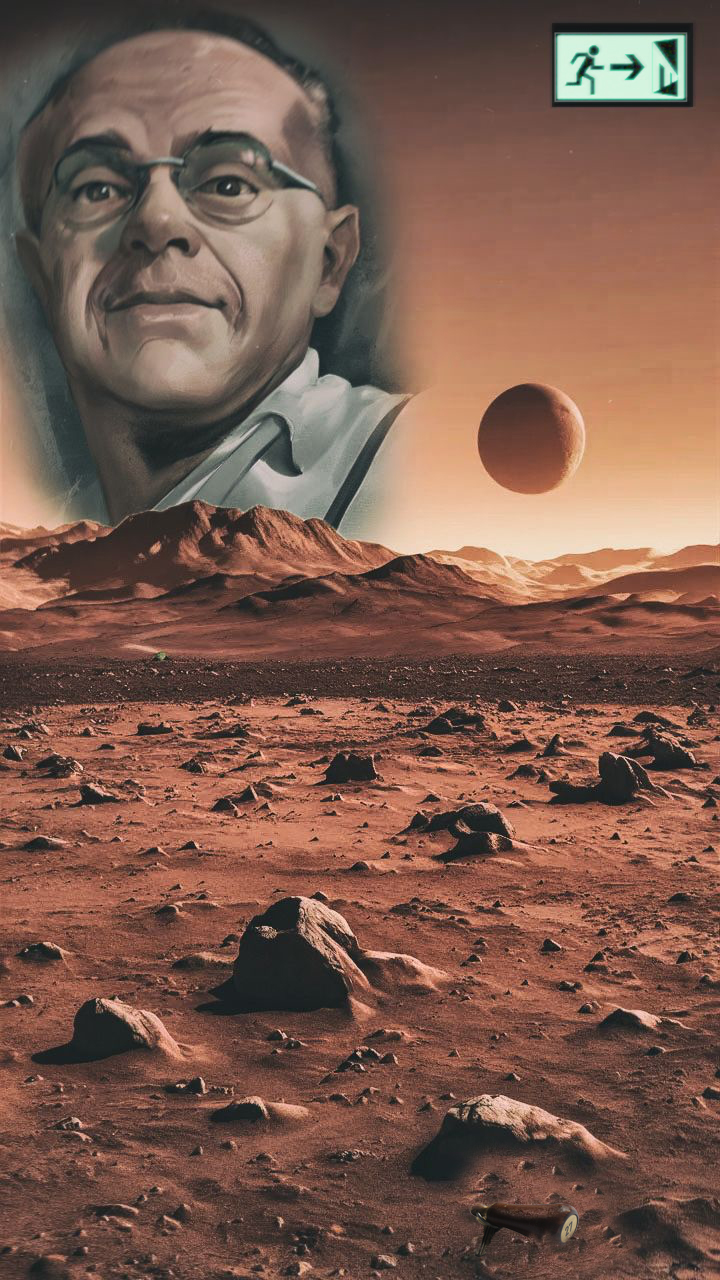
At first, the conversation revolves around Mars—I might have guessed. Since they’re speaking German, I understand everything this time. And yet I comprehend almost nothing. “Arlanthropos” seems to be the name for a Martian that is merely a piece of brain inside a giant metal machine and shares no human interests. Koriander’s guest, however, doesn’t seem inclined to talk about it and grumbles discontentedly again and again. Judging by his accent, he seems to be from somewhere in the East, Russia perhaps, or Romania. I’m not sure.
“Where has Golem XIV vanished to?” Mr. Koriander wants to know, but his guest informs him that that’s not how it works and that entirely different things matter, especially given the short amount of time.
Mr. Koriander seems a little miffed. He presses his lips together and snaps his notebook shut. His guest smiles, takes it from his hand, looks inside, and says, “Pirx.” But Mr. Koriander shakes his head. He wants to talk about evolution and consciousness.
His guest smiles mischievously and asks, “In a small black box?” Mr. Koriander bites his lip and says, “Trurl.” “Klapaucius,” says his guest. Their crazy conversation goes on like this. Somehow I gather that the visitor has evidently given far more thought to artificial intelligence and nanotechnology than others. For a while, they talk about something they call “Phantomatics,” then about a certain bacterial “Eruntics.” They might as well have been speaking Ancient Egyptian for all I understood.
Finally, it’s time to clear the table. Mr. Koriander looks somewhat desperate as he studies the long list of unasked questions in his notebook. His guest laughs, and I can still hear his laughter as I stand by the elevator and the church clock strikes one.
I enter the corridor, almost having forgotten my visions that had suddenly and without warning overwhelmed me there some time ago. However, I find myself standing there, almost beside myself, somewhere in the mountains, gazing up at an old man with a white pointed beard, wearing a simple, faded robe. My heart flies to him; he is the Master, my Master, calling me to the Himalayas to become his disciple and receive the precious spiritual gifts he has prepared for me.
“Hey there,” greets me a passing colleague. I don’t respond, still enraptured by my vision and the overwhelming desire in my heart—a devotion, an enthusiasm that I had almost forgotten I was capable of, back when I was a young woman.
Late at night in bed, the Master comes to mind again, and my heart aches briefly with longing. However, my husband, peacefully snoring beside me, would neither understand nor approve. What could I tell him? And where in the Himalayas should I search? Certainly, it would be an adventure to give up everything at once, to go into the unknown and seek a new spiritual home there. It sounds like something that could bring some excitement back to my life! On the other hand…
As my eyes close, the longing fades away, and I find my well-earned sleep.
I enter the corridor of the precinct and close the door to the john behind me. Every now and then a good idea hits me while sitting on the throne, but this time, my mind is a blank slate. I’ve been holed up with Albo for way too many hours, going through the killer’s hundred and fifty texts with him like we’re piecing together a puzzle. Somewhere in there, a clue has to be hidden about who he is and why he carves the hearts out of innocent triplets.
Albo is on the phone when I get back. This late at night? It seems true that the homicide squad never sleeps. Albo hangs up and stares at me with bloodshot eyes. “The converted double-decker bus that tours through the backwaters at night…” I resist the urge to grab another coffee and sit down instead. “With chill-out music and philosophical self-discovery.” Albo holds up the page in question. “Made it up. Doesn’t exist in reality. I had my guys check.”
Figured as much. It started with the fifty typewriters. The guy who supposedly bought them one by one, secondhand, only exists as a former eBay handle, “SpellingError68,” with a Berlin address and a PayPal account. He’s since deleted all the accounts, and no one’s lived at that address for years. Every trace has been meticulously erased; all inquiries lead to dead ends, just like in the texts: as far as we know, hotel chef Pascal is just as fictional as houseboat dweller Norbu or some Cory d’Or, male or female.
“A riddle wrapped in a mystery inside an enigma,” I’d muttered earlier in the evening.
“Hape Kerkeling,” Albo had offered with a nod, but I shook my head. “Winston Churchill.” Albo smirked crookedly. “Either way, all clues lead nowhere.” Which holds true for me, too, as a psychologist and—as Albo likes to elevate me—a profiler. Even the “KISTe,” the Federal Criminal Police Office’s text analysis database used to evaluate written statements by criminals—confession letters and ransom notes—couldn’t get us any further.
We’d last been debating the alien. “I would have so liked to speak with him about God. Then it must be done this way,” it reads in Number 106, right as the alien kills the human astronaut with whom communication seems impossible. Crazy story. Who comes up with this stuff? A religious fanatic?
I step over to the window. The city is silent. Even if Berlin never truly sleeps, around 3:30 in the morning it at least drifts into a brief half-slumber. “Maybe he thinks he’s doing something good,” I say. “There’s a movie where a philosophy professor fakes a murder that turns out to be a suicide at the last second—but as a critique of the death penalty and the American justice system, he waives his appeal and goes to the execution chamber as the alleged killer.”
Albo stretches his back with a groan. “How do you picture that? The triplets were in cahoots with him? He bred clones of himself, breathing husks without feeling, and he’s cutting them open to critique the morality of our scientists?”
I tug at the window, trying to pop it open. It’s been sticking for years. “I’ll get it fixed,” Albo says, and for a second I feel like I’m trapped in a time loop, having heard him say that at least a dozen times. “I say that every time, don’t I?” Albo asks, clearly having the exact same thought.
“If he were a psychopath, he couldn’t put himself in other people’s shoes the way he constantly does in these texts.” I realize I’m starting to lecture as I pace back and forth. “Of course, we’re still not sure if the texts even came from the killer. Maybe they came from the triplets. But assuming the murderer wrote them: then the texts point to the murders—and the murders, in turn, point to the texts.”
“We’ve covered that ground. We’re going in circles, pal,” Albo grunts sullenly.
“No,” I say, “because your flash of brilliance about a critique of the scientific establishment is the best idea we’ve had so far. Murders that aren’t really murders—meant to raise questions and shake people up.”
“Switching sides now? Planning to cozy up to him, grab a drink, be his buddy?”
I stop pacing. Albo’s sore. No wonder—the case is taking a nasty bite out of his professional pride.
“I wouldn’t be surprised,” I say, “if it was his own heart. Symbolically, I mean—that he’s tearing it out as the author of these texts because something in them cuts him to the quick, because one of these texts is genuinely real and he’s revealing himself to us. Maybe with whatever he’s storing behind the black door? Or the business with the shattering worldviews?”
Albo looks at me, tired but with a slight provocative edge. “In a case like that, you look at the suspects and cross off everything until only the most likely ones are left, right? So go home, man, and do your homework.”
Dawn is already breaking when I step out of the precinct. The crisp air feels good. The Life of David Gale suddenly pops into my head—with Kevin Spacey. That was the title of the movie about the philosophy professor. But how did Cory d’Or manage to tear their own heart out three times and plant it at three different Berlin landmarks? My thoughts haven’t made sense for a long time. High time to get some sleep.