141/398
♫ The Levogyre ♫
141/398


I enter the corridor. Norbu’s houseboat smells different than usual. I hear his voice from a small room I’ve never been in before: his bedroom.
Norbu is lying in bed, coughing miserably and looking like hell. “An infection,” he croaks, “don’t get too close to me.”
“Can I do anything for you?” I ask, concerned.
“Nah,” he says, “got everything here.”
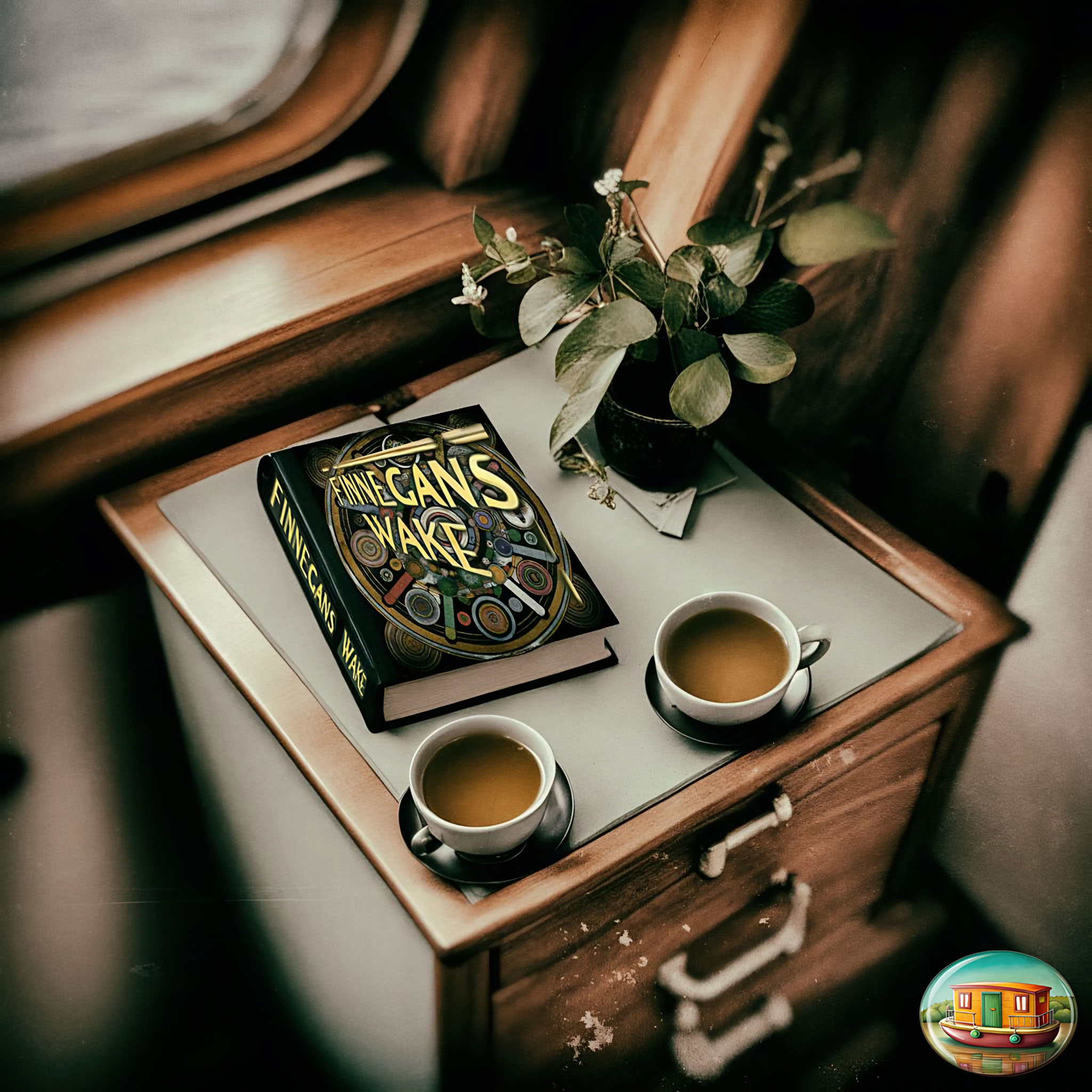
Curiously, I look around. I had always assumed Norbu’s bedroom to be his library, filled with all the books he must have accumulated over the years. In reality, I see only a single book on the shelf above the bed. Norbu follows my gaze.
“Finnegans Wake,” he says, “first edition. That’s all I need.”
I nod, but perhaps that’s not enough to show that I know what he’s talking about, so I add, “Yes, a novel that is a whole library in itself. Joyce somehow managed to pack life, the universe, and everything into it. A book that contains practically everything. That’s all one needs.”
Norbu gives me a sideways glance. “For me,” he says, “it’s mainly about reading just one or two lines, and I immediately fall into a deep sleep.”
“Aha,” I say, biting my lip and withdrawing my hand, which I had reached out to take the book and randomly flip through it, intending to nod knowingly after a brief glance inside. I seem to have missed the mark there.
“No book can encompass the entire cosmos; that’s romantic nonsense.” Norbu has to cough and asks me to make us some tea. I grumble a bit because I don’t like being talked down to or relegated to a maid, but in the end, Norbu is sick, and he probably doesn’t mean any harm.
In the small kitchen, I find chamomile tea, which I brew and carry into the bedroom as a makeshift tray using a chair, so I can sit with my sick friend. I pour us both a cup.
“Perhaps in the sense of a hologram,” I say. While making tea, I’ve been searching for something to counter Norbu’s rejection. “It’s all there, just less detailed.” I gesture toward the book.
Norbu shakes his head. He sits up, adjusts his pillow, and leans his upper body against the wooden wall of his houseboat. “That quickly leads to romanticized worldviews. In the past, it was the belief that God would personally listen when you read him your Christmas wish list. Today, quantum physics is used to make everyone believe they are the creator of their own reality.”
Norbu sounds offended—as if he wants to lodge a complaint with the higher-ups about his cold. And since it’s not God sitting at his bedside, but me, I’m the one who gets the brunt of it.
But I know how to defend myself. “Didn’t you yourself once say that human consciousness is the next unexplored continent? And what about yogis who let themselves be buried for days and apparently stop breathing during it, or Buddhist monks in the Himalayas who lie naked in the snow, making a living radiator out of themselves solely with the power of their minds?”
Norbu nods, smiling, but I think I can see a mischievous twinkle in his bloodshot eyes. “Yes, we like to believe that: that it’s possible and that the mind controls matter.” He places his steaming cup next to the Joyce volume on the shelf. “Why are there only anecdotal reports and no solid evidence? Think about it: if it were possible to nourish oneself with light alone—as people like Jasmuheen or the proponents of Chinese Bigu claim—why hasn’t evolution utilized that yet? Except for plants, I mean. But they don’t absorb prana; they use chlorophyll.” Norbu has to cough again, but this time he raises his hand to signal that he’s not done with his train of thought and I shouldn’t interrupt. I wait patiently.
“Or,” he continues with a scratchy voice, “if telekinesis were possible, why don’t animals use it? The same goes for teleportation or levitation. Evolution had billions of years to make desire not only the father of thoughts, but the ruler of reality. Instead, it lets everything be done by hand. Or by tentacle, fin, mandible, or fang. Right?”
Now he has intimidated me a little. I nod grudgingly. Somehow, I had always seen both of us as brave explorers of a new and barely known continent, pioneers of a new view of humanity that definitively puts an end to the reductionist myth that we are merely a clockwork, a machine, or a computer.
“Mind,” says Norbu, “is just a byproduct of matter and, as we can see with Alzheimer’s, error-prone and fleeting. The self-aggrandizement it indulges in, especially in esoteric circles, is just the wishful thinking of an overly complex and underemployed brain.”
He looks at me expectantly, and again, I nod grudgingly. “One could say,” he adds dryly.
I purse my lips and mumble my agreement, albeit reluctantly—until I realize that he has just questioned himself. “Isn’t it so?” I ask hopefully.
Norbu blows his nose loudly into a tissue. “Not if human consciousness is an emergent product of evolution—something that originates anew, but is more than the sum of its parts and creates new conditions and abilities that were previously unforeseeable. Just as life itself emerged from lifeless matter.”
“Aha. So that’s why evolution hasn’t produced precognitive predators in the animal kingdom, who only go after their prey when they know for sure they will be successful: their brains weren’t complex enough for that. In contrast, you want to say, to ours.”
“Well,” says Norbu, “there is research suggesting that we can unconsciously anticipate events. For example, during events that move many people on Earth, random number generators showed anomalies. And that was before the event even happened.”
The way Norbu says it, it sounds like there’s a “but.” I wait, and sure enough: “But overall, I see us as being at the very bottom of the competence ladder.”
We had talked about this years ago. I found the division into four stages very helpful back then, and I remembered it. It starts at the bottom with “unconscious incompetence.”
Norbu nods: “Not having the slightest idea that you don’t know or can’t do something.”
“Followed by ‘conscious incompetence’: I know that I don’t know.”
“Exactly. Then you work towards ‘conscious competence’…”
“Which eventually becomes ‘unconscious competence,’ like being able to speak fluently or maintain balance and walk on two legs—without constantly having to think about it.”
Norbu has been sipping his tea again in the meantime. I take a sip too. We don’t say anything for a while.
“We’re at the very beginning,” I say thoughtfully after a while, “but some already glimpse the uncharted continent on the horizon.”
“Land ho!” Norbu calls out, though it triggers a brief coughing fit. Again, he raises his hand until he can get something comprehensible past his lips. “The question is whether the continent already exists or whether we’re just dreaming up a completely new one.”
It takes a few moments for me to realize what possibilities he has just raised. Both finding and inventing would have unforeseen consequences for what the world is like and what holds it together at its core. “What do you think?” I ask eagerly.
“I think I need to get some sleep now.”
“Oh, okay,” I say and quickly finish my tea. “Can I do anything else for you?”
Norbu shakes his head with a smile, slides back entirely under his blanket, and adjusts his pillow. “Looking at the universe—and especially, of course, at a completely new universe on the horizon—always makes me very tired,” he murmurs. “Because of the tremendous opportunity and responsibility.” And with that, he’s asleep.
I quietly close the door to the houseboat behind me. “Opportunity and responsibility!” As I swing onto my bike, I feel inspired and full of energy, though unfortunately I have no idea what exactly for.
Emergence: 