97/398
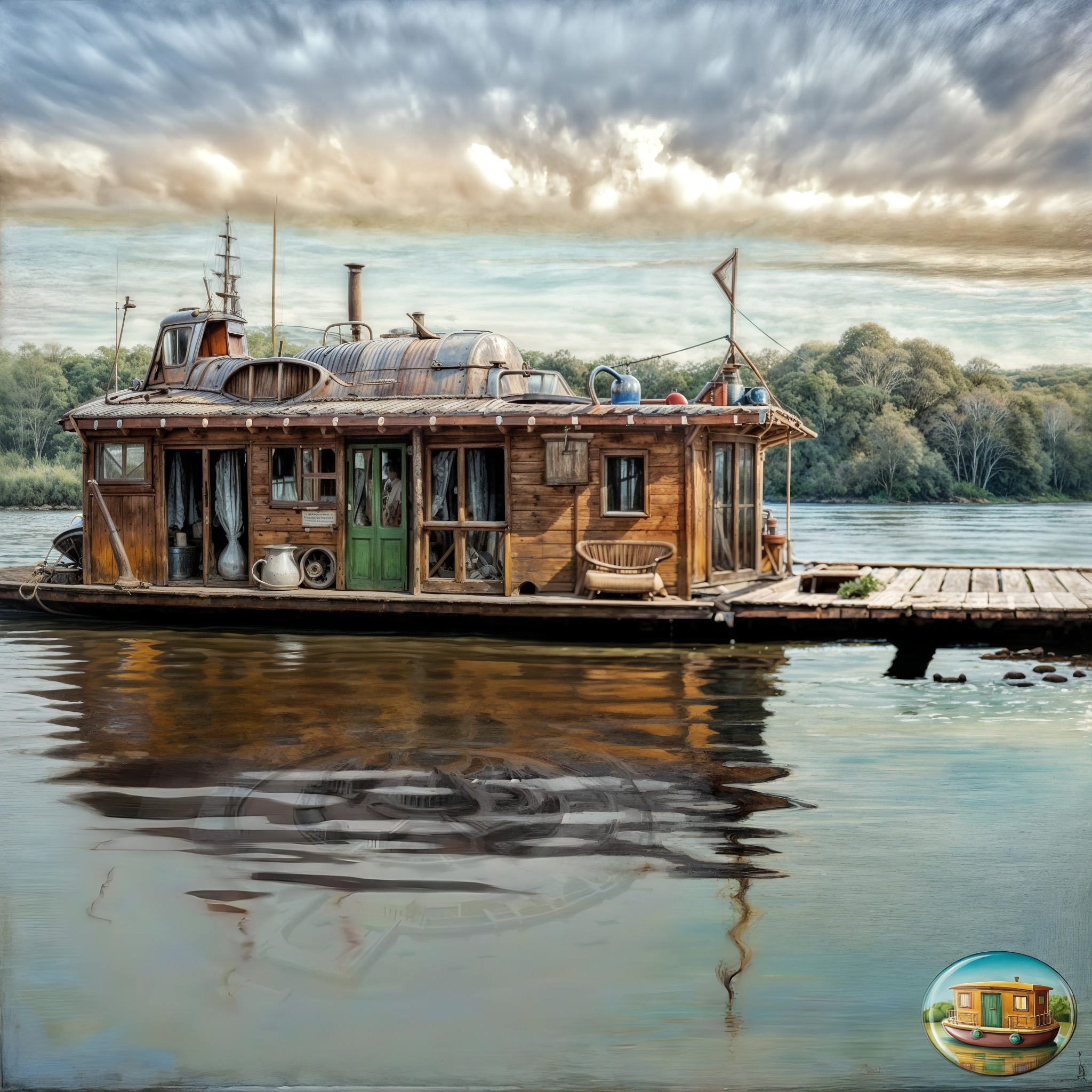
♫ Houseboat Lounge ♫
97/398


I enter the corridor. My friend Norbu seems not to be on board, but as I stand somewhat perplexed in his living room, I suddenly hear the sound of hammering. Burglars? No, it dawns on me, probably Norbu, who is sealing a leak and making sure that his houseboat doesn’t sink.
And there he comes, toolbox in hand, and we settle in with a glass of red wine. “I found ancient records of myself,” I tell him. As a teenager, I was fascinated by Atlantis and, like a little private scholar, combed the city library for archaeological clues about the inhabitants of this sunken continent. I show Norbu cave drawings, meticulously copied from various books and adorned with scholarly comments. They come from both the Old and the New World. “Atlantis lay in between,” I explain, “and that’s why there are such peculiar similarities in symbols and depictions, long before Columbus came or the Vikings discovered America: surviving Atlanteans who fled to the surrounding continents.” The thesis still convinces me today.
My friend Norbu rubs his chin. “Has it never occurred to you that these similarities may not have required any contacts by sea?”
“You mean it’s all just a coincidence?” Disappointed, I take back my yellowed and slowly disintegrating notebook.
“No, by no means. But haven’t you also delved into shamanism…”
Yes, right, there were shamans in almost all cultures worldwide, healers in contact with the spirit world and ancestors.
“And possibly,” my friend Norbu says, “in contact with each other.”
It takes a moment for the realization to sink in. “You mean, across the oceans, from people to people? And that—telepathically?” Norbu points affirmatively to my notebook. “Hm. Shamans of the European megalithic culture exchanging thoughts with those of the Proto-Americans,” I imagine. And of course, that could also explain the similarity of the pyramids or the fact that not only the Egyptians mummified their dead but also some Native American tribes. Besides the underworld of the dead and the upper world with helpful spirits, the shamans also know the middle world—the astral counterpart to our everyday reality and its reflection in the spiritual world. On journeys to the middle world, the shamans of earlier times, detached from space and time, could have visited foreign continents and civilizations—and thus their respective colleagues.
“But maybe not,” Norbu interrupts my thoughts. “There are indications that even before the Vikings, there were contacts between Europe and both Americas. The Chinese, Romans, Greeks, Egyptians, and Phoenicians—all are said to have been there and traded with the cultures there. Perhaps even the megalithic peoples. And all of this without the need for Atlantis as a bridge.”
I probably look somewhat disappointed because Norbu adds consolingly, “But of course, your early research honors you. Who knows, they might become important again and provide new answers? Or raise new questions?”
I know my friend Norbu isn’t entirely serious, but I feel strangely affirmed nonetheless. The young, curious fourteen-year-old still within me is pleased to receive a late acknowledgment for conducting significant foundational research.
I clutch my notebook as I cycle away, deciding not to stash it back in a dusty drawer but to give it a place of honor on my shelf with the early works of great minds.