117/398
♫ Embrace that Distant Shore ♫
117/398


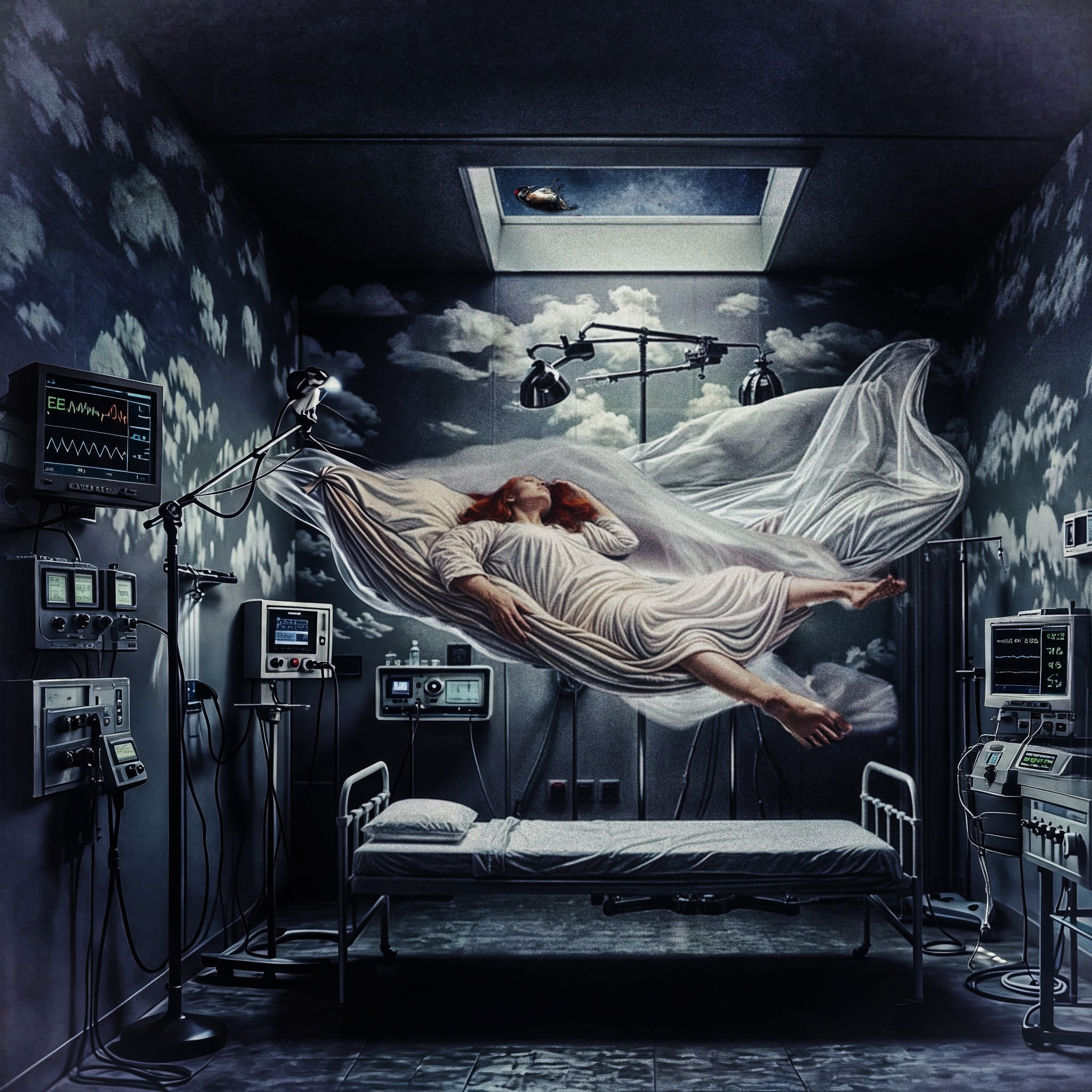
I enter the corridor after far too little sleep. But that’s how it is here in the sleep lab: the work mostly happens at night—the subjects sleep, the researchers stay awake and collect data. This time, I’m attempting to communicate with a subject who has mastered lucid dreaming. I step into our control room, from which we can observe the narrow bedrooms through one-way mirrors on three sides. Only one bed is occupied.
When the EEG indicates that the student is dreaming, I trigger three bright red flashes to illuminate her small room—a prearranged signal to help her achieve lucidity within the dream, a kind of knock to let her know we want to make contact. She’s one of our most experienced lucid dreamers.
The movements of her eyeballs, as shown on the corresponding monitor, now form a recognizable pattern. First, eight jerks to the left, then five, then twelve, then twelve again, then fifteen. A simple code: she’s just said “Hello.”
Through the intercom, I ask if she can hear me. The EEG shows she is asleep and dreaming. Nevertheless, she signals with her eyes: “Yes.” – “Then let’s go!” I say. She knows her task. She is to—while dreaming and without waking—levitate her body until she is above the cabinet in her room and relay to us what drawing she sees. We placed it up there without knowing what it was ourselves, as it is selected at random.
A short time later, she signals to me with our somewhat cumbersome but simple code: “dead bird.” I hurry to the cabinet, full of anticipation.
It’s not a dead bird, but a letter-number combination: F-B3T-42. I’m a bit disappointed, but as a scientist, I must not be guided by expectations; I have to stick to the facts. And the facts suggest that while she dreamed of performing the task, she only did so in her imagination rather than during an out-of-body experience. Our subject later reports having seen a woodpecker, but she said the word seemed too long to transmit via eye movements.
A week and a half after this experiment, I happen to see our caretaker in the courtyard outside the low-rise building that houses our labs, holding dead woodpecker in his hand. I ask him about it, and he explains that since our two chimneys were clad in polished chrome, birds occasionally break their necks on the roof, mistaking the reflection for the sky. I have him show me the spot on the building’s floor plan. Sure enough: the dead bird lay directly above the cabinet where we had placed our random drawings. Only a few meters higher, on the roof.
The caretaker, a man accustomed to all sorts of nonsense from us researchers, examines the woodpecker more closely at my request, pokes a finger under the feathers, and says: “Sure, coulda been layin’ up there for a week and a half. But what’s the difference, anyway?” I leave him without an explanation.
We had already discontinued the study because we couldn’t achieve significant, repeatable results. Was it too hasty? I don’t tell my colleagues about the dead bird. With an anecdote like that, we’d only be a laughingstock in scientific circles.
Lucid dream: 
Out-of-body experience: