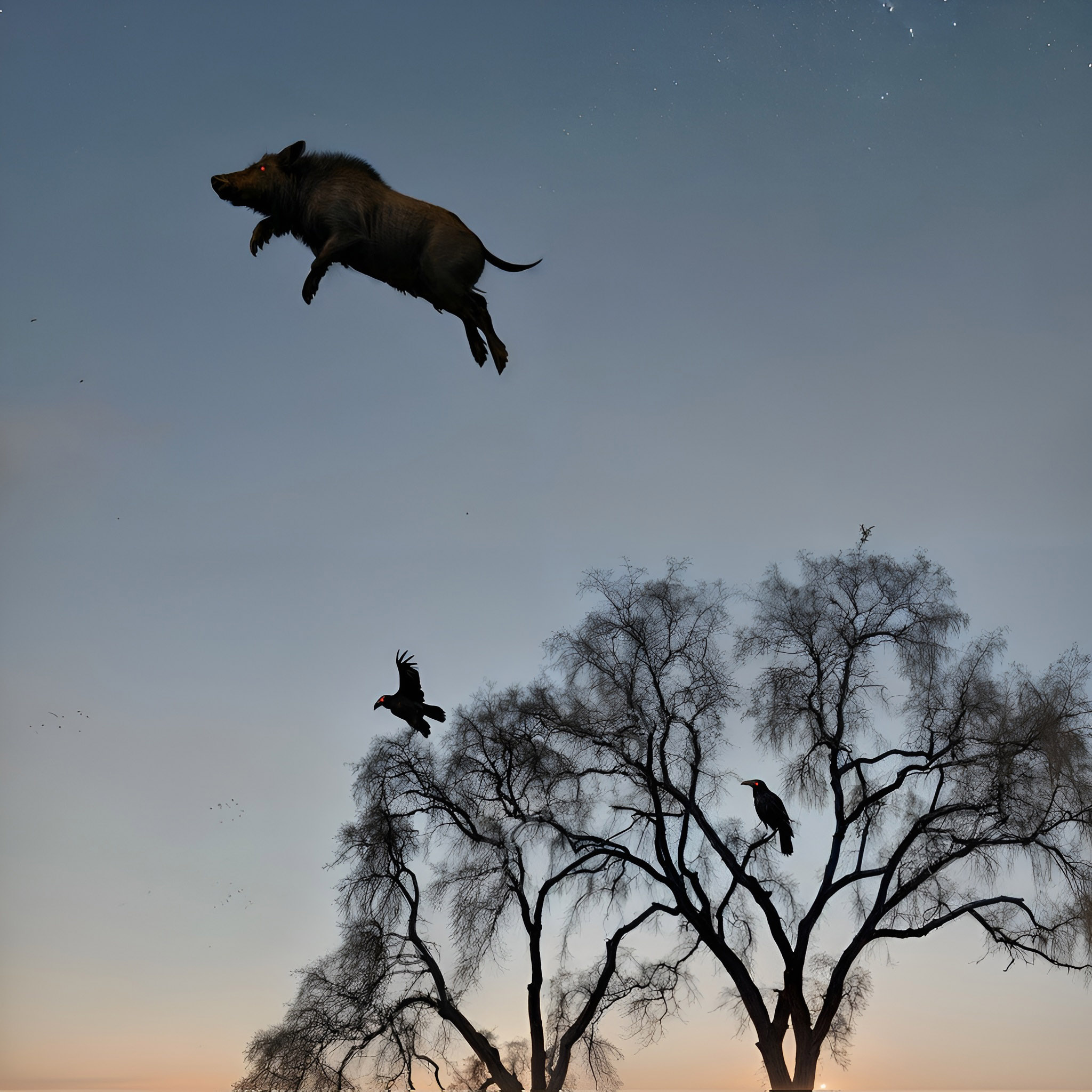
I enter the corridor. The hunters are already searching for me here as well. Before they can pounce on me, I dart aside. A long staircase begins here, for which my four legs are actually too short, but mortal terror propels me upward. The warriors are following me. In front of me, I see a man opening a heavy timber door. I follow him, run between his feet, knock him over unintentionally, and huddle in a corner of the room, trembling.
“Close the door, cook!” thunders a voice. Obediently, the man rises from the floor. Outside the door, a few of the Einherjar stand silently, staring in. The cook closes the door and turns around. His face is blackened by soot. I recognize him! He’s the cook who set the hunters on me and wants to throw me into his cauldron.
I do not know the other man, the one standing by the window opening. Two ravens sit on his shoulder, but now they flap their wings and fly off, croaking into the open air.
“My Lord, the boar…” the cook begins and falls silent.
“I see.” The man at the window has just one healthy eye. It fixes on me. My entire body trembles as I try to make myself as small as possible.
“The boar didn’t want to go into the forest today to be hunted. It ran back to the fortress, and then… obviously…” Again, the cook falls silent.
“Obviously straight to me. Spare me explanations for things that are plain to see. Maybe the boar doesn’t want to be hunted; maybe he doesn’t like that?” The cook nods.
“Maybe he doesn’t want to be butchered and cooked? Only to rise again from his bones the next morning, only to be hunted, butchered, cooked, and devoured again by warriors, valkyries, and my wolves? Day after day, week after week, year after year?” The cook stands motionless. “Or would you, perhaps, find pleasure in such a fate, cook?” The man with the soot-blackened face shakes his head. He, too, seems to want to make himself as small as possible.
“So let us deliver him from his fate.” The man at the window steps aside and takes a gleaming spear from the wall.
“But my Lord!” the cook interjects. “What am I to serve at the feast tomorrow? What are the Einherjar supposed to eat in the future? And what should your wolves feed on?” He ventures forward, but suddenly realizes whom he’s reprimanding and bows deeply, moving backward until he backs into the double doors.
The man by the window laughs. “Tomorrow, cook, when he is restored to life, the boar will know nothing of the fact that his god had promised him deliverance.”
And with that, he throws the spear. Everything happens too quickly for pain. Suddenly, I am entirely weightless, and I gaze down on the world from far above. I can see everything from up here. It seems a massive feast is approaching, where rivers of mead will flow. And under a large cauldron, the cook stokes the fire…
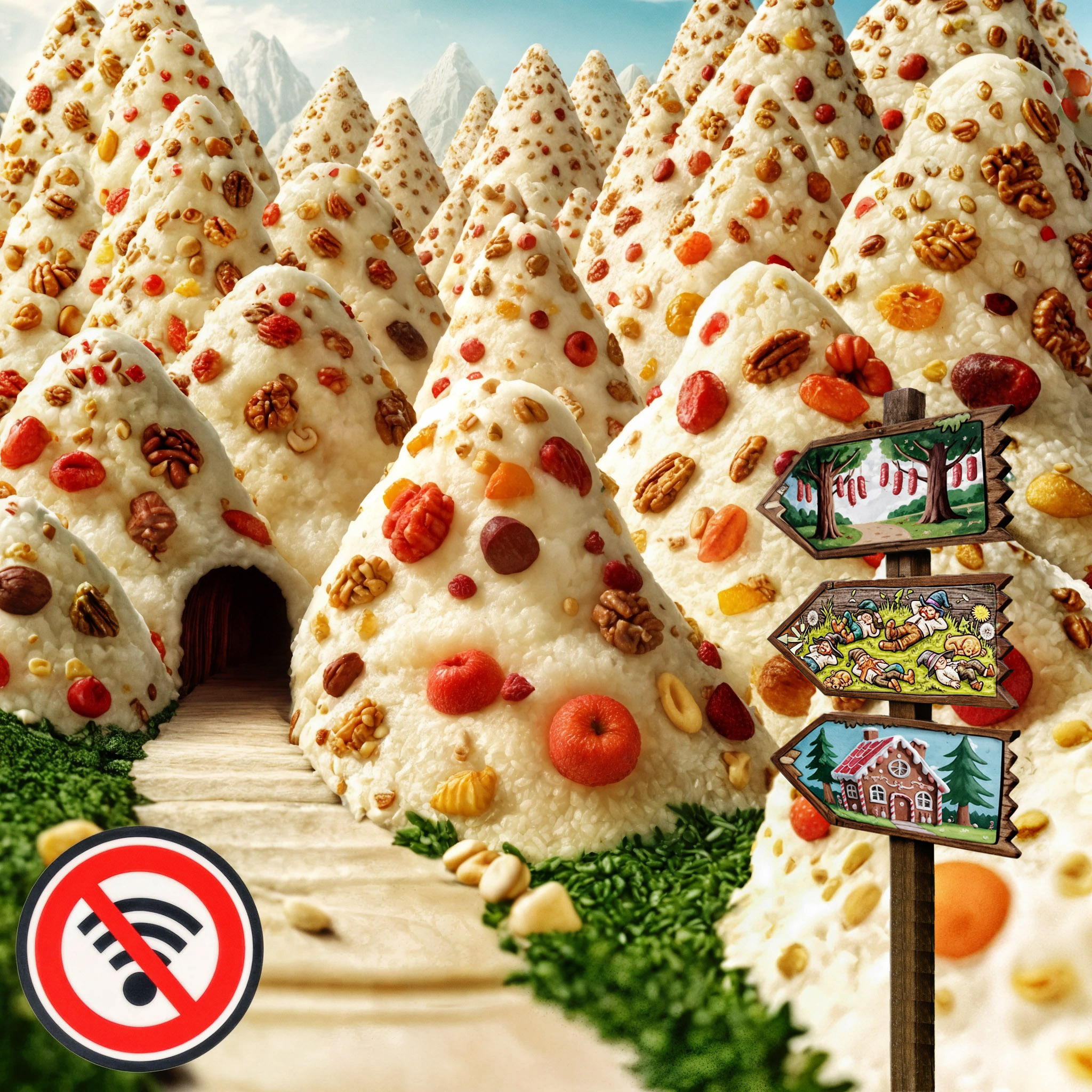
I enter the corridor that other wanderers before me have chowed into the mountain of rice pudding. Side passages branch off, but I scurry along the main tunnel, trying to outpace the viscous mess slowly oozing down.
Once I make it to the other side of the mountain, a fantastic world unfolds before me. I always thought it was just a fairy tale: the land where roasted pigeons fly right into your mouth and a quick “Psst!” makes fish leap into your hand. But it’s real! Around every house is a fence woven from bratwurst, you get a guilder for every hour you sleep, and yawning earns you a double thaler on top!
Still, as much as I wander around searching, I can’t find a single hotspot. Not even a modem connection can be found. When it comes to tech, this place is a real backwater—or back-mountain, if you will. Well, back I go, I guess. Hopefully, the tunnel through the rice pudding is still passable.
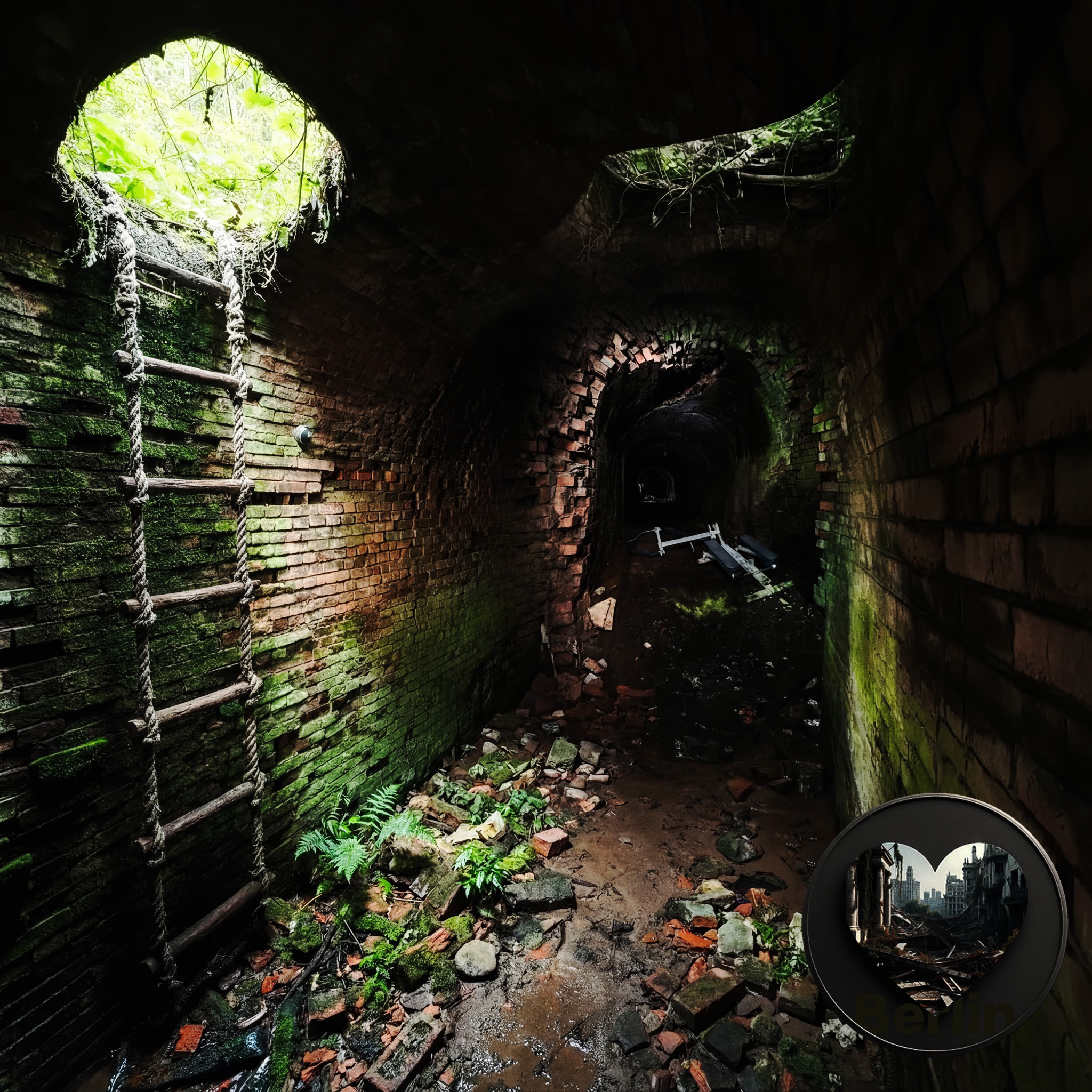
I enter the—corridor might be the wrong word here, since it suggests this passage is intended for human use. Though I wish that were the case, it’s not true of a canal, or more precisely, a sewer. It is a man-sized brick tunnel where other canals converge from both sides—a tunnel network beneath the city.
A deceased human body may decompose in a few weeks or months, depending on external conditions. With the metabolism of a city made of stone, metal, glass, and the artificial materials of its time, it takes centuries or millennia for nature to completely reclaim what humanity had wrested from it.
They call us corpse scavengers—and indeed, we like to compare the object of our investigations to a body, a human body. Since the city has been abandoned for a long time, it is a dead body. In essence, we perform an autopsy akin to pathologists, albeit without investigating the cause of death. That is apparent. We are searching for any viable organs that might remain.
The city’s sewer system, my field of expertise, serves as its excretory organ. No wastewater has flowed through its intestines, hidden deep in the ground, for a long time. That’s why it doesn’t stink here anymore, as some might think, who turn up their noses at my task. I know I’m not exactly well-regarded. But I take my task seriously and do my best.
It’s always the same. After a long march, we suddenly arrive, the whole troop. We encounter no resistance—aside from overgrowth and buildings on the verge of collapse. We noisily invade the otherwise silent city, reach its center, disperse, each assigned to their personal task. A few hours later, we gather again in the main square, and shortly afterward, the dilapidated city lies dead again, as if we had never been there.
A living body requires air and sustenance. Nerve pathways, veins, and a lymphatic system run through it. Food is digested, producing energy used for activities and communication. An immune system and various repair mechanisms fend off foes, resisting decay, wear, and excessive growth for as long as possible.
All this applied to the grand cities as well. In homage to ancient healers who once specialized in the various organs and systems of the human metabolism, we have given ourselves names, nicknames referring to our respective specialties. I am the “Proctologist.”
The old cities are considered cursed places, and that curse clings to us, the corpse observers. We are outcasts, accused of being in league with demons. Therefore, we’re forced to keep to ourselves. At times, we plunder women. Even I am reaching the age where I should start a family. I’ve set my sights on the “Neurologist.” But how can I impress her? I would need to make a significant find, yet what can be discovered in the sewer channels?
We seek unique artifacts, objects whose meaning and purpose are lost to us. From each city, we take only one of these items and, often through perilous routes and great efforts, bring it back to our fortress. There, in the mountain, we’ve established a vast underground museum, where these objects, labeled with the city of origin, are displayed—and no one but us knows about it.
Despite being seen as mere plunderers and cursed with vile names, we are, in truth, custodians, holding great reverence for the dead cities and their former inhabitants—the creators of all the wondrous yet enigmatic devices that our expeditions uncover.
I’ve been walking through the channels for many hours now. It’s time for me to return. My unerring sense of direction is why I’m tasked with traversing the drains and catacombs of the dead cities. I’ve never gotten lost, and even if my torch were to extinguish, I would find my way back.
There! In the flickering light, I spot something I must have missed on the way in. It’s a metal frame with a handle made from the past ones’ artificial materials. It’s black, pliable, and feels surprisingly pleasant, almost how I imagine a woman’s skin feels. I stand the frame upright, its short crossbars holding it steady on the ground—similar to one of those pedal-driven contraptions the past ones used. But it has no wheels or saddle. Even so, it looks like something you could climb on: two platforms, slightly larger than my feet, are fixed side-by-side at the bottom. Apparently, you’re meant to climb on while holding the tall handle. I’m excited; I’ve never seen anything like it. Is it dangerous? Recklessly, I step onto the footboards. My breath catches in my throat with fright: They move—one tilts away, simultaneously pushing the other upwards. The frame creaks. I put my weight on the raised foot, and its platform sinks slowly and heavily, while the other foot rises.
I can walk on it—walk in place! Weird. But a great find. I have no idea what it’s for.
It is heavy. I shoulder it and make my way to our meeting point. It makes me proud to bring something back from my excursions.
Our Elder examines the artifacts. He lingers in front of mine for a long time. Then he gestures for me to demonstrate it. I step onto the platforms and slowly start moving them with my feet, shifting my weight. It creaks as I start walking in place, like I’m climbing stairs. I hear murmurs from the others but only have eyes for the Neurologist, who regards me and the device with astonished glances—and smiles when the Elder makes his choice. She smiles at me! I step off and feel as if I am floating.
Our Elder crafts a small plaque in the dead language and script, which I’m allowed to attach to my find. “Berlin.” We set out. The Neurologist helps me carry the artifact. From the hushed whispers of the others, I realize they’ve noticed whom she’s chosen. The “Proctologist”—who’d have guessed?
In any case, I proudly carry the device with her—the one you can walk in place on. We have a long way to go, but I feel light and full of energy. I’ve found a museum piece… and a companion!
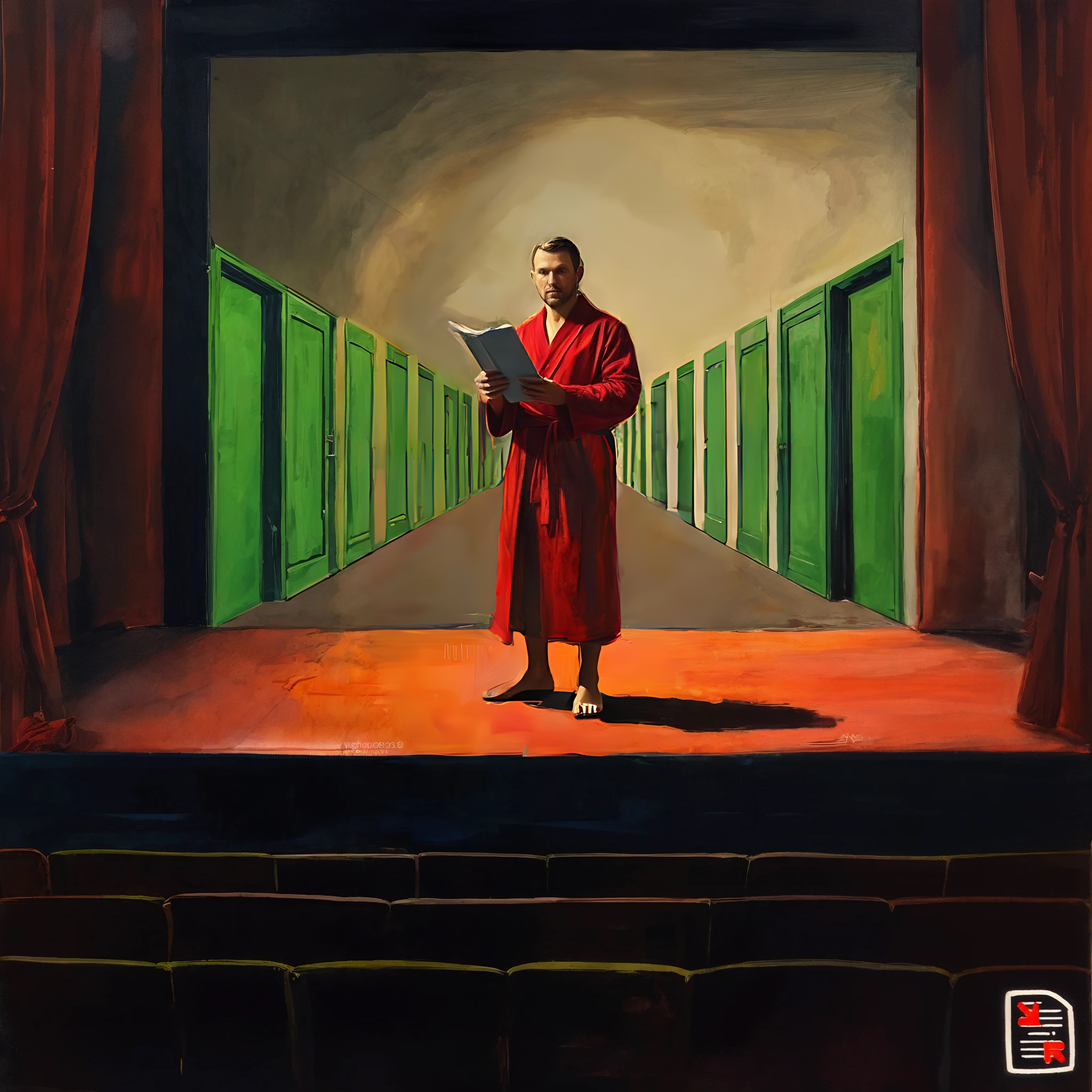
“I enter the corridor from which there is no return”—these are the powerful words that begin my great stage monologue. I stand in front of a door that, to the audience, seems to open onto a long, perhaps even endless corridor, I imagine, and I turn my head back to the other actors on the set. Then I deliver my moving farewell speech, and, in the end, I make my announcement come true and fearlessly enter the dark corridor of no return, the door slams shut behind me, and that will be the last thing that can be seen of me. At least until the final applause.
The play is going to make a splash; I can feel it. Granted, the director seems to have passed his peak, and it is only a small independent theater where we perform. But I can sense the power that the text holds and I am certain tthat we will significantly shake up the current, rather staid theater scene.
It is nothing new, actually: as a patchwork of text fragments from the Theater of the Absurd, it brings authors such as Pirandello, Artaud, Cocteau, Beckett, Ionesco, Sartre, and Camus into dialogue with one another—a remix! To be honest, I still haven’t figured out exactly which play and which dramatist this monologue stems from. But isn’t that ultimately irrelevant?
Finally, I’ll be back on stage! The project does not boast any stars, but relies on skilled second or third-tier actors in order to be convincing with the force of its story. At a boisterous meet-and-greet fueled by plenty of Chablis, the director explained his vision to us. It’s not about whether the Theatre of the Absurd imitates the absurd or, rather, turns what it imitates into the absurd. No, it concerns the definitive myth for our era, the mythical theater of postmodernism, and the only fitting depiction of the human condition: absurdity itself.
On stage, I represent all of humanity—the individual who crosses the point of no return. Confronted with a senseless world, they knowingly and voluntarily choose the path of madness and loss of reality, not without commenting on this with powerful, profoundly existential words that are sure to resonate with the audience. At least that is what my gut feeling tells me. It gives me chills just reading it.
“Forget me!” I shout at the end, or perhaps I’ll just whisper it with fervent passion: “I am lost to your world of feigned order and decency, and what is more, I am a danger to the children and fools who still have eyes and ears and could discover that there is a way behind the scenes you have erected, the Potemkin villages, the beautiful facades and shams with which you inadequately cover up and disguise the maelstrom of meaninglessness. Better if you just forget me, erase me from your memory and your church books, destroy everything that could remind you of me, deny and repress me as thoroughly as you negate the actual essence of being. Root me out, lock, stock, and barrel! I am leaving, and there is nothing left that connects you and me. All bridges behind me are burned. Adieu!”
I believe that the “definitive myth for our era” that the director wants to bring to the stage lies in precisely these words that penetrate deep into the heart of human existence, affect it, stir it up, and perhaps never truly let go of it again. I am proud to be allowed to embody and inhabit this role, and I can feel that this monologue will be the culmination of my professional career, maybe even my life’s work.
Addendum: During rehearsals for the play, the director came to the conclusion that some necessary text cuts had to be made. Ultimately, he retained only the opening words of my grand monologue. I should, he says, incorporate the rest emotionally as I exit the quite minimalist stage setting—without a door, without a corridor—off to the side, with the few but memorable words “I enter the corridor.”
I enter the corridor, realizing from hearing the the sound of a drill, that Norbu is fixing something on his houseboat again. I open a bottle of wine on the terrace and wait for him with two glasses. When I visit my friend Norbu, I always make sure to have plenty of time. It’s never predictable how deep we’ll get tangled up in our discussions.
This time, I have a topic in mind. I want to know what Norbu thinks about climate change.
He’s sweaty and covered in oil, but he’s clearly happy to see me when he finally emerges from the chambers and passages below the waterline in the living room, a power drill in his hand.
“Climate change isn’t the problem,” he casually remarks. We clink glasses. “Humanity will eventually die out anyway. And even if we survive for a while, life on Earth itself is limited.”
“That sounds like catastrophism,” I chide.
“Pure astrophysics. The sun will extinguish. The problem isn’t global warming; it’s the heat death. You need to think on larger scales!”
My friend Norbu enjoys doing that. I, on the other hand, only need to ponder for ten seconds why there is something rather than nothing, and I’m already caught in the Total Perspective Vortex, dissolving.
“Hey,” my friend Norbu says, “are you still with me?” That pulls me out of the Vortex. I nod eagerly, “Heat death of the sun. It expands and burns up all its planets. The end of life on Earth.”
But Norbu impatiently shakes his head, “Heat death of the universe, the end of all life. That’s the real problem, and that’s what we need to prevent.”
I stare at him in disbelief, “You want to prevent the heat death of the universe?” And then, “What is that, anyway?”
“Since shortly after the Big Bang, the universe has been steadily deteriorating: matter is distributed, interacting less due to increasing distances, and stars are burning out. Cold and hot zones are becoming more alike until everything assumes a uniform temperature and structure, like a featureless lukewarm soup. But so that we don’t allow it to happen without a fight, there’s ‘The Message.’ ”
Norbu gestures widely at the world around us. I can’t follow him. Finally, he sighs and begins to explain further, “The laws of nature are a message. The cosmic physical principles are exquisitely tuned so that life can emerge, life that recognizes itself for what it is. I’m talking about us!”
“Us two?” I ask meekly already suspecting that I may not be able to follow him again.
“All of us. Humans. And all other intelligent civilizations in the cosmos. And the laws of nature tell us that those who came before us tampered with them.”
“Those who came before us?” I can hardly keep up with him anymore.
“Sometimes I imagine,” and with that, Norbu leans back and looks thoughtfully at the rest of the red wine in his glass from below, “that before the heat death of the universe, a handful of intelligent civilizations will manage to make contact with each other and jointly initiate the greatest project in the world.”
He doesn’t say more. I should now ask what the greatest project in the world is, but now I’m being obstinate and staying silent.
After a while, he continues in a whisper, “To create a new one before the end of your own universe, so that it can give life again. So that the chain of being doesn’t break.”
Suddenly, I’m filled with awe at the thought that we could leave a message for the next universe, for the intelligent beings who will follow us: the laws of nature that help them evolve—a forward-looking measure that certainly exceeds what can be accomplished within a single legislative period and even surpasses a 739-year organ work, a ten-thousand-year Long Now clock, and the safest possible disposal of nuclear waste for hundreds of thousands of years by a wide margin.
“Of course,” my friend Norbu suddenly becomes quite sober again, ” only if the universe is a closed system. Otherwise, there are numerous other possibilities because it doesn’t necessarily have to end in heat death or a Big Crunch. But as long as we don’t know for sure…”
“… it might be better to prepare for the worst.”
“Exactly,” affirms my friend Norbu. “640 billion years until heat death is a hell of a short time to evolve to the point where we can plan a new universe and put it into action. Better get started on that right away.”
My head is spinning, not just from the wine. As I ride home later under a gloriously starry sky, I look up and ask the universe arching above me if it has a message for me. And indeed it does. I can’t hear it or see it, but I can sense something. Life is worth living.
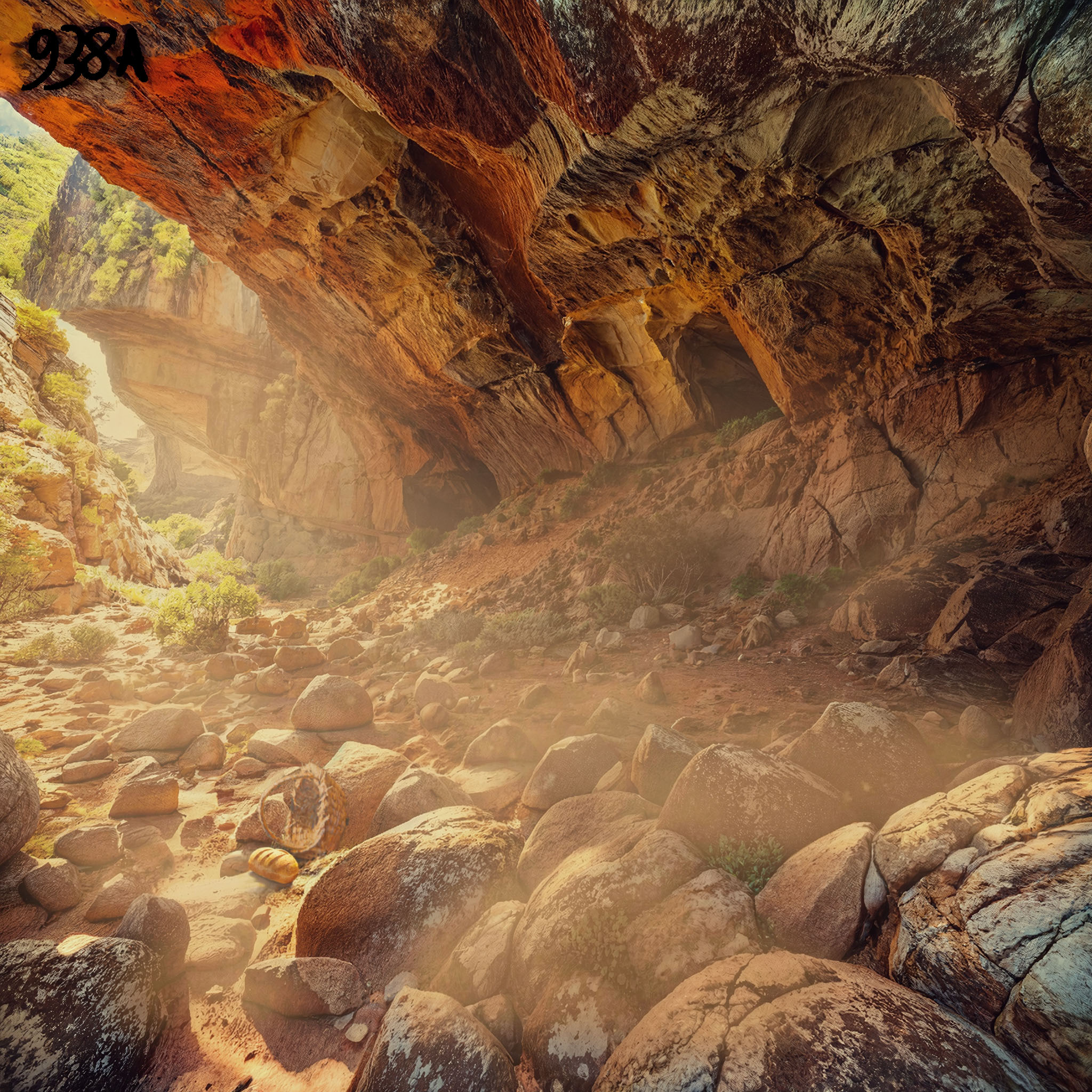
I enter the corridor, clutching a loaf of homemade bread. Misfortune dogs my every step, but today, I intend to turn the tide of my destiny. I will finally confront the Fate who has plagued me with disasters of every kind throughout my life. Will I succeed in winning her over? Will my offering soften her heart?
Ignoring the countless side passages, I follow the main corridor hewn into Mount Dikti. It leads deep into the mountain’s heart, where the Fates are said to dwell. But even here, I sense impending doom. She will not leave me in peace, not even here! The familiar, hateful constriction tightens in my chest, growing stronger and stronger—a sure sign that she intends to make life miserable for me and everyone around me once again.
With what this time? Wild beasts? A flood? A drought followed by famine? A plague? Pirate raids? Defeat in war?
No.
An earthquake. The mountain roars and shudders, throwing me to the ground as the bread slips from my grasp. Terror-stricken, I crawl back toward the daylight. I narrowly escape the falling debris, and no sooner have I made it out onto the rocky ledge than the corridor leading to the Fates collapses. I hear screams—or is it the screech of shattering stone?
Suddenly, all is quiet. Only a few small stones trickle down the mountainside. I can hardly believe it: the oppression that has ruthlessly shadowed me my entire life has left me. It feels as though it will never return.
Filled with new courage, I begin the journey back to the city—to the palace, to my deformed brother, and to my family.
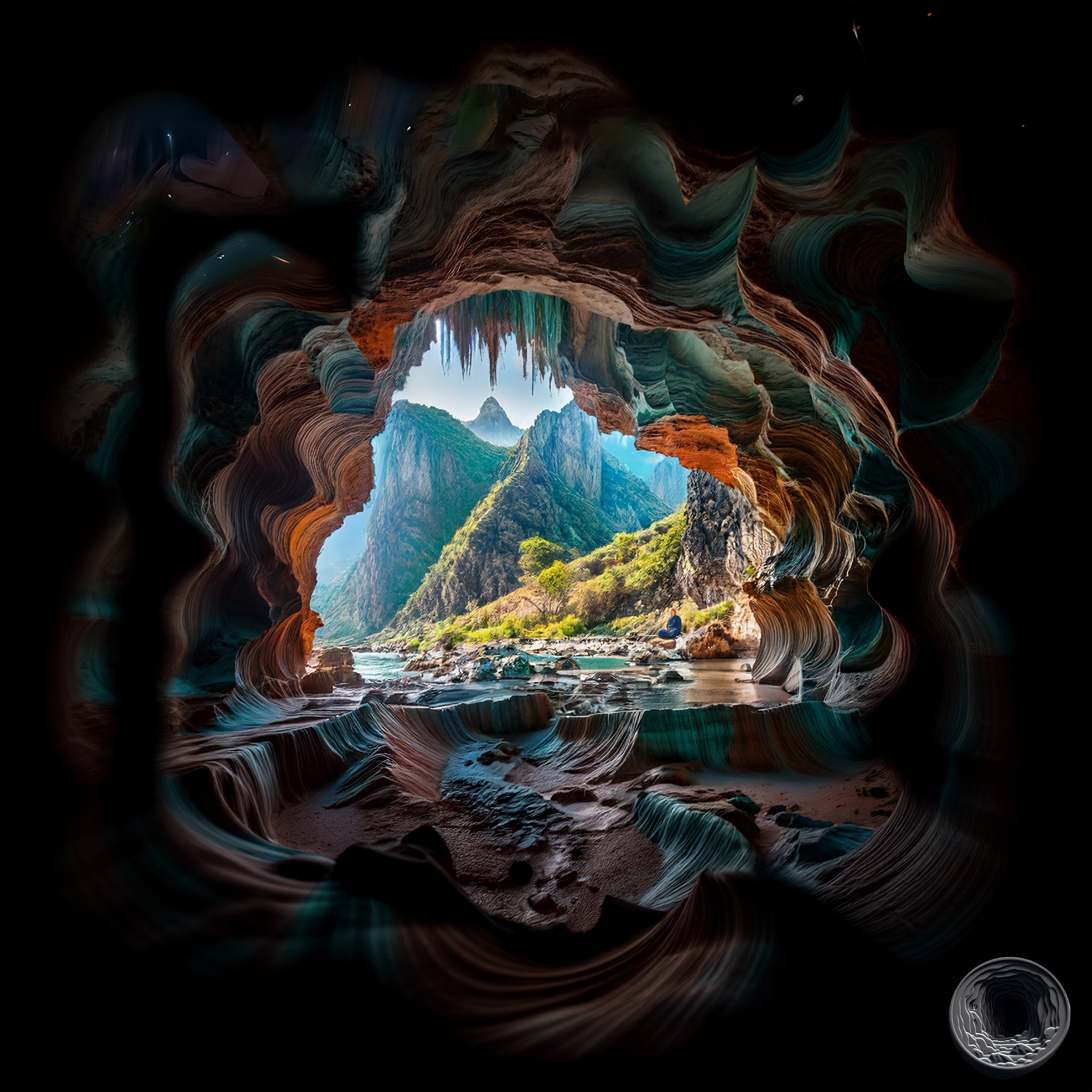
I enter the corridor. It’s a natural fissure in the rock, widened by monks like me over centuries of labor. Along the sides, the passage opens into small cells, yet my path leads deeper into the mountain. I take a deep breath.
For 49 days, I will sit in darkness, in a place where no ray of light penetrates. I have been warned by other monks. Some meditators have gone mad in there, and it was whispered in hushed tones that some adepts didn’t survive these 49 days.
Descending deeper into the mountain, toward an unknown and frightening place, I realize that I am about to confront what lies deep within me—unknown and terrifying. I break out in a sweat. Nevertheless, I continue to inch forward into the darkness. I don’t want to disappoint my master, and I certainly won’t change my decision.
What will I discover? What will rise from the depths of my being when I sit there in absolute silence and complete darkness? I stumble, and despite my desperate grip on the metal bucket, it slips from my grasp, falls over, and the precious water—the only thing accompanying me into the depths of the mountain apart from my robe—spills onto the bare rock and seeps into the cracks and crevices. I must turn back. Without water, I won’t survive!
Yet, I keep going.
There are no more cells along the sides of the corridor for a long time, not even niches. The passage narrows. I feel lost. It’s better to turn back now than to come crawling out later, half-starved and dying of thirst!
But my master said that I can take this path into the darkness, into the mountain’s interior, only once. If I turn back now, the descent into the mountain is forever closed to me. I start sobbing for no apparent reason. Fear of death seizes me. Yet, I continue to stagger forward. I am deep inside the belly of a mountain, and it feels as if the rock weighs tons on my shoulders.
People I once knew come to mind, hurtful words, thoughtless actions that I regret. I beg the black, cold walls for forgiveness. They do not respond. I am four years old, exploring the basement alone, and an unfortunate coincidence causes the only lightbulb to blow. I scream, and my own voice and its echoes through the mountain send shivers down my spine. I can’t stand myself anymore, yet I have no choice but to endure myself, somehow. It’s as if I’m walking through hell, and hell is me.
There. A glimmer ahead of me. At first, I think I’m mistaken. Then I realize that there must be another monk down here. He must have brought a light, a candle, or a torch. But the light does not flicker.
I’ve actually been ascending for some time now. It’s daylight that awaits me. I have to squint. The deepest and darkest part of the journey, the dark night of the soul, is bright?
I step out into the open. A green valley, bathed in sunlight, stretches out on the other side of the mountain. The master sits on a rock, pouring me a cup of tea. I feel confused. How long was I on the journey? Was it hours? Or weeks? Am I already dead? Am I dreaming?
“We never really know for sure,” says the master.
I enter the corridor that connects my house to the boathouse. I haven’t been here in months—first because the lake froze over during the harsh winter, and second because a demanding job for a non-profit organization left me with no time for my private research. Here in the hallway, I’ve set up a narrow table where my notes are spread out next to the cryptic original text and my attempts to reconstruct the game board and pieces.
Years ago, through a lucky coincidence, I came across some yellowed records mentioning a long-lost board game that was apparently quite popular in southern Europe during the Renaissance. It was called “Citadel,” and the text—a letter to a merchant father from his son traveling in distant lands—mentions some of the pieces, though unfortunately only in passing and not to document the game and its rules. The reconstruction is proving difficult. If it is ever to succeed at all.
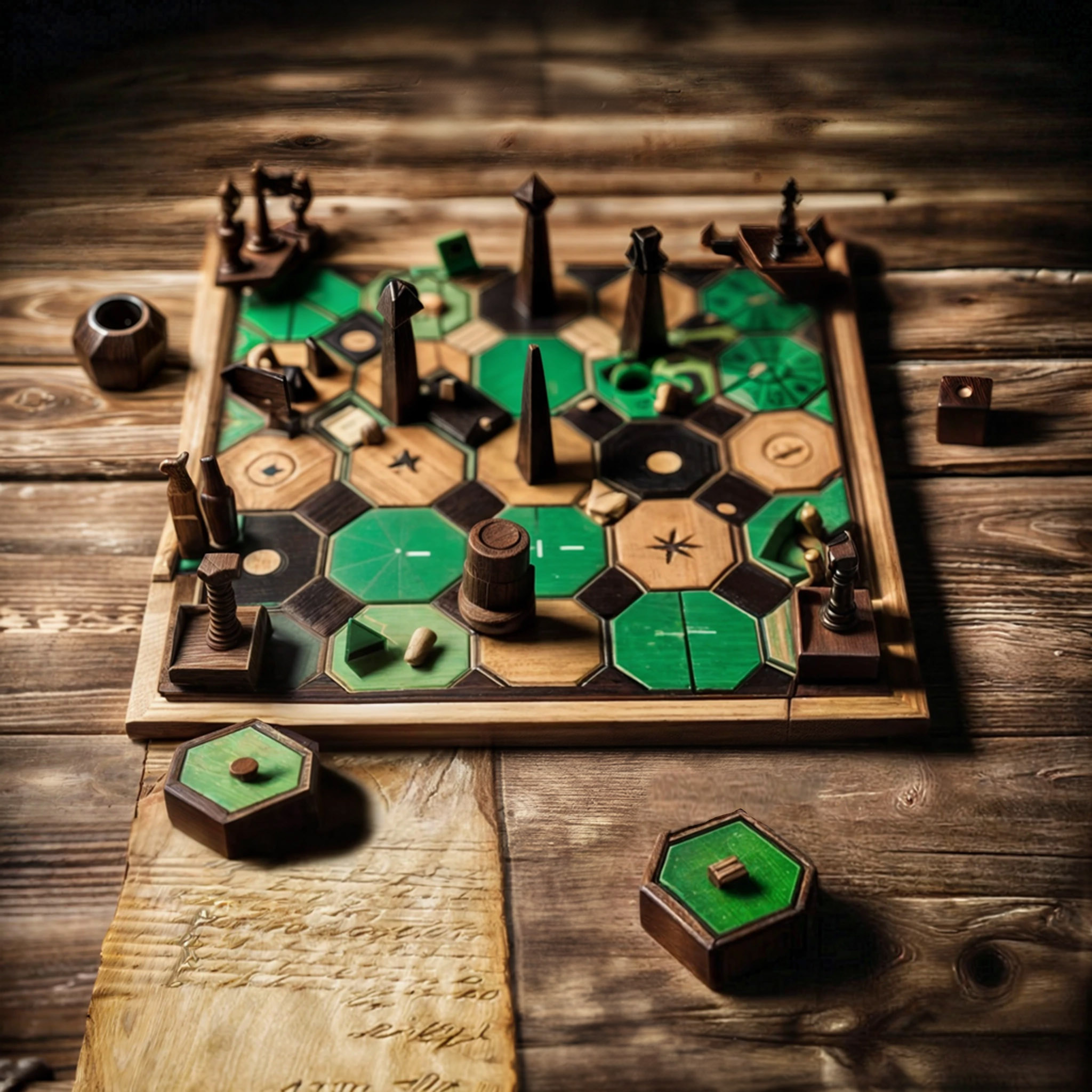
My honeycomb-shaped replica of the game board is sawn from balsa wood. I have colored the spaces alternating brown and green, true to the anonymous author’s notes.
Thoughtfully, I pick up the game pieces I carved. The text speaks of a “sweeping courier,” “catapults,” and a “nimble princess.” The inferior pieces apparently included numerous “vassals,” which—due to my lack of crafting or artistic skills—resemble simple obelisks. The “Throne” and “Scepter” pieces didn’t exactly turn out to be masterpieces, either.
I lose myself in my intricate notes. “Executioner captures jester,” I read. But how? Must there perhaps be a symbolic sentencing by a judge first? Once again, the enigmatic game completely consumes me.
And then, just as I give my tired eyes a good rub, he is sitting across from me: the unknown author, a dapper young man with a mustache and a green velvet beret. With a surprising move, he places his king’s son next to my princess. “Throne and scepter,” he says with a broad smile, before the brief vision vanishes.
That’s it!
Internally, I rejoice, having just taken a massive step forward: “Throne and scepter” in the yellowed letter—that doesn’t describe two more pieces; those are the words that end the game!
I take the small, crude pieces I had carved for the scepter and throne off the board and carelessly let them fall under the table—and with that, the game suddenly comes to life, the moves and strategies become clear, and the rules stand vividly before my eyes. It’s all so obvious. “Throne and scepter!” I shout, dancing through the hallway.
I enter the corridor. Sand—white sand has been blown in. Through it lead strange geometric tracks marked by imprints of rectangular crossbars: a line of primitive Braille consisting of the same repeated letter, etched evanescently into the sand.
The corridor opens onto a beach—the roar of the sea had already signaled this. I follow the tracks eastward, my gaze fixed on the grooved sand and the low-hanging sun.
Now, faint, mournful sounds pierce through the roar of the ocean like the tips of knives through a billowing curtain. A figure is perched by the water, playing a stringed instrument, his face turned toward the horizon-wide ocean.
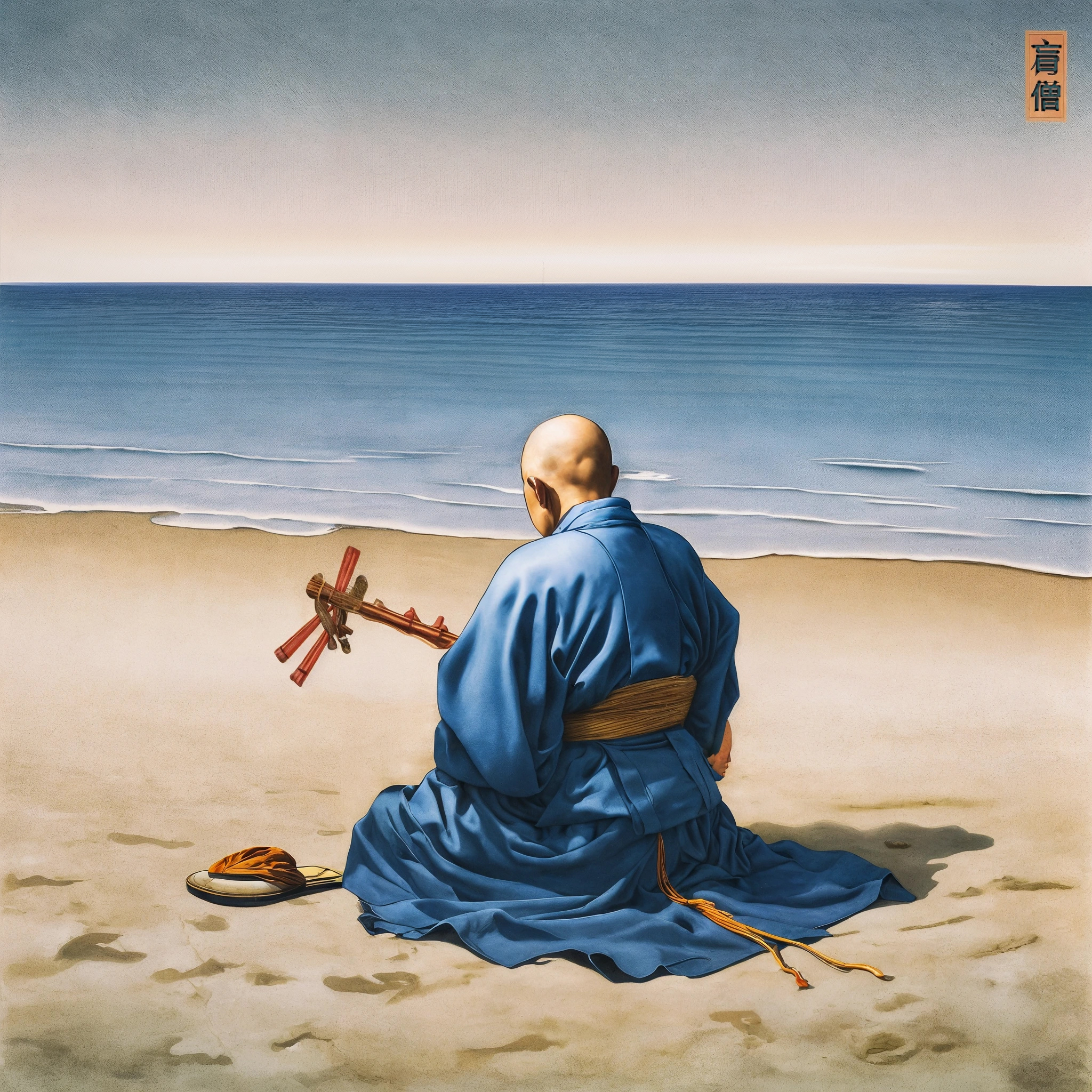
He is Asian. His head is shaved bald, though the regrowth is already darkening his scalp. The monk wears a blue silk robe and white trousers. Beside him sit his sandals—simple wooden blocks with a loop on top and two wooden slats beneath—the source of the tracks that led me here.
The monk sings, striking the four strings of his lute with a tapered piece of wood.
“It is a biwa,” a voice in my head explains—but it is not a voice. It is more of a déjà vu, a fragment of long-forgotten knowledge.
The monk ceases his playing, as if a noise had pierced his concentration, and turns his head in my direction. He mutters something in Japanese, nodding as if to confirm his own words to himself; then he stands, sets the biwa aside, and bows deeply to me. As he raises his head, I see now that he is blind: his eyes are mute, broken long ago.
Nevertheless, I bow as well and sit down to his left after he begins to tell me a story.
I cannot explain how I am able to understand the moso’s story, as he is speaking Japanese. But somehow the old man’s dry voice touches my heart and paints ink drawings in my mind, so that I grasp everything he tells me.
And so I listen, moved, to the moso’s tale of water, fire, wood, earth, and metal—of a land where people live in harmony with nature and know how to appease the demons—and I am saddened that I can take so little of it back with me into the narrow corridor of my alienated and superficial life.
The sun has long since set by the time the monk resumes his biwa playing and I begin my walk back. Regrettably, the magic of his words and images quickly evaporates; they melt like snowflakes in my open palm the moment the clamor of the city rolls over me again.
I enter the corridor. Once again, the throbbing headaches plague me, even though, fundamentally, I don’t even have a head anymore. Instead, I travel through time like a bodiless spirit, always inside the minds of others who don’t notice me—alongside people who fascinated me as a child, even if I have long since forgotten them.
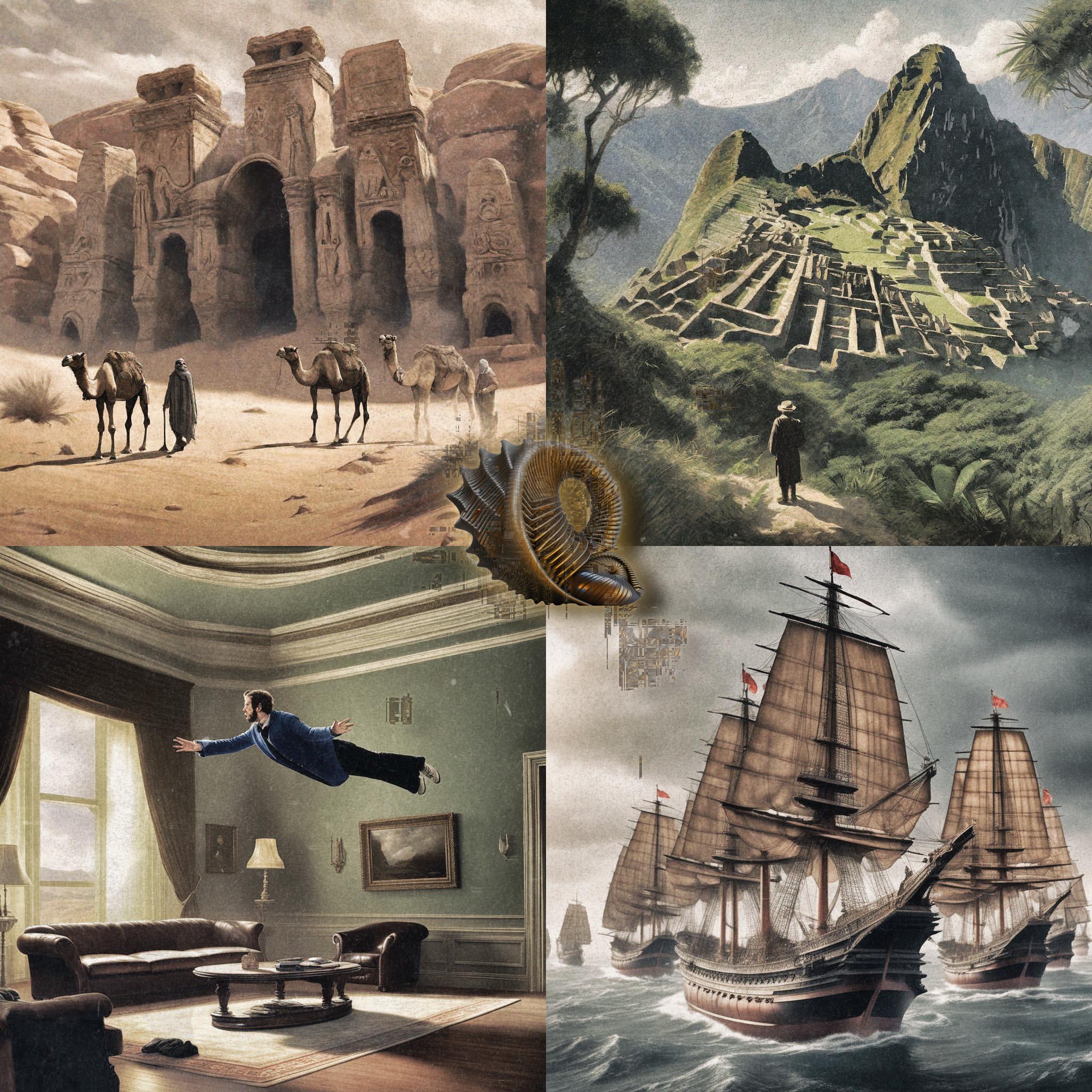
It all began with the diving record of the Trieste. Most recently, it was a journey of a completely different kind, where I ended up in the Lop Nor Desert with Sven Hedin. I sat helplessly behind the eyes of the expedition’s Swedish participant, forced to experience all the hardships, until he finally entered an underground passage in a Bronze Age ghost town they were exploring.
It is their dreams that give me headaches. They often ambush me at night and last throughout the morning. I feel completely helpless against it all, but for a few days now, I have been trying to focus on a thought that keeps slipping away from me: Maybe it’s not an accident, a punishment, or a curse that has befallen me. Maybe it’s an opportunity—or a blessing!
There was this movie where the hero was trapped in a similar way and couldn’t find a way out. He was a meteorologist, I believe, and only when he started to see the hopeless situation he had gotten himself into as an opportunity and fully exploit its potential could he finally free himself from it.
So, I try to rediscover the fascination I had as a child when I read about all these adventures.
I am in the jungle, trapped in the mind of a young local man who accompanies a well-equipped expedition as a porter. Hiram Bingham has us hacking with machetes through the dense vegetation overgrowing large stone blocks. He is convinced that he has finally discovered the Inca city of Vilcabamba. I know better. This is Machu Picchu. But I can’t tell the explorer. I am condemned to helplessness, left only to watch desperately and hope that some corridor will free me from my prison. I wanted to focus on something. But everything keeps blurring and eluding me. I curse my fate. Eventually, the man enters a low passageway in one of the partially excavated pyramid structures…
I am Lord Lindsay—or at least that’s how I am addressed—standing on the third floor of a building. With a mixture of admiration and dismay, I observe a man—that must be the medium Daniel Dunglas Home, I vaguely remember—rise from the floor and levitate. Soon, he floats, stretched out, with his back facing downward in the room. Lord Lindsay is seized by horror, while I sit in his head and watch the spectacle, fascinated. Eventually, Home glides out the window, his face contorted with exertion and his eyes closed. Lord Lindsay stands terrified, while another observer of the scene rushes to another window and opens it. Home floats back in, feet first. He lands upright, opens his eyes, and smiles at his three spectators. Lord Lindsay suddenly feels a pressing need to relieve himself and rushes out of the room into the stairwell…
I stand beside Xu Fu on the bridge of an ancient Chinese sailing ship. A fleet follows us, stretching to the horizon. The Elixir of Immortality! Everything comes back to me. Qín Shǐhuángdì, the founder of the Chinese Empire, equipped a naval expedition out of his paranoid fear of death, which was supposed to obtain the elixir of immortality for him. The sixty barges never returned, and no one knows what happened to them. Will I find out now? My curiosity reminds me that I wanted to focus on enjoying my journey as much as possible—despite my helplessness, despite the frequent headaches, and despite the constant blackouts. Why do I keep forgetting that? I smell the sea breeze, feel the wind on my skin—skin that is not my own. But then the man goes below deck, and I immediately lose my grip on his mind and whirl aimlessly through space and time…