145/398
♫ Leisure Hunters ♫
145/398


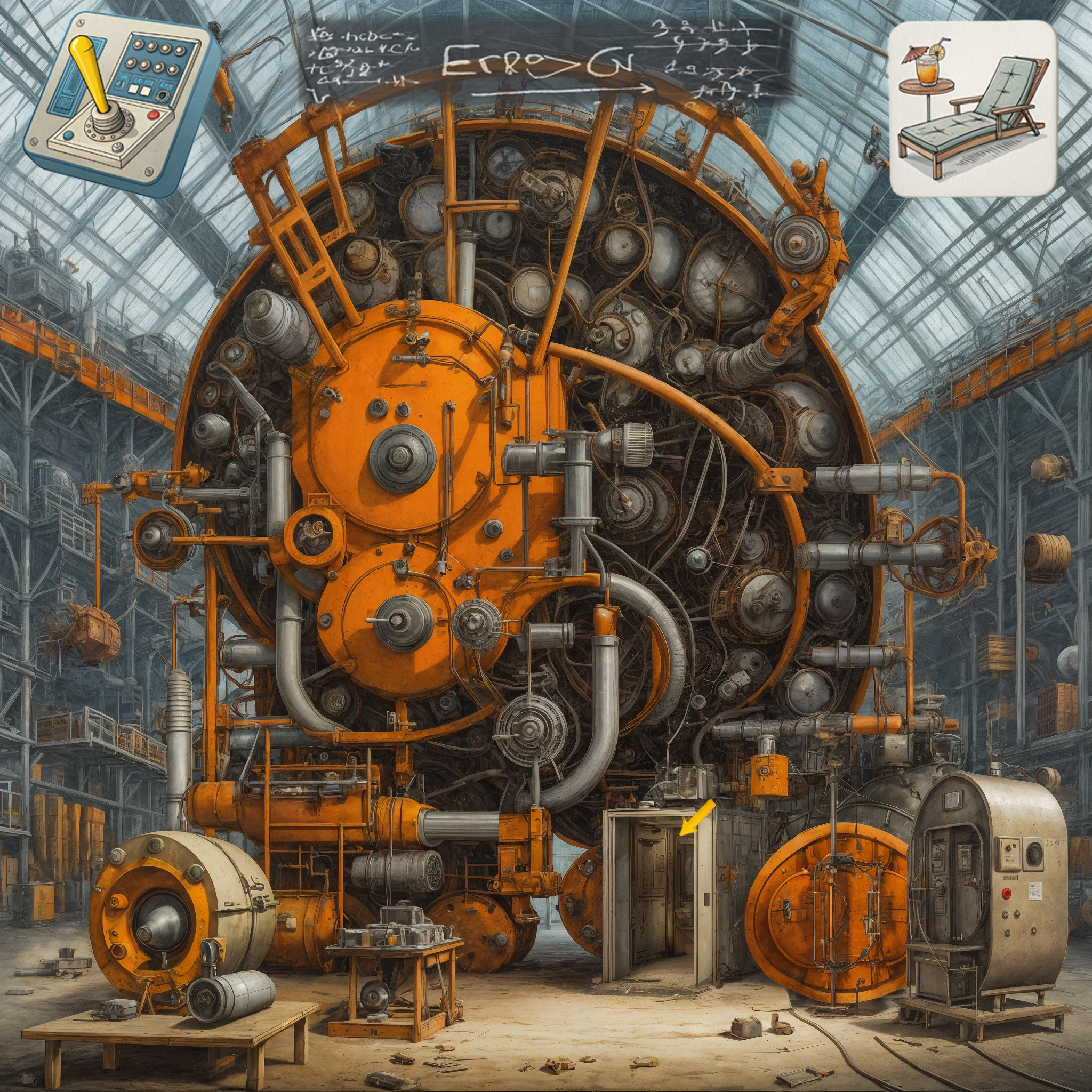
I enter the corridor. Professor Ceril calls the thing a “Leisure Machine,” but to me, it’s once again a towering structure of hallways, chambers, and connecting shafts, filled as always with an unpleasant energy that tingles on my skin and makes my hair crackle.
The professor’s latest theory goes like this: True civilizational progress only happens during leisure time, since that’s when the pressure of career and profit vanishes, and people—presumably inventors like himself—can let their thoughts wander freely and focus on things that actually interest them. This way, fire, the wheel, writing, dental floss, and the snooze button were invented. At least, that’s Ceril’s version.
We need more leisure time—that’s his motto. Not for himself, since he’s already (thanks to my father’s sponsorship) an independent scholar and thus a full-time leisure researcher, but for everyone. By everyone, he doesn’t just mean the population of planet Earth, but all the undiscovered, unnoticed, and unreachable civilizations in the entire galaxy. However, for our neighboring galaxies or the whole universe, he says his machine would have had to be larger than our solar system, reaching all the way out to Neptune’s orbit. That’s obviously unfeasible, hence his atypical self-restriction to the Milky Way—including, not to forget, all parallel Milky Ways in multidimensional quantum reality, which, as we all know, allows every possibility and probability to become real, on whichever of the infinite dimensional planes.
At least, that’s Ceril’s take.
At the end of the corridor, I find a control panel with large, color-coded levers, behind which there’s a busy hum, scrape, and throb. This time, it’s simple: I’m supposed to pull the yellow lever. It will activate a complicated mechanism that—as I gather from the professor’s convoluted explanations—soaks up and eliminates mundane tasks and routine work. These, his (leisure!) research has revealed, consist mostly of a specific kind of subtle elementary particles he calls ergons.
With my hand on the yellow lever, it suddenly hits me that my parents wouldn’t have to work anymore either.
Hmm, that would be bad.
Even now, their scant free time is consumed with grooming their teenage prodigy for a brilliant career as a genius and constantly bossing me around. If they had more free time, things could get pretty annoying for me.
I drop my hand and leave the lever in its starting position.
“Well?” the professor asks enthusiastically as I step out of his machine, relieved not to have gotten lost in the maze of shafts and hallways, or worse, gotten sucked up myself. I nod. As expected, Ceril thinks he can already feel the effects. “Don’t you feel it, too? Aren’t there fewer ergons around us already?” I nod again. “Finally, a desirable form of unemployment and a leisure-based society!” he exclaims excitedly. But a glance at his gauges gives him pause. “Hmm. The concentration is dropping much slower than I calculated.” He looks at me, brow furrowed.
“Couldn’t new ergons be constantly generating?” The professor scratches his chin, pulls the relevant formulas from his index card box, and starts scribbling a mess of numbers and variables onto his graph paper. “Entropy! Darn it! I should have known…” he mutters. Whether it’s ergons or entropy, I don’t care—as long as someone keeps my parents off my back.
(Then my parents suddenly came up with entirely new plans for me, their prodigy, but that’s another story.)
Entropy (video, 5 min): 