168/398
♫ Pathos and the Monologue ♫
168/398

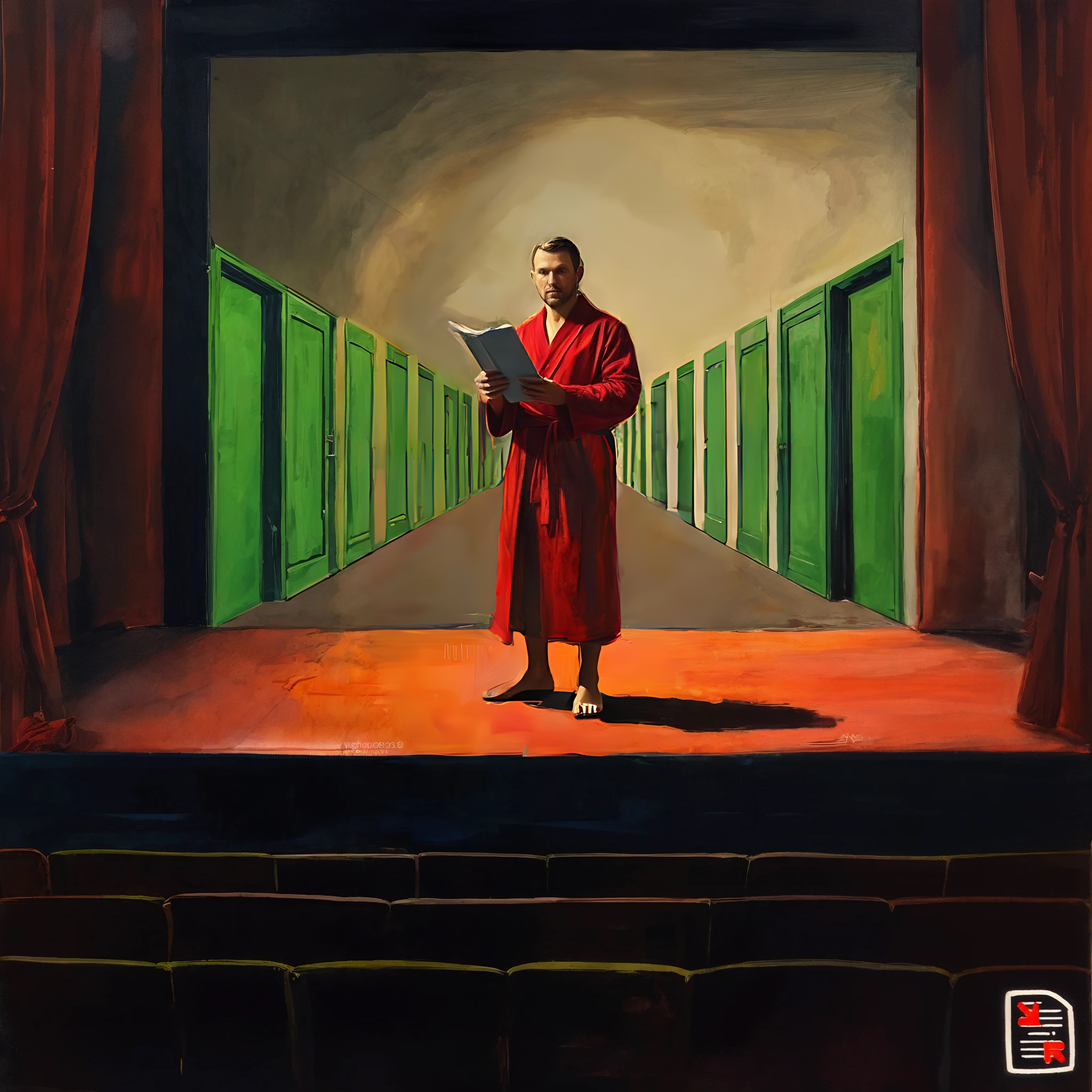
“I enter the corridor from which there is no return”—these are the powerful words that begin my great stage monologue. I stand in front of a door that, to the audience, seems to open onto a long, perhaps even endless corridor, I imagine, and I turn my head back to the other actors on the set. Then I deliver my moving farewell speech, and, in the end, I make my announcement come true and fearlessly enter the dark corridor of no return, the door slams shut behind me, and that will be the last thing that can be seen of me. At least until the final applause.
The play is going to make a splash; I can feel it. Granted, the director seems to have passed his peak, and it is only a small independent theater where we perform. But I can sense the power that the text holds and I am certain tthat we will significantly shake up the current, rather staid theater scene.
It is nothing new, actually: as a patchwork of text fragments from the Theater of the Absurd, it brings authors such as Pirandello, Artaud, Cocteau, Beckett, Ionesco, Sartre, and Camus into dialogue with one another—a remix! To be honest, I still haven’t figured out exactly which play and which dramatist this monologue stems from. But isn’t that ultimately irrelevant?
Finally, I’ll be back on stage! The project does not boast any stars, but relies on skilled second or third-tier actors in order to be convincing with the force of its story. At a boisterous meet-and-greet fueled by plenty of Chablis, the director explained his vision to us. It’s not about whether the Theatre of the Absurd imitates the absurd or, rather, turns what it imitates into the absurd. No, it concerns the definitive myth for our era, the mythical theater of postmodernism, and the only fitting depiction of the human condition: absurdity itself.
On stage, I represent all of humanity—the individual who crosses the point of no return. Confronted with a senseless world, they knowingly and voluntarily choose the path of madness and loss of reality, not without commenting on this with powerful, profoundly existential words that are sure to resonate with the audience. At least that is what my gut feeling tells me. It gives me chills just reading it.
“Forget me!” I shout at the end, or perhaps I’ll just whisper it with fervent passion: “I am lost to your world of feigned order and decency, and what is more, I am a danger to the children and fools who still have eyes and ears and could discover that there is a way behind the scenes you have erected, the Potemkin villages, the beautiful facades and shams with which you inadequately cover up and disguise the maelstrom of meaninglessness. Better if you just forget me, erase me from your memory and your church books, destroy everything that could remind you of me, deny and repress me as thoroughly as you negate the actual essence of being. Root me out, lock, stock, and barrel! I am leaving, and there is nothing left that connects you and me. All bridges behind me are burned. Adieu!”
I believe that the “definitive myth for our era” that the director wants to bring to the stage lies in precisely these words that penetrate deep into the heart of human existence, affect it, stir it up, and perhaps never truly let go of it again. I am proud to be allowed to embody and inhabit this role, and I can feel that this monologue will be the culmination of my professional career, maybe even my life’s work.
Addendum: During rehearsals for the play, the director came to the conclusion that some necessary text cuts had to be made. Ultimately, he retained only the opening words of my grand monologue. I should, he says, incorporate the rest emotionally as I exit the quite minimalist stage setting—without a door, without a corridor—off to the side, with the few but memorable words “I enter the corridor.”
Maelstrom: 