174/398
♫ Queen Puabi (Reigning Cats and Dogs) ♫
174/398


I enter the corridor that connects my house to the boathouse. I haven’t been here in months—first because the lake froze over during the harsh winter, and second because a demanding job for a non-profit organization left me with no time for my private research. Here in the hallway, I’ve set up a narrow table where my notes are spread out next to the cryptic original text and my attempts to reconstruct the game board and pieces.
Years ago, through a lucky coincidence, I came across some yellowed records mentioning a long-lost board game that was apparently quite popular in southern Europe during the Renaissance. It was called “Citadel,” and the text—a letter to a merchant father from his son traveling in distant lands—mentions some of the pieces, though unfortunately only in passing and not to document the game and its rules. The reconstruction is proving difficult. If it is ever to succeed at all.
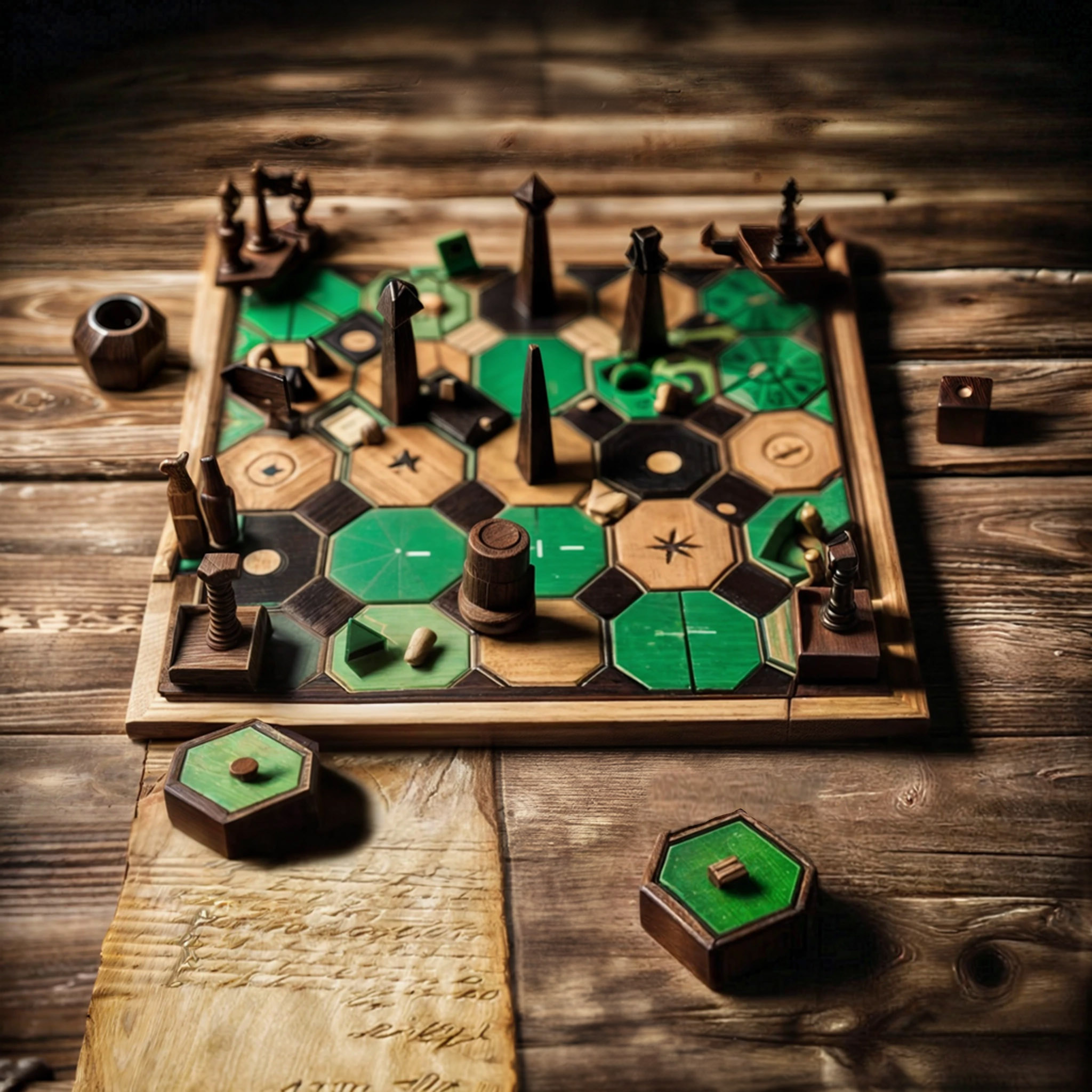
My honeycomb-shaped replica of the game board is sawn from balsa wood. I have colored the spaces alternating brown and green, true to the anonymous author’s notes.
Thoughtfully, I pick up the game pieces I carved. The text speaks of a “sweeping courier,” “catapults,” and a “nimble princess.” The inferior pieces apparently included numerous “vassals,” which—due to my lack of crafting or artistic skills—resemble simple obelisks. The “Throne” and “Scepter” pieces didn’t exactly turn out to be masterpieces, either.
I lose myself in my intricate notes. “Executioner captures jester,” I read. But how? Must there perhaps be a symbolic sentencing by a judge first? Once again, the enigmatic game completely consumes me.
And then, just as I give my tired eyes a good rub, he is sitting across from me: the unknown author, a dapper young man with a mustache and a green velvet beret. With a surprising move, he places his king’s son next to my princess. “Throne and scepter,” he says with a broad smile, before the brief vision vanishes.
That’s it!
Internally, I rejoice, having just taken a massive step forward: “Throne and scepter” in the yellowed letter—that doesn’t describe two more pieces; those are the words that end the game!
I take the small, crude pieces I had carved for the scepter and throne off the board and carelessly let them fall under the table—and with that, the game suddenly comes to life, the moves and strategies become clear, and the rules stand vividly before my eyes. It’s all so obvious. “Throne and scepter!” I shout, dancing through the hallway.
Simplified modern version of Citadel / Zitadelle: 