177/398
♫ Rent-a-Monk ♫
177/398


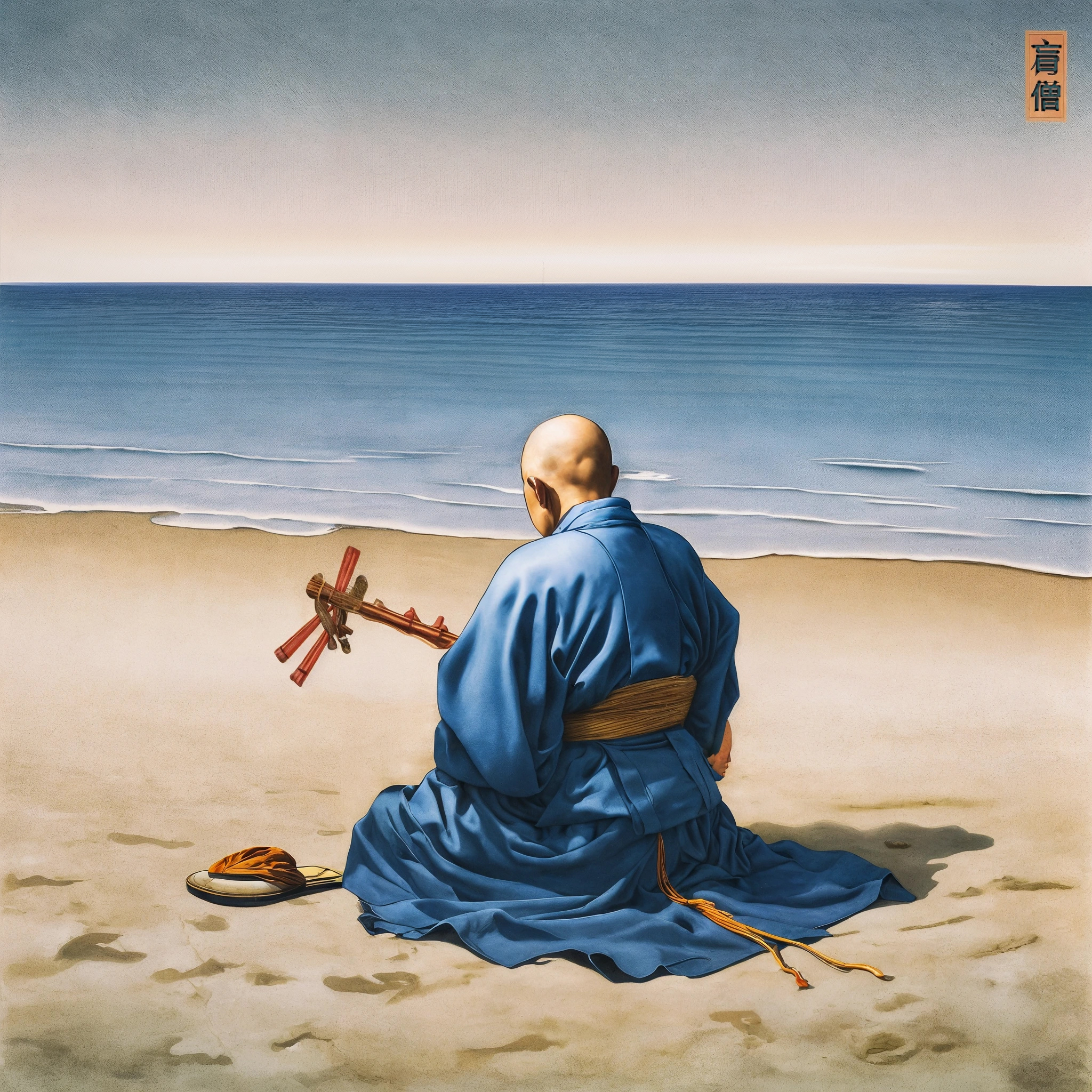
I enter the corridor. Sand—white sand has been blown in. Through it lead strange geometric tracks marked by imprints of rectangular crossbars: a line of primitive Braille consisting of the same repeated letter, etched evanescently into the sand.
The corridor opens onto a beach—the roar of the sea had already signaled this. I follow the tracks eastward, my gaze fixed on the grooved sand and the low-hanging sun.
Now, faint, mournful sounds pierce through the roar of the ocean like the tips of knives through a billowing curtain. A figure is perched by the water, playing a stringed instrument, his face turned toward the horizon-wide ocean.
He is Asian. His head is shaved bald, though the regrowth is already darkening his scalp. The monk wears a blue silk robe and white trousers. Beside him sit his sandals—simple wooden blocks with a loop on top and two wooden slats beneath—the source of the tracks that led me here.
The monk sings, striking the four strings of his lute with a tapered piece of wood.
“It is a biwa,” a voice in my head explains—but it is not a voice. It is more of a déjà vu, a fragment of long-forgotten knowledge.
The monk ceases his playing, as if a noise had pierced his concentration, and turns his head in my direction. He mutters something in Japanese, nodding as if to confirm his own words to himself; then he stands, sets the biwa aside, and bows deeply to me. As he raises his head, I see now that he is blind: his eyes are mute, broken long ago.
Nevertheless, I bow as well and sit down to his left after he begins to tell me a story.
I cannot explain how I am able to understand the moso’s story, as he is speaking Japanese. But somehow the old man’s dry voice touches my heart and paints ink drawings in my mind, so that I grasp everything he tells me.
And so I listen, moved, to the moso’s tale of water, fire, wood, earth, and metal—of a land where people live in harmony with nature and know how to appease the demons—and I am saddened that I can take so little of it back with me into the narrow corridor of my alienated and superficial life.
The sun has long since set by the time the monk resumes his biwa playing and I begin my walk back. Regrettably, the magic of his words and images quickly evaporates; they melt like snowflakes in my open palm the moment the clamor of the city rolls over me again.
Biwa: 