163/398
♫ Love in Times of Blitz and Blithe ♫
163/398


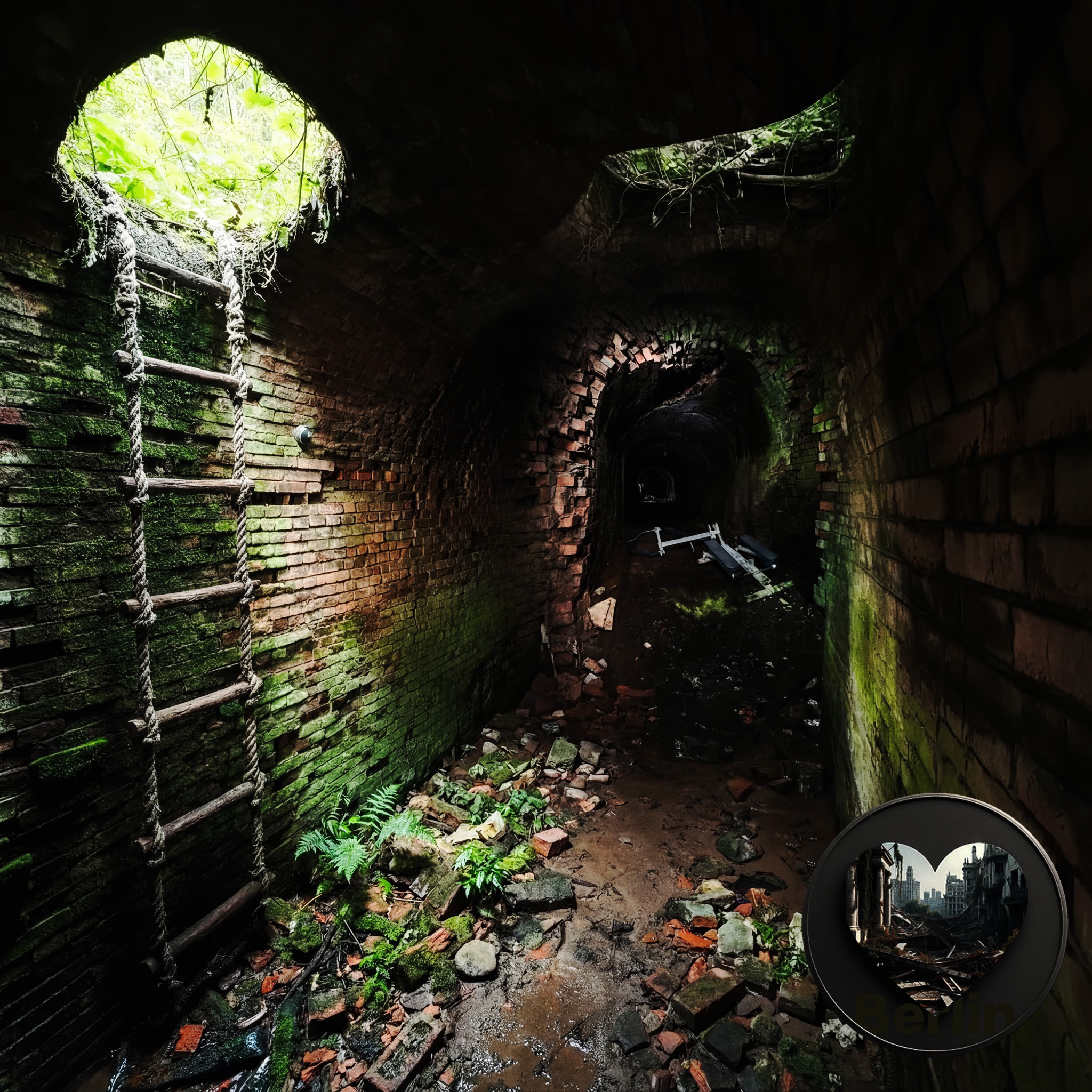
I enter the—corridor might be the wrong word here, since it suggests this passage is intended for human use. Though I wish that were the case, it’s not true of a canal, or more precisely, a sewer. It is a man-sized brick tunnel where other canals converge from both sides—a tunnel network beneath the city.
A deceased human body may decompose in a few weeks or months, depending on external conditions. With the metabolism of a city made of stone, metal, glass, and the artificial materials of its time, it takes centuries or millennia for nature to completely reclaim what humanity had wrested from it.
They call us corpse scavengers—and indeed, we like to compare the object of our investigations to a body, a human body. Since the city has been abandoned for a long time, it is a dead body. In essence, we perform an autopsy akin to pathologists, albeit without investigating the cause of death. That is apparent. We are searching for any viable organs that might remain.
The city’s sewer system, my field of expertise, serves as its excretory organ. No wastewater has flowed through its intestines, hidden deep in the ground, for a long time. That’s why it doesn’t stink here anymore, as some might think, who turn up their noses at my task. I know I’m not exactly well-regarded. But I take my task seriously and do my best.
It’s always the same. After a long march, we suddenly arrive, the whole troop. We encounter no resistance—aside from overgrowth and buildings on the verge of collapse. We noisily invade the otherwise silent city, reach its center, disperse, each assigned to their personal task. A few hours later, we gather again in the main square, and shortly afterward, the dilapidated city lies dead again, as if we had never been there.
A living body requires air and sustenance. Nerve pathways, veins, and a lymphatic system run through it. Food is digested, producing energy used for activities and communication. An immune system and various repair mechanisms fend off foes, resisting decay, wear, and excessive growth for as long as possible.
All this applied to the grand cities as well. In homage to ancient healers who once specialized in the various organs and systems of the human metabolism, we have given ourselves names, nicknames referring to our respective specialties. I am the “Proctologist.”
The old cities are considered cursed places, and that curse clings to us, the corpse observers. We are outcasts, accused of being in league with demons. Therefore, we’re forced to keep to ourselves. At times, we plunder women. Even I am reaching the age where I should start a family. I’ve set my sights on the “Neurologist.” But how can I impress her? I would need to make a significant find, yet what can be discovered in the sewer channels?
We seek unique artifacts, objects whose meaning and purpose are lost to us. From each city, we take only one of these items and, often through perilous routes and great efforts, bring it back to our fortress. There, in the mountain, we’ve established a vast underground museum, where these objects, labeled with the city of origin, are displayed—and no one but us knows about it.
Despite being seen as mere plunderers and cursed with vile names, we are, in truth, custodians, holding great reverence for the dead cities and their former inhabitants—the creators of all the wondrous yet enigmatic devices that our expeditions uncover.
I’ve been walking through the channels for many hours now. It’s time for me to return. My unerring sense of direction is why I’m tasked with traversing the drains and catacombs of the dead cities. I’ve never gotten lost, and even if my torch were to extinguish, I would find my way back.
There! In the flickering light, I spot something I must have missed on the way in. It’s a metal frame with a handle made from the past ones’ artificial materials. It’s black, pliable, and feels surprisingly pleasant, almost how I imagine a woman’s skin feels. I stand the frame upright, its short crossbars holding it steady on the ground—similar to one of those pedal-driven contraptions the past ones used. But it has no wheels or saddle. Even so, it looks like something you could climb on: two platforms, slightly larger than my feet, are fixed side-by-side at the bottom. Apparently, you’re meant to climb on while holding the tall handle. I’m excited; I’ve never seen anything like it. Is it dangerous? Recklessly, I step onto the footboards. My breath catches in my throat with fright: They move—one tilts away, simultaneously pushing the other upwards. The frame creaks. I put my weight on the raised foot, and its platform sinks slowly and heavily, while the other foot rises.
I can walk on it—walk in place! Weird. But a great find. I have no idea what it’s for.
It is heavy. I shoulder it and make my way to our meeting point. It makes me proud to bring something back from my excursions.
Our Elder examines the artifacts. He lingers in front of mine for a long time. Then he gestures for me to demonstrate it. I step onto the platforms and slowly start moving them with my feet, shifting my weight. It creaks as I start walking in place, like I’m climbing stairs. I hear murmurs from the others but only have eyes for the Neurologist, who regards me and the device with astonished glances—and smiles when the Elder makes his choice. She smiles at me! I step off and feel as if I am floating.
Our Elder crafts a small plaque in the dead language and script, which I’m allowed to attach to my find. “Berlin.” We set out. The Neurologist helps me carry the artifact. From the hushed whispers of the others, I realize they’ve noticed whom she’s chosen. The “Proctologist”—who’d have guessed?
In any case, I proudly carry the device with her—the one you can walk in place on. We have a long way to go, but I feel light and full of energy. I’ve found a museum piece… and a companion!