Korridorium

A daily dose of corridors in prose

Tag: thriller

51/398

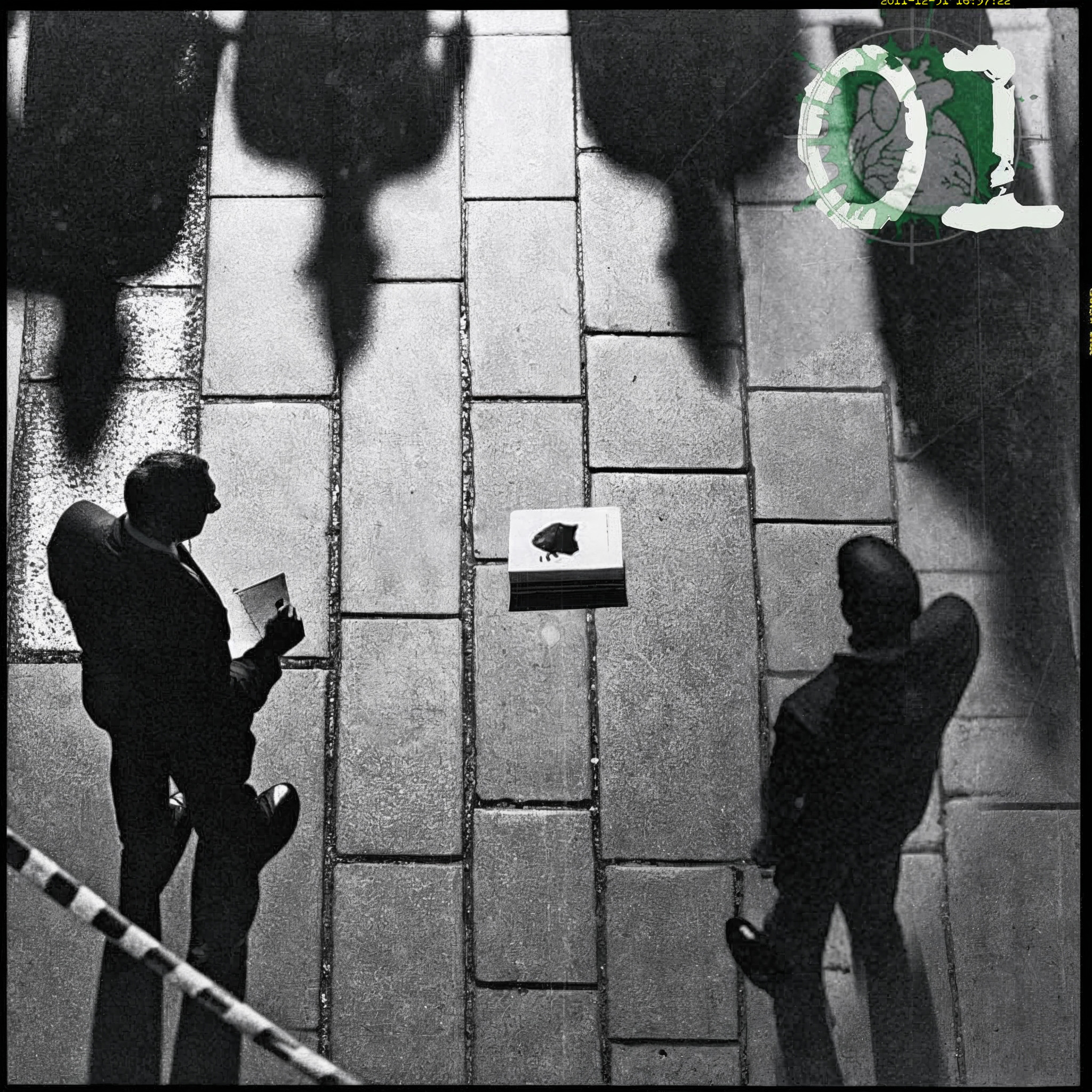
The cover art features a stark black-and-white photograph with a visible cut border. Viewed from above. It shows two men from above, behind a barrier tape on a paved floor with a stack of paper in the center and long shadows falling into the image. An overlay displays the number 01 over the pictogram of a human heart in the crosshairs.

♫ Thundersnow ♫


51/398

LogoSwitch language

I enter the corridor. I’ve never wound up inside the Victory Column before. Probably just a tourist thing anyway. There are none here this time because the homicide squad has cordoned off the whole place. Uwe Albo walks up to me. “I’ve never seen anything like this in my life. Truly nasty. I’m gonna nail that bastard myself, if…” He loses his train of thought. Looks rattled. I help him along: “The guy? Or the woman?” Albo blinks, but quickly realizes I couldn’t possibly know more than he does yet. “No woman would do something like this.” He steps aside for me. The photographer is busy working. His flash illuminates a stack of loose pages topped with a bloody lump of meat. A fresh heart, it seems—most likely human, or Albo and the homicide squad wouldn’t have shown up, and he wouldn’t have called me in so fast. Well, what a great way to end the year. I look around the corridor, but I can’t spot anything psychologically noteworthy.

Later in his office, after waiting for what felt like twenty paper cups of bitter coffee, Detective Albo hands me the pages. The blood has left dark red stains on them. I’m pretty glad the crime lab sealed every single sheet in a plastic sleeve.

“There are fifty of them,” Albo says. He looks especially tired today, as if the dark bags under his eyes have absorbed even more of the world’s suffering. “Numbered sequentially.” He drops into his swivel chair. “That’s all we’ve got. Suspect DNA, fingerprints, footprints: zilch.” I flip through the pages. Typewritten. Short texts. Stories. No confession letter, by the looks of it. No love letters, either. “The heart?” I ask.

Albo reaches for his phone as if it just vibrated. But he must have been mistaken; he slips it away with a barely noticeable shake of his head. “The heart, yeah. The victim is male, judging by the blood. No sign of the rest of him.”

I stand up and wave the stack of pages: “I’ll take a closer look at these at home.” Albo stares at me like I’ve just opened my jacket to show him a suicide belt. “You can’t take those! Have you lost your mind? That’s crucial evidence.” I take three steps to the copier and lift the lid. The document feeder won’t do me any good here with the plastic around the pages. Albo looks like he wants to protest. A green glow sweeps beneath the glass. Can a copier light destroy forensic evidence? Albo seems to decide that’s pretty unlikely. He slumps back into his chair. He must have known right away that we’re dealing with a sick mind. Otherwise, I wouldn’t be here.

I place the second sheet on the glass. On the first page I set aside, there’s a lot of dried blood that left ugly black continents on the copy, like inkblots in a Rorschach test. The stains pool around the text numbered 1 on the page. It’s just a single sentence. It reads: “I enter the corridor …“
55/398

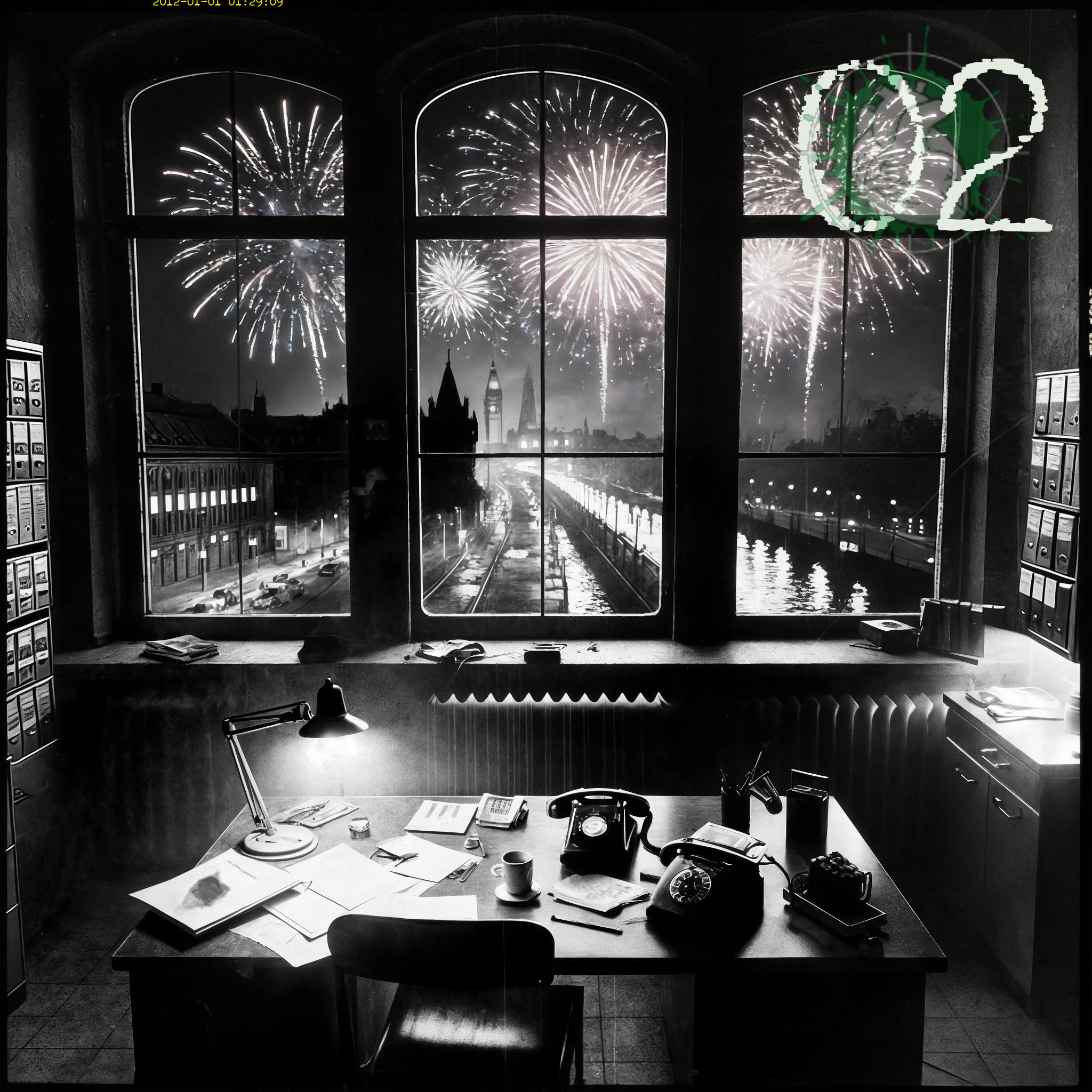
The cover art features a stark black-and-white photograph with a visible cut border. It shows a view from an office with a desk, phones, and papers onto a city with fireworks over a river at night.

♫ Under the Throne ♫


55/398

LogoSwitch language

I enter the corridor. The neon tube flickers. Albo’s office door is slightly ajar. “Come in,” he calls, “Happy New Year!” He sits partially bathed in the pool of light from his desk lamp. The rest of the room remains in darkness. Outside, a few belated fireworks go off. It’s long past midnight.

“Happy New Year!” I reply, although the gruesome discovery from earlier today hasn’t exactly put me in a festive mood.

“So?” he asks. I know what he wants from me. Albo needs to catch a killer, and I’m supposed to help him do it. I head for the coffee machine first. Its red power light guides my way. A bad habit, but definitely better than immediately reaching for the hard liquor.

It seems Albo is ringing in the New Year with coffee, too. I notice he’s made copies of the fifty pages as well. He’s probably read them as many times as I have over the past few hours. They would’ve made decent New Year’s reading if a human heart hadn’t been sitting on top of them.

Albo’s head stays in the shadows. Maybe that’s for the best. I sit down across from him. “All typed. On a typewriter, I mean. And different typewriters, judging by the font.”

“Fifty different typewriters. I already had it checked out. There’s an eBay account, SpellingErrors68, that bought fifty old typewriters a few months ago and then deactivated the account. We reached out to eBay and the sellers—nothing useful so far, at least not what we could dig up on a holiday. Looks like he covered his tracks thoroughly.”

“SpellingError?”

“Yeah, there are tons of accounts with names like that. Why?”

“Because he doesn’t make any.”

“If you think that’s a contradiction, it’s just one of many, isn’t it?” Albo places his palm flat on the copies with spread fingers, as if laying a curse on them. “Sometimes a man, sometimes a woman, sometimes old, sometimes young, playing dumb one minute, playing smart the next…”

“Who says the killer wrote them?”

Albo pulls his hand back. “The opening. Always the same. A corridor. Remember where we found the cut-out heart? In a corridor.”

“Hardly proof,” I say. “And besides, who says it was written by a single person? Could be multiple people.”

Albo leans forward, dipping his stubbly chin into the pool of light. “Come on, man,” he says, “I need results, clues, leads, something!”

I crumple the empty paper cup and toss it toward where the trash can usually sits in daylight.

Albo gestures with his hands. “Is it a madman? An unrecognized artist? A literature teacher? Someone whose texts were stolen, seeking bloody revenge? Believing it will get him on the front page of the local tabloids? You’re the profiler, so tell me.”

“If it’s an author, and if he’s a male author – which I think is both likely – then he’s someone who likes to juggle with possibilities. And who apparently likes to play hide-and-seek.”

“What does that mean?” Albo rumbles, as he did in his prime. “That he wants us to chase him? That this guy sees murder as a game?”

I purse my lips and shake my head. Albo probably can’t see me any better than I can see him. But I need it for myself. Making clear statements here means venturing far out onto thin ice. “A game, yes. Or a kind of puzzle course through corridors. There’s mention of around four hundred texts in total: if we’re unlucky, it will continue.”

“We’ll prevent that. That’s why I need some clues!”

“What do you want to hear? That he’s educated, probably has a degree, is well-versed in the new German spelling, has a broad range of interests, including fairy tales, myth, history and science fiction possesses a dry sense of humor, seems to consider himself a poet or ‘short prose writer,’ gravitates toward word play and existential tirades, and has an obsession with corridors? That he’s forty-three years old?”

“Forty-three? Does he write that?”

“Just a hunch, because of ‘SpellingErrors68’—he might’ve used his birth year. A lot of people do.”

Albo leans forward again, this time to make sure I see him smile. “Well, that’s something. We’re narrowing it down. What about the woman he writes about at the start?”

“Could be a tragic love story. She turns up later as an anagram—I just hope the ‘chosen one‹’ hasn’t been missing her heart since yesterday.”

Albo grunts. “The victim was male.”

“Right, yeah. Maybe text number 50 gives us a lead.”

Albo rummages through the copies until he finds the right one: “The therapist?”

“Yup. That could be something: trauma, nightmares, therapy. And the bloody heart could be a manifesto. Or a cry for help.”

“So I should have all the female trauma therapists in Berlin checked to see if they’ve got someone with a corridor obsession on their couch…”

“I’d actually check the male therapists instead. Everything in these texts is twisted.”

Albo holds out one of the copies. “Who’s R. L. St.?”

I stand up and walk over to the window. Rain is falling, making the streetlights outside the station look even gloomier than usual. At least from here I can spot two shimmering reflections in the dark hole where Albo’s head must be. “Robert Louis Stevenson. Wrote Jekyll and Hyde, inspired by hallucinated little men.”

“Jekyll and Hyde. Great, this oughta be fun,” he grunts.

“I need more time, Uwe,” I say. Albo mutters something I take as grudging agreement. I leave him alone. The new year is a few hours old now, and as I step out into the night, the rain stops, as if someone had suddenly placed a hand over the city.

68/398

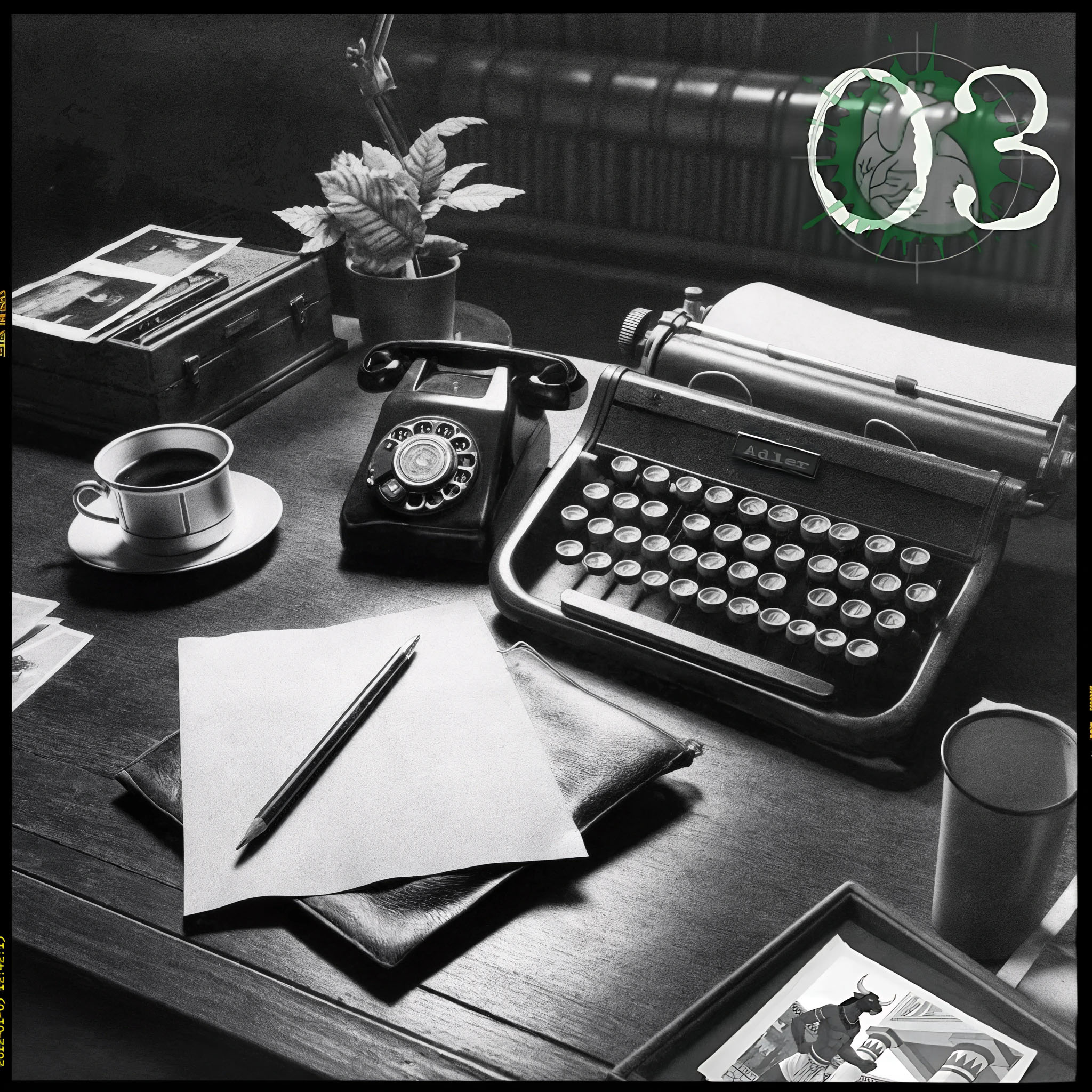
The cover art shows a black-and-white photograph of a desk with an Adler brand typewriter, an old rotary dial telephone, a cup of coffee, a small potted plant, a pen on paper, and a framed picture showing a human-like figure with a bull's head.

♫ Wimmelbild ♫


68/398

LogoSwitch language

I enter the corridor at the police station. Even from here, I can hear Albo yelling. He seems to be in a foul mood. No surprise there. When he sees me, he shoos the rookies out of the office. Even pulls up a chair for me. Never does that, the detective.

“Find anything?” His voice is hoarse. He nods towards the copies with the bloodstain that fades down to document number 10. “The team here says he’s a cannibal and ate everything but the heart.”

I help myself to a coffee. “They must mean text number 15, the ‘man-eater.’ It’s a literary allusion to the Minotaur myth. Unlikely that he identifies with it that way.”

Albo sits on the desk and rubs his right thigh. “But there’s no body. And no missing person report that fits. He cut the heart out with a knife that, the experts say, ‘was neither particularly sharp nor particularly dull.’ Great! Got anything else for me?”

“It’s all pretty vague. Based on the texts, I’d guess he’s single, a loner, doesn’t like being around people.”

“The thing about Mount Olympus?”

“Yeah. But also the one about the hippies. And he’s got a grudge against government institutions and bureaucracy. Number 42, with the promised bloodbath…”

“Could just be he’s having trouble with his tax office. This is all garbage, man. I’ll spell it out for the dummies: What am I supposed to be searching for? And don’t tell me some young female clerk at the building department named Cory d’Or!”

“That’s just one of many false leads, sure. Although…”

Albo shifts to get comfortable and knocks a pencil sharpener off the desk. He groans as he bends down. “Although what?”

“There’s a decent chance his real name actually is Cory. It’s a man’s name, too.”

Albo reaches out with extended fingertips, but the sharpener just slides further under the desk.

“Text number 8, with cavity, horn, and boiling basin, and so on,” I add.

“Yeah?” He gives up, drops back into his swivel chair, and looks at me expectantly.

“All possible etymological origins of the name ‘Cory.’ And unless he happens to be a linguist—which I can’t entirely rule out—only someone with that name would know that.”

Albo rubs his stubble. “I’ll have it checked out. A thin lead and a slim chance, but I’ll check it. Can’t be that many Corys in Berlin and the surrounding area.”

“And one more thing, Uwe.” Albo drops his hand. “I’ve been thinking we should publish some of the texts. With a note making it clear we’re looking for the author.”

“And you don’t think that might be exactly what he wants?”

I expected that question. “Yeah, could be. But we’ll only publish excerpts, and we’ll slip in a few typos. Enough to make him see red. What do you think? Maybe someone recognizes the texts. Or the style, or an allusion.”

“That’s all you’ve got? What if he feels provoked? I don’t want to find a liver somewhere tomorrow, or a lung, excised with a knife that’s not too dull and not too sharp.”

I point to the copies. “I’ve squeezed them dry. The whole thing is a shell game designed to lead us by the nose. I can’t just point a finger at someone and say, ‘That’s him, he wrote them, you’ll find fifty typewriters in his garage and the bloody knife in his kitchen cabinet.'”

Albo sways his head back and forth. We’ve known each other for so many years—every now and then he’d consult me, his old psychologist friend, on tricky murder cases. But despite the useful insights I could offer from time to time, he should know I can’t work miracles. He lowers his voice, leaving no doubt that what comes next is important. “I want a written profile, as precise as possible, clear? One that says he isn’t a cannibal, but an intellectual who enjoys cruel games. Who might be named Cory, which gave him a trauma that turned into an obsession with corridors. Got it?!”

“That’s pretty much all I have, though.”

“Write it down. I need it for admin. If you happen to think of anything useful while doing it, let me know. And as for publishing the stuff—I’ll think about it.”

101/398

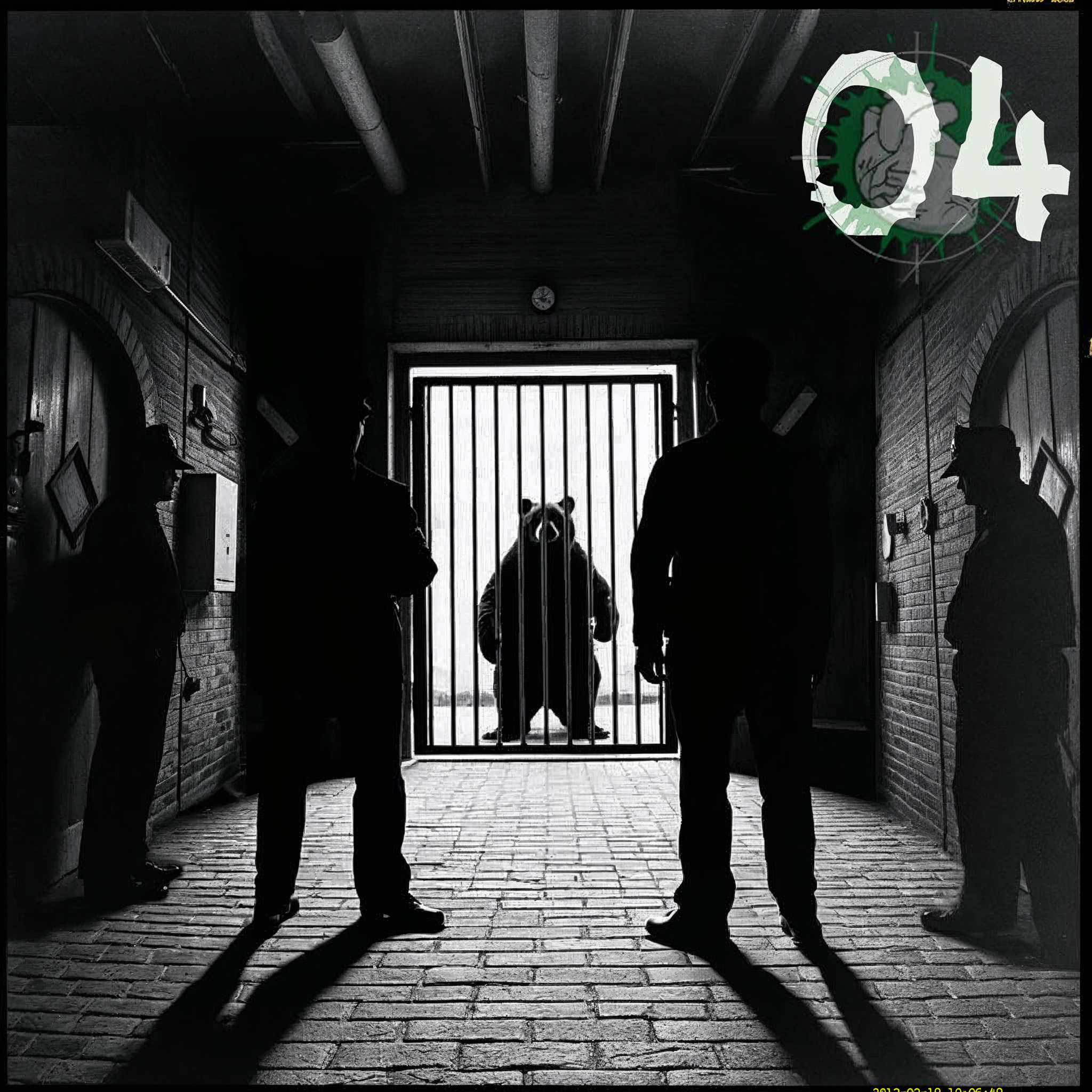
The cover art displays a black and white photograph: Four individuals dressed in dark attire are positioned in a hallway with brick walls, standing before a bear cage. Behind this bars, a bear figure stands upright. An overlay presents the number 04 above a pictogram of a human heart within a crosshair.

♫ Shiver Policy ♫


101/398

LogoSwitch language

I enter the corridor. It reeks horribly of a zoo enclosure—no surprise, considering I’m in a bear pit. The two residents, Maxi and Schnute, have been locked in the other side to give the homicide squad access.

“The bears didn’t touch it. They actually recoiled from it, according to the keeper,” Uwe Albo greets me, wearing his usual ill-fitting suit, his face deeply lined with worry. Here, the bears can step outside on two sides to be admired by visitors, right in the middle of Berlin in a small park between the Embassy of Angola and the German Psychologists’ Publishing House. The corridor inside the small bear quarters, situated between the two fenced outdoor areas surrounded by blue-tiled moats, sits in gloom.

“Another heart,” Albo says. He sounds exhausted. “And another fifty pages.”

“Déjà vu,” I say. My stomach turns. This was supposed to be a relaxing long weekend.

Later, the detective paces his office diagonally in suppressed rage, back and forth, from the door to the coffee machine, from the coffee machine to the door. And back again. Tomorrow, Carnival Monday parades will wind through German cities. But the Berlin homicide squad won’t have any reason to celebrate or throw candy. “Now we’ve got two victims. And a serial killer we know nothing about, except that he’s sent us a hundred damn messages we can’t make heads or tails of.”

That’s directed at me. I’ve only been able to skim through the new texts so far. To have something to say, I respond with a counter-question – an old psychologist’s trick: “Why first the Siegessäule and then the Bärenzwinger? Berlin landmarks. He’s trying to signal something.”

Albo grabs the open door frame. “You tell me.” He gets interrupted, stepping out of the room to talk to an officer. Somehow, I already have a hunch what the news will be.

And sure enough: “No usable evidence. The guy probably just climbed into the enclosure at night. Must have a death wish. Or he knows his way around bears. And the pages: another fifty typewriters. The exact same fifty typewriters. In the exact same order.”

I picture a simultaneous chess player stepping from table to table, making one move on each. Fifty tables, fifty chessboards, fifty games. Advancing one move at a time. I don’t mention any of this to Albo. Bad timing. He’s tired and angry—a wounded bear that doesn’t know why everyone is hounding him or where to take cover.

Work is waiting for me. Reading. Thinking. Following leads. Connecting the dots. I figure it’s time to make myself scarce.

105/398

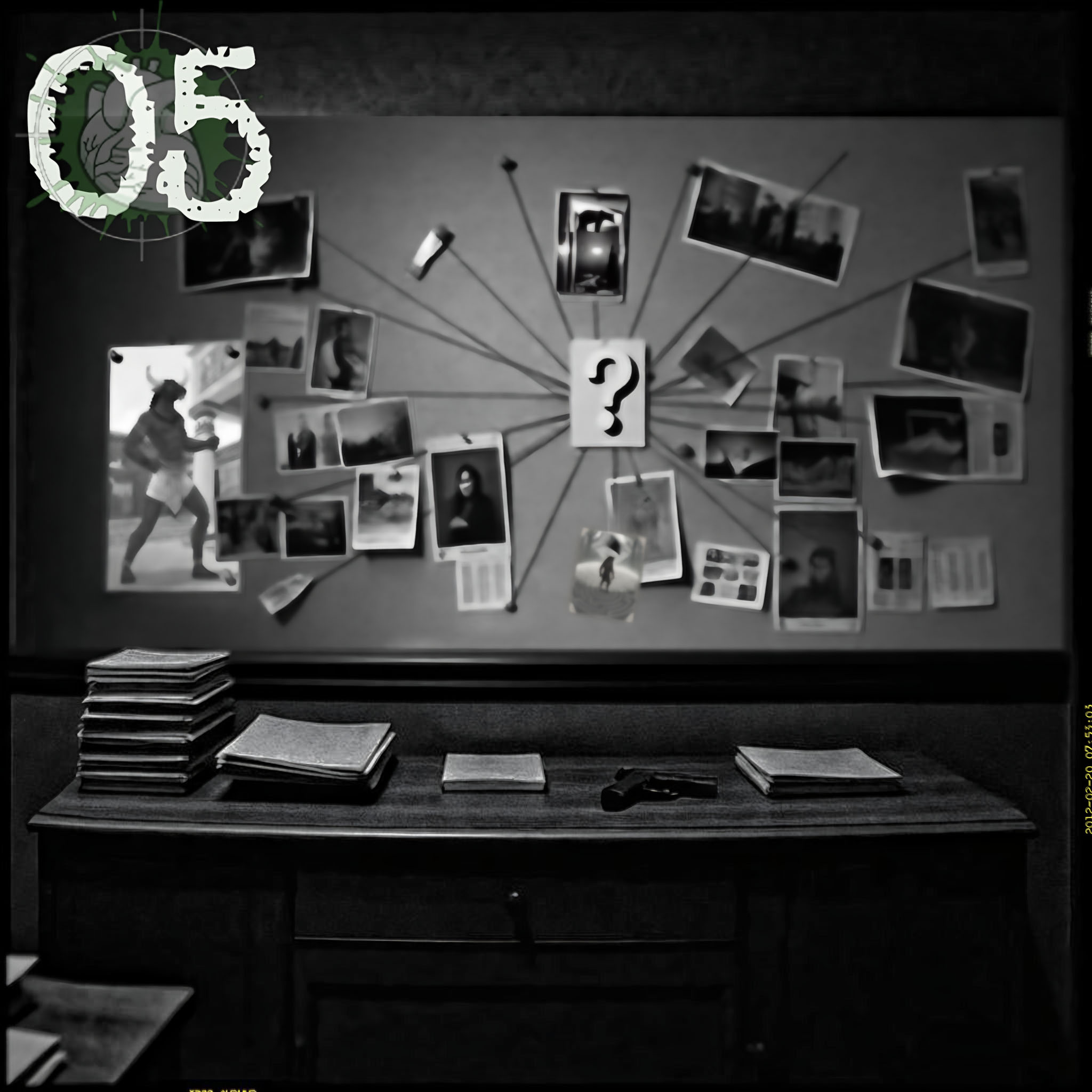
The cover art shows a black-and-white photo of an investigation board with pinned-up photos connected by threads, and a question mark in the middle. The board hangs over a desk with files and a pistol. An overlay in the upper corner shows the number 05 above the pictogram of a human heart in crosshairs.

♫ Insomnia ob omnia ♫


105/398

LogoSwitch language

I enter the corridor. It’s suspiciously quiet behind the door to the detective’s office. I knock—something I never do. A kind of groan is my answer: Albo grunts as he pushes himself up from his swivel chair, looking disoriented. “What time is it?”

“Too early, by the looks of it. Uwe, did you crash here?” Albo massages one of his legs, which seems to have fallen asleep, too. “I need to hit the washroom for a second.” He limps out of the room.

While he’s gone, I take another look at the copies of the messages left by the killer. I’ve already spent the whole night poring over them. Albo usually sits in his office at the crack of dawn, so I thought it’d be a good chance to see if the cops have anything new.

Albo comes back, hair wet and water splattered across his shirt. Doesn’t look like he keeps a razor here at the station.

“Number 73” he says, aimlessly flipping through his copies without finding the one he’s looking for, “is a joke, right?”

The coffee tastes even more bitter than usual in the early morning. I set the paper cup on Albo’s desk. He looks like he needs it. “The one about ‘joy everywhere’? He’s making fun of us. But I think we can pin him down this time.”

“Out with it,” Albo prompts as he drops into his chair, which almost rolls right out from under his ass.

“I had the impression from the start that this guy suffers from obsessive-compulsive disorder. Text number 95 speaks volumes. Plus we’ve got a childhood trauma, a schizoid story with death threats, and the dead-end situation.”

“Number 54, you mean? That one’s too old. He worked his way past that a long time ago. Don’t forget, he used the exact same typewriters in the exact same order.” Albo takes a sip from the cup I put in front of him and coughs.

“He could’ve used them backward or scrambled them up. But you’re right, Uwe, he won’t be stopped that easily.”

“Schizo, you say? The one with the mirror-self.”

“That’s where he plants a bomb.”

“His Islamist suicide bomber wants to blow everything sky-high, too. So why does the guy kill with a knife himself…?” Albo’s voice trails off. His thoughts are already somewhere else—or maybe it’s just the sleep deprivation catching up to him.

“You should go home and hit the sack, Uwe. You look terrible.”

“Thanks, same to you,” he retorts. “And don’t show your face back here until you’ve got something useful.” His phone rings. With a sharp, shooing wave of his hand, he kicks me out. Before I leave, I study the walls. We should put up one of those huge corkboards somewhere, like in American movies where they pin up all their evidence and connections. We’d leave the middle blank, and gradually, the image of the suspect would take shape right there. What was it again? Cory means “cavity“?

I decide to take my own advice, cancel all my morning appointments, and crawl back into bed.

120/398

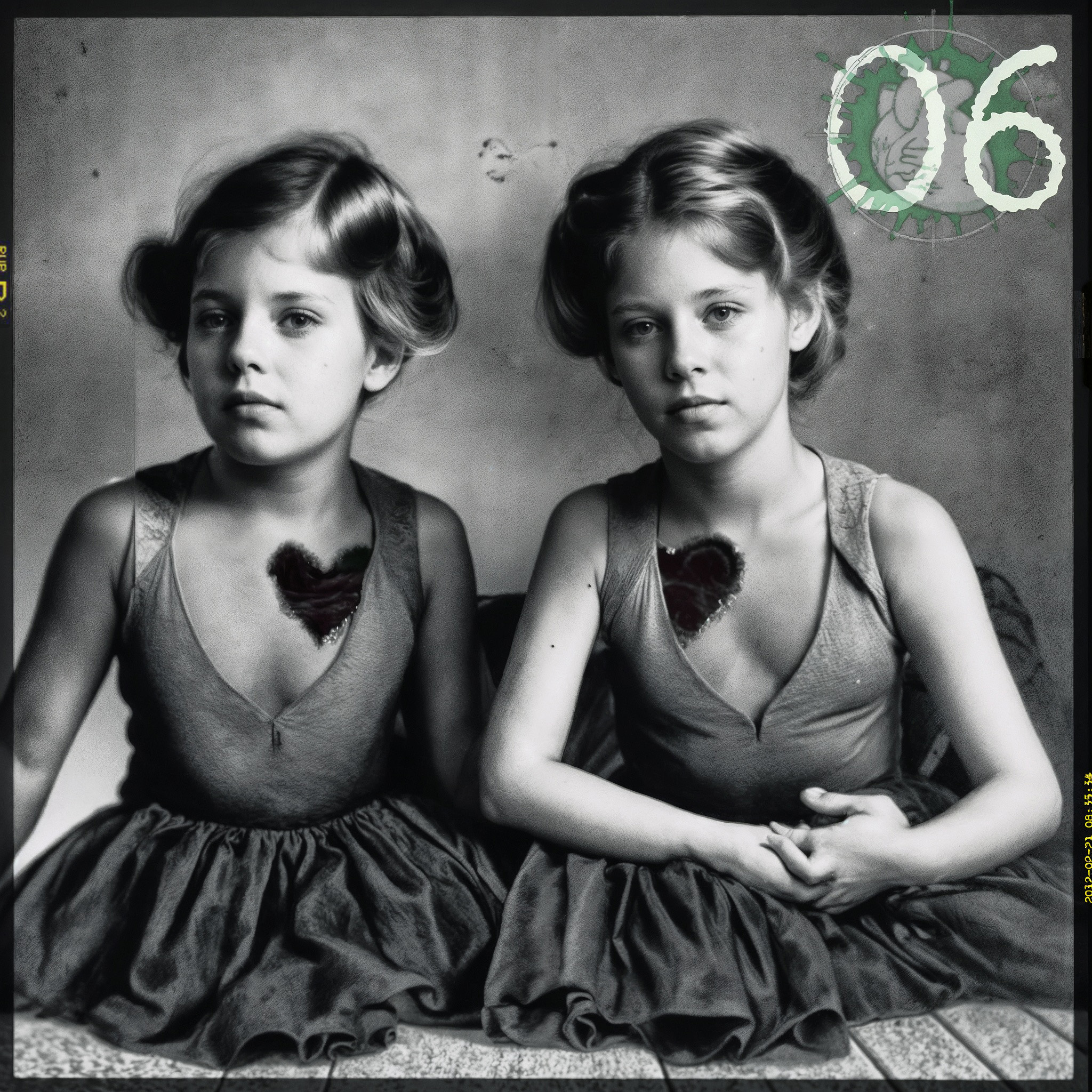
The title image shows a black-and-white photo with two girls in sleeveless dresses standing next to each other in front of a wall. Both have a large, heart-shaped hole in their chests. An upper-corner overlay displays the number 06 over the pictogram of a human heart in the crosshairs.

♫ Don’t Wake the Ferryman ♫


120/398

LogoSwitch language

I enter the corridor, and judging by the smell, one of the officers tracked in dog shit. Or is that me? I check my soles: not exactly clean, but visibly nothing that could stink this atrociously.

In Albo’s office, it smells like coffee as usual.

“They were twins,” Albo says the moment he sees me. Without me being able to stop it, a movie starts playing in my head. I see the Kessler Twins standing before me, each gripping a butcher knife. Ellen says, We want your heart. And Alice says, It’s for the sake of poetry, sorry.

“The deceased,” Albo adds, “share the exact same DNA. Unless it was the same heart twice, they were identical twins.”

Ah, not the killers! The victims! The scene shifts in a flash. Ellen says, I didn’t want to die at all. And Alice: It had to be done. Both have holes in their chests.

I have to sit down.

Why would that bastard cut the hearts out of a pair of twins? And fifty days apart to the day? What the hell is waiting for us when another fifty days run out?

“Well? You got something for me, too?” Albo looks like he just spent a sunny afternoon in the garden of his country cottage. Or like he actually got a full night’s sleep for once. Does he know something? Has he been holding out on me?

“What about the twins? Are you gonna find them?” Albo lets out his signature dry laugh: “There are way too many out there. And they don’t even have to be local. The hearts had been removed twelve to sixteen hours before they were found each time. If he kept them cold, he could’ve stretched that by a few more hours.”

“So why the good mood, Uwe?” I ask. Why waste time guessing when I can press him on the sore spot?

“Because you’re about to tell me who the hell I should be looking for.”

Bad start. I’ve never handled high expectations well. Back in school, it used to make me stutter. Let’s see if I’ve learned anything since then. “Maybe the simulation angle gets us somewhere.”

“The thing with the simulated patients? Yeah, they really exist. Over a hundred of them. But nobody with that exact set of symptoms. Besides, we’re looking for a man.”

“The killer could be one of the med students. Or one of the professors.”

Albo purses his lips and offers a subtle shake of his head. Leave that to the pros, he’s telling me. But I’m not giving up that easily. “If he’s simulating being a standardized patient—maybe the murders are simulated, too. Maybe the whole thing is just one big simulation to him.”

“Simulation of what? And what the hell is a simulated murder?”

“One that only looks like a murder. Nothing in those texts is real, either.”

Albo grunts in disgust. “Except the hearts. Those are real. He carved them out of some twins, and that’s where the simulation ends, doesn’t it? No matter what he writes in those pages. Murder is murder—he can’t write that off his conscience.”

He’s getting worked up. Best not to push that angle any further. Luckily, I’ve got something else—something he definitely hasn’t figured out yet. “The Trickster.”

“Mm-hmm. Number 85 with the go-go dancers. I knew there was more to that one.”

“Those velvet pillows they’re serving things on.” Albo leans forward, intrigued. “I figured out what the colors mean. There’s a specific sequence.”

Albo rummages through his copies: “A rainbow?”

“Hardly. It’s a sequence of developmental stages from a specific sociological theory. It spans all of human history from its inception to the present day. And right on into the future. A kind of open-ended Richter scale for human evolution.”

Albo furrows his brow. That’s probably not what he was hoping to hear.

“Tribal societies, kingdoms, democracies,” I lecture. “And it keeps going. Don’t you get it? He thinks he’s superior to you and me. He thinks he’s evolved beyond all of it: bureaucracy, the social contract, morality…”

I let that sink in. I can see the wheels turning in Albo’s head. Then: “And he wants to prove that to us? That the laws of civilization don’t apply to him?” Albo can’t stay seated anymore. He springs up and walks over to the window, staring out, thinking it through. “How does that help us, though?”

I was waiting for that. “This stage-and-color theory is pretty en vogue among a very specific crowd. Free spirits who think their philosophy is going to save the world. There’s a scene—the ‘integral scene.’ Small, but tight-knit. Centered right here in Berlin.”

Albo turns back toward me. “Berlin intellectuals. Right. And one of them went off the deep end. Thinks he’s…” He can’t find the right word. Before I can chime in, Albo already has the phone receiver in his hand. “I’ll have it checked out. ‘Integral scene,’ you say?” And when he sees me nod: “Infiltrate them. Can’t hurt. Ask around, see if anyone’s noticed a megalomaniac nutcase in their ranks.”

I start to protest, but Albo shuts me down before I can resist. “You used to want to save the world as a free spirit yourself. And what’s the saying? Takes a philosopher to catch a philosopher.”

148/398

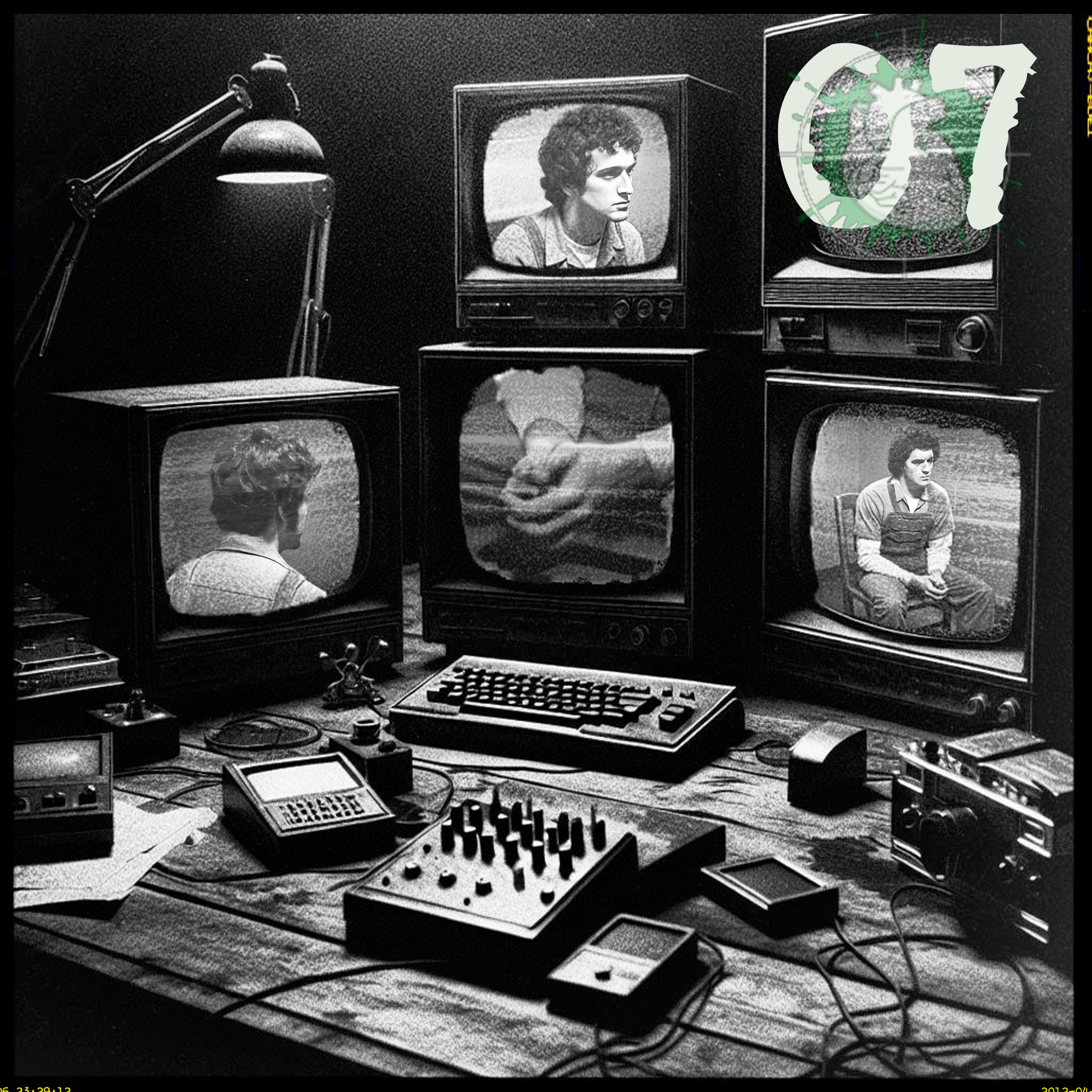
The cover art features a stark black-and-white photograph with a visible cut border. It shows a desk with multiple old-fashioned televisions or surveillance monitors stacked on top of each other. They show, from different perspectives, a man sitting on a chair. An upper-corner overlay displays the number 07 over the pictogram of a human heart in the crosshairs.

♫ Before the Ritual ♫


148/398

LogoSwitch language

I enter the corridor. A uniformed officer I’ve never seen around here before steps up to me. “I’m here to see Albo,” I say, and follow him down the hallway until he knocks on a door.

Inside, the detective sits in front of several monitors showing the interrogation room. Sitting alone at a plain wooden table in there is a man. He’s wearing handcuffs with his hands flat on the table.

“We got him,” Albo says, looking up at me. “And I definitely want you in that room with me for the interrogation.”

Maybe it would’ve been nice to hear an apology first for dragging me out to precinct headquarters in the middle of the night. But that’s just not Albo’s style. His call yanked me out of a dead sleep, and I still feel seasick, like the world is wrapped in cotton wool.

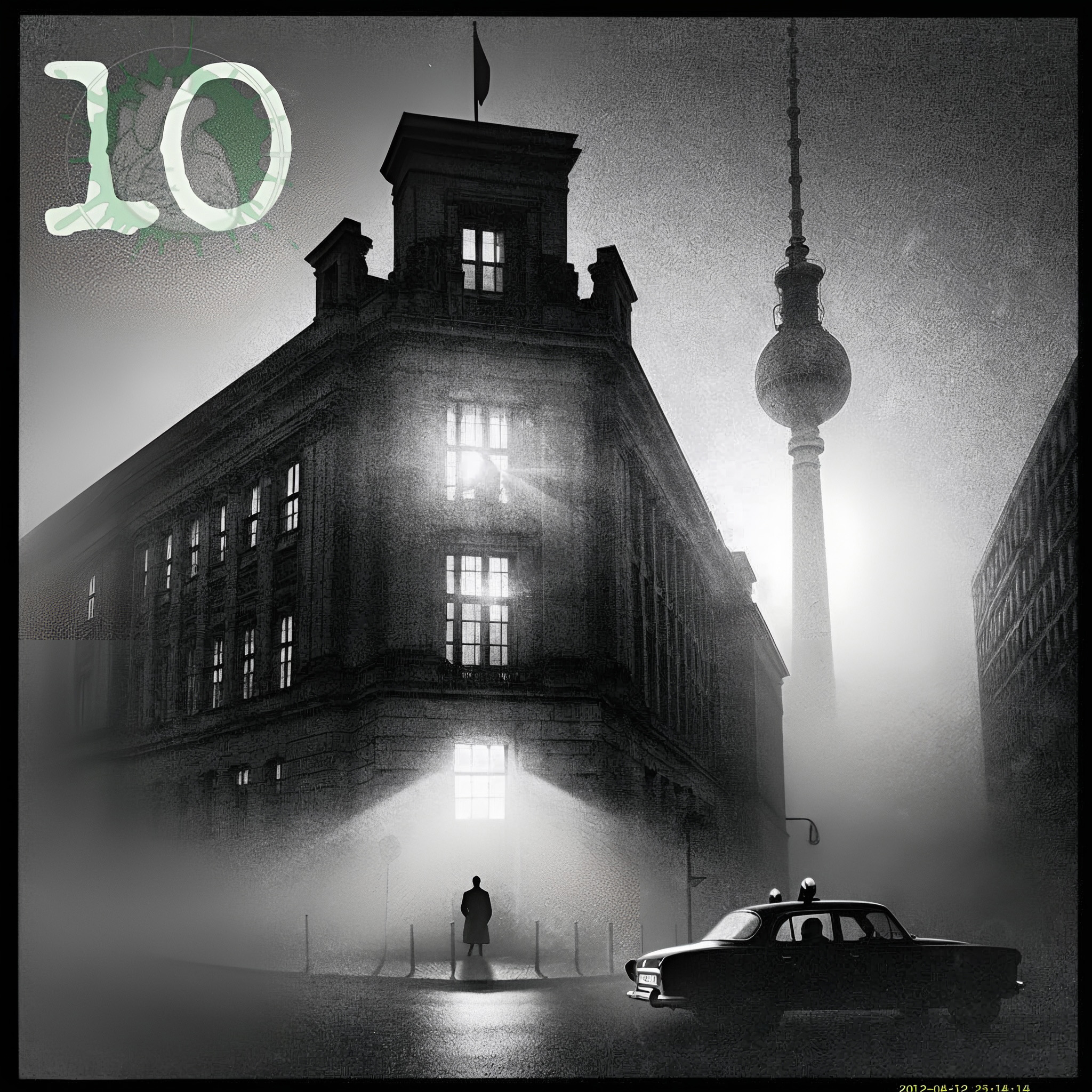
“He tried to break into the Alex. The TV tower,” he adds unnecessarily.

“Was he trying to… put another heart in a corridor up there?”

It’s a young guy with messy blonde hair. I can see dried blue paint on his hands and coveralls.

Albo scratches his eyebrow and shakes his head. “He disguised himself as a painter, complete with overalls and a paint bucket, but he got busted when he tried to head up the emergency stairs.”

“So, no heart,” I say with relief. “What about texts?”

“Zip,” Albo says. “That would’ve been too early anyway. He just wanted to scout out the next corridor. I’ve had my guys step up patrols around the city’s major landmarks the last night or two.”

“Did he say anything? Confess?” I try to size up the guy on the monitor. His eyes seem to be staring into nothingness, though the camera feed might be deceiving. He’s young. Way too young, really. Wet behind the ears.

“Can’t get a word out of him,” Albo says, though he still looks a little proud and relieved. He gives me a jovial punch on the thigh. “I’m hoping you can crack him for me. Before I have to resort to my own methods.”

“And what if he’s not the guy?” I ask.

Albo shifts restlessly on his stool. “What else would he be doing at the Alex?”

“Suicide,” I say. “A bet with his buddies, a grand gesture for his girlfriend…”

Albo dismisses it with a wave of his hand.

I don’t drop it. “I seriously doubt the guy knows what the Many-Worlds Interpretation is.”

“Many-Worlds Interpretation?” Albo asks.

“Text number 63” I say. “And I doubt he knows how to spell ‘Megalithic cultures,’ number 97, or…”

Albo stands up. “How about you figure out how we get a confession out of him instead!”

“Uwe, man, face facts: this isn’t the guy we’re looking for. But if your team finds fifty typewriters in his apartment, call me—even in the middle of the night—and I’ll crawl back here on my knees and apologize to you.” Sometimes you have to wave a fence post in Albo’s face—or better yet, hit him over the head with it—for him to realize he’s barked up the wrong tree.

He visibly deflates. “I was so sure.”

“You’re overworked. If I can give you a piece of friendly advice: take a few days off, head out to the cottage by the lake, sit in the sun, and stare holes into thin air.”

Albo gives a sour smile.

“I’m sorry,” he says, and I can tell the words are practically being dragged out of him, “for dragging you out of bed. I was a bit quick on the trigger, I guess. Coffee?”

I shake my head. “Come on then,” he says, “I’ll drive you home.” I know how that goes. Screaming through red lights with the siren blaring. Never again. I’d rather call a cab.

The cab takes its time getting here, so I pop into the painter’s room after all.

“Hey,” I say, not waiting for an answer. “Maybe I can get you a permit for a graffiti piece on the TV tower. You just gotta know the right people. Is it a good quote?”

He stares at me like he’s seeing a ghost. Finally, his mouth opens and moves a few times like a fish gasping for air before he answers: “It was supposed to be our logo.”

“Ah,” I say. “A company logo?”

“No, no: ours, mine and my girlfriend’s.” Wrong order, pal, I think. You two aren’t gonna last. I’m about to ask him what kind of logo it is, but the officer who brought me to Albo steps in and whispers in my ear: “Your cab’s here.”

“Well, have fun,” I say, raising my hand. The guy actually raises his hand back, like we’re buddies. Ah, sweet innocence! This generation probably can’t think two cents’ worth because pfennigs were abolished. Everything’s going down the drain.

The taxi driver wants to chat about some soccer games. Albo would say, “Shut up and drive.” I give it a try myself—and look at that, it works like a charm.

151/398

♫ Silencer ♫


151/398

LogoSwitch language

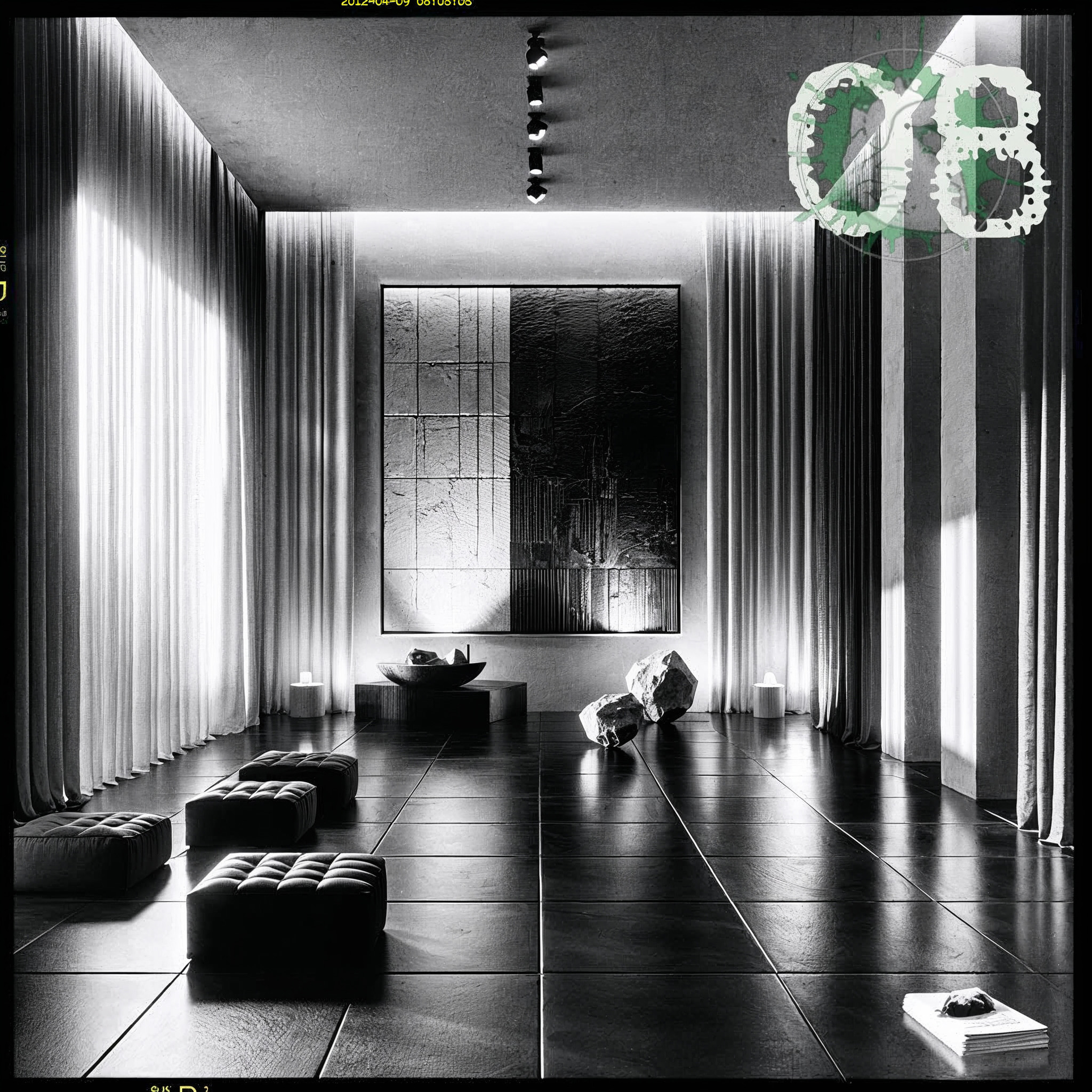
I enter the corridor leading to the “Room of Silence” inside the Brandenburg Gate. Before Uwe Albo called me, I had no idea a place like this even existed. “Silence” is written on the wall in various languages. A pretty fitting place for Easter, really, but I already have a bad feeling about what’s waiting for me here.

Everything is cordoned off. Albo’s colleagues recognize me and wave me through. The detective himself stands in the small, unadorned meditation room like a lumberjack in a perfume shop. My gaze immediately drops to the floor, and sure enough, right on cue: in the middle of the room lies a stack of paper, topped with a bloody lump of meat.

“Another heart,” Albo says when he sees me. “Number three.”

A sharp wave of his hand scatters the young officers. We’re alone. “This room is locked at night. Yet this morning, the heart was sitting right here.” Albo grabs my arm. I can clearly see the whites of his eyes. “That bastard scares me, you know? He writes a story every day on one of his typewriters, and whenever he finishes his run of fifty typewriters, he calmly drops another one of his hearts somewhere in Berlin—without us getting an inch closer to catching him!”

I can smell Albo’s breath; he’s standing that close. Is this a cry for help? Is he cracking? Is he at the end of his rope? But Albo relaxes his grip, lets go, and clenches both fists. His eyes narrow to slits as he says, menacingly low, “I’m gonna nail him with these bare hands, and once I’ve got him, he can play all the hide-and-seek he wants in the cell where he’ll spend the rest of his life.”

He looks at me, as if looking for backup. I give him a stern nod. That seems to satisfy him. “Come on, let’s move. Forensics can handle the rest.”

Later in Albo’s office, we study copies of the new texts. Familiar themes, new twists—the playful, compulsive streak shines through again and again.

“I paid the Integralists a visit,” I say. Albo looks up, intrigued, having clearly forgotten he asked me to infiltrate Berlin’s Integral scene in the first place. “Decent people across the board who think they’ve found the Philosopher’s Stone—a kind of cut crystal with a whole range of facets that all need to be accounted for when looking at humanity and the world.”

“Facets?” Albo asks, frowning.

“Yeah, just like the killer’s texts. Everything can be viewed from different angles and perspectives…”

“Which I can then conveniently pick and choose from.”

I shake my head. “No, no—the whole point of the integral approach is that it’s holistic. You don’t just limit yourself to single aspects.”

“In other words: you felt right at home with them.”

“Point is, it’s a philosophy that values life in all its forms. It doesn’t breed killers, if that’s what you’re asking.”

Albo scratches his stubble. “So where do we find him then?” I rap my knuckles against my stack of copies. Our only lead.

A uniformed officer with a goatee and ponytail knocks on the open door to grab our attention. Albo steps over to him. I immerse myself in the pages in front of me. There’s mention of a twin. Interesting. A lead to the victims, the first two of whom were apparently identical twins? “Then get back to work!” I hear Albo bark.

Snorting, he comes back into the office, waving a thin folder. “The heart’s got the same DNA as the other two.”

“A third identical twin?” I ask, surprised. “Is that even a thing? Identical triplets?”

Albo slams the file onto his desk with a loud bang. “They’re so rare that every single one of them is registered. But none of this makes sense, quite apart from the fact that no pair of triplets has been reported missing.”

I let his “pair of triplets” slide. “Then they must be unregistered triplets. Or the lab made a mistake…”

Albo nods, looking suddenly exhausted. “Told them the same thing. They need to recheck everything, step by step.”

“—Or,” I continue, “they’re clones.”

Albo stares at me. “Those were three hearts from adult human beings,” he says hoarsely. I nod.

Albo leans heavily on his desk and looks me dead in the eye, worn out. “Officially, human clones don’t exist—and certainly not adults.”

I nod again. “Officially,” I say.

“Man,” Albo groans, slumping into his office chair. “Houston, we have a problem.”

153/398

♫ Sloe Season ♫


153/398

LogoSwitch language

I enter the corridor at the station, clutching the stack of copies containing the writings of the triple murderer—texts literally stained with blood. The blood of illegal clones?

Albo is engrossed in his files. I skip the pleasantries: “Is there such a thing as identical quadruplets?”

Albo looks up. “Just had some in Leipzig recently. Damn rare, but not impossible.”

I grab a coffee. No sugar left.

Albo keeps his eyes on me. “Why do you ask?”

“Because then it might finally be over.”

Albo laughs bitterly. “Over? I have to catch a killer, regardless of what happens in fifty days!”

“—Forty-eight,” I correct him. Albo gives me a look that wouldn’t pass daytime TV censorship.

“Ray Bradbury,” he says then. I look at him, slightly confused. “American author,” I say.

Albo nods. “Any Friend of Nicholas Nickleby’s Is a Friend of Mine.“

I shrug. Albo tosses me a thin, worn paperback: Ray Bradbury’s I Sing the Body Electric! “Any Friend of Nicholas Nickleby’s…” is one of the stories listed in the table of contents.

“You read stuff like this?” I ask, surprised.

Albo shakes his head. “One of our forensic guys put me onto it. There’s a guy in there who thinks he’s Charles Dickens but can’t put anything worthwhile on paper. He buys six dozen typewriters and writes like a madman…” With that, he stands up, walks over, and takes the slim volume back from my hand. He flips it open, finds the spot, and quotes: “The poem. The essay. The play tragique. The farce. The short story. And it was all bad.“

“What are you trying to tell me, Albo?”

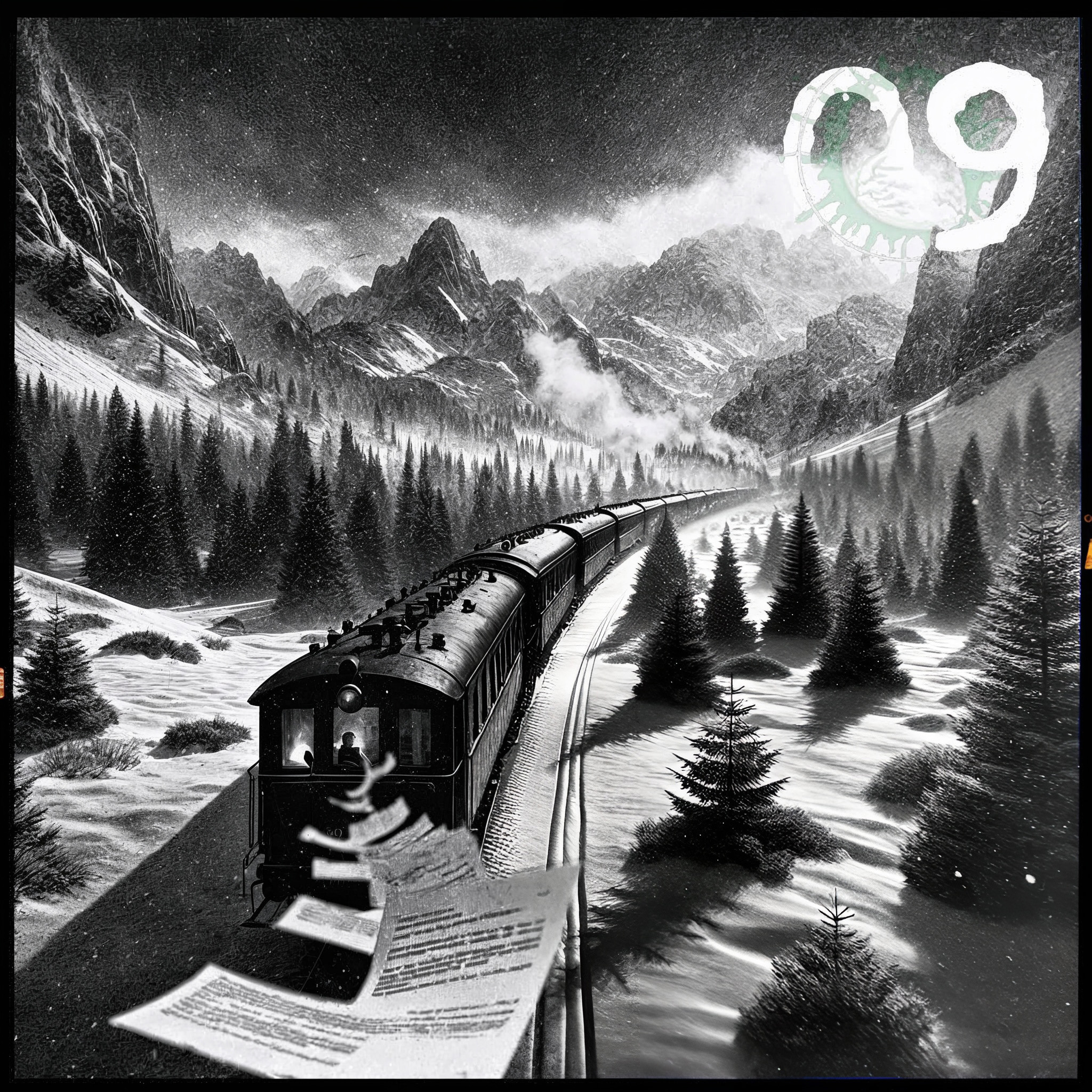
“That’s him, don’t you see? The typewriters, the different texts. And then he sits…” Albo taps the booklet. “…at the back of a train and throws all the pages out one by one, and they flutter away. Thousands of them.”

“But that’s just a story, Albo. We have three dead bodies and a serial killer.”

Albo slams the book onto his desk. “Just a story, you say? But these are all stories, too! The typewriters—don’t you get it? He knows the Bradbury story and identifies with it!”

“Take it down a notch, Albo. He identifies with everything and nothing. That’s precisely our problem. He’s a shape-shifter, and we can’t get a grip on him. One minute he’s ‘integral,’ the next he’s surrealist. We don’t grasp him, get it? You can’t just pick out one facet and call it a day. Not here. Not with him. And six dozen typewriters aren’t fifty.”

Albo looks like he’s on the verge of blowing a fuse. He must have latched onto this Bradbury thing out of sheer desperation. I don’t give him room to breathe: “Number 122 is another one of those. Incomprehensible gibberish…”—I pull the sheet from my copies—”…until you find the original.”

“Which original?” Albo asks, frowning at the page.

“A Braulio Arenas is mentioned, right? Chilean poet. Just so happens he wrote a poem titled ‘Errata’ that lists a bunch of printing errors found in an unnamed text. A surrealist poem.”

“And?”

“Number 122 is that text. It contains every single error listed. For example, in the poem, it says, ‘Instead of making two hits with one shot it should be making two lips with one mouth.’ Sound familiar? Or ‘Instead of the youth the beauty the mill it should be the mill the beauty the youth.’ Ultimately, it was the missing commas that tipped me off that his text was built on that poem.”

Albo looks at his copy, rubs his stubble, and thinks it over. Finally, he asks: “Does it make any sense?”

“None,” I say. “It’s just—and I quote—’a grotesque parody of something that is already absurd.'”

“Uh-huh,” Albo says.

I tap his copy. “There’s one error missing, by the way.”

Albo’s brow furrows.

“One line reads: ‘Instead of I love you it should be I love you.'”

“Where’s the error?”

“That’s the whole point of Surrealism. And the same goes for the killer. He’s no more Braulio Arenas than he is Charles Dickens!”

Albo nods without looking up. “So how do we nail him?”

“Let’s talk about someone who decided to stretch his bizarre mind games so far into reality that the homicide squad has to deal with them,” I say, holding up the copies. “Let’s talk about incompatible claims and collapsing belief systems.”

Albo looks up. “Always a good idea,” he says. Do I spot a wry smile tugging at the corners of his mouth? Maybe it feels to him, too, a bit like thirty or forty years ago, when we used to sit up all night debating life, God, and the universe—and all the insanity we humans inject into it.

158/398

♫ Hunting Spree ♫


158/398

LogoSwitch language

I enter the corridor of the precinct and close the door to the john behind me. Every now and then a good idea hits me while sitting on the throne, but this time, my mind is a blank slate. I’ve been holed up with Albo for way too many hours, going through the killer’s hundred and fifty texts with him like we’re piecing together a puzzle. Somewhere in there, a clue has to be hidden about who he is and why he carves the hearts out of innocent triplets.

Albo is on the phone when I get back. This late at night? It seems true that the homicide squad never sleeps. Albo hangs up and stares at me with bloodshot eyes. “The converted double-decker bus that tours through the backwaters at night…” I resist the urge to grab another coffee and sit down instead. “With chill-out music and philosophical self-discovery.” Albo holds up the page in question. “Made it up. Doesn’t exist in reality. I had my guys check.”

Figured as much. It started with the fifty typewriters. The guy who supposedly bought them one by one, secondhand, only exists as a former eBay handle, “SpellingError68,” with a Berlin address and a PayPal account. He’s since deleted all the accounts, and no one’s lived at that address for years. Every trace has been meticulously erased; all inquiries lead to dead ends, just like in the texts: as far as we know, hotel chef Pascal is just as fictional as houseboat dweller Norbu or some Cory d’Or, male or female.

“A riddle wrapped in a mystery inside an enigma,” I’d muttered earlier in the evening.

“Hape Kerkeling,” Albo had offered with a nod, but I shook my head. “Winston Churchill.” Albo smirked crookedly. “Either way, all clues lead nowhere.” Which holds true for me, too, as a psychologist and—as Albo likes to elevate me—a profiler. Even the “KISTe,” the Federal Criminal Police Office’s text analysis database used to evaluate written statements by criminals—confession letters and ransom notes—couldn’t get us any further.

We’d last been debating the alien. “I would have so liked to speak with him about God. Then it must be done this way,” it reads in Number 106, right as the alien kills the human astronaut with whom communication seems impossible. Crazy story. Who comes up with this stuff? A religious fanatic?

I step over to the window. The city is silent. Even if Berlin never truly sleeps, around 3:30 in the morning it at least drifts into a brief half-slumber. “Maybe he thinks he’s doing something good,” I say. “There’s a movie where a philosophy professor fakes a murder that turns out to be a suicide at the last second—but as a critique of the death penalty and the American justice system, he waives his appeal and goes to the execution chamber as the alleged killer.”

Albo stretches his back with a groan. “How do you picture that? The triplets were in cahoots with him? He bred clones of himself, breathing husks without feeling, and he’s cutting them open to critique the morality of our scientists?”

I tug at the window, trying to pop it open. It’s been sticking for years. “I’ll get it fixed,” Albo says, and for a second I feel like I’m trapped in a time loop, having heard him say that at least a dozen times. “I say that every time, don’t I?” Albo asks, clearly having the exact same thought.

“If he were a psychopath, he couldn’t put himself in other people’s shoes the way he constantly does in these texts.” I realize I’m starting to lecture as I pace back and forth. “Of course, we’re still not sure if the texts even came from the killer. Maybe they came from the triplets. But assuming the murderer wrote them: then the texts point to the murders—and the murders, in turn, point to the texts.”

“We’ve covered that ground. We’re going in circles, pal,” Albo grunts sullenly.

“No,” I say, “because your flash of brilliance about a critique of the scientific establishment is the best idea we’ve had so far. Murders that aren’t really murders—meant to raise questions and shake people up.”

“Switching sides now? Planning to cozy up to him, grab a drink, be his buddy?”

I stop pacing. Albo’s sore. No wonder—the case is taking a nasty bite out of his professional pride.

“I wouldn’t be surprised,” I say, “if it was his own heart. Symbolically, I mean—that he’s tearing it out as the author of these texts because something in them cuts him to the quick, because one of these texts is genuinely real and he’s revealing himself to us. Maybe with whatever he’s storing behind the black door? Or the business with the shattering worldviews?”

Albo looks at me, tired but with a slight provocative edge. “In a case like that, you look at the suspects and cross off everything until only the most likely ones are left, right? So go home, man, and do your homework.”

Dawn is already breaking when I step out of the precinct. The crisp air feels good. The Life of David Gale suddenly pops into my head—with Kevin Spacey. That was the title of the movie about the philosophy professor. But how did Cory d’Or manage to tear their own heart out three times and plant it at three different Berlin landmarks? My thoughts haven’t made sense for a long time. High time to get some sleep.