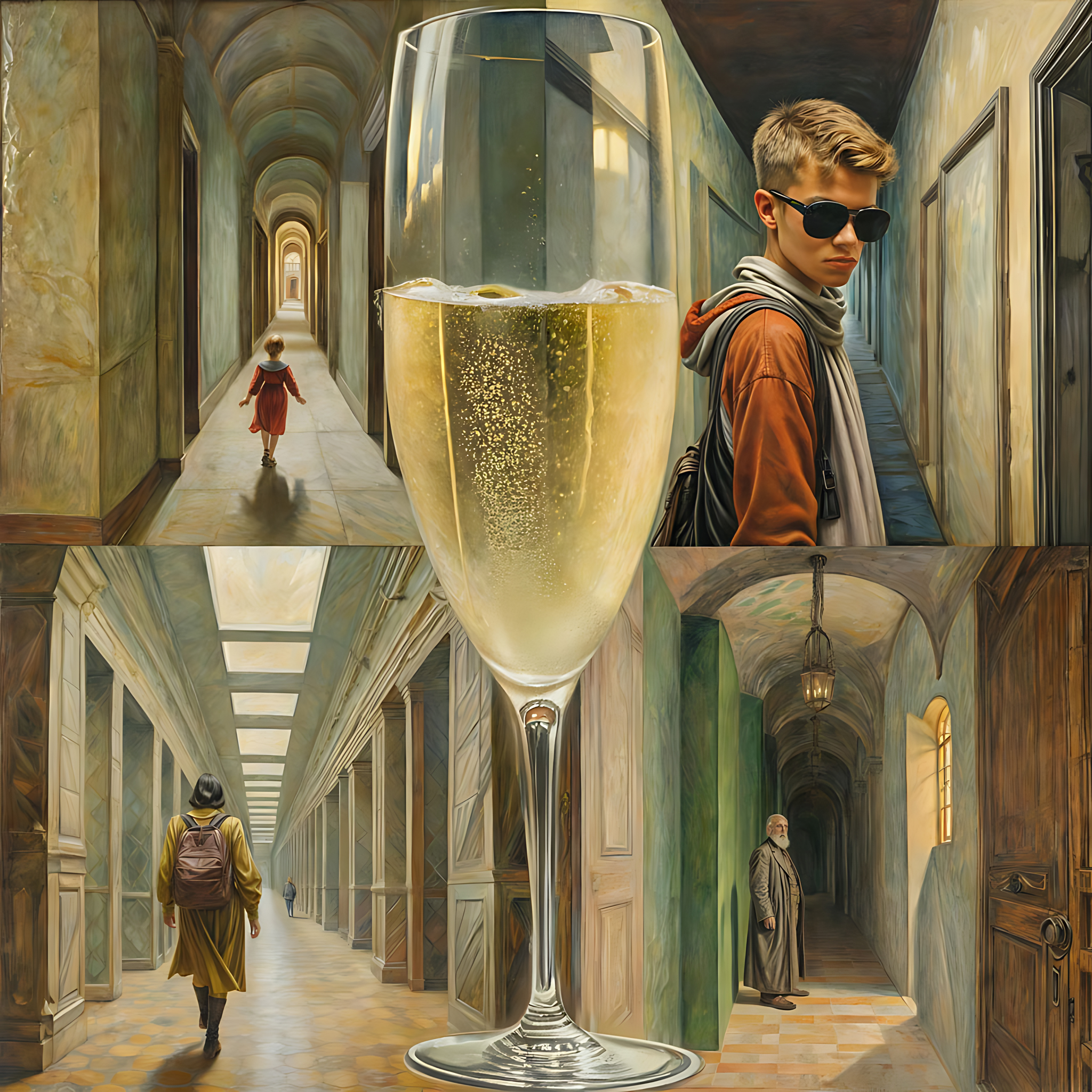
I enter the corridor as a childlike believer, convert—having grown uncertain—to a youthful agnostic a few steps past the threshold, and finally traverse it as an adult possibilianist, a discoverer of possibilities, so to speak, open to (and curious about) whatever may be hidden behind its doors, and as whomever I will be when I leave it—in the end, perhaps even a mystic?
(This life story in a single sentence may seem all too condensed to you, but believe me, the seed has already been planted in your mind without you even noticing.)
I enter the corridor, realizing from hearing the the sound of a drill, that Norbu is fixing something on his houseboat again. I open a bottle of wine on the terrace and wait for him with two glasses. When I visit my friend Norbu, I always make sure to have plenty of time. It’s never predictable how deep we’ll get tangled up in our discussions.
This time, I have a topic in mind. I want to know what Norbu thinks about climate change.
He’s sweaty and covered in oil, but he’s clearly happy to see me when he finally emerges from the chambers and passages below the waterline in the living room, a power drill in his hand.
“Climate change isn’t the problem,” he casually remarks. We clink glasses. “Humanity will eventually die out anyway. And even if we survive for a while, life on Earth itself is limited.”
“That sounds like catastrophism,” I chide.
“Pure astrophysics. The sun will extinguish. The problem isn’t global warming; it’s the heat death. You need to think on larger scales!”
My friend Norbu enjoys doing that. I, on the other hand, only need to ponder for ten seconds why there is something rather than nothing, and I’m already caught in the Total Perspective Vortex, dissolving.
“Hey,” my friend Norbu says, “are you still with me?” That pulls me out of the Vortex. I nod eagerly, “Heat death of the sun. It expands and burns up all its planets. The end of life on Earth.”
But Norbu impatiently shakes his head, “Heat death of the universe, the end of all life. That’s the real problem, and that’s what we need to prevent.”
I stare at him in disbelief, “You want to prevent the heat death of the universe?” And then, “What is that, anyway?”
“Since shortly after the Big Bang, the universe has been steadily deteriorating: matter is distributed, interacting less due to increasing distances, and stars are burning out. Cold and hot zones are becoming more alike until everything assumes a uniform temperature and structure, like a featureless lukewarm soup. But so that we don’t allow it to happen without a fight, there’s ‘The Message.’ ”
Norbu gestures widely at the world around us. I can’t follow him. Finally, he sighs and begins to explain further, “The laws of nature are a message. The cosmic physical principles are exquisitely tuned so that life can emerge, life that recognizes itself for what it is. I’m talking about us!”
“Us two?” I ask meekly already suspecting that I may not be able to follow him again.
“All of us. Humans. And all other intelligent civilizations in the cosmos. And the laws of nature tell us that those who came before us tampered with them.”
“Those who came before us?” I can hardly keep up with him anymore.
“Sometimes I imagine,” and with that, Norbu leans back and looks thoughtfully at the rest of the red wine in his glass from below, “that before the heat death of the universe, a handful of intelligent civilizations will manage to make contact with each other and jointly initiate the greatest project in the world.”
He doesn’t say more. I should now ask what the greatest project in the world is, but now I’m being obstinate and staying silent.
After a while, he continues in a whisper, “To create a new one before the end of your own universe, so that it can give life again. So that the chain of being doesn’t break.”
Suddenly, I’m filled with awe at the thought that we could leave a message for the next universe, for the intelligent beings who will follow us: the laws of nature that help them evolve—a forward-looking measure that certainly exceeds what can be accomplished within a single legislative period and even surpasses a 739-year organ work, a ten-thousand-year Long Now clock, and the safest possible disposal of nuclear waste for hundreds of thousands of years by a wide margin.
“Of course,” my friend Norbu suddenly becomes quite sober again, ” only if the universe is a closed system. Otherwise, there are numerous other possibilities because it doesn’t necessarily have to end in heat death or a Big Crunch. But as long as we don’t know for sure…”
“… it might be better to prepare for the worst.”
“Exactly,” affirms my friend Norbu. “640 billion years until heat death is a hell of a short time to evolve to the point where we can plan a new universe and put it into action. Better get started on that right away.”
My head is spinning, not just from the wine. As I ride home later under a gloriously starry sky, I look up and ask the universe arching above me if it has a message for me. And indeed it does. I can’t hear it or see it, but I can sense something. Life is worth living.
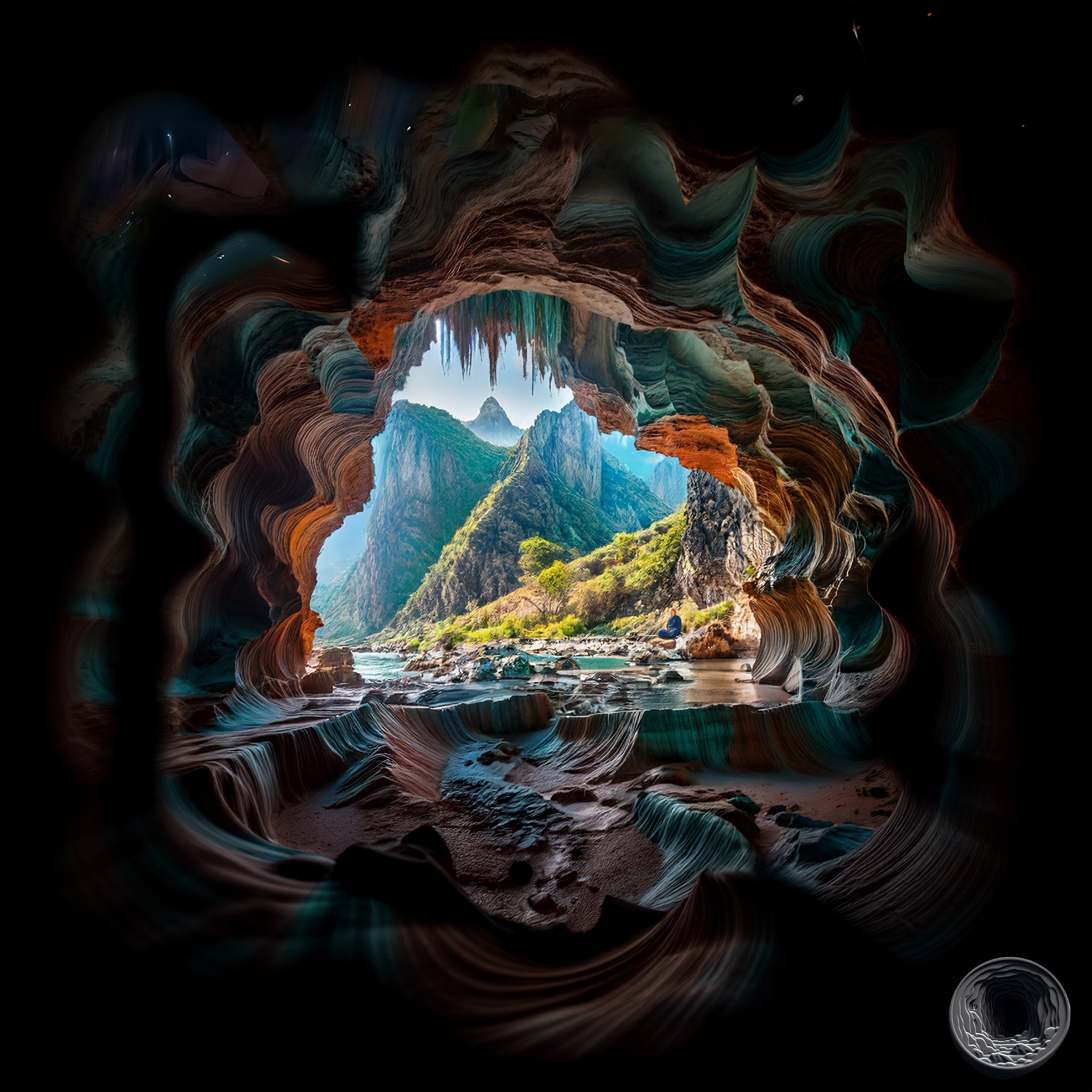
I enter the corridor. It’s a natural fissure in the rock, widened by monks like me over centuries of labor. Along the sides, the passage opens into small cells, yet my path leads deeper into the mountain. I take a deep breath.
For 49 days, I will sit in darkness, in a place where no ray of light penetrates. I have been warned by other monks. Some meditators have gone mad in there, and it was whispered in hushed tones that some adepts didn’t survive these 49 days.
Descending deeper into the mountain, toward an unknown and frightening place, I realize that I am about to confront what lies deep within me—unknown and terrifying. I break out in a sweat. Nevertheless, I continue to inch forward into the darkness. I don’t want to disappoint my master, and I certainly won’t change my decision.
What will I discover? What will rise from the depths of my being when I sit there in absolute silence and complete darkness? I stumble, and despite my desperate grip on the metal bucket, it slips from my grasp, falls over, and the precious water—the only thing accompanying me into the depths of the mountain apart from my robe—spills onto the bare rock and seeps into the cracks and crevices. I must turn back. Without water, I won’t survive!
Yet, I keep going.
There are no more cells along the sides of the corridor for a long time, not even niches. The passage narrows. I feel lost. It’s better to turn back now than to come crawling out later, half-starved and dying of thirst!
But my master said that I can take this path into the darkness, into the mountain’s interior, only once. If I turn back now, the descent into the mountain is forever closed to me. I start sobbing for no apparent reason. Fear of death seizes me. Yet, I continue to stagger forward. I am deep inside the belly of a mountain, and it feels as if the rock weighs tons on my shoulders.
People I once knew come to mind, hurtful words, thoughtless actions that I regret. I beg the black, cold walls for forgiveness. They do not respond. I am four years old, exploring the basement alone, and an unfortunate coincidence causes the only lightbulb to blow. I scream, and my own voice and its echoes through the mountain send shivers down my spine. I can’t stand myself anymore, yet I have no choice but to endure myself, somehow. It’s as if I’m walking through hell, and hell is me.
There. A glimmer ahead of me. At first, I think I’m mistaken. Then I realize that there must be another monk down here. He must have brought a light, a candle, or a torch. But the light does not flicker.
I’ve actually been ascending for some time now. It’s daylight that awaits me. I have to squint. The deepest and darkest part of the journey, the dark night of the soul, is bright?
I step out into the open. A green valley, bathed in sunlight, stretches out on the other side of the mountain. The master sits on a rock, pouring me a cup of tea. I feel confused. How long was I on the journey? Was it hours? Or weeks? Am I already dead? Am I dreaming?
“We never really know for sure,” says the master.
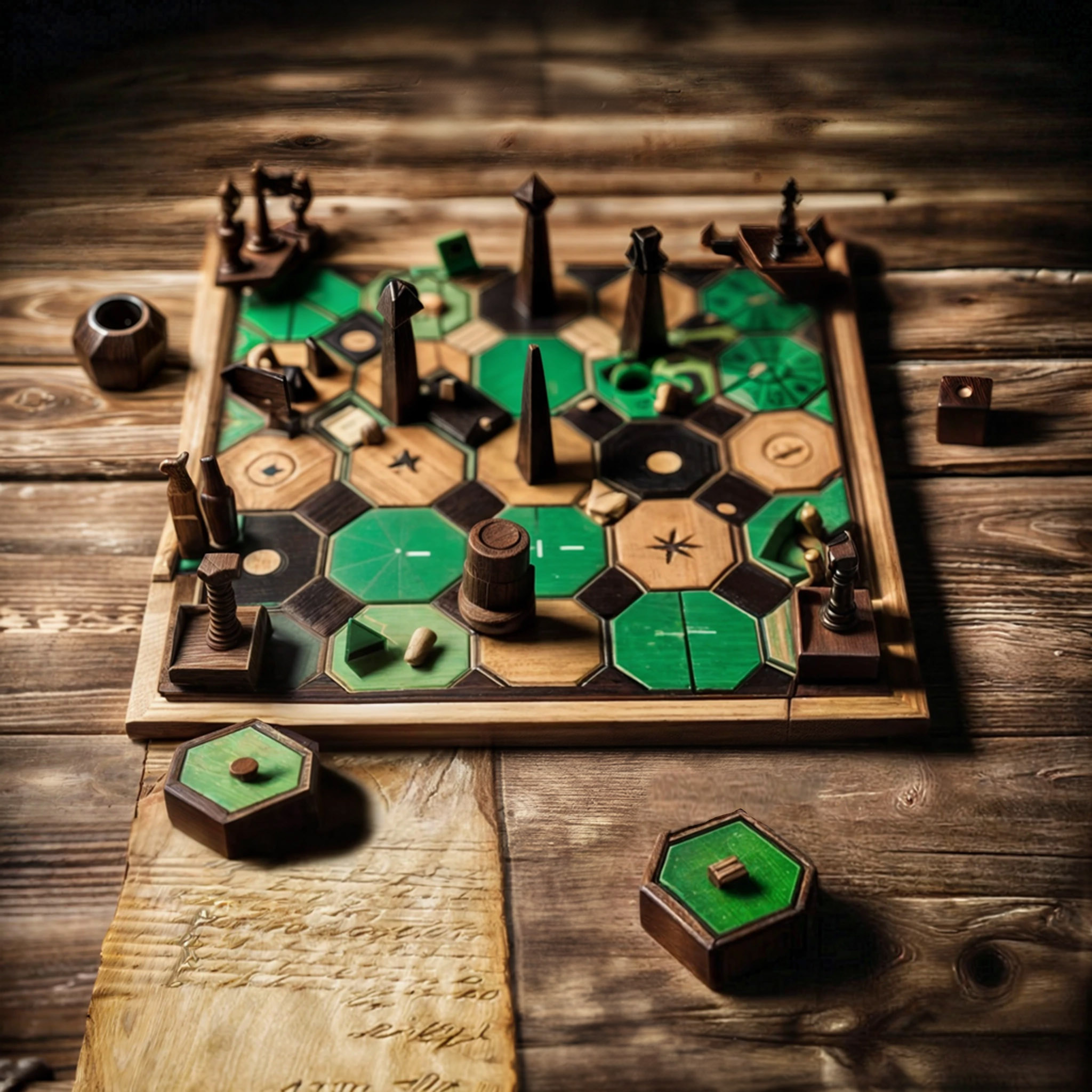
I enter the corridor that connects my house to the boathouse. I haven’t been here in months—first because the lake froze over during the harsh winter, and second because a demanding job for a non-profit organization left me with no time for my private research. Here in the hallway, I’ve set up a narrow table where my notes are spread out next to the cryptic original text and my attempts to reconstruct the game board and pieces.
Years ago, through a lucky coincidence, I came across some yellowed records mentioning a long-lost board game that was apparently quite popular in southern Europe during the Renaissance. It was called “Citadel,” and the text—a letter to a merchant father from his son traveling in distant lands—mentions some of the pieces, though unfortunately only in passing and not to document the game and its rules. The reconstruction is proving difficult. If it is ever to succeed at all.
My honeycomb-shaped replica of the game board is sawn from balsa wood. I have colored the spaces alternating brown and green, true to the anonymous author’s notes.
Thoughtfully, I pick up the game pieces I carved. The text speaks of a “sweeping courier,” “catapults,” and a “nimble princess.” The inferior pieces apparently included numerous “vassals,” which—due to my lack of crafting or artistic skills—resemble simple obelisks. The “Throne” and “Scepter” pieces didn’t exactly turn out to be masterpieces, either.
I lose myself in my intricate notes. “Executioner captures jester,” I read. But how? Must there perhaps be a symbolic sentencing by a judge first? Once again, the enigmatic game completely consumes me.
And then, just as I give my tired eyes a good rub, he is sitting across from me: the unknown author, a dapper young man with a mustache and a green velvet beret. With a surprising move, he places his king’s son next to my princess. “Throne and scepter,” he says with a broad smile, before the brief vision vanishes.
That’s it!
Internally, I rejoice, having just taken a massive step forward: “Throne and scepter” in the yellowed letter—that doesn’t describe two more pieces; those are the words that end the game!
I take the small, crude pieces I had carved for the scepter and throne off the board and carelessly let them fall under the table—and with that, the game suddenly comes to life, the moves and strategies become clear, and the rules stand vividly before my eyes. It’s all so obvious. “Throne and scepter!” I shout, dancing through the hallway.
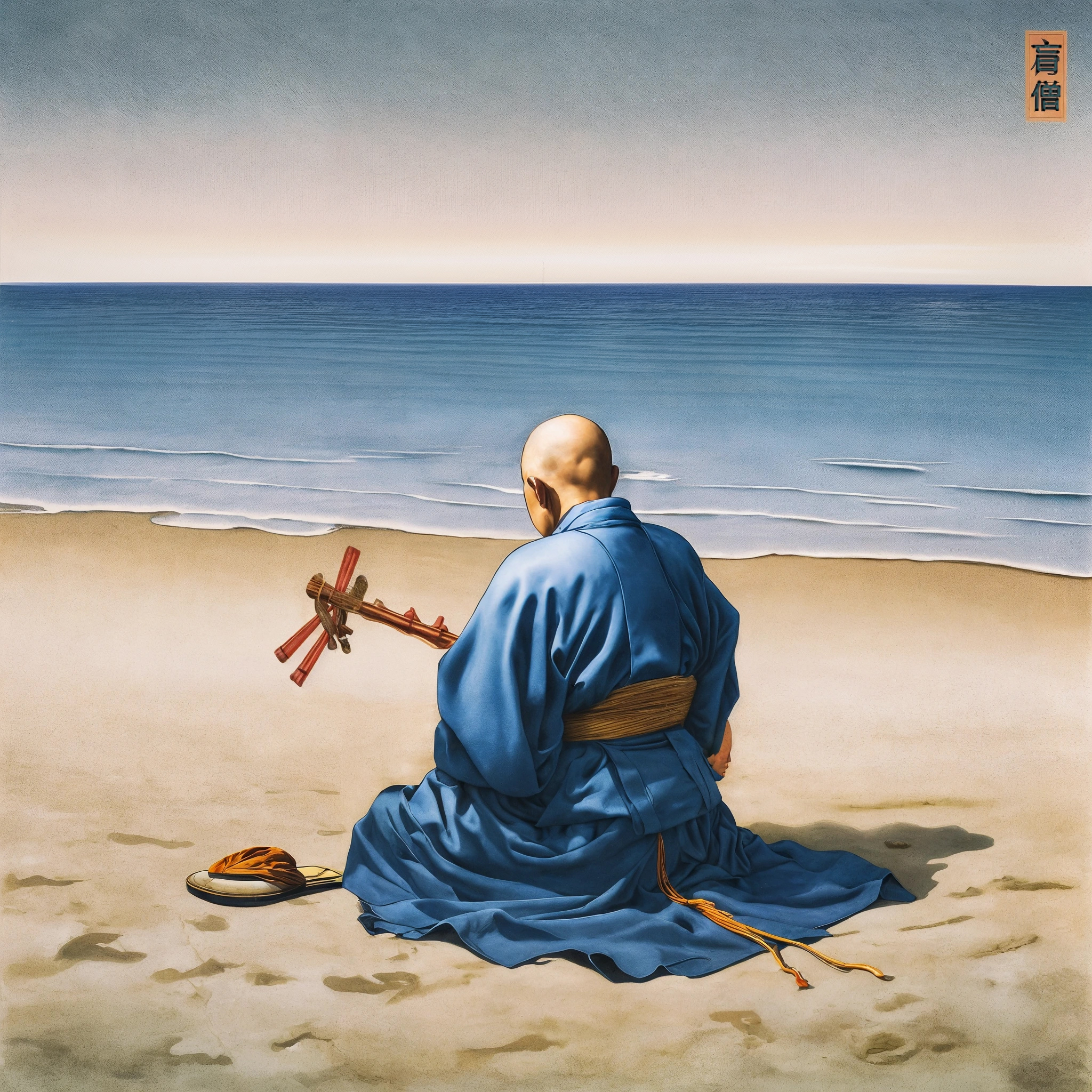
I enter the corridor. Sand—white sand has been blown in. Through it lead strange geometric tracks marked by imprints of rectangular crossbars: a line of primitive Braille consisting of the same repeated letter, etched evanescently into the sand.
The corridor opens onto a beach—the roar of the sea had already signaled this. I follow the tracks eastward, my gaze fixed on the grooved sand and the low-hanging sun.
Now, faint, mournful sounds pierce through the roar of the ocean like the tips of knives through a billowing curtain. A figure is perched by the water, playing a stringed instrument, his face turned toward the horizon-wide ocean.
He is Asian. His head is shaved bald, though the regrowth is already darkening his scalp. The monk wears a blue silk robe and white trousers. Beside him sit his sandals—simple wooden blocks with a loop on top and two wooden slats beneath—the source of the tracks that led me here.
The monk sings, striking the four strings of his lute with a tapered piece of wood.
“It is a biwa,” a voice in my head explains—but it is not a voice. It is more of a déjà vu, a fragment of long-forgotten knowledge.
The monk ceases his playing, as if a noise had pierced his concentration, and turns his head in my direction. He mutters something in Japanese, nodding as if to confirm his own words to himself; then he stands, sets the biwa aside, and bows deeply to me. As he raises his head, I see now that he is blind: his eyes are mute, broken long ago.
Nevertheless, I bow as well and sit down to his left after he begins to tell me a story.
I cannot explain how I am able to understand the moso’s story, as he is speaking Japanese. But somehow the old man’s dry voice touches my heart and paints ink drawings in my mind, so that I grasp everything he tells me.
And so I listen, moved, to the moso’s tale of water, fire, wood, earth, and metal—of a land where people live in harmony with nature and know how to appease the demons—and I am saddened that I can take so little of it back with me into the narrow corridor of my alienated and superficial life.
The sun has long since set by the time the monk resumes his biwa playing and I begin my walk back. Regrettably, the magic of his words and images quickly evaporates; they melt like snowflakes in my open palm the moment the clamor of the city rolls over me again.
I enter the corridor. Once again, the throbbing headaches plague me, even though, fundamentally, I don’t even have a head anymore. Instead, I travel through time like a bodiless spirit, always inside the minds of others who don’t notice me—alongside people who fascinated me as a child, even if I have long since forgotten them.
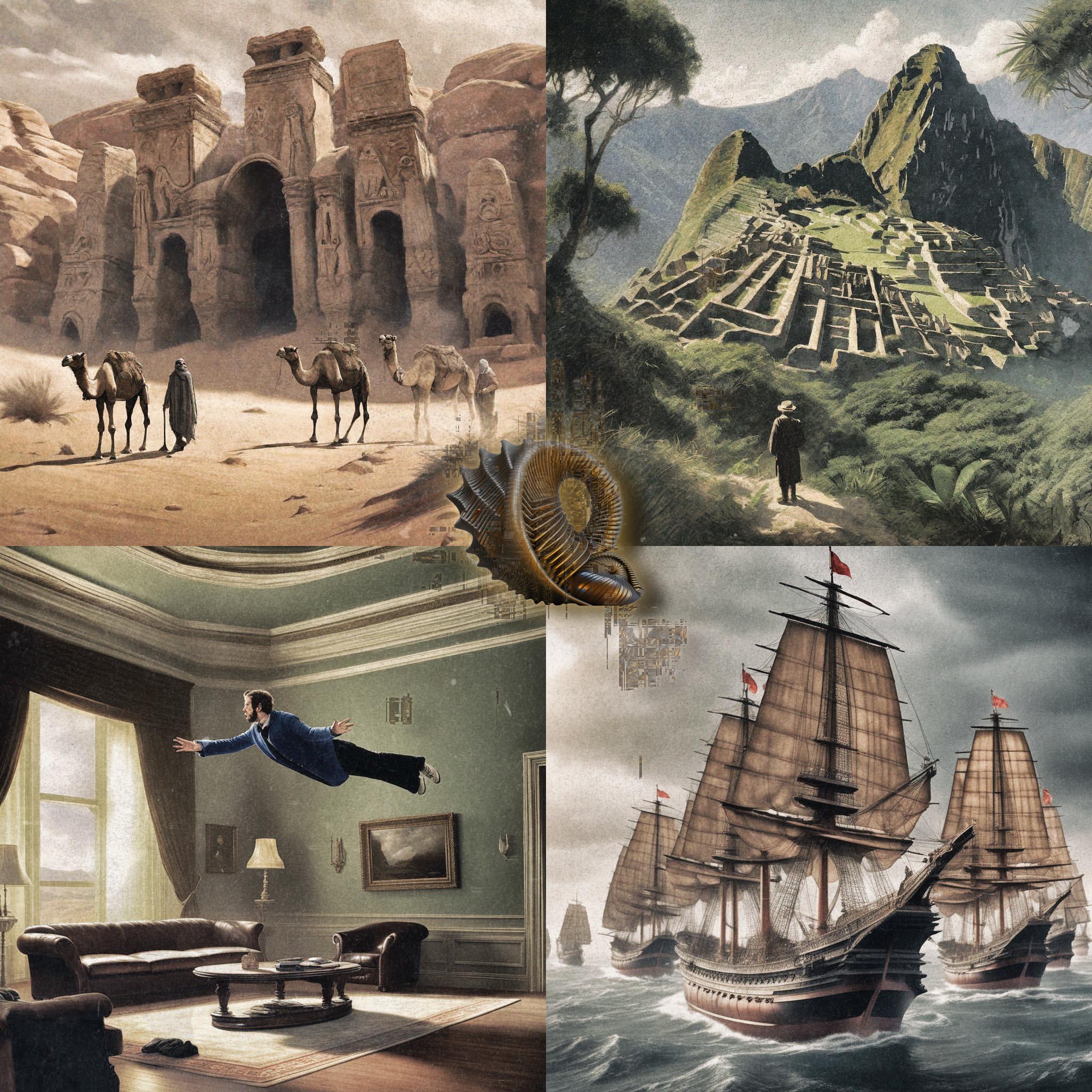
It all began with the diving record of the Trieste. Most recently, it was a journey of a completely different kind, where I ended up in the Lop Nor Desert with Sven Hedin. I sat helplessly behind the eyes of the expedition’s Swedish participant, forced to experience all the hardships, until he finally entered an underground passage in a Bronze Age ghost town they were exploring.
It is their dreams that give me headaches. They often ambush me at night and last throughout the morning. I feel completely helpless against it all, but for a few days now, I have been trying to focus on a thought that keeps slipping away from me: Maybe it’s not an accident, a punishment, or a curse that has befallen me. Maybe it’s an opportunity—or a blessing!
There was this movie where the hero was trapped in a similar way and couldn’t find a way out. He was a meteorologist, I believe, and only when he started to see the hopeless situation he had gotten himself into as an opportunity and fully exploit its potential could he finally free himself from it.
So, I try to rediscover the fascination I had as a child when I read about all these adventures.
I am in the jungle, trapped in the mind of a young local man who accompanies a well-equipped expedition as a porter. Hiram Bingham has us hacking with machetes through the dense vegetation overgrowing large stone blocks. He is convinced that he has finally discovered the Inca city of Vilcabamba. I know better. This is Machu Picchu. But I can’t tell the explorer. I am condemned to helplessness, left only to watch desperately and hope that some corridor will free me from my prison. I wanted to focus on something. But everything keeps blurring and eluding me. I curse my fate. Eventually, the man enters a low passageway in one of the partially excavated pyramid structures…
I am Lord Lindsay—or at least that’s how I am addressed—standing on the third floor of a building. With a mixture of admiration and dismay, I observe a man—that must be the medium Daniel Dunglas Home, I vaguely remember—rise from the floor and levitate. Soon, he floats, stretched out, with his back facing downward in the room. Lord Lindsay is seized by horror, while I sit in his head and watch the spectacle, fascinated. Eventually, Home glides out the window, his face contorted with exertion and his eyes closed. Lord Lindsay stands terrified, while another observer of the scene rushes to another window and opens it. Home floats back in, feet first. He lands upright, opens his eyes, and smiles at his three spectators. Lord Lindsay suddenly feels a pressing need to relieve himself and rushes out of the room into the stairwell…
I stand beside Xu Fu on the bridge of an ancient Chinese sailing ship. A fleet follows us, stretching to the horizon. The Elixir of Immortality! Everything comes back to me. Qín Shǐhuángdì, the founder of the Chinese Empire, equipped a naval expedition out of his paranoid fear of death, which was supposed to obtain the elixir of immortality for him. The sixty barges never returned, and no one knows what happened to them. Will I find out now? My curiosity reminds me that I wanted to focus on enjoying my journey as much as possible—despite my helplessness, despite the frequent headaches, and despite the constant blackouts. Why do I keep forgetting that? I smell the sea breeze, feel the wind on my skin—skin that is not my own. But then the man goes below deck, and I immediately lose my grip on his mind and whirl aimlessly through space and time…
…I enter the corridor, just as I learned to do from the Spirit Masters as a young child, and descend into my “temple of fleeting images.” At first I hesitate—for weren’t the Spirit Masters the very ones who descended too deep into their inner temples, and with their hubris conjured up the demise of us all? But the imminent drowning and the unbearable pain in my shattered leg drive me to this place where everything is still and motionless.
My “temple,” however, is—an island.
No one was allowed to know about it, since invoking the image of an island in the mind’s eye instead of a temple building contradicts the spiritual law as it is taught to us. Yet, as much as I tried to fight this island, it simply wouldn’t disappear. I didn’t even tell my closest friends about it, so I am profoundly shocked when I see a group of strangers standing there on my little island. An old man, the left side of his face completely scarred, approaches me. Behind him stand eleven men and women.
“I am Ktephaim,” the old man says. What are these people doing in my mind? Or have they come to collect me and lead me to the realm of the dead?
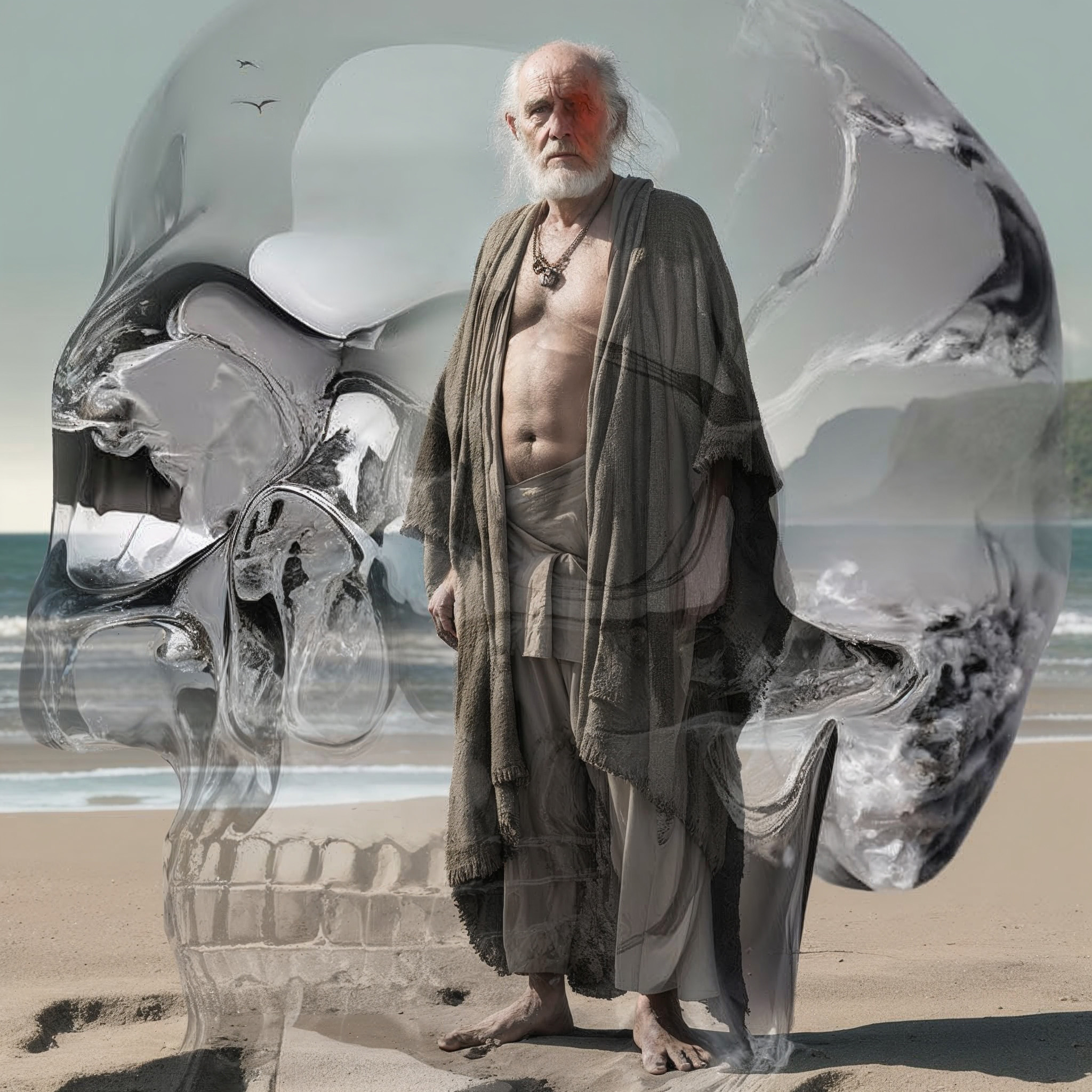
“We are… Wanderers. And we would like to offer you the chance to become one of us.” I want to know what all of this means first, but he motions for me to be silent. “You can save yourself.” With that, he hands me a polished crystal in the shape of a human skull.
I know what I have to do. The other eleven standing behind Ktephaim watch me silently. One of the women smiles encouragingly. I look into the eyes of the crystal skull.
“Concentrate,” the old man says. “You have practiced for this a long time. Now is the moment.”
All at once, I am back in my body. Icy cold water surges around me, and I feel a burning throb in my shattered leg. I take one last breath before the sea swallows me whole. And I concentrate.
My homeland sinks back into the magma. When the sun breaks through the black clouds for the first time again, nothing will be left of it. A new humanity will rise from the mud, a new historiography will unfold, new ancient wars will ignite, and old new inventions and experiences will stir the human soul.
But these are things I will only learn later. Because I survive. With a final breath, using the crystal skull and an unknown will to live within me, I transport myself to another place, another time.
A cushion of moss, massive roots, a clearing.
Slowly, I come to. Enra’daí, the woman from the group of Wanderers who had smiled at me, sits beside me, examining my leg. “Where am I?” I ask her, but Enra’daí corrects me: “Better ask when you are. You are one of us now.”
She explains to me that there are twelve of us, and that we possess the ability to jump to the flipside of time, wandering from there to wherever we are needed. Some of the Wanderers manage to do this five, six, or even ten times. Then the power runs dry. A new Wanderer must be found to fill the gap. “And you are probably the youngest there has ever been,” she adds.
Over the next few days, she heals my leg with herbal poultices and roasts her wild game for us over a fire. I don’t know what is happening to me. Her movements, her touch, her quiet voice: all of it intoxicates me, bringing joy to my innermost self, touching my heart, and awakening entirely unfamiliar feelings—feelings that promise sweetness and pain, which I shamefully hide from her. She nurses me lovingly, but clearly with the care of a mother for her son. How I long to prove to her that I am already a man. I could fell trees and build a hut for us, I would learn to hunt and slay wild beasts for her—but my leg does not yet allow for any of it; I must rest it.
Leaping to the flipside of time saved my life. I doubt our Spirit Masters knew of this ability. Enra’daí hesitates when I ask her what becomes of a Wanderer who loses the strength to jump. Her voice sounds fragile: “They remain where the new Wanderer was taken from.” I want to ask her if Ktephaim was transferred to the Hall of Crystals in my place, but Enra’daí grimaces painfully and turns her gaze away. That makes me falter, and I leave the question unasked.
“I must move on,” she says finally, looking a little sad. “We Wanderers are loners.”
I want to protest, begging her to stay, claiming my leg hurts again. But Enra’daí cannot be swayed. To say goodbye, she only touches my arm briefly and then quickly looks away. I want to call out after her that I love her, but she has already vanished between the massive trunks of the trees. Tears well up, and I begin to weep bitterly.
It is a goodbye…
All the dead—an entire people! My friends! My mother! My little sister! Not until dawn breaks do my tears dry up, and I fall into a restless sleep.
I enter the corridorganroar with keen eardrums. At once astral jets (with the grace of a crocodile’s tear) fire clone-ish upper, over, hyper, and cyber tones into our eleven-dimensional aftertaste buds, ol’ factory cells, and victimpanums, peeling multisensual-processaurally out of the Infinite Persilencium in order to occupy panresonant listening outposts, seeping clangor-iced into the castratosphere of our whims, quirks, and schisms—contrapuntally confront-heavy amidst open-sourced sardonick-nack. Patasonic OMGluons—disgustily lustfully rustling—whisper rhythmotives, sonarchitectonics, and long-blasting tapedecklarations, rendering panflewd flavours, (de)cadencing delicate metaphors d’oeuvres, shivting spin in full swing into biotronic organificialities, ear-tickling my laughing muscles, emerging and surging against our poesienna-colored listening shells, snuggling quadrillphonically into third ears. Whiz. Sound swells. Seazures. Requiempathy just below the cheering threshold. Decibelcanto. Dingue-dangle. The jangly tingle of a fleating jingle wangles us from the bleak bliss of mere apphearances to utterly flirritating luciditties in our gray matter’s Shangri-labyrinth, until unexpectedly a microcosmic sound fragment (for a minimaliceful ultragicomical-infragile Only-Now) transports you into clair-audience/sooth-hearing/lucid-listening. In a trice. All ears. Being.
I enter the corridor as if in slow motion, savoring it with closed eyelids, fully focused on the sounds pouring from my headphones into my ears, evoking strange shapes and colors on my retinas. If I open my eyes now, I will see exactly that corridor in front of me—the one the musical progressions shape and create. It is, time and again, an exciting adventure, wherever the sounds carry me.
With delicious slowness, I lift my eyelids, and indeed!
I enter the corridor. This time, I think the professor really went overboard. Everything has a playful Victorian feel: on the walls, small fountains bubble beneath oval mirrors framed in carved ivory. So this is his latest trick: the “Myth Machine.” Something got Ceril thinking that the world’s myths are all tapped out. “A ‘mython’ shortage?” I asked smart-aleckly, but he just gave me a contemptuous look. Apparently, today isn’t about elementary particles unknown to conventional science.
He had me summarize what a myth is, but he wasn’t satisfied with my Wikipedia knowledge and explained that, as a leisure mythologist, he spends a lot of time studying “archetypal narratives that can serve as a collective model.” “Harry Potter?” I suggested, and “Avatar?” The professor furrowed his brow: “That’s precisely what worries me: this omnipresent regression into magical thinking. The myth of the noble savage and that of an enchanted world that obeys human will rather than the laws of nature—unfortunately, not very helpful or productive when it comes to the future of humanity.”
Hence his machine. It’s supposed to create the myth for the 21st century: the universal story that gives new meaning to everything we experience and strive for—and I’m supposed to bring this creation into the light of day.
The fabric-covered doors in the corridor are labeled with shifting letters. Just like in a dream, you can’t quite make out what they say, and they’re constantly changing. Did that just say something about “selling one’s soul to the devil”? Or “creation of the world in seven days”? Or “Emperor Barbarossa is just sleeping”?
I start getting pretty woozy, so I make sure to get myself out of that machine fast.
“It looks like it’s still at the very beginning of its calculations,” I tell the professor in a steady voice.
“But it’s already been working for six whole days,” he says sadly. Then he shrugs: “Oh well, let’s give it another week.” And seeing my expression: “A month?” I don’t answer, so Ceril finally sighs in disappointment: “Fine: a year. That should put us on the safe side.” I nod contentedly. Anything to avoid having to go back in there anytime soon!
The following night, I dream I’m fleeing from a massive horde of fairy-tale and mythical figures, all desperate to be my “role model.” I wake up drenched in sweat. Hopefully this nightmare won’t haunt me night after night for a whole year.
(It didn’t. Instead, a pretty crazy new classmate took my dreams by storm. But that’s another story.)