Korridorium

A daily dose of corridors in prose

Tag: classic

92/398

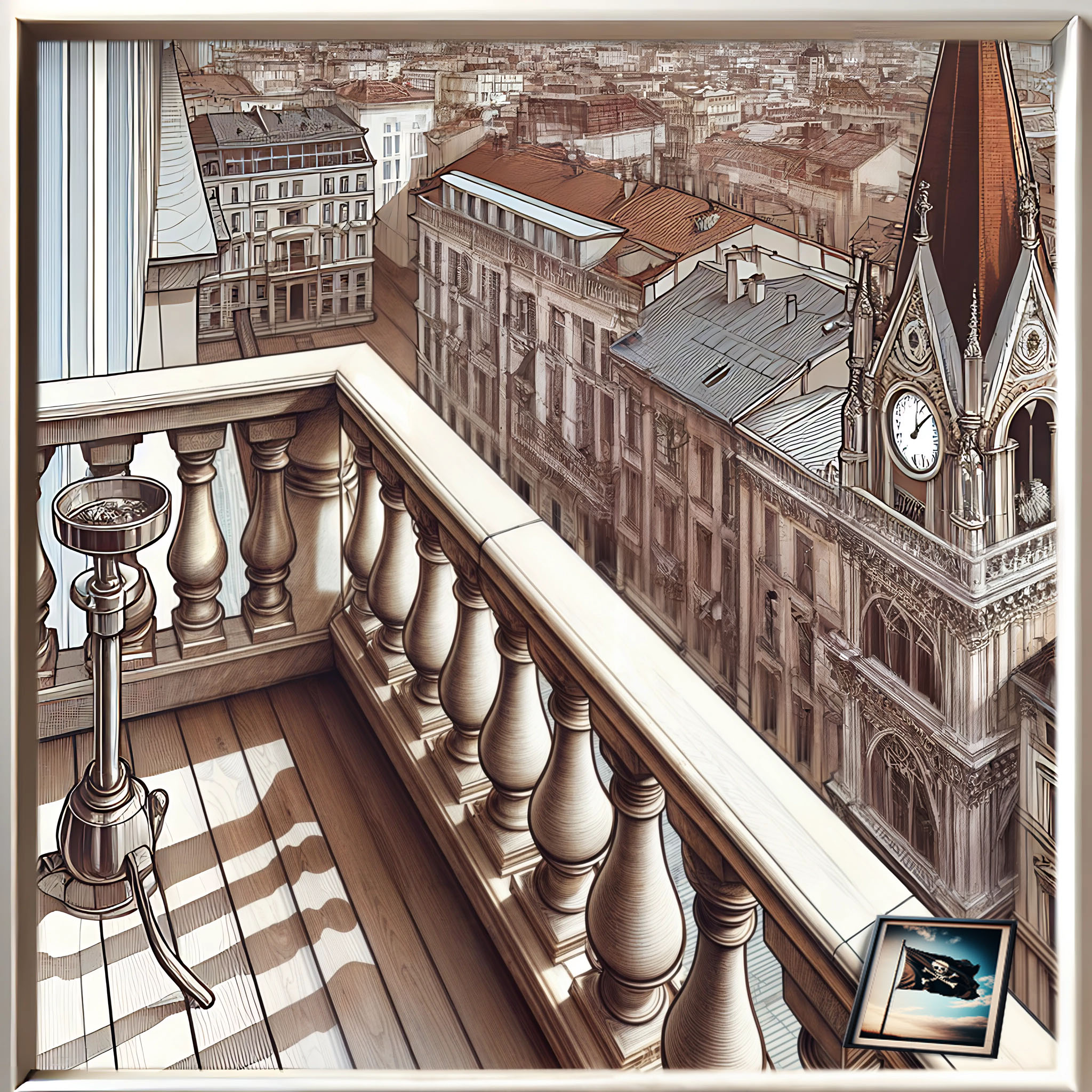
The cover art shows the view from a balcony with a balustrade onto a city with historical buildings and a tower with a clock. An ashtray stands on the floor, and a framed picture with a pirate flag lies on the railing.

♫ Korsarenstück ♫


92/398

LogoSwitch language

I enter the corridor at precisely eleven. Nicole is coming down the hallway. It’s our ritual: at eleven, we head to the smoking balcony, just the two of us, for a smoke and world-altering conversations for the duration of a cigarette, before retreating to our respective offices.

“How’s it going?” I ask as I reach for a pack of cigarettes. She smokes roll-ups.

“If only it were the weekend already,” she sighs.

“You’ve been saying that since Monday. But you’re right, of course. Got plans? A date?” I ask, teasing.

The small smoking balcony is occupied. Outrageous! Everyone in the office knows it belongs to us at eleven. The guy promptly clears out. It’s the technician responsible for the copiers.

“Nice butt,” I say with a melting look as he disappears around the corner.

“Way too young and inexperienced.”

“Maybe for you. You’re twenty years older than me.”

Nicole groans. “Don’t remind me. You still have all the typ—uh, doors open. For me, the ship has sailed. All the good men are taken.”

“Oh, come on, the right one will come along.”

“My mother’s been saying that for what feels like half a century.”

We laugh and take a drag from our cigarettes. Men. Our favorite topic number one.

“Have you actually booked yet?” I ask her. Vacation. Our favorite topic number two.

“Two weeks on the Appalachian Trail. Hiking away the frustration and a few pounds.”

“That doesn’t exactly sound like a four-star hotel…”

Nicole grins. “More like zero stars. It’s like with snails. You carry your home on your back.”

“Home on your back?” I must look a little confused, because Nicole laughs. “Well, the tent, of course.”

“And you want to meet an American millionaire out there?”

“Why a millionaire? I’m not after money. That phase is over. I’m looking for an adventurer, a pirate, or something.”

I roll my eyes. “Some rum-loving sleazeball from the Caribbean?”

Nicole laughs again. It’s too sweet when she giggles and shakes all over. “No,” she says, once she’s caught her breath, “someone who’s actually daring.”

“Uh-huh,” I say without much conviction.

“Like, make a move on me, for example.” It takes me a moment to catch on, and then we both cackle. “Do you actually believe,” she asks me next, “in love at first sight?”

“Sure,” I say, “I’ve experienced it. More than once.”

“What?” Nicole seems surprised.

“Kellan Lutz,” I say. Nicole furrows her brow and shakes her head: never heard of him. “Twilight,” I add, and then again “The movie.” Nicole’s eyes widen in horror. Before she can say anything, I drop “Jörn Schlönvoigt” on her. Once again, she looks surprised. “Aha. Have you been hiding something from me? That sounds more like a guy in your league…”

I wrinkle my nose briefly to let her know she can skip the league talk—feeling quite capable of handling Kellan Lutz myself—and explain: “GZSZ, my favorite soap.” Nicole’s face falls completely. That alone made it worth it. We laugh.

“I’m not talking about actors, Lisa,” she puts on record, “and not about staring at a screen or gazing into the idiot box…”

“He sings, too,” I interrupt.

Nicole groans. Even worse! “I’m talking about running into a total stranger somewhere, for just a single moment, and there’s a spark. And it’s so powerful that all your fuses blow—and his, too!”

“Supposed to happen, yeah,” I say as Nicole looks at me expectantly. “Why do you ask? Has that ever happened to you?”

Nicole nods. “It was in the theater lobby. I was drunk, to put it mildly—pretty plastered,” she says, grinning. We extinguish our cigarettes in unison. Part of the ritual.

“Drunk? And him?” I ask.

“He was a life-size cardboard cutout of Bruce Willis.”

Again, it takes me a second to process. As we part ways in front of my office to head back to work, we are still howling with laughter.

93/398

The cover art shows a doctor with a stethoscope, looking concerned at a giant wave of speech bubbles rolling towards him. A digital button in the upper right corner displays the pictogram of a syringe.

♫ Cuore non duole ♫


93/398

LogoSwitch language

I enter the corridor and hurry along to the seminar room. Three other SPs are already sitting in front of the door. I’m running late. John P. is among them, grinning at me. “You’re up first. The professor’s already back in.” As always, I enjoy his cute British accent. “Thought I’d have to do the ‘covert depression’ for you!” He briefly gestures to the door to the seminar room, behind which, as usual, there are about twenty students waiting for us.

I nod briefly to my fellow simulated patients and join them.

To expose the psychosomatics in their eighth semester real-life scenarios they will encounter after their training, their professors arrange encounters with “simulation patients” at the beginning of each year. That’s us, the SPs. With carefully crafted and meticulously rehearsed roles, we engage with the aspiring doctors, and since they have never dealt with real patients before, few of them are up to the task. For most, we represent a humbling yet formative experience.

I portray various roles for those specializing in somatic medicine, including hysterectomy, salmonella, a family member of an Alzheimer’s patient, and a cancer-stricken, unwittingly doomed mother of multiple children. But I particularly enjoy the roles involving psychosomatics, such as mania and depression, such as today’s “covert” case or the one with “somatoform pain disorder.” They pose a greater acting challenge.

“Also an actress and unemployed?” the blonde with frayed hair next to me asks. She extends her hand. “I’m Lara, hello. Uh, ‘Frau Edna Gierke,’ of course.” Ah, so the three of them are playing the family with the teenager who has stopped taking his insulin injections: the father unemployed, the mother a meter maid. I’ve had that pleasure before. Today, a pimply twenty-year-old with glasses who sweats and nervously fidgets in his chair plays the teenager.

“Frau Karsten,” I introduce myself to them with my character’s name. Around forty, slightly overweight, formerly employed at Deutsche Telekom before her primary diagnosis, she deals very rationally with her illness, etc.

The door to the seminar room opens. A medical student in a white coat steps into the corridor. “Frau Karsten?” he asks briskly, as if this were his waiting room. In reality, he is incredibly nervous: this is his first patient interaction. He won’t forget it anytime soon!

I jump up and pull out an envelope. “Doctor, it’s good that you’re seeing me right away, look, Doctor, just look, here!” I let him peek inside the envelope. As expected, the student reacts in bewilderment. There’s a clump of hair inside, which I’ve been collecting for weeks in the drain of my shower for this purpose. “I just showed it to Herr and Frau Gierke,” I unabashedly fib, “I’m losing my hair!” My three colleagues nod, but I don’t pay much attention to them. My voice becomes shrill, and I clutch my doctor’s arm. “This must be a bad sign, right? Doctor? What do you think? You’re the expert. I don’t want to go bald!” The student is initially at a loss for words, then stammers, “Please, uh, come in, Frau uh, Karsten.”

I follow him obediently but turn around one last time and wink at John P. We’re seasoned pros in this business and immediately noticed that this white-coated newbie is about to thoroughly screw up the first patient interview of his career.

117/398

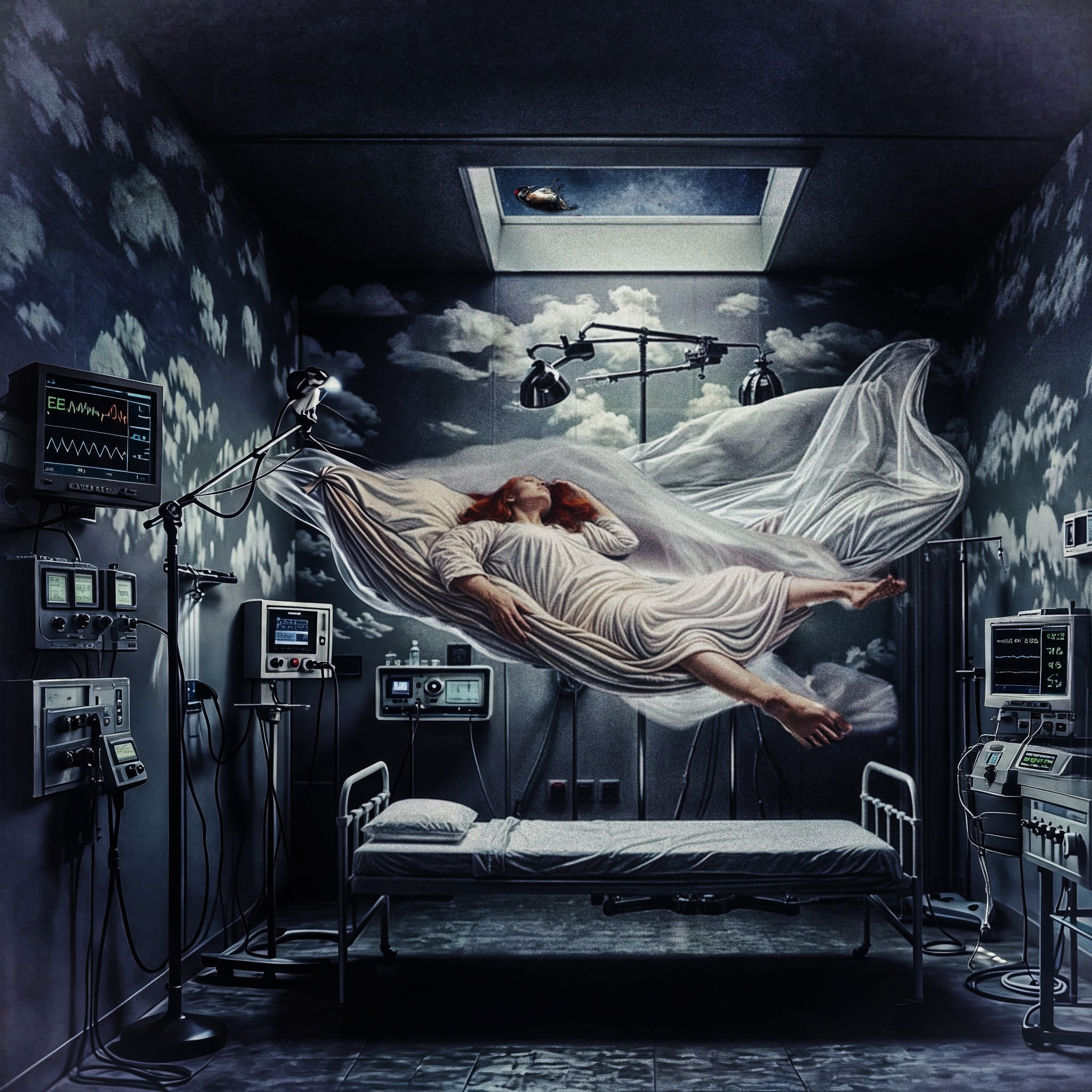
The cover art depicts a hospital room, replete with medical instruments and monitoring equipment. Suspended above the vacant bed is a woman, asleep beneath a shroud of white fabric. The room is adorned with cloud-patterned wallpaper and features a skylight, upon which rests a deceased bird.

♫ Embrace that Distant Shore ♫


117/398

LogoSwitch language

I enter the corridor after far too little sleep. But that’s how it is here in the sleep lab: the work mostly happens at night—the subjects sleep, the researchers stay awake and collect data. This time, I’m attempting to communicate with a subject who has mastered lucid dreaming. I step into our control room, from which we can observe the narrow bedrooms through one-way mirrors on three sides. Only one bed is occupied.

When the EEG indicates that the student is dreaming, I trigger three bright red flashes to illuminate her small room—a prearranged signal to help her achieve lucidity within the dream, a kind of knock to let her know we want to make contact. She’s one of our most experienced lucid dreamers.

The movements of her eyeballs, as shown on the corresponding monitor, now form a recognizable pattern. First, eight jerks to the left, then five, then twelve, then twelve again, then fifteen. A simple code: she’s just said “Hello.”

Through the intercom, I ask if she can hear me. The EEG shows she is asleep and dreaming. Nevertheless, she signals with her eyes: “Yes.” – “Then let’s go!” I say. She knows her task. She is to—while dreaming and without waking—levitate her body until she is above the cabinet in her room and relay to us what drawing she sees. We placed it up there without knowing what it was ourselves, as it is selected at random.

A short time later, she signals to me with our somewhat cumbersome but simple code: “dead bird.” I hurry to the cabinet, full of anticipation.

It’s not a dead bird, but a letter-number combination: F-B3T-42. I’m a bit disappointed, but as a scientist, I must not be guided by expectations; I have to stick to the facts. And the facts suggest that while she dreamed of performing the task, she only did so in her imagination rather than during an out-of-body experience. Our subject later reports having seen a woodpecker, but she said the word seemed too long to transmit via eye movements.

A week and a half after this experiment, I happen to see our caretaker in the courtyard outside the low-rise building that houses our labs, holding dead woodpecker in his hand. I ask him about it, and he explains that since our two chimneys were clad in polished chrome, birds occasionally break their necks on the roof, mistaking the reflection for the sky. I have him show me the spot on the building’s floor plan. Sure enough: the dead bird lay directly above the cabinet where we had placed our random drawings. Only a few meters higher, on the roof.

The caretaker, a man accustomed to all sorts of nonsense from us researchers, examines the woodpecker more closely at my request, pokes a finger under the feathers, and says: “Sure, coulda been layin’ up there for a week and a half. But what’s the difference, anyway?” I leave him without an explanation.

We had already discontinued the study because we couldn’t achieve significant, repeatable results. Was it too hasty? I don’t tell my colleagues about the dead bird. With an anecdote like that, we’d only be a laughingstock in scientific circles.

135/398

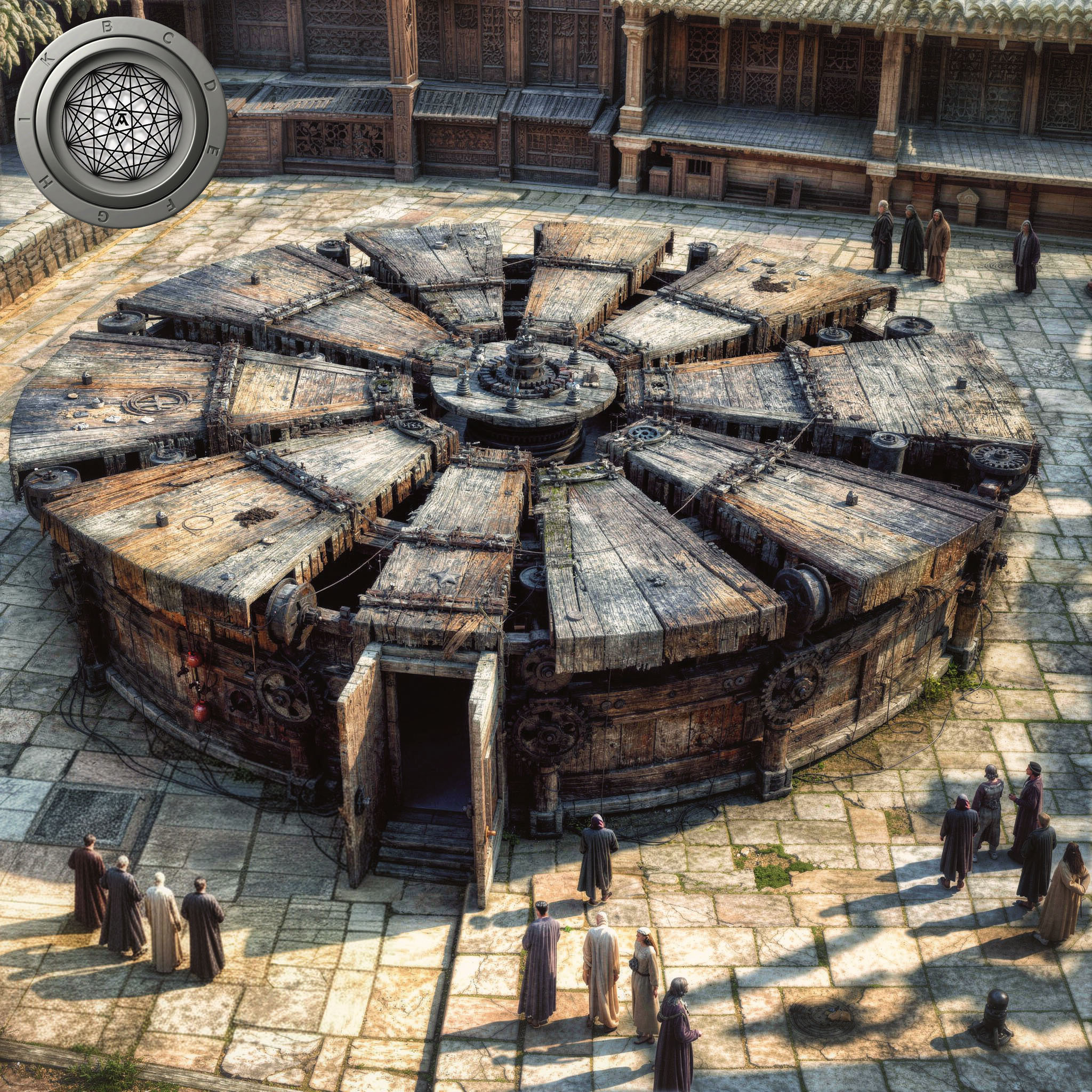
The cover art shows a large, round, mechanical structure made of wood with several segments and open doors, surrounded by people in historical garb on a paved courtyard in front of a building with arcades. A digital button in the upper left shows a complex diagram surrounded by letters.

♫ Computing the Numen ♫


135/398

LogoSwitch language

I enter the corridor that has opened up after Abdoul and I turned the large wooden wheels a bit further. I still cannot fathom it. After so long a time! My Ars magna has become accessible, and now all may see how grande, how majestic, how all-powerful God is. What were just a few labeled paper rings before, this ingenious mind I met in the Djamaa ez-Zitouna, the Olive Tree Mosque, has crafted out of timber. Now, when you climb one of the minarets and view it thence, my Ars magna resembles a huge overturned church clock, almost filling the entire courtyard, except that it doesn’t indicate the time but the truth.

Truth must be logical because God—or Allah, as they call Him here—does not entangle Himself in contradictions like us humans. His truth can reveal itself to us in a wonderful way. Just as it opened before my eyes when I slid some labeled paper rings on top of each other, revealing the Ars magna to me, it is now tangible in Abdoul’s grand mechanism.

We have taken the Complete Figure with the squaring and triangulation of the perfect circular form as the basis, and Abdoul has crafted huge, movable spoke wheels for it. Each spoke carries a term, in Latin and Arabic, and turning the wheels shifts them against each other. Encountering this theologian, who is also a gifted designer, was a great stroke of luck for me. Now, I can literally walk through and feel the virtues of God: His eternity and power, His wisdom and His will, the entire glory of the Highest. Now we, young Abdoul and I—an old man of eight decades—can create chambers, as I have always dreamed, corridors of concepts that make irrefutable statements about His actions and His existence, rendering all disputes between religions obsolete.

The Muslims who gather to view our work whisper among themselves. The wooden mechanism, which allows the ultimate truth to be found, the walkable Ars generalis ultima, seems to scare and displease them. More and more of them are pouring forth into the courtyard, and their voices are getting louder. However, I feel upraised, and if Abdoul did not restrain me, I would lead them all into the Ultimate All-Encompassing Art and show them that it may answer all their questions.

“Is the world everlasting?” This is the question Abdoul and I have chosen, and we have set the large wooden wheels accordingly: B for the question “whether,” D for the Eternal—and for C, the middle position, we have chosen Goodness from the catalogue of qualities. And now I stand in the midst of the answer to it, the only possible and logical answer. We see it in the chambers and corridors that form: If His creation were eternal, in logical consequence, so would be Goodness without end. But if Goodness were without end, there could be no Evil, because Chamber C can only symbolize either one or the other, never both, true to His infallible logic. However, since there undeniably exists Evil, and we experience and feel it everywhere and at all times, this is a contradiction that reveals to us that the world cannot possibly be eternal. Only God is eternal. I would like to shout this from depths of mine heart to them, to the whole world, and lead them all by the hand if Abdoul did not earnestly beseech me for patience and caution.

Nevertheless, an internal rejoicing fills me. It is almost as if the vision I had over fifty years ago, which gave an unexpected turn to my life as a troubadour, has finally become reality: wooden, mechanical, tangible, irrefutable reality.

136/398

The cover art depicts a cluttered artist's loft, its walls bearing the marks of time. A vibrant red table anchors the space, surrounded by easels, scattered art supplies, and metallic implements resting on the floor and stools. Dominating the background, an abstract canvas is suspended against the wall.

♫ Altering the Integral Triangle ♫


136/398

LogoSwitch language

I enter the corridor. And although I’ve walked the path to the studio hundreds, perhaps thousands of times, today is different. I gaze at the cubist paintings on the walls, the curious figures and machine-beings in the niches—favorites, unsellable pieces, small works of art I once found inspiring and perhaps life-defining. Now, suddenly, they confront me with the truth: there will not be enough time. I have taken on too much. I shouldn’t fool myself into believing I can ever complete everything in my notebooks waiting to be realized. I will leave behind unfinished paintings, sculptures that exist only as sketches, collages that have barely progressed beyond the idea stage—a chaotic, fragmented assemblage, incomprehensible in its entirety: enigmatic and, in all likelihood, thoroughly misunderstood.

Dizziness sweeps over me, and I have to lean against the wall. I resolve to produce more, sleep less, and stop letting myself be distracted, focusing instead on the essentials. Perhaps I can scale back my simple, frugal life even further to avoid constantly working for money, allowing me to devote myself to art with even more focus, more intensity, and more exclusivity?

Yet I cannot deceive myself. No matter what I do, it won’t change the fundamental truth: life is simply too short—and art far too long.

174/398

♫ Queen Puabi (Reigning Cats and Dogs) ♫


174/398

LogoSwitch language

I enter the corridor that connects my house to the boathouse. I haven’t been here in months—first because the lake froze over during the harsh winter, and second because a demanding job for a non-profit organization left me with no time for my private research. Here in the hallway, I’ve set up a narrow table where my notes are spread out next to the cryptic original text and my attempts to reconstruct the game board and pieces.

Years ago, through a lucky coincidence, I came across some yellowed records mentioning a long-lost board game that was apparently quite popular in southern Europe during the Renaissance. It was called “Citadel,” and the text—a letter to a merchant father from his son traveling in distant lands—mentions some of the pieces, though unfortunately only in passing and not to document the game and its rules. The reconstruction is proving difficult. If it is ever to succeed at all.

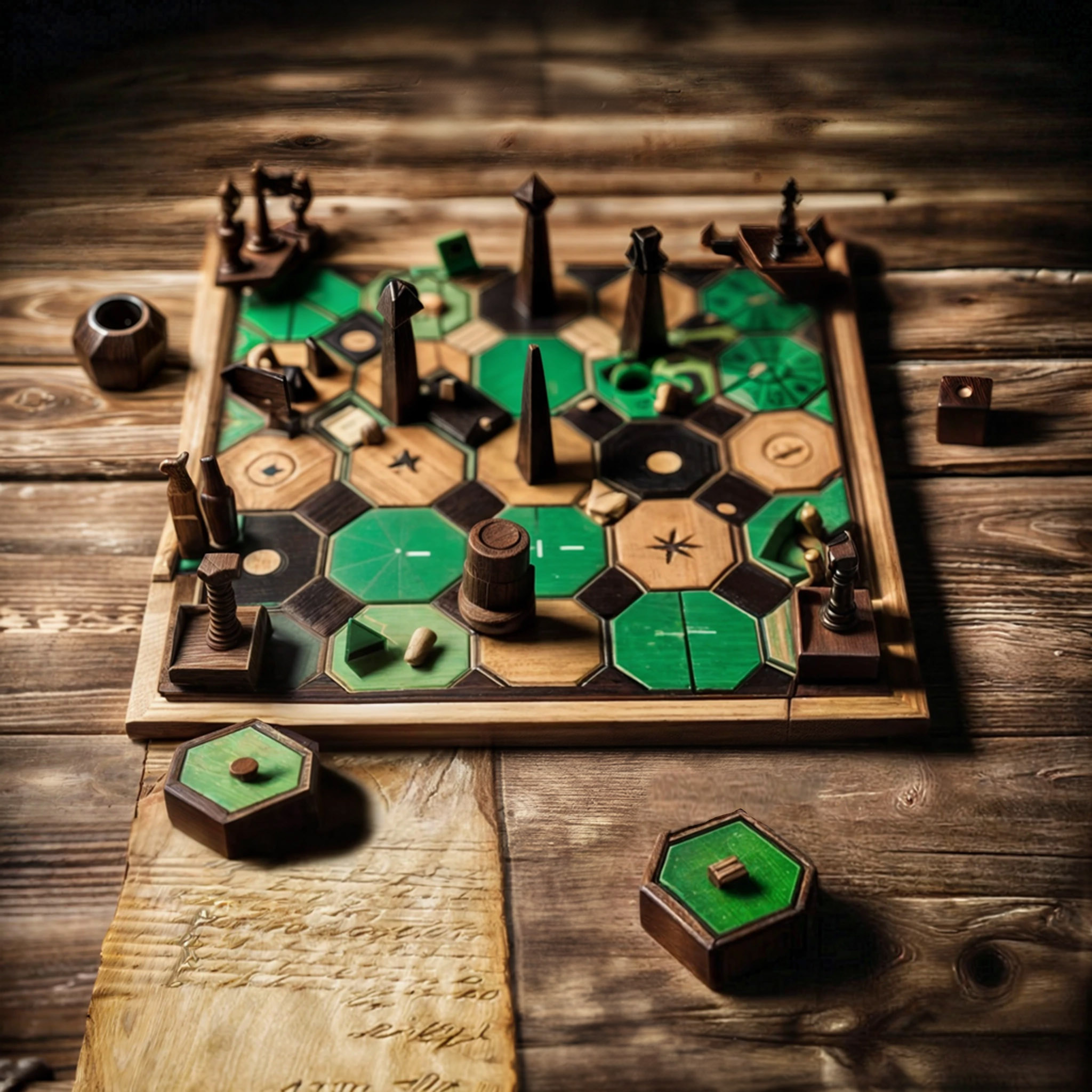
My honeycomb-shaped replica of the game board is sawn from balsa wood. I have colored the spaces alternating brown and green, true to the anonymous author’s notes.

Thoughtfully, I pick up the game pieces I carved. The text speaks of a “sweeping courier,” “catapults,” and a “nimble princess.” The inferior pieces apparently included numerous “vassals,” which—due to my lack of crafting or artistic skills—resemble simple obelisks. The “Throne” and “Scepter” pieces didn’t exactly turn out to be masterpieces, either.

I lose myself in my intricate notes. “Executioner captures jester,” I read. But how? Must there perhaps be a symbolic sentencing by a judge first? Once again, the enigmatic game completely consumes me.

And then, just as I give my tired eyes a good rub, he is sitting across from me: the unknown author, a dapper young man with a mustache and a green velvet beret. With a surprising move, he places his king’s son next to my princess. “Throne and scepter,” he says with a broad smile, before the brief vision vanishes.

That’s it!

Internally, I rejoice, having just taken a massive step forward: “Throne and scepter” in the yellowed letter—that doesn’t describe two more pieces; those are the words that end the game!

I take the small, crude pieces I had carved for the scepter and throne off the board and carelessly let them fall under the table—and with that, the game suddenly comes to life, the moves and strategies become clear, and the rules stand vividly before my eyes. It’s all so obvious. “Throne and scepter!” I shout, dancing through the hallway.

177/398

♫ Rent-a-Monk ♫


177/398

LogoSwitch language

I enter the corridor. Sand—white sand has been blown in. Through it lead strange geometric tracks marked by imprints of rectangular crossbars: a line of primitive Braille consisting of the same repeated letter, etched evanescently into the sand.

The corridor opens onto a beach—the roar of the sea had already signaled this. I follow the tracks eastward, my gaze fixed on the grooved sand and the low-hanging sun.

Now, faint, mournful sounds pierce through the roar of the ocean like the tips of knives through a billowing curtain. A figure is perched by the water, playing a stringed instrument, his face turned toward the horizon-wide ocean.

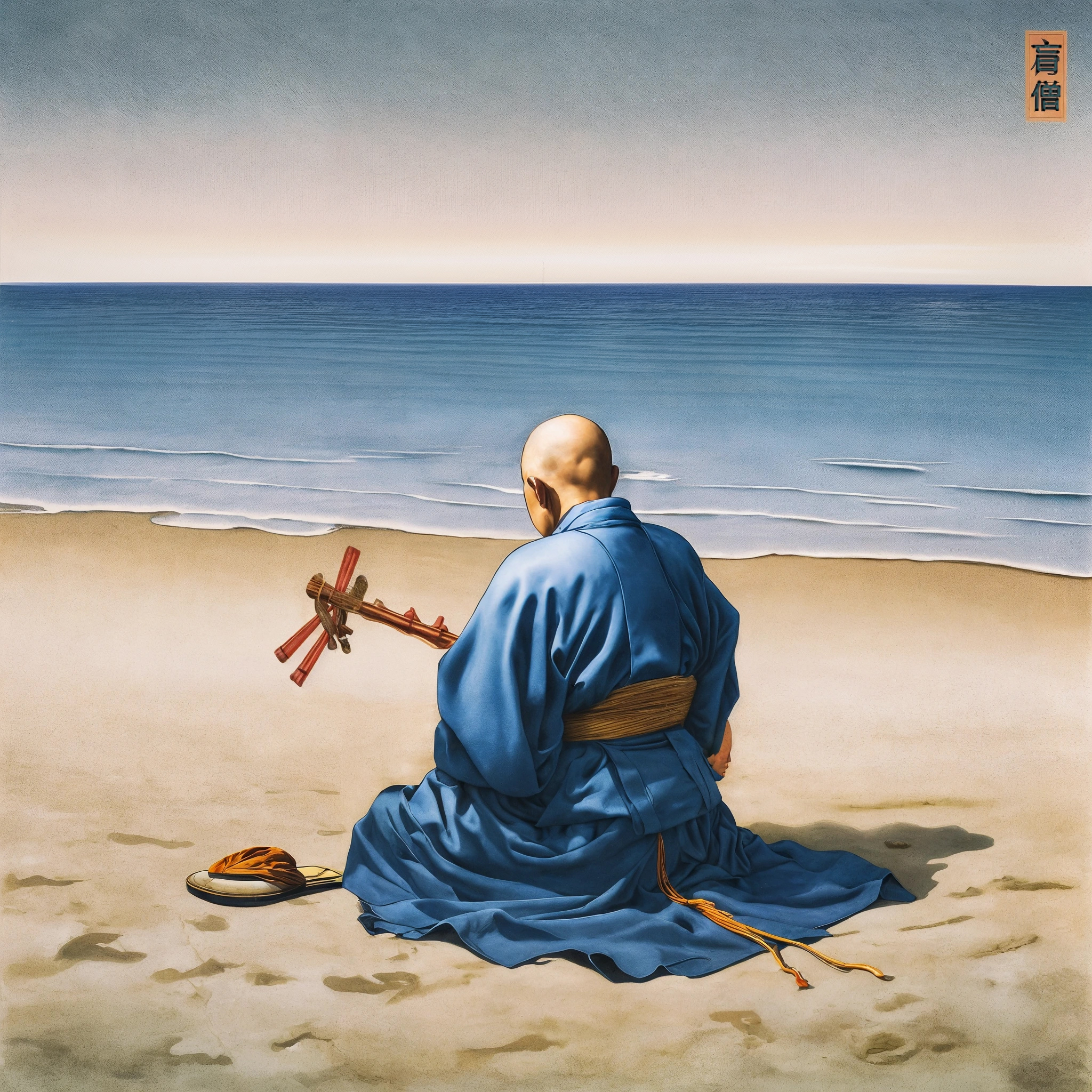
He is Asian. His head is shaved bald, though the regrowth is already darkening his scalp. The monk wears a blue silk robe and white trousers. Beside him sit his sandals—simple wooden blocks with a loop on top and two wooden slats beneath—the source of the tracks that led me here.

The monk sings, striking the four strings of his lute with a tapered piece of wood.

“It is a biwa,” a voice in my head explains—but it is not a voice. It is more of a déjà vu, a fragment of long-forgotten knowledge.

The monk ceases his playing, as if a noise had pierced his concentration, and turns his head in my direction. He mutters something in Japanese, nodding as if to confirm his own words to himself; then he stands, sets the biwa aside, and bows deeply to me. As he raises his head, I see now that he is blind: his eyes are mute, broken long ago.

Nevertheless, I bow as well and sit down to his left after he begins to tell me a story.

I cannot explain how I am able to understand the moso’s story, as he is speaking Japanese. But somehow the old man’s dry voice touches my heart and paints ink drawings in my mind, so that I grasp everything he tells me.

And so I listen, moved, to the moso’s tale of water, fire, wood, earth, and metal—of a land where people live in harmony with nature and know how to appease the demons—and I am saddened that I can take so little of it back with me into the narrow corridor of my alienated and superficial life.

The sun has long since set by the time the monk resumes his biwa playing and I begin my walk back. Regrettably, the magic of his words and images quickly evaporates; they melt like snowflakes in my open palm the moment the clamor of the city rolls over me again.

185/398

♫ Inducing Magnetic Lucidity ♫


185/398

LogoSwitch language

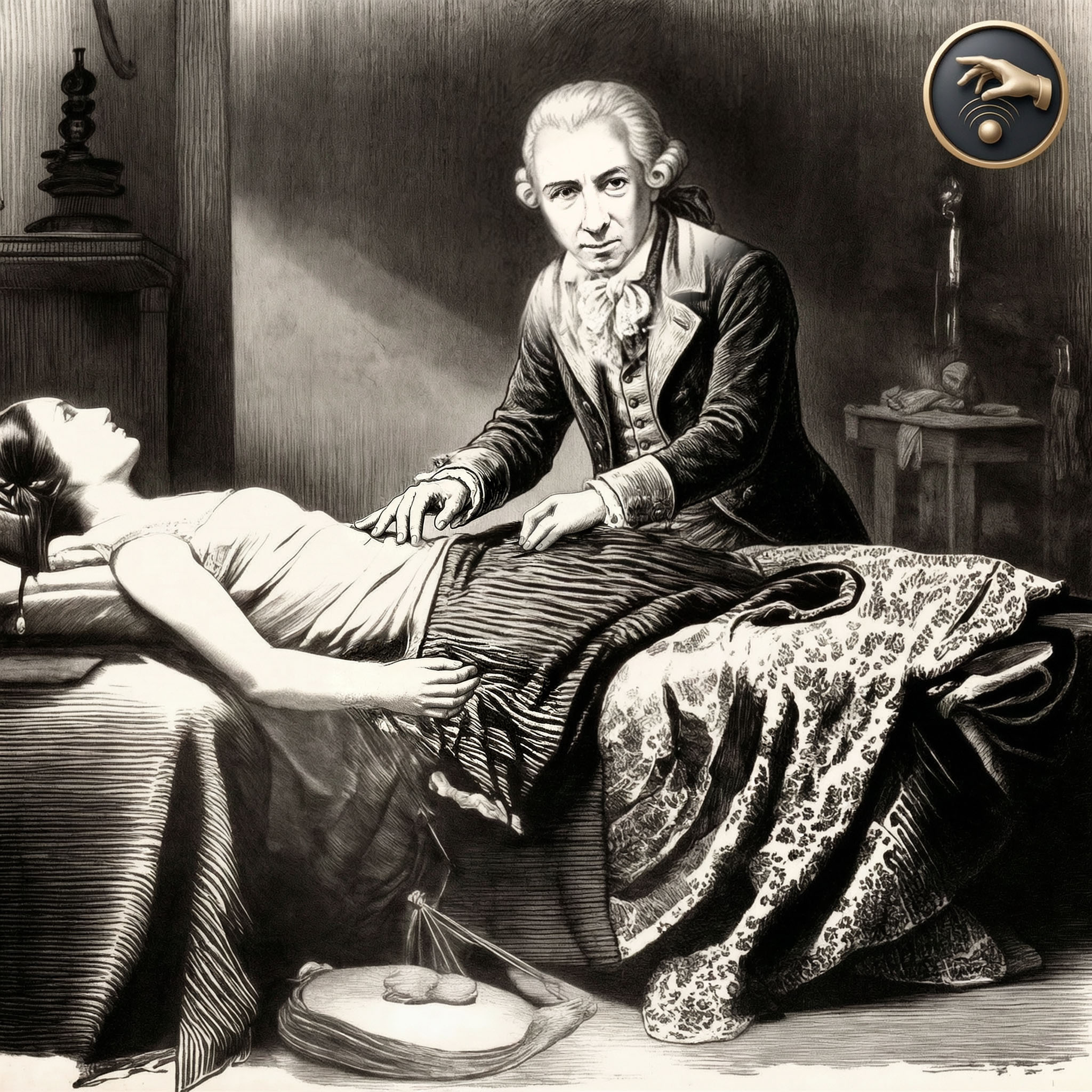
I enter the corridor. A woman’s moaning drifts from the treatment room. I knock and enter, placing the requested magnets on the table for the Maître. He holds his hands over his patient, pays no further attention to me, and mutters, “The fluid must flow; the invisible fire of life must spark the crisis to pave the way to healing.” Then he reaches for the magnets and passes them along the body of the woman, who is breathing heavily, her eyes rolling back.

I have also tried my hand as a magnetopath, covertly borrowing the Maître’s healing stones and waving them over the slowly swelling belly of my girlfriend, Eloise, the Maître’s maid. She, too, rolled her eyes, but likely because she found me and my muttered incantations quite ridiculous. In the end, she went to an angel-maker.

Perhaps it is not the magnets at all, but rather the Maître himself—his own magnetismus animalis—that causes the reactions of his female patients and these miraculous healings? I still hope that he will take me on as a disciple and initiate me into his secrets. With an impatient wave of his hand, he dismisses me.

I step back into the corridor. For a long time, I listen at the door, hearing how, with the help of his magnets and incantations, he melts away the woman’s blockages bit by bit.