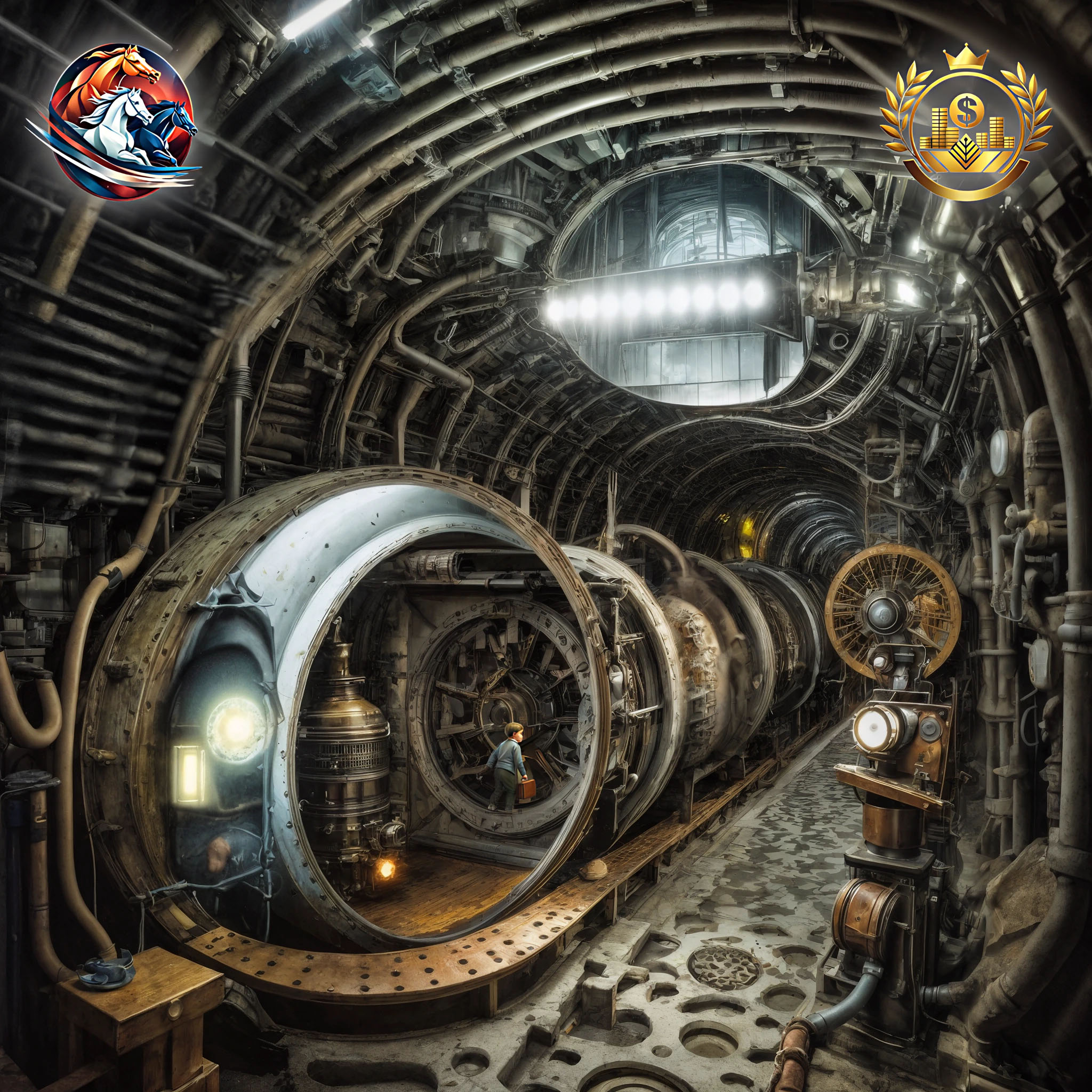
I enter the corridor leading to my memory palace. Of course, this long hallway doesn’t actually exist—not even on blueprints—any more than the palace itself, whose sprawling rooms are accessed through the colorful doors of the entrance corridor. It is a pure invention, a figment of my imagination. I traverse it in my mind repeatedly to give my feeble memory a boost. Whenever I want to remember something new, I either tuck it away in the appropriate room or simply add on another cabinet.
In the palace, I know every detail: the rooms, wall niches, windowsills, the half-height columns, tables, secretary desks, dressers, shelves, and printer’s trays—all the places where I mentally deposit things I want to remember. Or must.
The entrance corridor, however, is empty. It contains no niches or furniture—only the doors to the various wings of the palace. Behind the white one reside all the phone numbers I’m supposed to know by heart. (This is also where I would have stored the number Pi to any number of decimal places, had I the ambition to memorize it.) Then come doors in every color of the rainbow, beginning with infrared and ending with ultraviolet. From scientific discoveries, formulas, and jargon to biological facts, technical terms, and the life dates of famous researchers, all the way to the great milestones of human history—you can find just about everything here that ever seemed worth remembering to me. Whether it’s the names of the primordial continents (and the potential ones of our future, like Pangaea Ultima and Amasia), the 398 expletives from Joyce’s Finnegans Wake, or the 28 possible features of a leaf (from hastate to seven-pinnate).
At the very back, there is a black door. It leads to the basement of my palace. There, I store… but perhaps I should keep that to myself. In any case, this corridor—the one with the many colorful doors through which I enter the wings of the palace—inspired me to write a few short texts. I regularly deposit their content, their order, and their connections to each other and to other works of literature behind the orange door. Just as I am doing now with this very piece: traveling to deposit it in a special spot within my personal cabinet of curiosities, never to be forgotten again.
I enter the corridor, and, yes, I will also take the next step and enter the lecture hall. But, folks, do not be too quick to rejoice. Even though I stand here today—breaking the long, long silence to a certain extent unexpectedly—rest assured that surrealism is not my subject, nor is this about love or death. David Gascoyne once wrote—if memory serves me right—“The full breasts,” well, not exactly, it reads just “The breasts of eternity await my tender hands.” But eternity won’t be my subject either, just as the youth the beauty the mill or the secret word won’t be.
Yes, the gazettes write it again and again and hardly leave me any room to doubt: that I was once called “the tiger”. “Ocean of silence” I would have liked almost better—my attacks were explosions, but inconsequential as they were meant to remain unique. At least, love is also not my theme, and there’s a good reason for that.
I believe I should regret my decision to speak to you, for it seems to me the attempt alone is destined to fail. I won’t deny that the lunar caustic likely corrodes as its name suggests, but it doesn’t heal.
I often have to think of Gascoyne’s phrase, “the breasts of eternity”, a fleshy image, but perhaps misguided. He seeks to make two hits with one shot, but by my own reckoning, he doesn’t account for the fact that the essence of duration ultimately ends in silent reverence. The voluptuous blonde up there with “Nirvana” on her T‑shirt might grasp it if you will, but for those who’ve written “1984” on the board—insofar as I am aware—they might as well have scribbled “Kilroy was here” or just his long nose. As I recall, with some reservation, for memories are treacherous, which in turn distracts from the fact that the idea we make of the present is also as deceptive as a fairy tale we tell ourselves … But I digress.
Didn’t I firmly resolve not to err? Now it seems this lecture is turning into a sort of confession. But except for monologues delivered by villains at the end of crime stories, to explain what they did and why, such a confession is undoubtedly not just superfluous but thoroughly agonizing. I want to say—but what do I want to say, not just prattle on but, one might say, call down, conjure up, what is my theme? That such a theme can only be a fragment, and as they say, no fragment of reality does it justice?
Don’t worry, I won’t speak much longer; speaking tires me, and seeing some of you taking notes depresses me. So many mistakes are made, and multiplying them in this way seems to me—why shouldn’t I admit it?—like an unintentional grotesque parody of something that is absurd in itself. Or, as I’d like to call it, it’s a second-order absurdity.
Can the night, if I’m not mistaken about the times, give the day’s agenda a wipe? I remember now. The bold interjection—wasn’t it Braulio Arenas, whom I just saw somewhere in the fourth row?—leads down a wrong path. “The Farewell,” it should be called! That’s the theme, that’s the inducement, that, if there’s any moral approximation, is the crux.
It’s been twenty-four years. I recollect. It comes back to me: the attempt back then to start all over again. “I enter the corridor to visit the ladies of the past,” I wrote. You may find it surreal or hermetic or simply misguided, but at that moment, it appeared to be a truly life-defining step, and I put three dots after it. As I’m told, everything left unsaid stimulates the human mind to vividly imagine the omission, and let it not be thought that this doesn’t apply to the one responsible for the omission. Perhaps for this reason, three dots seemed insufficient to me, and I added more of them almost frenetically, at increasingly greater intervals. When I reached eighteen dots at the end of the page, it became clear, as one might easily imagine, not only the futility of all this but also that I would never speak again, let alone proclaim anything from the pulpit.
I had, to use this admittedly old and, grant this to me, beloved metaphor, crossed the mirror. And that’s the mirror, which I, forgive me, would hold up to all of you if I were capable. I had completed the crossing of the mirror, leaving all themes and dramas, all futile words and incantations behind me. And now, to be honest and straightforward, I looked calmly at what lay—tangible but literally defying any description—before me.
And so, I fell silent, in an instant, unawares, had become, to call a child by its name, speechless. I fell silent, as I will do now—after these useless and (despite all the, pardon the coarse expression, drudgery on my part) probably more than erroneous and incomprehensible explanations — for good and forever.
I enter the corridor leading to Professor Ceril’s laboratory. It’s made of a gleaming, silvery material that flows in curved shapes: no sharp edges or right angles. The professor claims that walking contemplatively down this corridor gets him in the zone for his work, heightens his concentration, and deeply inspires him. I don’t notice any of that. Instead, I slip on the uneven floor and go sprawling. It echoes as if someone had struck a giant Chinese gong. Luckily, I didn’t hurt myself too badly.
“That’s the breakthrough!” Ceril’s unmistakable voice greets me from inside the lab. He seems—too absorbed in his research—not to have noticed my gong performance. Everything in here is blinking and beeping, and I have trouble spotting the professor behind all the cables, suspensors, and pulleys hanging from the ceiling, and the various artifacts of past experiments. Wearing headphones, he is bent over a small metal box covered in buttons. Excitedly, he explains to me that he’s developed a virtual microphone he can send to any coordinates in the world via gravitational waves. At first, I don’t get it.
“I can enter any coordinates, and then I hear whatever there is to hear at that location. It’s a kind of gravitational-wave radio that can receive signals from virtually infinite stations—namely, from any point in the universe.” I must look pretty lost. That doesn’t change when he hands me a second pair of headphones to demonstrate his invention. Just to test it out, he types in the coordinates for the White House. “Let’s do a little spying,” he says with a mischievous grin.
I hear the rustling of silk sheets and soft whispers of love, though despite an intense read-through of an English dictionary two or three years ago, I don’t catch every word. But I do pick out two names: John and Cindy. Now Ceril looks pretty lost, too. I enlighten him (after all, I have to live up to my reputation as a child prodigy every now and then): “McCain and his wife?” Ceril wonders what on earth they could be doing in Obama’s bedroom, but then light dawns on him: “We’re eavesdropping on a parallel world! One where McCain won the election instead of Obama. Yes, that must be it—the laws of physics are protecting themselves from a sonically infinitesimal recursion. Just like the uncertainty principle.”
Ceril immediately punches in the coordinates of his own lab, and sure enough, we witness a conversation between him and me—except, he says, these are our alter egos from a parallel universe. Interestingly, in that reality, I seem to be the aging inventor and he’s the teenage assistant.
Before I can learn any more, Ceril switches off the device, takes off his headphones, and turns to me: “This opens up fantastic possibilities, kid! I can eavesdrop on other versions of myself who have already worked out my many ideas”—he taps the massive index card box beneath his desk—“which saves me lengthy testing phases.” And saves me, I think, from potentially perilous real-world tests of his countless inventions. “I just need to modify the thing accordingly.” With that, he starts scribbling complex formulas on paper with one hand while twisting wires together with the other. As for me, I am completely forgotten.
Would I even be interested in what other versions of me have to say? On the walk back through the corridor, I shake my head. What good would that do anyway? Then I remember why I went to see Ceril in the first place: to ask if he could build me a machine that spits out what teachers will want to know on exams a few days in advance. Then again, I have to admit to myself that even without a prediction machine like that, I’ve always known everything anyway—and school shouldn’t get any more boring for me than it already is.
(And it won’t. Quite the opposite. Because of her. But that’s another story.)
I enter the corridor, this one I’ve walked down so many times in recent weeks. Behind that white door over there, you lie, with a machine aiding your breathing. Sudden brain hemorrhages sent you into a coma within hours, and the doctors say too much damage has been done to your brain to hope that one day you’ll wake up and be the same again.
I hold your hand. The heart-lung machine’s bubbling and hissing have become oddly calming and meditative—but only since I let go of my protest against all of this, my anger, my bewilderment, my despair, and my hope for a miracle.
When we’re alone, I quietly reminisce about our shared experiences, the trips we took, the movies we saw, parties, seminars, and meetings with friends—or just little quirky everyday anecdotes that come to mind. Sometimes, I also play your favorite music on the small cassette recorder.
People suffer and die all over the world—constantly. Why does it hurt me so much to see you lying here while I’m indifferent to everyone else? Almost inaudibly, I ask you the question, imagining you could speak to me, and you say: I’m not suffering – you are.
And then, for a few moments, a few heart-lung machine breaths, it’s as if you’re holding my hand and offering me comfort, courage, and hope through your silent presence.
Today, they’re turning off the machines, and you’ll be transferred to a hospice. I’ve chosen a small, cozy room for you: through the window, you can see trees, and you can hear the birds sing, even though it’s in the middle of the city.
You’re going to like it.
And if you no longer want to stay, you can leave. I still hold your hand, but I’m no longer keeping you here.
I enter the corridor, which initially strikes me as wild and expressionistic, reminding me of van Gogh’s Corridor in the Saint-Paul Asylum in Saint-Rémy. But just a few moments later, it begins to melt, and everything dissolves as in a painting by Dalí. Initially, it’s the oil paintings on the walls that slowly start to drip down. Then the doors, too, begin to buckle, losing their consistency and flowing sluggishly into the corridor. Meanwhile, as I try to escape—to get away from here, where everything seems to be disintegrating!—I increasingly lose my ability to move, and my body stiffens and solidifies. I can still stretch an arm with my last strength, but I’m already frozen, turned into stone. Slowly, I sink into the amorphous mass that was a respectable art gallery in Venice just moments ago.
Later, after centuries, they will retrieve me from the sea and mistake me for an ancient statue, whose horrified expression an old, nameless master had masterfully captured.
I enter the corridor. It’s a strange feeling to come back here after all these years. At first glance, everything looks just as it did then: the white vaulted ceiling, the simple stone pillars stretching at regular intervals into the distance, the smooth, cool marble floor beneath my bare feet—and the guardhouse standing right at the entrance. The troll opens the small, oval wooden door in the window to speak to me.
“Who are you, and what is your business here?” He sounds stern, but then, he has to be. He’s the controller here. I’d completely forgotten that he appears to me as a troll. I didn’t invent him. At least not consciously.
“It’s me, the Boss. I just wanted to see that everything is in order here.”
The troll looks at me, knitting his brow. “Do you have an appointment? Have you filled out the forms? Do you have an ID or a recommendation? Because you can’t just come in here like…”
“Whoa, whoa—slow down,” I interrupt him. “I don’t need any of that. I’m the Chief here. And I’d like to have a word with my Controller.”
“That’s me,” says the troll in his guardhouse, without a trace of humor.
“What’s your task?” I ask him. He explains it to me. Like everyone else here in the first part of the corridor, the troll has a fairly limited horizon. So, it’s no surprise when he tells me that his job is to keep everything under control, day and night, because otherwise things would immediately go off the rails. Control is everything, and without him, total chaos would break out. “I’m just trying to do my job as well as I can,” he says.
“You’re doing a fantastic job,” I say, and I mean it. In fact, my inner controller has saved me from a lot of trouble, and he’s visibly pleased by the praise.
Then I ask him if he’ll let me talk to the others further down the corridor without him interfering. There’s a brief discussion, but eventually, he agrees to take a short break. I give him a grateful nod and pass the guardhouse, heading deeper into the corridor.
Beyond the arches lining the sides of the corridor, various rooms open up. They are inhabited by other members of my inner ensemble—one-dimensional characters much like those found in myths, fairy tales, and pop culture. Types like the Minotaur, Chewbacca, the circus clown (“Ta-da! Magic!”), Gollum (“We wants it, we needs it. Must have the precious!”), or Scrat, the saber-toothed squirrel—characters who, in their simple-mindedness, sometimes move us deeply.
I hear a sob.
It’s a small, gloomy room with a worn-out bed. In one corner of the room, a pathetic little heap is huddled. “Who are you?” I ask, though I already know. It is Despair. A sob is her only answer. “What is your task?” I inquire. She turns to me and begins recounting her experiences in a halting voice: she sets out full of hope, only to be driven to despair by circumstances and other people. This has been going on her whole life. And since apparently no one else is willing to feel and confront this despair, she takes on the task herself—she explains, big tears welling in her eyes.
I thank her for her selfless dedication and stifle a cynical “Good job!”—instead, I suggest to the little, teary-eyed girl that she should team up with the Methodologist. He lives a bit further down the corridor. I can still hear his words ringing in my ears from our last encounter: “Formulate a goal, define the steps, work through them methodically!” The two of them could make a great team.
My next visit takes me to the study of the “Questologist,” as I’ve dubbed him: a young man with three-day stubble, a hat, and a coiled whip on his belt. He has maps spread across the entire room, with open books scattered among them. “What is your job?” I ask the Inner Seeker. Of course, he only knows one thing: searching! He is constantly on a quest—for love, for the answer, for happiness, salvation, perfection, the path, meaning, significance, enlightenment… “What about finding?” I ask with a smirk. But in truth, the Seeker is solely fixated on the search itself. If he ever manages to land a hit, he immediately sets his sights on the next goal, the next landmark on the horizon.
I tip my hat to him as well, because his insatiable yearning is very valuable to me—though he’s already too deep in his maps and treasures to even notice.
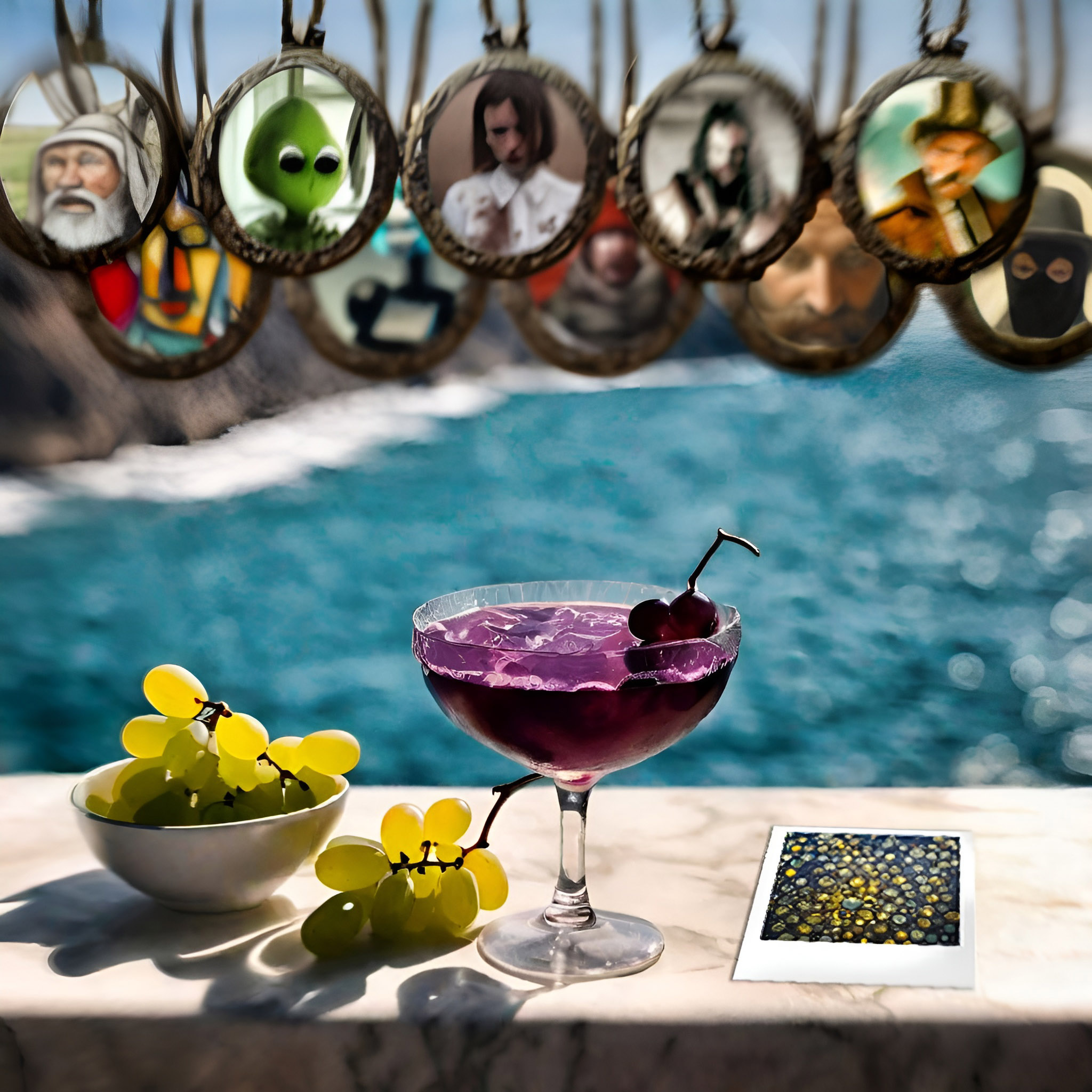
I was actually planning to visit the Daydreamer next, but as I continue walking, I notice a room that seems completely unfamiliar. It’s luxuriously furnished and opens onto a terrace overlooking the sea. In a deck chair, I spot a somewhat paunchy, hairy man in swim trunks. Next to him, within arm’s reach: a cocktail and a bowl of grapes.
“Delicious!” he exclaims. “Wonderful!”
“Who are you?” I ask, taken aback. He belongs to me?
“Mmmh, you’ve got to try these! They taste absolutely heavenly!”
He nudges the grapes toward me. I’m usually wary of people who end every sentence with an exclamation point. But I decide to try one anyway. They taste… not bad.
Aaaahh, the sun on my belly—could there be anything better? And this panorama! The breeze isn’t too shabby, either! That hint of salt in the air!”
“What is your task?” I ask. “Enjoooying!” he answers, drawing out the syllable with pure relish. “Living life to the fullest! Delighting in everything beautiful, delicious, and blissful! Speaking of which…” he says, turning his equally hairy back to me, “could you maybe give me a quick scratch between the shoulder blades?”
I hesitate for a second, but then I do him the favor.
“A little lower, yesss! Oh, that’s the spot, ooohh, just right, wonderful!”
Even the smallest things can be deeply pleasurable, I think, and I thank the Enjoyer for the inspiration.
I step back into the corridor. It’s time to proceed to the next section. Toward the end, it becomes brighter: the floor, the walls, the pillars, the ceiling—it all seems to radiate light from within. Here, I encounter further facets, but these are transpersonal: they are the parts of the soul that transcend our limited human perspective, anchored in Great Being itself.
Finally, I call out into the bright, gentle glow in front of me, “I would like to speak with the ‘Division-Exceeding Unifying Sense.‘”
“Yes?” responds a voice that is neither male nor female, neither old nor young. My gaze, heart, and mind expand. It’s as if I am floating in the void between galaxies, becoming cosmic space itself. It’s as if I were a silent flame in the innermost heart of all things—a power whose curiosity and love create the world and its beings, granting creation and all creatures the freedom to unfold in any direction they choose, to have every experience they seek, and even, if they wish, the freedom to forget who they truly are. It feels like the memory of the Source of all existence. “What is on your heart?” the voice asks gently.
A long conversation follows. On one hand, it’s a bit staggering to view one’s own small life from a cosmic perspective; on the other, it puts every problem, worry, and fear into perspective. And it feels simply wonderful to bathe in all-encompassing compassion.
One last step remains: to take all aspects of myself—including the transpersonal—out of the corridor, to leave it behind as the meditation ends, and to step into life not necessarily as a better person, but perhaps more at peace with myself… and thoroughly “soulful.”
I enter the corridor, my heart pounding in my chest. Time and again, I’m struck by the fact that stories, paintings, photos, and films of corridors leave me cold. But being there, physically experiencing the architecture—that’s what gets my heart racing and sends a shiver down my spine!
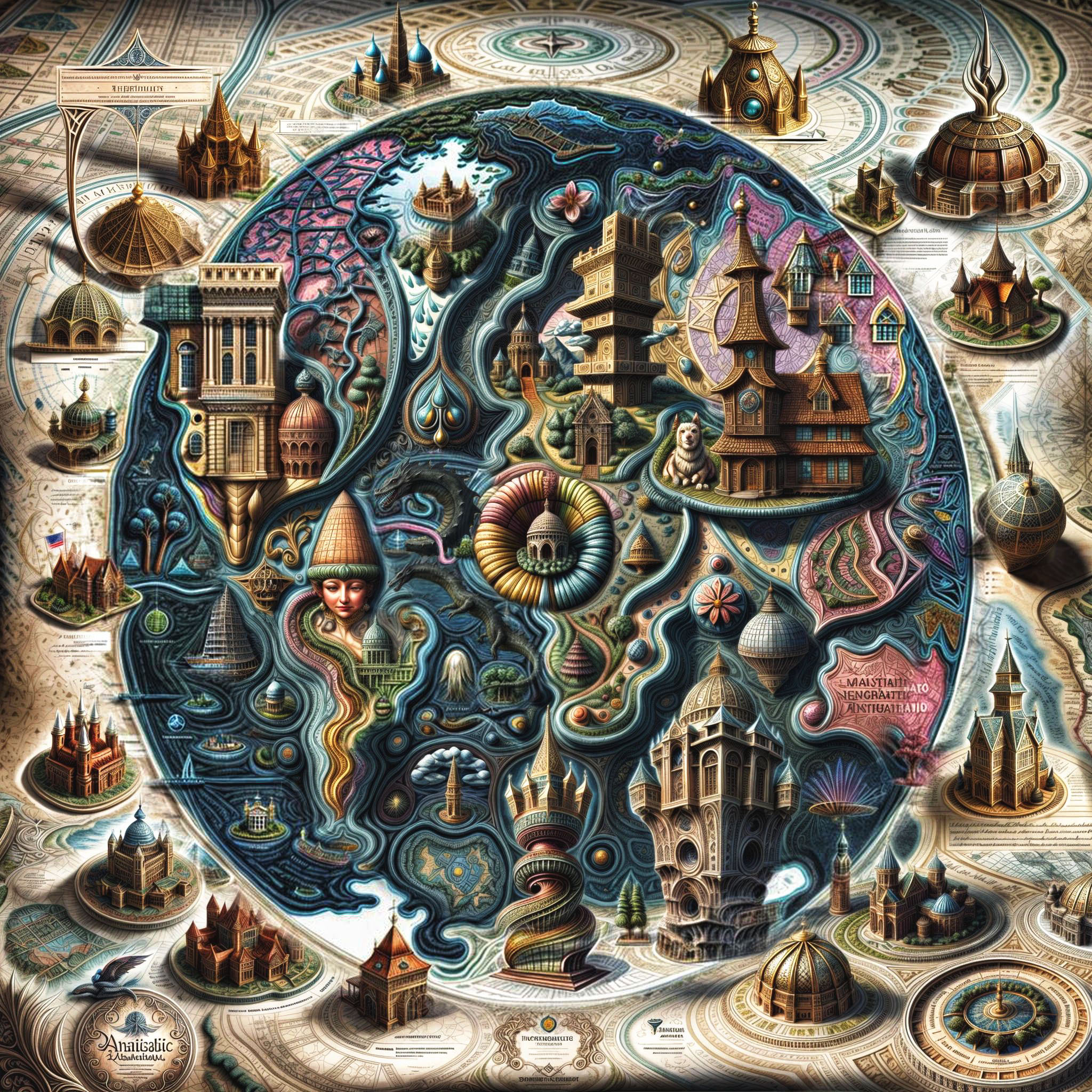
Here, I find extraordinary, one-of-a-kind corridors, akin to the unique buildings, castles, temples, dwellings, and villas found nowhere else in the world, in places that resonate with a special sound in my ears:
Chandigarh in India with the bizarre Rock Garden …
Here, obsessive visionaries have built their castles in the air, often in secret, and frequently over decades. I enter living testaments turned to stone—and the strain of the long journey, the jet lag, it all vanishes in these moments.
Filled with awe, I look around. These structures seem to have sprung from dreams—or perhaps nightmares:
On most visits, I take the time to create a drawing in one of the often artistically designed hallways and passages—which bear the signature of their builders down to the smallest details—inspired by the strong feelings that this fantastic architecture evokes in me. I use these sketches to adorn the corridors of the cellar vaults I’ve been secretly excavating beneath my property for over thirty years, expanding them bit by bit, corridor by corridor.
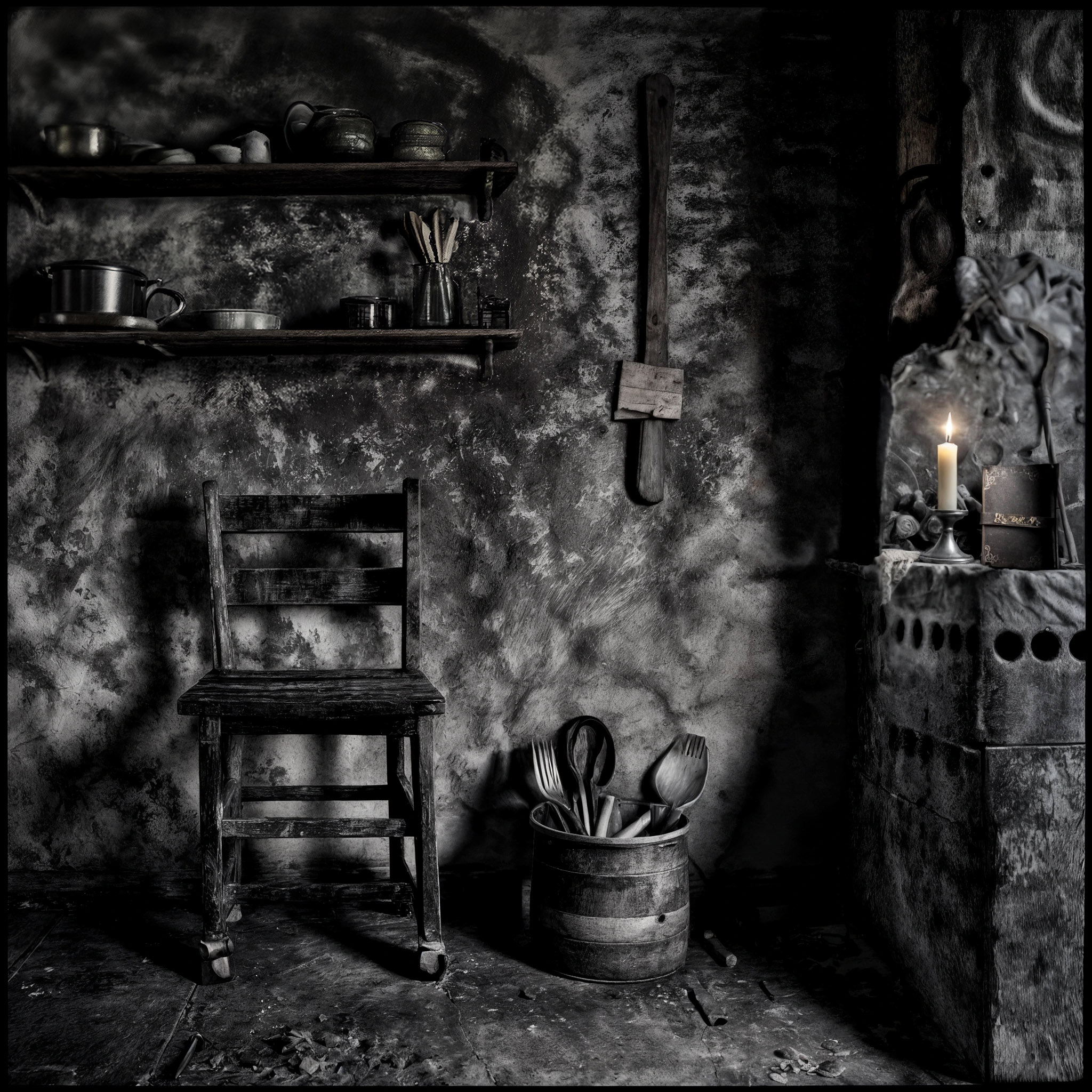
I enter the corridor. This narrow passage leading to the former coal cellar is the place where I set my small musings on life to paper. It smells musty here; it is cramped, plain, and dim. Yet, for some inexplicable reason, inspiration strikes me here with beautiful regularity. It is almost as if an alien, wiser hand were guiding my pen. I have placed an old wooden office chair on casters in the corner, next to the cobweb-draped wooden partition—and a candle on a narrow stone ledge in the wall. The ledge is pierced by a series of small, enigmatic holes that may have once served to hang tools, fetishes, or instruments of torture.
Here, my notebook and pen holder await. Here, I write—beginning with the three-quarter chime of the grandfather clock from the Biedermeier rooms above, muffled as it drifts down to me. I jot down my thoughts, the booklet resting on my knees, only to drop my pen precisely at the one o’clock chime, blow out the candle, ascend the stairs, and then, without further ado, retire to bed.
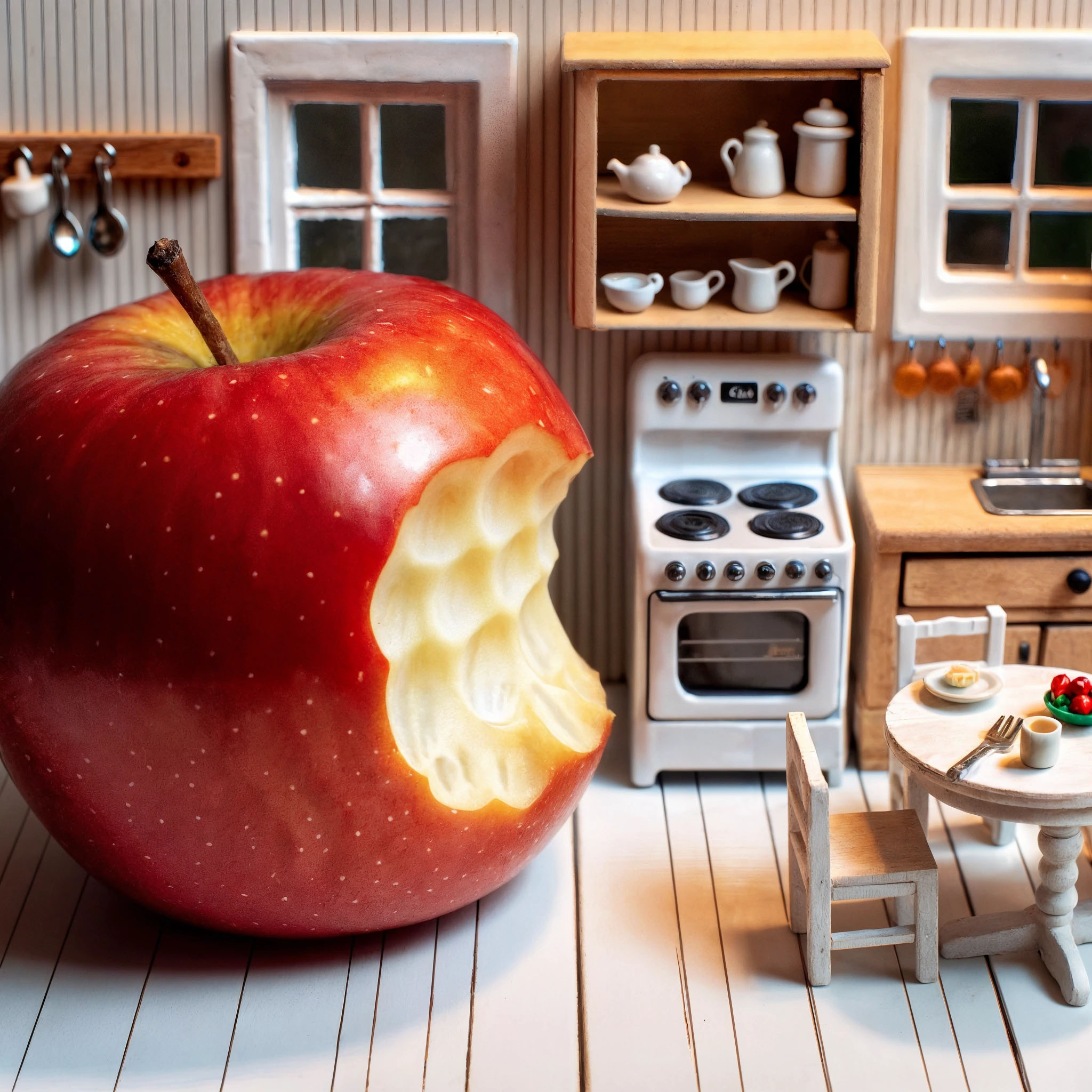
I enter the corridor of the dollhouse to make my way to the kitchen. The utensils there are comically oversized, but I don’t want to completely abandon civility. Rather than shoveling my food into my mouth, I prepare it to the best of my ability. If I already look like an uncivilized forest dweller, I want to maintain at least some dignity internally and in my daily actions.
Because ever since my courtesan bewitched me with a voodoo spell and shrunk me to the size of a thumb, I am completely at the mercy of her adolescent daughter. She sees me as a toy and, for her amusement, forces me to perform all kinds of tricks. Although I unroll the poster I painted with the word “Hunger” almost daily and let it hang from the bedroom over the partially open entrance hall, she only occasionally thinks about putting a lettuce leaf or a slice of fruit in the vestibule for me.
Worse than the daughter though is the mother, who sometimes secretly takes me at night and lies with me in bed. Despite her grotesque gigantism, it almost feels like before, except now she forces me to crawl over her naked body and pluck out all the unwanted hairs sprouting from it. For me, it means laborious foot marches and hard work. It’s even more humiliating as she’s using me to make her more desirable for her new lover, while for me, no knife is sharp enough to shave or even trim the now matted mane that reaches down to my knees.
I enter the corridor with deliberate steps, even though I’d much rather have run far, far away. Everything here is electric, and it’s making the hairs on my arms stand on end. Professor Ceril gave me detailed instructions. In fact, he even handed me a manual beforehand that felt like it was five hundred pages thick. With the professor, it’s always go big or go home. As brilliant as his inventions are, they always have to be the size of a gym. Same goes for his time machine.
The reason I’m always the one who has to test his inventions comes down to a deal between my dad and him: the professor is a childhood friend of my father’s, and ever since my dad made a fortune off his server farms, he’s been bankrolling Ceril’s research. In return, Ceril is supposed to teach me about physics, electrodynamics, quantum states, dark energy, and all that jazz.
The corridor—the “spatial dilation compressor”—is lined with round metal hatches like you’d expect on a submarine, complete with the handwheel locks used to open them. Behind the walls, I hear a creaking and clicking like little wooden clockwork gears—it sounds more mechanical than electronic. But that doesn’t help me much either. I stand there feeling pretty helpless, flipping aimlessly through the machine’s manual. The professor drilled into me that I must go through the correct hatch. Opening the wrong one would be disastrous, throwing “Temporal Stratigraphy” into complete chaos—something he wants to avoid at all costs. Instead, my task is to convince his younger self on October 1st, 2006, to bet on Schiaparelli instead of Discretion—in a trifecta on three-year-old colts and fillies.
In the end, though, I can’t even get the hatch open that’s supposed to take me to the crucial horse race: screwed shut too tight. Fine by me. That way, I don’t have to sneak onto a racetrack as a twelve-year-old and hunt down young Ceril among all those gambling addicts. Instead, I sit down in the corridor and wait for a while, which is uncomfortable enough in the flickering electricity generated inside the time machine. Then I walk back down the hallway and step out of the machine.
Ceril is waiting for me excitedly. I nod, shove the manual back into his hands, and grit out through my teeth: “Mission accomplished.”
Ceril is thrilled and starts dancing around. “Who bets on Discretion anyway?!” he sings out. When I ask what actually changed because of my actions, he explains in a fatherly tone that now a young Muzimi Ceril in a parallel universe has become filthy rich and can fulfill all his dreams. And among those dreams, perhaps, is thanking his benefactor—meaning not me, but himself—by returning the favor.
If I understand this correctly, the other, now stinking-rich Ceril is supposed to get the idea to send his assistant—presumably a parallel version of me—back in time to make him, our professor, rich in turn. Who even comes up with a wild scheme like that?! I pretend I still have homework to do and leave him alone in his lab. As I pedal away on my bike, I can hear him singing for a long time, and I wonder if the professor shouldn’t invent a machine that simply produces complete silence instead.