130/398
♫ The Mechanical Quirk ♫
130/398


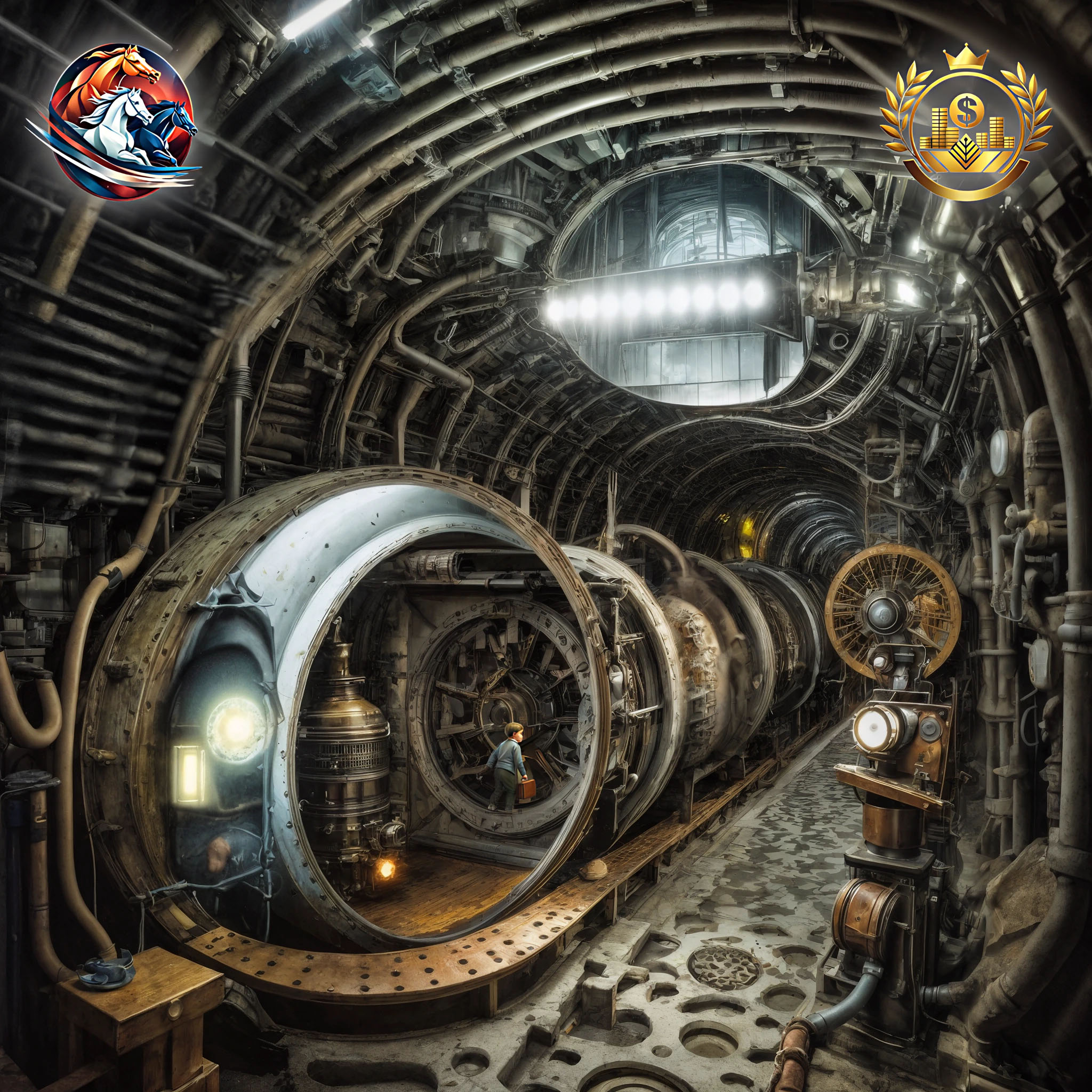
I enter the corridor with deliberate steps, even though I’d much rather have run far, far away. Everything here is electric, and it’s making the hairs on my arms stand on end. Professor Ceril gave me detailed instructions. In fact, he even handed me a manual beforehand that felt like it was five hundred pages thick. With the professor, it’s always go big or go home. As brilliant as his inventions are, they always have to be the size of a gym. Same goes for his time machine.
The reason I’m always the one who has to test his inventions comes down to a deal between my dad and him: the professor is a childhood friend of my father’s, and ever since my dad made a fortune off his server farms, he’s been bankrolling Ceril’s research. In return, Ceril is supposed to teach me about physics, electrodynamics, quantum states, dark energy, and all that jazz.
The corridor—the “spatial dilation compressor”—is lined with round metal hatches like you’d expect on a submarine, complete with the handwheel locks used to open them. Behind the walls, I hear a creaking and clicking like little wooden clockwork gears—it sounds more mechanical than electronic. But that doesn’t help me much either. I stand there feeling pretty helpless, flipping aimlessly through the machine’s manual. The professor drilled into me that I must go through the correct hatch. Opening the wrong one would be disastrous, throwing “Temporal Stratigraphy” into complete chaos—something he wants to avoid at all costs. Instead, my task is to convince his younger self on October 1st, 2006, to bet on Schiaparelli instead of Discretion—in a trifecta on three-year-old colts and fillies.
In the end, though, I can’t even get the hatch open that’s supposed to take me to the crucial horse race: screwed shut too tight. Fine by me. That way, I don’t have to sneak onto a racetrack as a twelve-year-old and hunt down young Ceril among all those gambling addicts. Instead, I sit down in the corridor and wait for a while, which is uncomfortable enough in the flickering electricity generated inside the time machine. Then I walk back down the hallway and step out of the machine.
Ceril is waiting for me excitedly. I nod, shove the manual back into his hands, and grit out through my teeth: “Mission accomplished.”
Ceril is thrilled and starts dancing around. “Who bets on Discretion anyway?!” he sings out. When I ask what actually changed because of my actions, he explains in a fatherly tone that now a young Muzimi Ceril in a parallel universe has become filthy rich and can fulfill all his dreams. And among those dreams, perhaps, is thanking his benefactor—meaning not me, but himself—by returning the favor.
If I understand this correctly, the other, now stinking-rich Ceril is supposed to get the idea to send his assistant—presumably a parallel version of me—back in time to make him, our professor, rich in turn. Who even comes up with a wild scheme like that?! I pretend I still have homework to do and leave him alone in his lab. As I pedal away on my bike, I can hear him singing for a long time, and I wonder if the professor shouldn’t invent a machine that simply produces complete silence instead.
(He almost did. But that’s another story.)