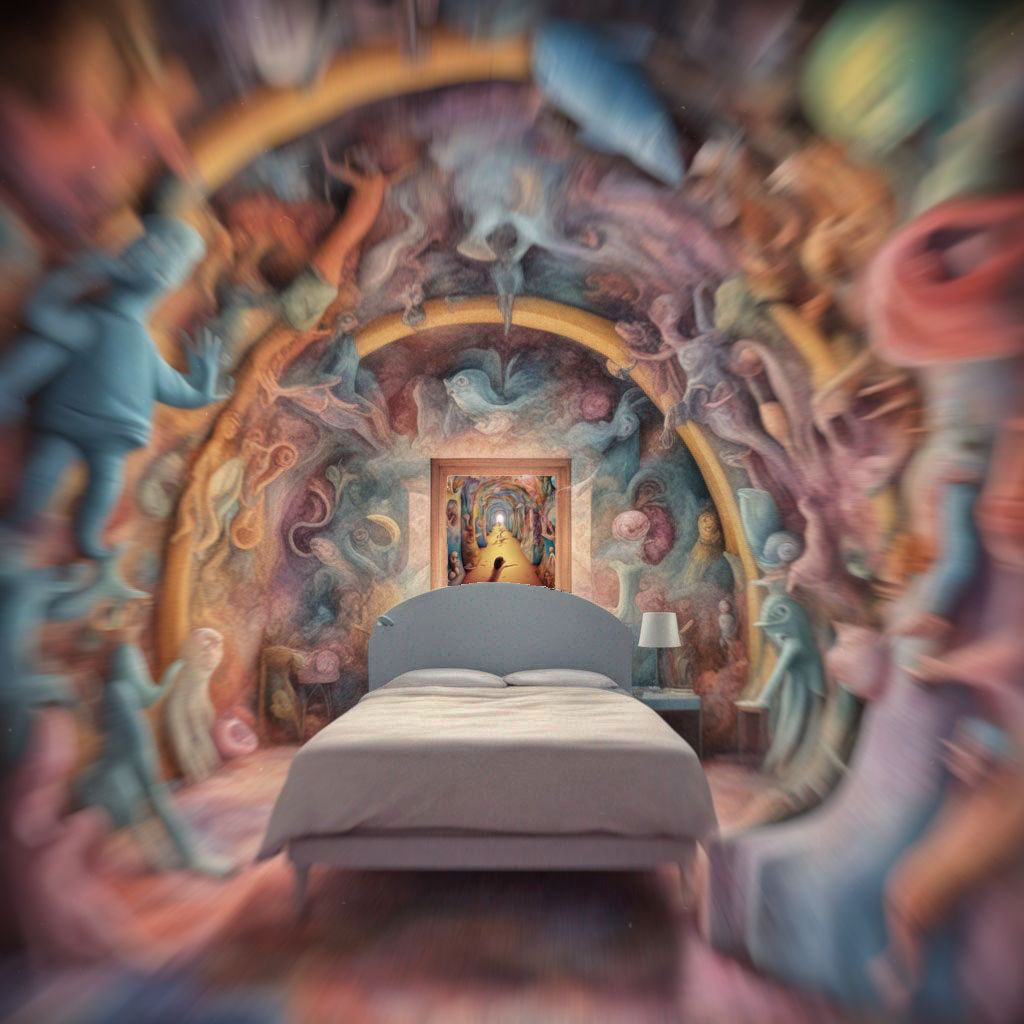
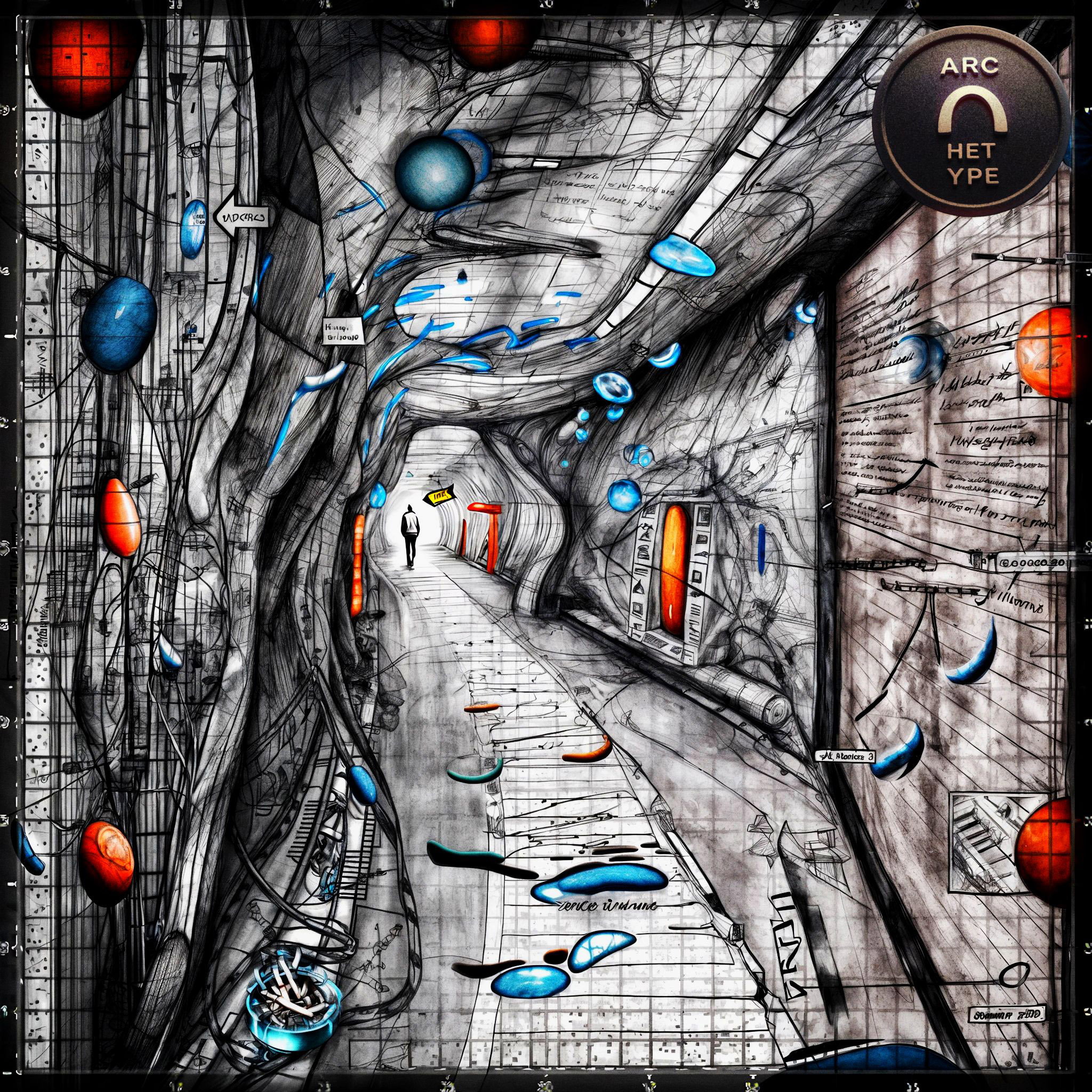
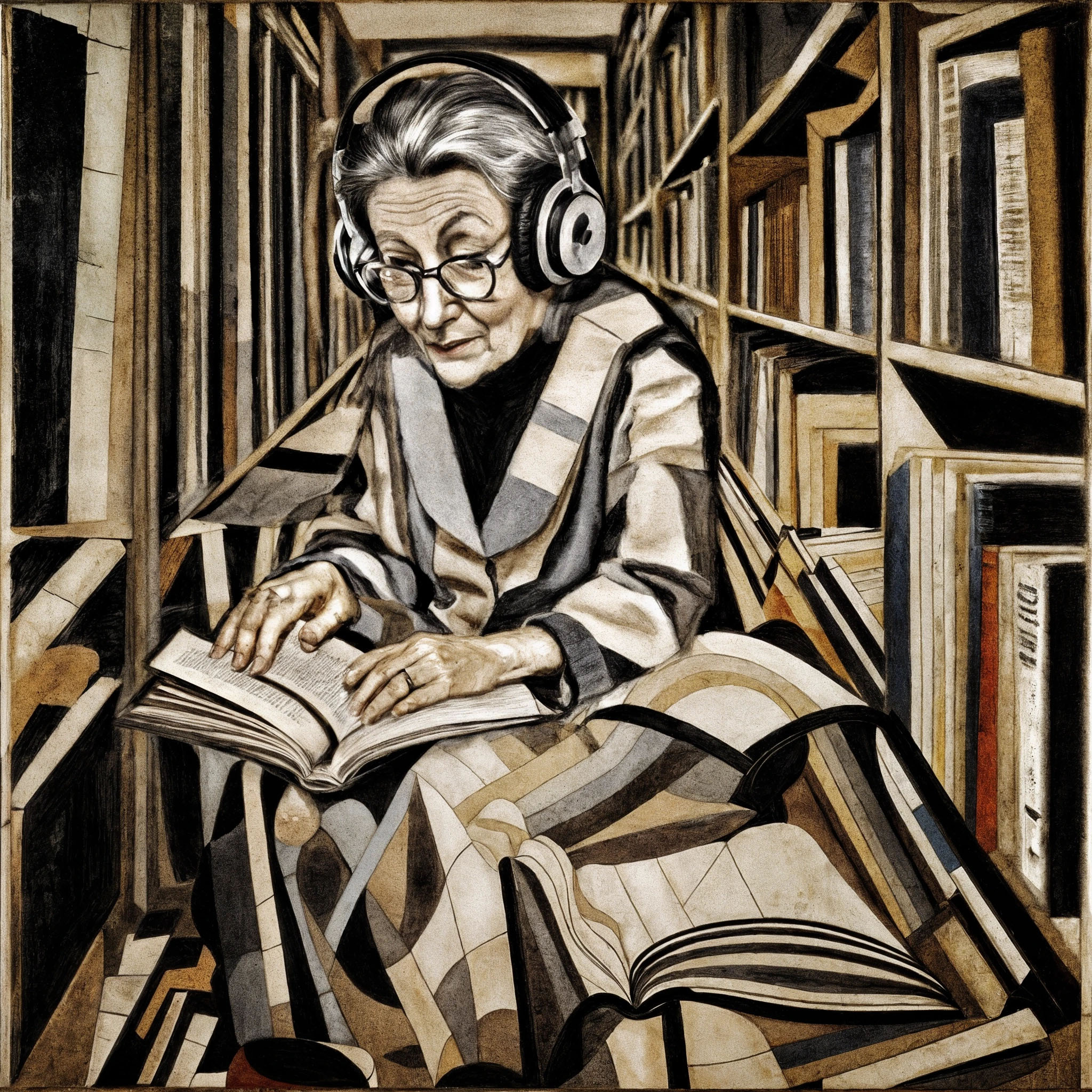
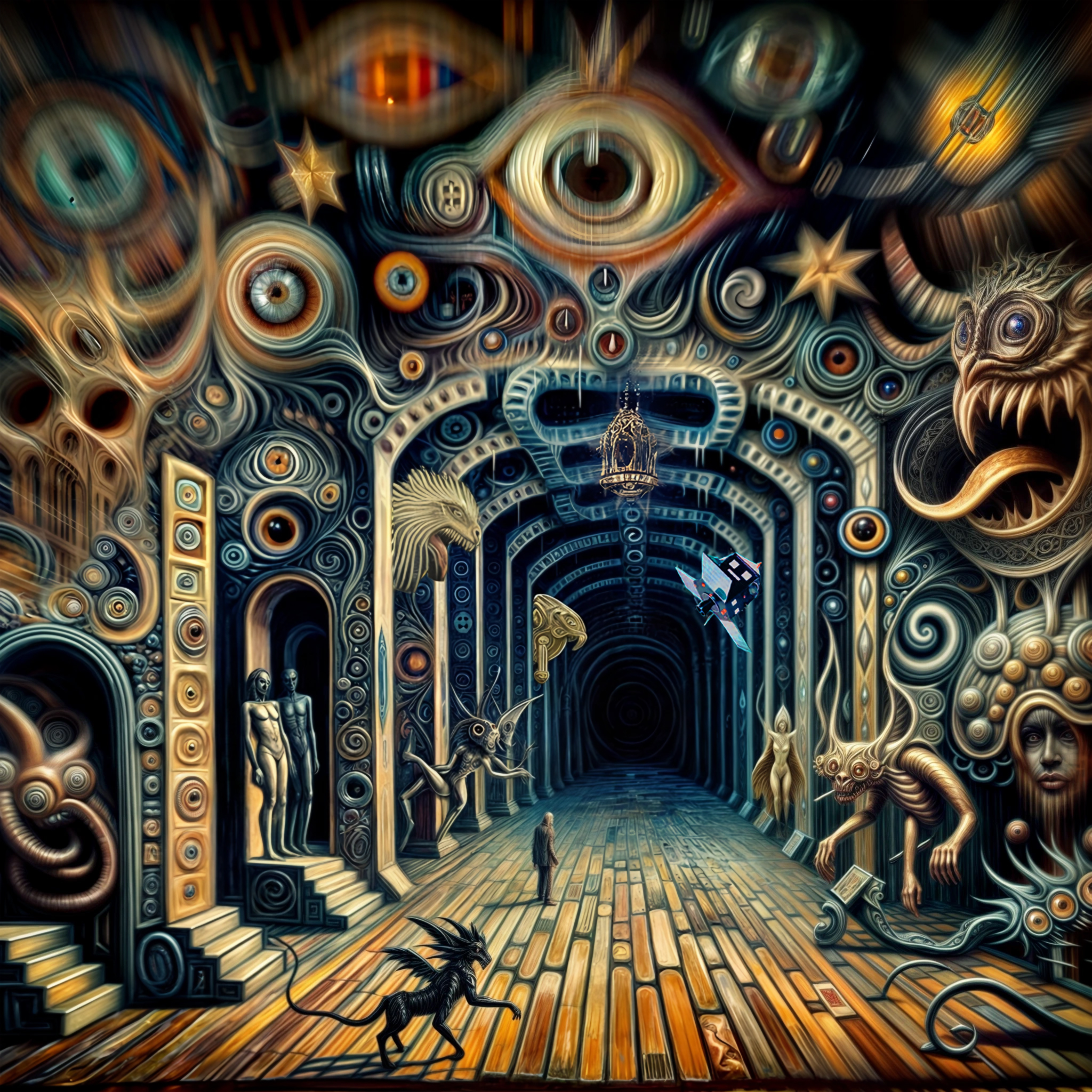
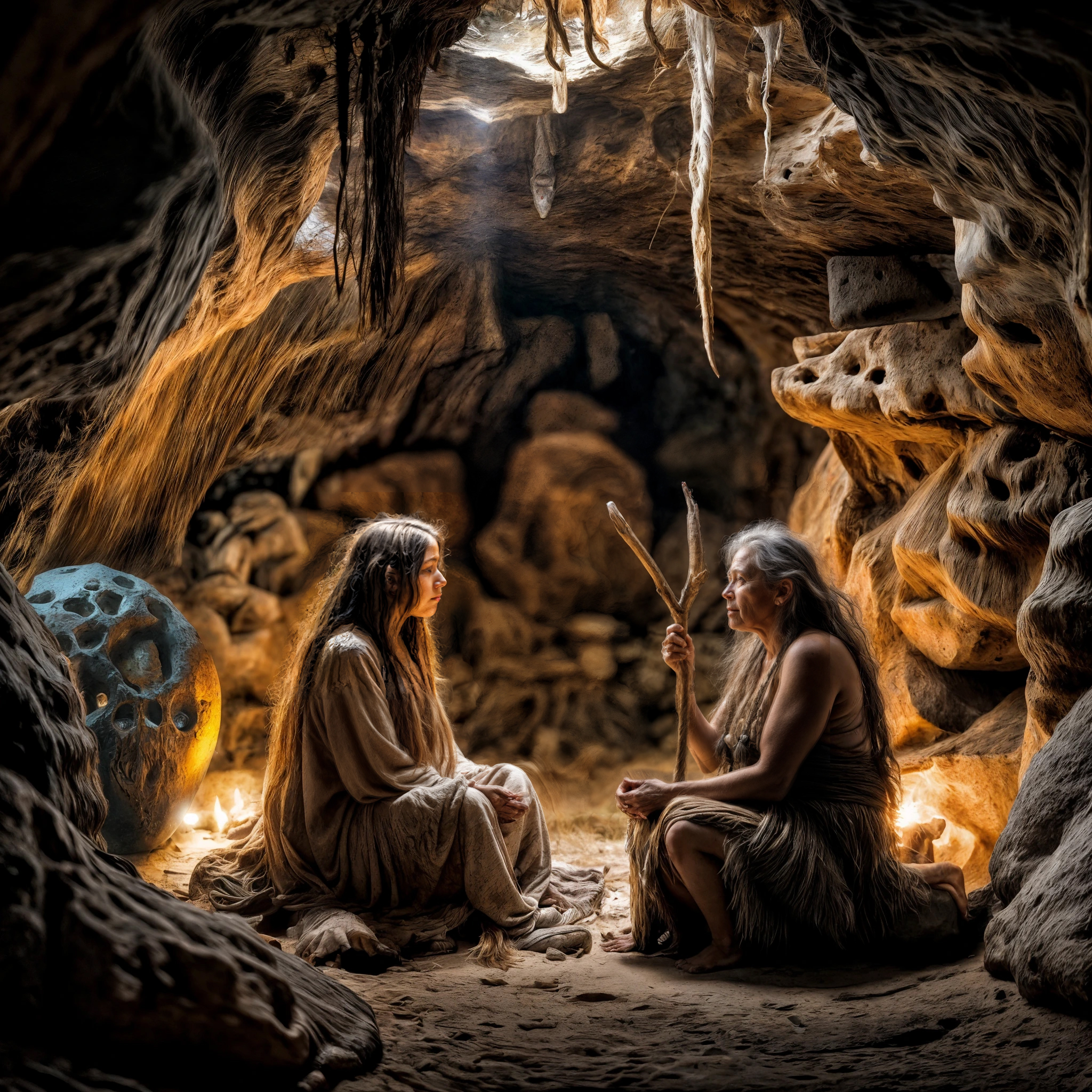
I enter the Corridor of Fading Senses. It narrows and darkens as it recedes, yet the further I venture, the more vibrant and bright the images on the walls, floor, and ceiling become, and the more distinct the sounds that float meandering through the space, occasionally striking my third ear.
“Your Majesty. May I try to bring Nemo here? I have a very brilliant idea.”
Fascinated and awestruck, I observe the imagery and manifestations of my mind, listening to the inner musique concrète of my soul.
Unfortunately, despite years of training, I can only maintain a lingering spark of consciousness for a short while; a little later (much too quickly, always much too quickly), Hypnos takes me in his arms, and sleep embraces me.
I enter the corridor. And, strangely, for some reason, the archetypal nature of the situation suddenly stands before my eyes—as if I were seeing myself and my circumstances from the outside:
I—the self-assured, reflective human being; the Cartesian, sovereign ego; feeling and acting separate from the world; thinking it through; proactive.
The act of entering—at once a birth process and a willful decision to move forward, for progress and development. Resonating here: the human thirst for knowledge, the craving for adventure, the insatiable curiosity, and the undaunted spirit of discovery that seeks to traverse new spaces and expand the reach of power and knowledge to the very limits of the doable and the thinkable.
The corridor—as birth canal, transit station, life path, and an opening into the possibilities of choice: doors branch off, leading to new spaces, new hallways, new rooms, new…
The vision that so unexpectedly and involuntarily overcame me breaks off. I am standing in a corridor. It is dusty, uninvitingly furnished, poorly ventilated, and dim. On a ledge, an overflowing ashtray. It reeks of stale smoke. Wrinkling my nose in disgust, I bolt.
I enter the corridor. But don’t assume that I just slip in and out quickly. No. I take my time. Initially, I make sure not to read any words, not even accidentally. Instead, I start the soundtrack and listen to it with half-closed eyes. Then, when I’ve developed a feel for the sounds, without evaluating or categorizing them, with a beginner’s mindset, so to speak, I dare to take a first look at the text—at the first words, the first sentence.
Is it the one I expect? Yes. The beginning is always the same. Nice. Carried by the accompanying music, I venture further down the corridor. Confident on one hand, but also a bit fearful because around every bend, an unnamed terror may lurk.
Yet, as in a dream, all misfortune will be mere imagination. Slowly and with delight, I feel my way forward, exploring cautiously. Most corridors are short, much too short. Sometimes, however, they continue within me, before my mind’s eye, in the rhythm of the accompanying music and the flow of my thoughts and feelings. The first step is always the same. But all the others…
The soundtrack fades away. I open my eyes. And step into life.
I enter the corridor between the cells. A great honor! How I have asked, begged, and prayed to have the chance of speaking with the old master poets, to seek their advice, to benefit from their wisdom! Finally, after lengthy negotiations, I am granted admission to the Akasha Palace. Here, not only are their timeless works are safeguarded, but also their personalities from that time remain in perpetual protective custody. Nothing fades, not even the spirit of our ancestors who stand ready to answer us—if we can find the way to them.
I have been allowed into the corridor of poets—there isn’t one for short prose writers—and for those who weren’t confined to poetry alone, their cells are said to open onto other corridors: tragedies, epic poems, comedies, choral odes, astrological treatises…
But this is just a speculation, not a certainty. The keepers here aren’t very forthcoming. In any case, it seems that the criterion for admission to the inmates is the kiss of a muse. Here, perhaps, it was Euterpe’s. I read names on the nameplates on the doors, names like Milton, Dante, Bolo, Orpheus, Neidhart, Brant, Shiki, Bukowski, Vergil, Yeats, Tyrtaios, Tao Yuanming, and many others I have never heard of. Euterpe was diligent. Or was it Erato?
Who should I ask here? I don’t have much time. I am allowed to ask one of the poets behind the heavy wooden doors a question. For years, decades, I have been able to contemplate this one question. I know it inside and out. It is the question, the key to the answer behind all answers.
The guard already looks impatient. From Bukowski’s cell, a howl seems to come, but maybe it’s the wind of time trapped in these endless, twisting corridors. My gaze falls on the nameplate Rumi. Yes! He will be the one! He will know the answer and gladly tell me. Internally, I rejoice as I slide the small wooden panel in the door to the side. Yes, who could give me better information than the Persian master poet and visionary of mystical love and spiritual ecstasy!
“Jalaluddin?” I call into the darkness of his cell. Dimly, I see a man wearing a turbaned dervish cap, spinning in place with outstretched arms. He radiates an infinite serenity, beyond all description, and at the same time, an unspeakable joy shimmers out from him in spirals, piercing deep into my heart.
don’t know if I stood there for a single breath or an eternity. The hand of the guard pushes the small wooden hatch to Rumi’s cell shut. He guides me back. When I finally stand outside again and the guard has closed the gates of the palace behind me, I begin to spin, slowly on my axis, with outstretched arms.
I enter the corridor of sliding plastic walls. The researchers start their stopwatch. They want to test if I know something I shouldn’t: if so-called morphic fields form from the learning experiences of individuals, which other members of the same species can then access.
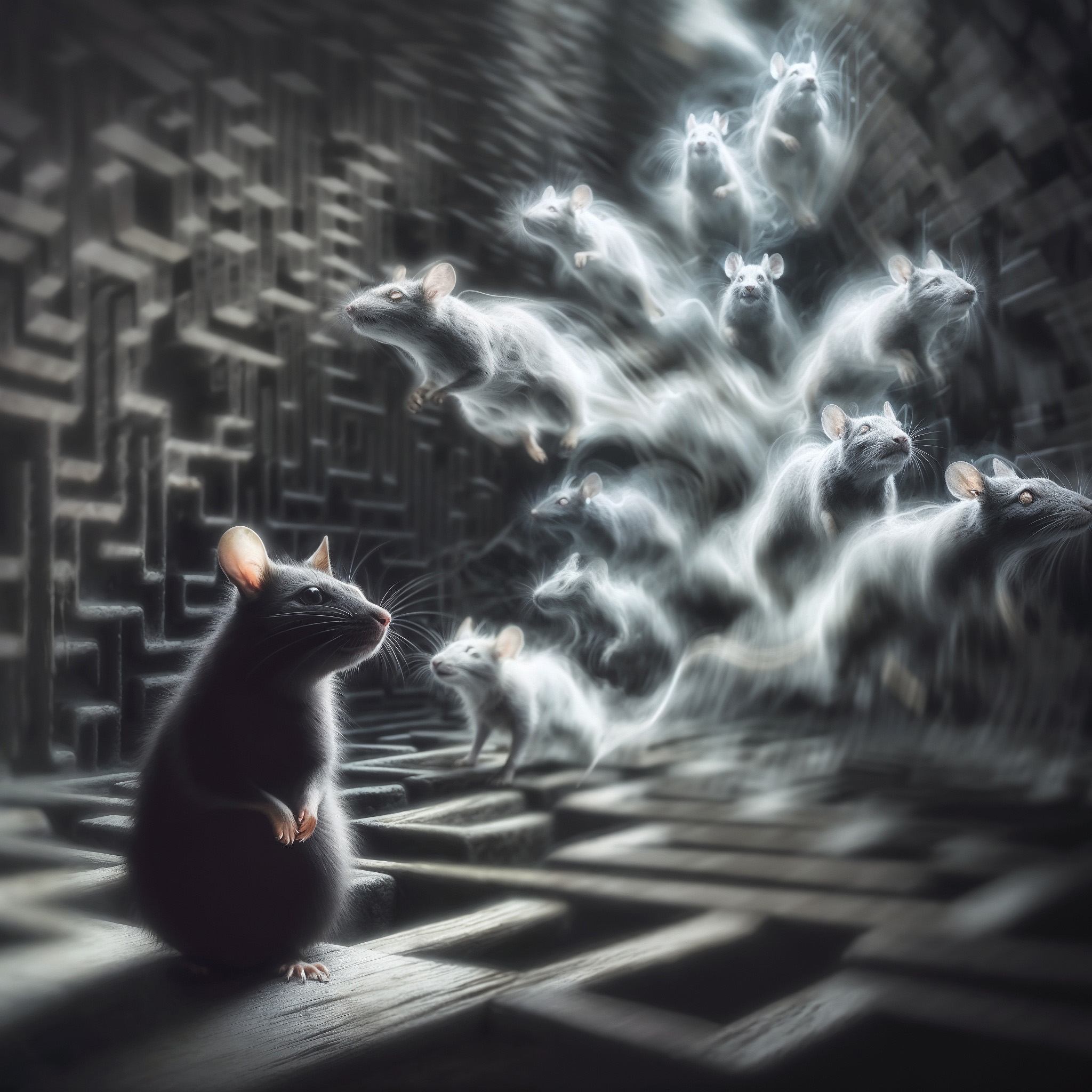
I, for my part, do not know the way through this maze. But countless other rats wandered through it until they could memorize the shortest route to the food. Some of them are now dead and dissected—they accompany me invisibly with their knowledge, helping their unwitting comrade, giving me impulses to go right here, left there, or to ignore forks in the path.
At the end of the course, I savor the canned meat—my reward—while the researchers record their results in a table.
All living beings have ancestors who help them. Even the researchers. It’s just that, much like they must protect their hairless bodies from the cold with skins and fabrics, they also keep all inklings at a distance. Their brains have likely swollen so much for this purpose that none of these faint inklings can penetrate into the sensitive depths within.
So they often go astray, again and again, before—if they are very lucky—they reach the destination of their desires.
I enter the corridor leading to one of the temples in the Pirámide del Adivino in Uxmal. The Maya were great builders, but ultimately, their success led to their downfall: despite sophisticated irrigation systems, several years of drought brought their rapidly growing population to its knees. They left behind magnificent structures and a complex calendar that—as some believe—predicts the end of our world for December 21, 2012.
Typically, I experience panic attacks in narrow corridors and passageways; however, since I set foot on the Yucatán Peninsula, strange, long-forgotten memories have come flooding back to me. The ruins appear as though I knew them in their original state—these interiors do not cause me any discomfort; on the contrary, they draw me in as if by magic.
Have I lost my troublesome claustrophobia, which I’ve been trying to combat through a kind of self-treatment with a blog? No, a remnant of panic remains. But there’s a noticeable improvement, and my efforts to conquer my fears seem to be bearing fruit. I’ll give myself exactly one more year! Then, I decide spontaneously right here in the temple corridor of Uxmal, the world will end—at least the world of my little therapy blog, which I will ruthlessly delete on that exact day. It will be a sign that I can now take on corridors in naturam—the physical ones made of stone, metal, wood, and glass. While an entire universe of real corridors awaits me, a world of imagined corridors will be consigned to destruction in a single stroke. As if the Maya had foreseen it…
I enter the corridor. It’s always a long ascent to Elysium, even on this Christmas Eve in 1930 A.D. Finally, I reach the top. As I do every year, I report to the Creator.
He looks at me expectantly: “Well?” – “They have disregarded your warning, eaten from the Tree of Knowledge, and left the Garden of Eden.” – “I know, I know. Don’t always start with Adam and Eve.” – “They wage cruel wars in your name, recklessly exploit the creation you entrusted to them, and behave in a downright blasphemous manner—short-sighted, cold-hearted, and narrow-minded.” – “You’re quite the devil’s advocate. I’m painfully aware of all of this.”
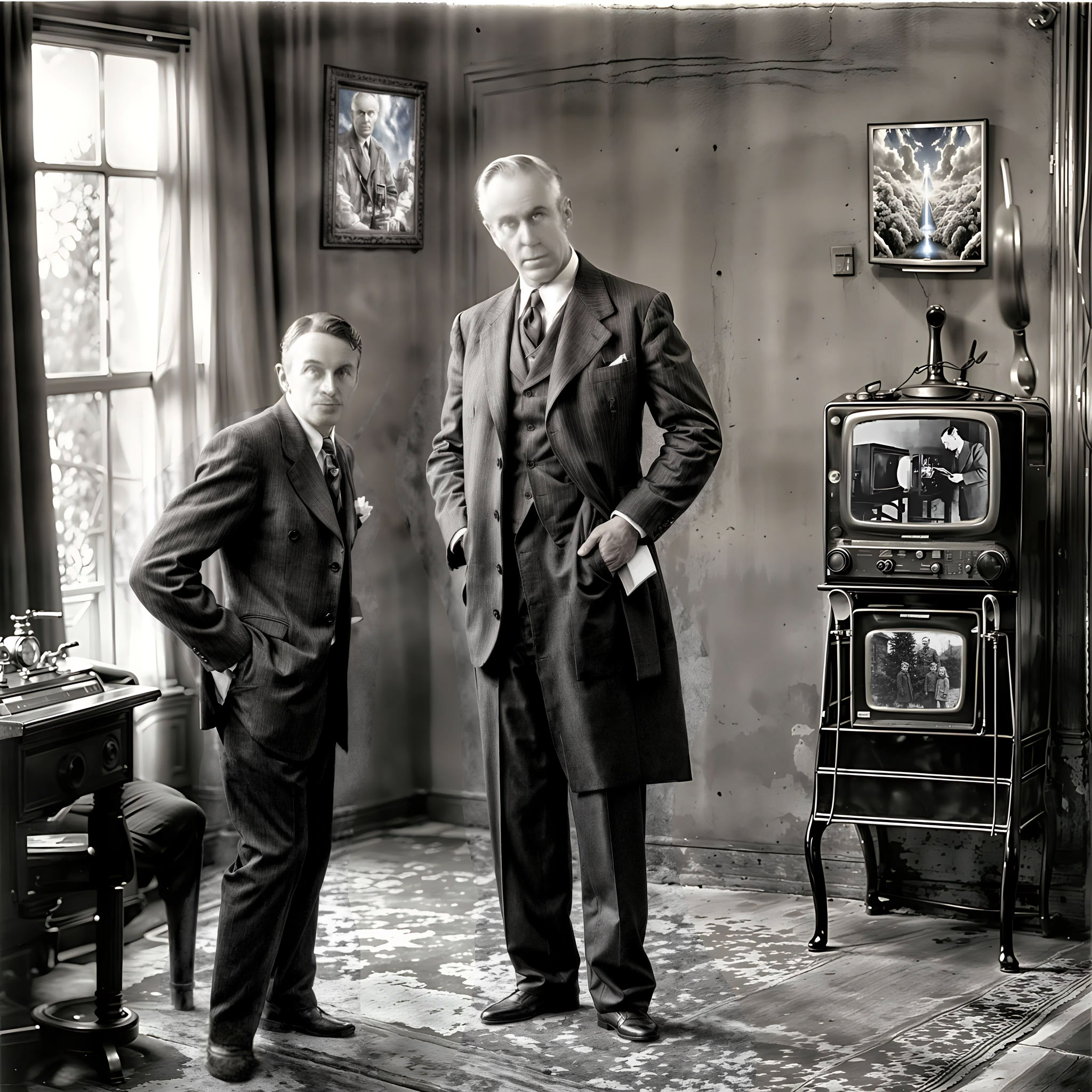
“In any case, I think they deserve punishment. May I… cast them into the fires of hell?” I ask slyly, wiping a thread of drool from the corner of my mouth. “Not necessary. They’ll inflict it upon themselves in a few years.” – “Another world war? Hm. Can I at least… further confound their minds, so that they succumb not just to stupidity, but to madness as well?” I ask, trying not to appear too eager. “They’ll handle that themselves too. They’ve just invented television.”
“Television? Oh. Hm. May I…? Is it possible…? With my evil gaze, perhaps…” I stutter, nervously scuffing my cloven hoof and chastising myself for not seeming more confident and convincing. “You’ll simply continue to watch over them, my dear.” – “But why?” – “Because you still have much to learn.”
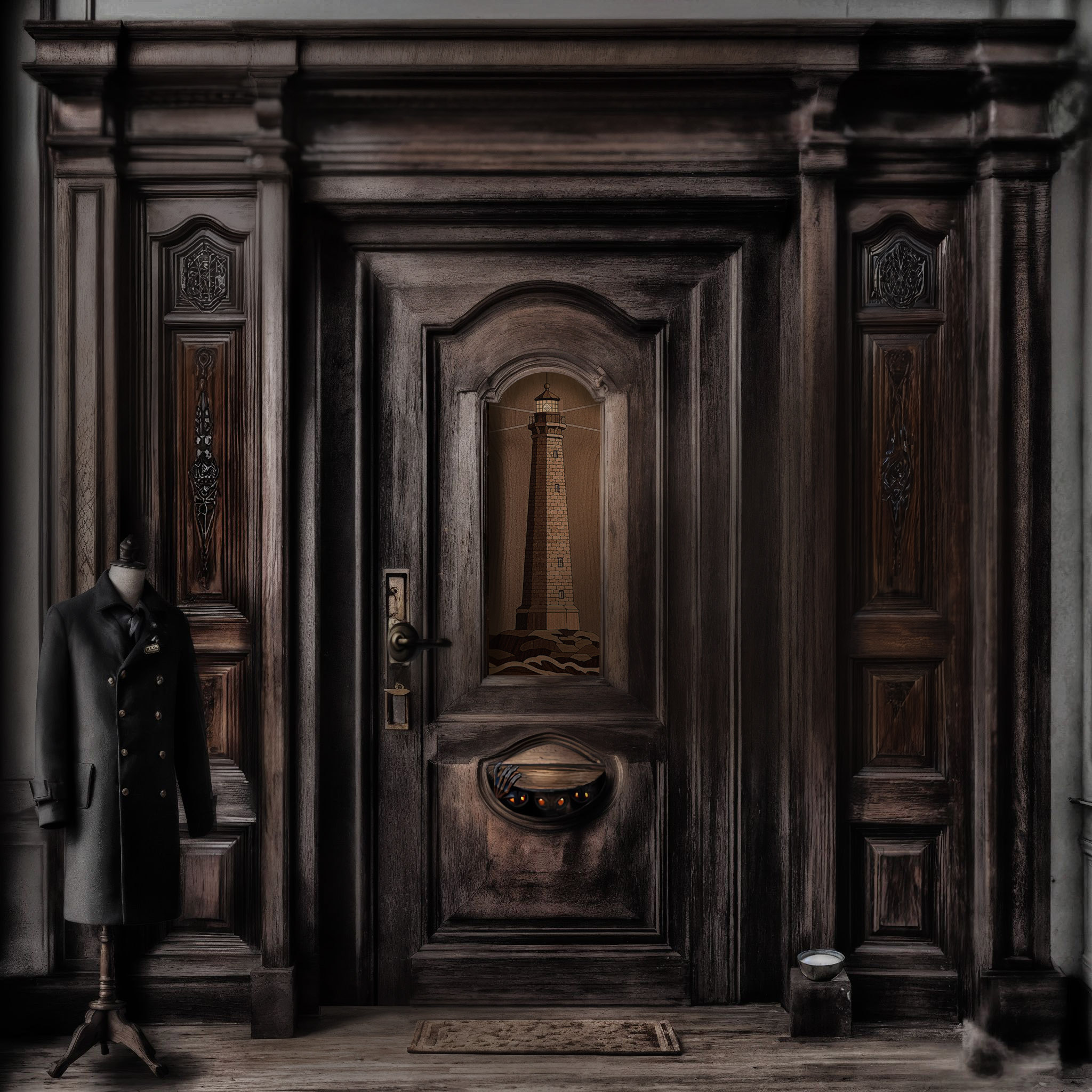
I enter the corridor to my bedroom. It is always the same ritual. First, I darken the room completely; then, at a very low volume—near the threshold of hearing, so to speak—I let soft ambient drones play. I lie on my back with my hands folded across my chest, close my eyes, and observe as my breath becomes calmer, until it is nearly imperceptible. The shimmering figures wavering across the inside of my retinas grow increasingly colorful, and suddenly, a door stands before me. It is always the same: dark, solid wood with inlays—abstract geometric patterns that create an impression of perspective. I press down the well-worn bronze handle and enter a new adventure, brimming with anticipation.
Let’s see what the Little People have in store for me this time. (Just don’t fall asleep first!)
I enter the corridor, shuddering and full of dark foreboding. Countless corridors from thousands of nightmares once again culminate in the ultimate terror for me. Soon, when the night is at its darkest and quietest, I will wake up screaming and drenched in sweat, and my cat will once again bolt from the bed, meowing. I will lie awake until morning, and then, like every Friday, I will recount to my therapist the hair-raising horrors that—in gloomy, ghostly corridors—lay in wait for me throughout the seven nights of the Christmas holidays.
She will probably advise me again to continue writing little stories about them to free myself from these nightmares. She doesn’t share my concern that these tales might be the very thing triggering the nighttime horrors in the first place.
»Ich betrete den Korridor«, wiederhole ich folgsam, wie es mir der Meister vorgesagt hat.
»Und nun sage mir«, fordert er mich auf, »was darin der ursprüngliche, unbewegte Beweger ist. Ist es das Ich, der Korridor, das Betreten, das Betreten-Werden oder vielleicht doch das Betreten-Sein?«
Ich bin verwirrt und schweige betreten. Der Meister lächelt zustimmend, und da trifft mich der Blitz der Erkenntnis.