140/398
♫ The Labour of Emergence ♫
140/398


I enter the corridor, at long last, after arduous attempts to fall into a trance. Now I’m back in familiar territory. From the beginning, in my imagination, it has always been this corridor—with its bare brick walls and fading frescoes on the vaulted ceiling—that has led me to my past lives. I study them to glean details and information for my research as a historian, insights that the sources available to me as a scholar would never yield. Of course, none of my colleagues, let alone the director of the institute, can ever know about this.
This time, however, it’s different. At the end of the corridor, no door awaits to transport me to some long-gone era and a strangely familiar environment—this time, the corridor opens into a garden that feels entirely foreign. It greets me with an almost overwhelming blaze of color, intoxicating floral scents, and the buzzing of legions of insects. A large, buzzing beetle—a dung beetle, I suppose—barrels toward me, and I have to duck quickly to avoid being hit.
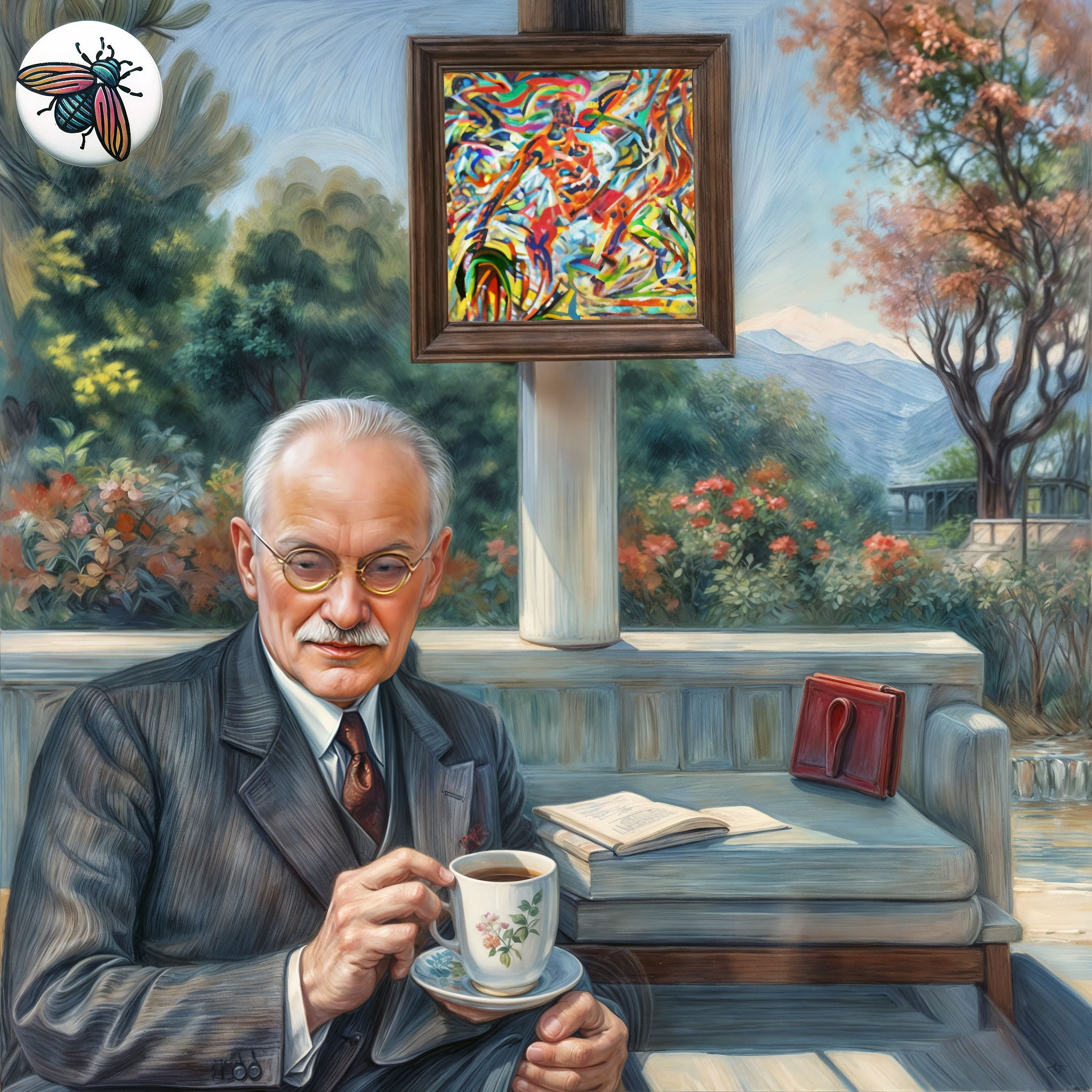
In a pavilion sits an elderly gentleman with a fine, gray mustache, looking at me expectantly. He pours me a cup of tea. “You wanted to speak with me?” he asks kindly. I know him. This can’t be a past life; C.G. Jung didn’t die until 1961. Next to the delicate Chinese porcelain teapot lies a book bound in red leather.
We drink tea and talk about myths and archetypes. I explain my conviction that our world needs an entirely new myth, one that gives us the strength and guidance to overcome the problems of our time. I believe only a universal story and constellation can move us—can move this fragmented world toward a collective new beginning, a new departure. Gilgamesh, Prometheus, Odysseus, Arjuna, Paul Bunyan, Frankenstein, Peter Pan, Harry Potter, Little Nemo (the comic, not the film), Rübezahl, Batman, Bernd das Brot—I’ve already vetted many mythical figures from different cultures to see if they could offer us contemporary answers, or even just strategies for finding them.
“Is it about answers?” my host asks shrewdly, sipping his tea.
Yes and no. Ultimately, it’s about a healthy perspective—on ourselves and the world. One that leads to sustainable solutions and progress.
But I lose my train of thought and start talking about the corridor. “I enter the corridor?” he repeats, smiling. That, he says, cannot be the sought-after new myth. It must be something connecting, something collective that instills a communal spirit while drawing deeply from the unconscious. “Try, ‘We enter the corridor,’” he suggests.
At first, I’m somewhat taken aback, then, I suddenly feel light and inspired.
“Or even: ‘We enter, drunk with fire, the corridor,’” he adds with a smile.
Of course: We! All of us! Moving forward with shared joy and confidence into a space full of new possibilities, well on our way to finding the best way—the best ways. I am not alone, and neither are you. None of us is. Because we are many! And we have the same goal.
A promising vision.
I’m welcome to return anytime, my host says as we part. The search for a new myth is an important task, one he’s happy to support with advice and action. Glad to have found a true authority as an ally, I leave his pavilion and the lush garden and enter the corridor once more…