Korridorium

A daily dose of corridors in prose

Tag: Norbu

87/398

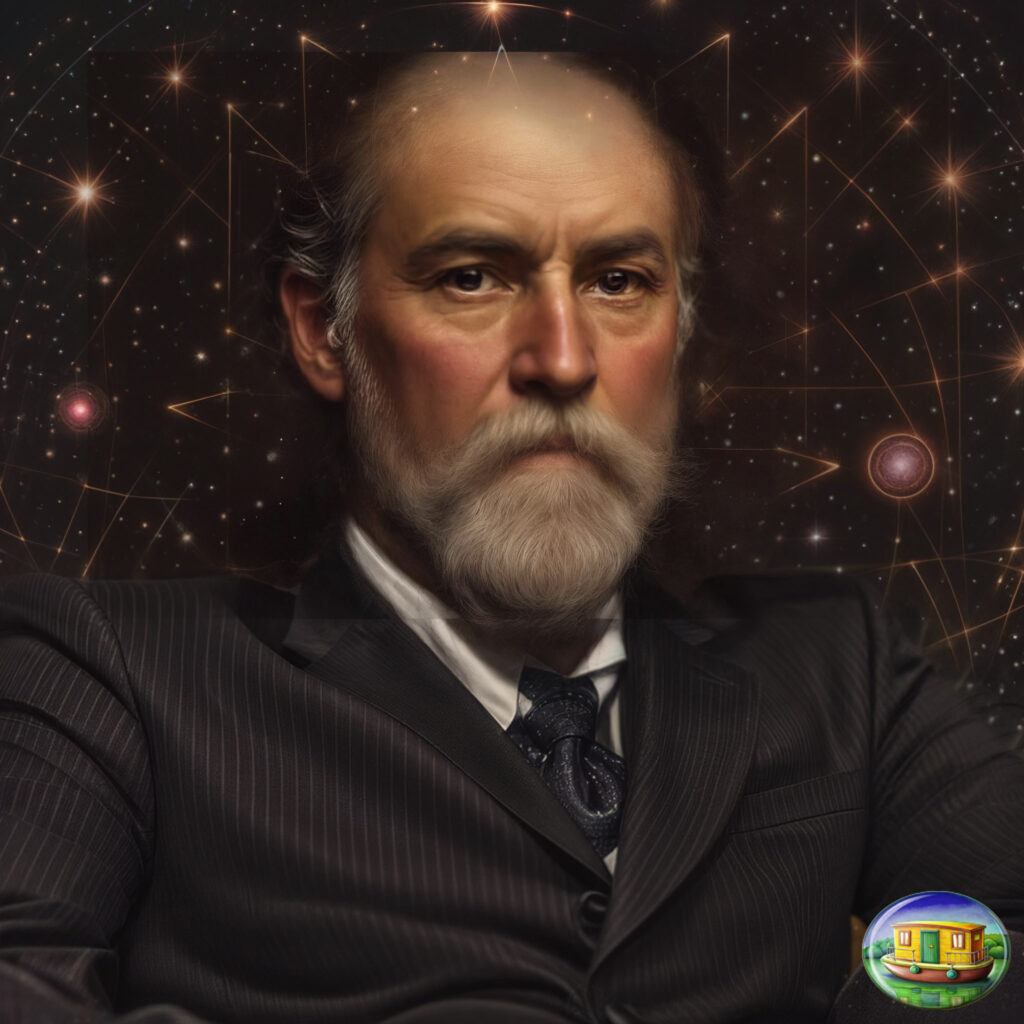
The cover art shows the portrait of an older man with a gray beard and receding hair, wearing a dark suit with a tie, against a background of shining stars and geometric lines. Tucked in the bottom right is a small plaque, depicting a houseboat.

♫ Astral Short Cuts ♫


87/398

LogoSwitch language

I enter the corridor of his houseboat and find my friend Norbu on the small terrace as expected, hunched over the laptop on his lap.

“Wikipedia!” he groans, and it sounds like a suppressed curse. I open the wine I brought along. I already know where to find the glasses.

“When you hit the outer limits, they’re all terrible ideologues.”

“What limits?” I ask.

“Well, the limits of science. Here, for example, the entry on Frederic Myers.” He points to the text on his display, but without my glasses, I can only make out a blurry logo and a photo. “Myers was one of the founders and later president of the Society for Psychical Research, which dealt with spiritualist topics. He coined the term ‘telepathy.’”

“Doesn’t ring a bell,” I say, then quickly add, “The man, I mean.”

“But the Wikipedia editors,” he continues, unfazed, “leave out his most important contribution.”

“Well,” I venture, “spiritualism and telepathy aren’t exactly standard Wikipedia topics.”

Norbu looks at me, shaking his head. “But they have to be. An encyclopedia can’t just erase a part of reality simply because the editors and authors don’t like it.”

I clink my glass against his to buy a little time. “Aren’t they all completely different authors? I mean, after all, you’re a contributor too.”

Norbu gives a pained laugh. “Sure. But there are the decision-makers, a kind of priestly caste, and it’s mostly the ideologues who’ve made it to the top. They cut out whatever doesn’t fit their agenda, using flimsy excuses and practically warlike tactics.”

I nod to show understanding. “Like telepathy.”

“And everything that evades the scientistic creed.”

Scientific creed? I let Norbu get away with the contradiction and point a finger to remind him of the old bearded man on his display, staring out at me from the deep darkness.

“After his death,” my friend Norbu explains, “mediums all over the world received strange transmissions through automatic writing, many signed ‘Myers.’”

“You mean he was reaching out from the, uh, realm of the dead?”

Norbu nods zealously. “And not just that. The texts made no sense.”

“Aha,” I say with satisfaction, “then it doesn’t need to be on Wikipedia.”

That earns me a glare from Norbu.

I take another sip of the red wine. Pretty dry. But that’s how Norbu likes it.

“Only independent observers were able to piece together the transmissions—like I said, transcripts from various mediums across the globe—and suddenly a pattern emerged. They all referenced each other.”

“Wow,” slips out of my mouth, “telepathy!”

Norbu shakes his head testily. “No, exactly not. Whoever sent these messages intended to rule out the possibility that the mediums were communicating with each other telepathically.”

“So no telepathy,” I say, frowning. What then?

“Let’s apply Occam’s razor and go with the simplest explanation: After his death, Myers came up with a way to prove the survival of the human psyche—through these scattered transmissions to different mediums that only make sense when taken together. They contained information very few living people had access to. And over roughly thirty years, that added up to more than three thousand texts. It’s just that none of it appears on Wikipedia—neither the German nor the English version. Just like there’s nothing about spiritualism in the article on ‘Automatic Writing,’ and so on and so forth.”

Norbu looks at me expectantly. But I can’t really bring myself to agree.

“Maybe that’s for the best. What you’re telling me sounds pretty, uh, unsettling. The part about the 3,000 transmissions.” I take a big gulp of wine and pour myself a refill. The longer I think about it, the more uncomfortable I feel under Myers’s gaze from his Wikipedia page.

“You’re just like them,” Norbu says, shutting his laptop in disappointment. “Whatever doesn’t fit into your neat little worldview gets kicked out.”

“Speaking of which,” I say, “up for a game?”

The distraction tactic is a resounding success: A short while later, we’re standing at Norbu’s foosball table, replaying the latest Champions League matches.

It’s only on the walk home—a bit unsteady, but in good spirits—that I remember this Myers fellow again. Strange guy. 3,000 nonsensical texts? Sounds like something from the internet age. With a blog from the afterlife, he probably would’ve achieved a lot more—and maybe even made it onto Wikipedia…
97/398

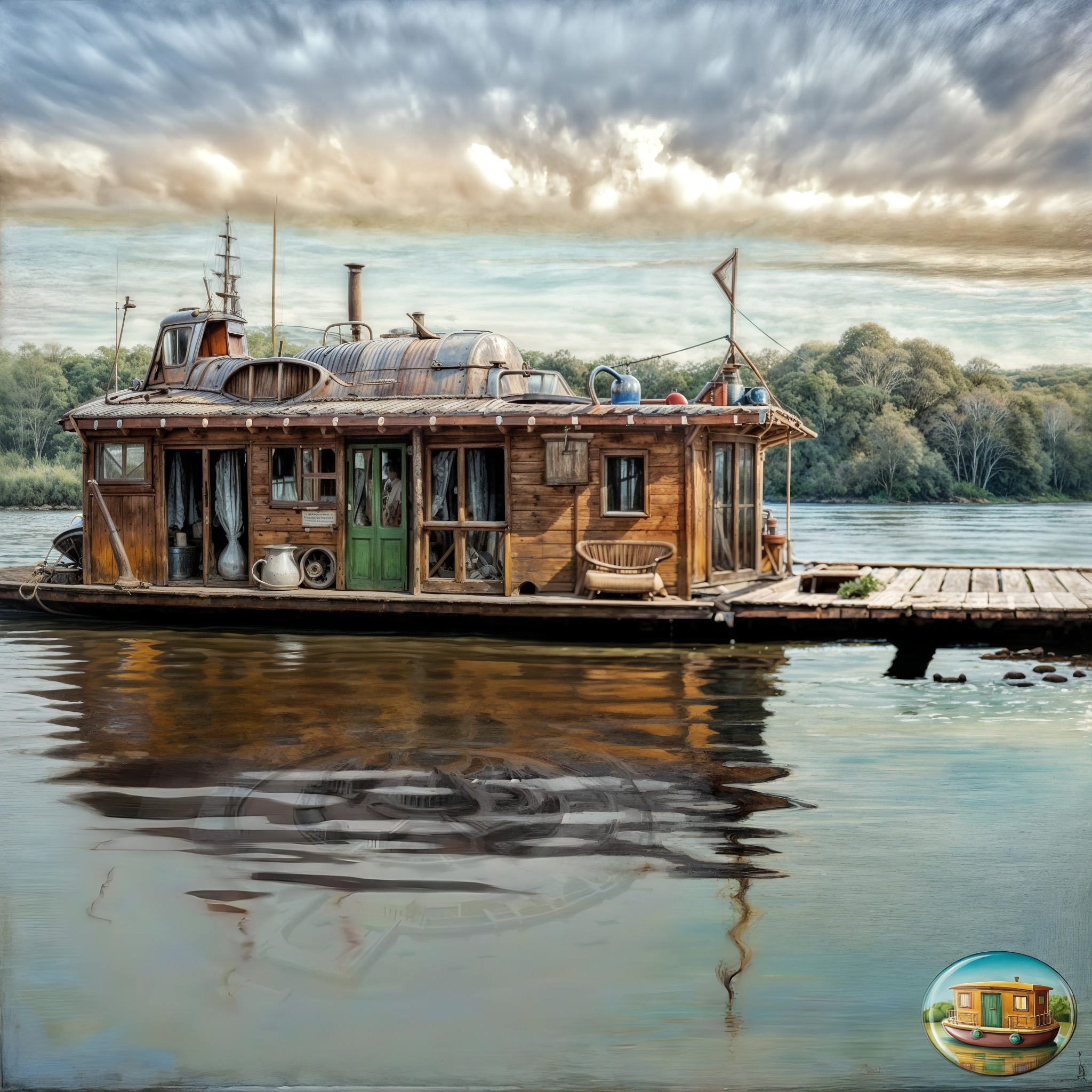
The cover art shows a wooden houseboat with a green door and various structures on the roof, in front of a wooded shore under a cloudy sky. A circular architectural structure can be discerned in the calm water. Tucked in the bottom right is a small plaque depicting a houseboat.

♫ Houseboat Lounge ♫


97/398

LogoSwitch language

I enter the corridor. My friend Norbu seems not to be on board, but as I stand somewhat perplexed in his living room, I suddenly hear the sound of hammering. Burglars? No, it dawns on me, probably Norbu, who is sealing a leak and making sure that his houseboat doesn’t sink.

And there he comes, toolbox in hand, and we settle in with a glass of red wine. “I found ancient records of myself,” I tell him. As a teenager, I was fascinated by Atlantis and, like a little private scholar, combed the city library for archaeological clues about the inhabitants of this sunken continent. I show Norbu cave drawings, meticulously copied from various books and adorned with scholarly comments. They come from both the Old and the New World. “Atlantis lay in between,” I explain, “and that’s why there are such peculiar similarities in symbols and depictions, long before Columbus came or the Vikings discovered America: surviving Atlanteans who fled to the surrounding continents.” The thesis still convinces me today.

My friend Norbu rubs his chin. “Has it never occurred to you that these similarities may not have required any contacts by sea?”

“You mean it’s all just a coincidence?” Disappointed, I take back my yellowed and slowly disintegrating notebook.

“No, by no means. But haven’t you also delved into shamanism…”

Yes, right, there were shamans in almost all cultures worldwide, healers in contact with the spirit world and ancestors.

“And possibly,” my friend Norbu says, “in contact with each other.“

It takes a moment for the realization to sink in. “You mean, across the oceans, from people to people? And that—telepathically?” Norbu points affirmatively to my notebook. “Hm. Shamans of the European megalithic culture exchanging thoughts with those of the Proto-Americans,” I imagine. And of course, that could also explain the similarity of the pyramids or the fact that not only the Egyptians mummified their dead but also some Native American tribes. Besides the underworld of the dead and the upper world with helpful spirits, the shamans also know the middle world—the astral counterpart to our everyday reality and its reflection in the spiritual world. On journeys to the middle world, the shamans of earlier times, detached from space and time, could have visited foreign continents and civilizations—and thus their respective colleagues.

“But maybe not,” Norbu interrupts my thoughts. “There are indications that even before the Vikings, there were contacts between Europe and both Americas. The Chinese, Romans, Greeks, Egyptians, and Phoenicians—all are said to have been there and traded with the cultures there. Perhaps even the megalithic peoples. And all of this without the need for Atlantis as a bridge.”

I probably look somewhat disappointed because Norbu adds consolingly, “But of course, your early research honors you. Who knows, they might become important again and provide new answers? Or raise new questions?”

I know my friend Norbu isn’t entirely serious, but I feel strangely affirmed nonetheless. The young, curious fourteen-year-old still within me is pleased to receive a late acknowledgment for conducting significant foundational research.

I clutch my notebook as I cycle away, deciding not to stash it back in a dusty drawer but to give it a place of honor on my shelf with the early works of great minds.

141/398

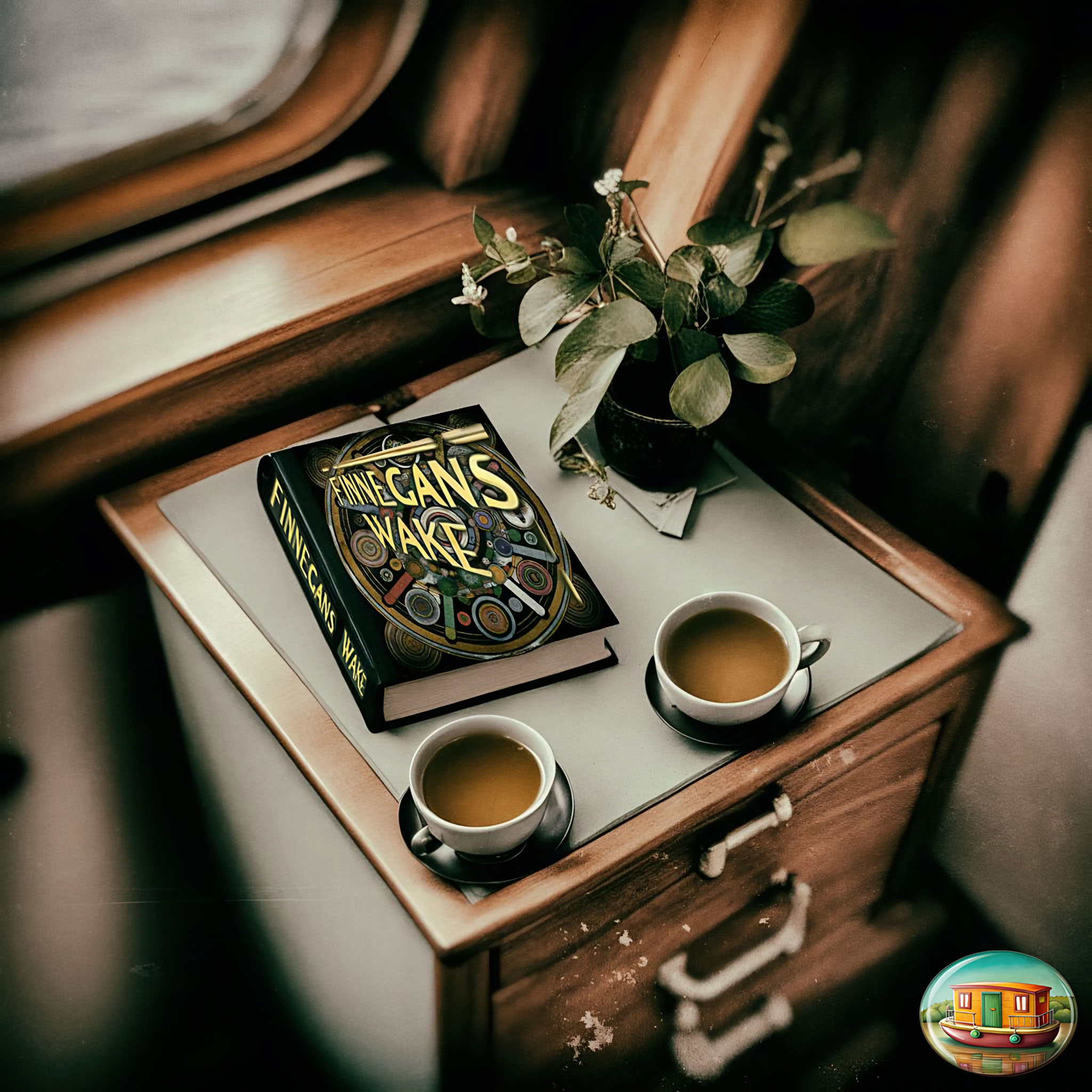
The cover art shows two cups of tea and a copy of "Finnegans Wake" on a small table with drawers in front of a window. In the lower right, a plaque with the image of a houseboat is inserted.

♫ The Levogyre ♫


141/398

LogoSwitch language

I enter the corridor. Norbu’s houseboat smells different than usual. I hear his voice from a small room I’ve never been in before: his bedroom.

Norbu is lying in bed, coughing miserably and looking like hell. “An infection,” he croaks, “don’t get too close to me.”

“Can I do anything for you?” I ask, concerned.

“Nah,” he says, “got everything here.”

Curiously, I look around. I had always assumed Norbu’s bedroom to be his library, filled with all the books he must have accumulated over the years. In reality, I see only a single book on the shelf above the bed. Norbu follows my gaze.

“Finnegans Wake,” he says, “first edition. That’s all I need.”

I nod, but perhaps that’s not enough to show that I know what he’s talking about, so I add, “Yes, a novel that is a whole library in itself. Joyce somehow managed to pack life, the universe, and everything into it. A book that contains practically everything. That’s all one needs.”

Norbu gives me a sideways glance. “For me,” he says, “it’s mainly about reading just one or two lines, and I immediately fall into a deep sleep.”

“Aha,” I say, biting my lip and withdrawing my hand, which I had reached out to take the book and randomly flip through it, intending to nod knowingly after a brief glance inside. I seem to have missed the mark there.

“No book can encompass the entire cosmos; that’s romantic nonsense.” Norbu has to cough and asks me to make us some tea. I grumble a bit because I don’t like being talked down to or relegated to a maid, but in the end, Norbu is sick, and he probably doesn’t mean any harm.

In the small kitchen, I find chamomile tea, which I brew and carry into the bedroom as a makeshift tray using a chair, so I can sit with my sick friend. I pour us both a cup.

“Perhaps in the sense of a hologram,” I say. While making tea, I’ve been searching for something to counter Norbu’s rejection. “It’s all there, just less detailed.” I gesture toward the book.

Norbu shakes his head. He sits up, adjusts his pillow, and leans his upper body against the wooden wall of his houseboat. “That quickly leads to romanticized worldviews. In the past, it was the belief that God would personally listen when you read him your Christmas wish list. Today, quantum physics is used to make everyone believe they are the creator of their own reality.”

Norbu sounds offended—as if he wants to lodge a complaint with the higher-ups about his cold. And since it’s not God sitting at his bedside, but me, I’m the one who gets the brunt of it.

But I know how to defend myself. “Didn’t you yourself once say that human consciousness is the next unexplored continent? And what about yogis who let themselves be buried for days and apparently stop breathing during it, or Buddhist monks in the Himalayas who lie naked in the snow, making a living radiator out of themselves solely with the power of their minds?”

Norbu nods, smiling, but I think I can see a mischievous twinkle in his bloodshot eyes. “Yes, we like to believe that: that it’s possible and that the mind controls matter.” He places his steaming cup next to the Joyce volume on the shelf. “Why are there only anecdotal reports and no solid evidence? Think about it: if it were possible to nourish oneself with light alone—as people like Jasmuheen or the proponents of Chinese Bigu claim—why hasn’t evolution utilized that yet? Except for plants, I mean. But they don’t absorb prana; they use chlorophyll.” Norbu has to cough again, but this time he raises his hand to signal that he’s not done with his train of thought and I shouldn’t interrupt. I wait patiently.

“Or,” he continues with a scratchy voice, “if telekinesis were possible, why don’t animals use it? The same goes for teleportation or levitation. Evolution had billions of years to make desire not only the father of thoughts, but the ruler of reality. Instead, it lets everything be done by hand. Or by tentacle, fin, mandible, or fang. Right?”

Now he has intimidated me a little. I nod grudgingly. Somehow, I had always seen both of us as brave explorers of a new and barely known continent, pioneers of a new view of humanity that definitively puts an end to the reductionist myth that we are merely a clockwork, a machine, or a computer.

“Mind,” says Norbu, “is just a byproduct of matter and, as we can see with Alzheimer’s, error-prone and fleeting. The self-aggrandizement it indulges in, especially in esoteric circles, is just the wishful thinking of an overly complex and underemployed brain.”

He looks at me expectantly, and again, I nod grudgingly. “One could say,” he adds dryly.

I purse my lips and mumble my agreement, albeit reluctantly—until I realize that he has just questioned himself. “Isn’t it so?” I ask hopefully.

Norbu blows his nose loudly into a tissue. “Not if human consciousness is an emergent product of evolution—something that originates anew, but is more than the sum of its parts and creates new conditions and abilities that were previously unforeseeable. Just as life itself emerged from lifeless matter.”

“Aha. So that’s why evolution hasn’t produced precognitive predators in the animal kingdom, who only go after their prey when they know for sure they will be successful: their brains weren’t complex enough for that. In contrast, you want to say, to ours.”

“Well,” says Norbu, “there is research suggesting that we can unconsciously anticipate events. For example, during events that move many people on Earth, random number generators showed anomalies. And that was before the event even happened.”

The way Norbu says it, it sounds like there’s a “but.” I wait, and sure enough: “But overall, I see us as being at the very bottom of the competence ladder.”

We had talked about this years ago. I found the division into four stages very helpful back then, and I remembered it. It starts at the bottom with “unconscious incompetence.”

Norbu nods: “Not having the slightest idea that you don’t know or can’t do something.”

“Followed by ‘conscious incompetence’: I know that I don’t know.”

“Exactly. Then you work towards ‘conscious competence’…”

“Which eventually becomes ‘unconscious competence,’ like being able to speak fluently or maintain balance and walk on two legs—without constantly having to think about it.”

Norbu has been sipping his tea again in the meantime. I take a sip too. We don’t say anything for a while.

“We’re at the very beginning,” I say thoughtfully after a while, “but some already glimpse the uncharted continent on the horizon.”

“Land ho!” Norbu calls out, though it triggers a brief coughing fit. Again, he raises his hand until he can get something comprehensible past his lips. “The question is whether the continent already exists or whether we’re just dreaming up a completely new one.”

It takes a few moments for me to realize what possibilities he has just raised. Both finding and inventing would have unforeseen consequences for what the world is like and what holds it together at its core. “What do you think?” I ask eagerly.

“I think I need to get some sleep now.”

“Oh, okay,” I say and quickly finish my tea. “Can I do anything else for you?”

Norbu shakes his head with a smile, slides back entirely under his blanket, and adjusts his pillow. “Looking at the universe—and especially, of course, at a completely new universe on the horizon—always makes me very tired,” he murmurs. “Because of the tremendous opportunity and responsibility.” And with that, he’s asleep.

I quietly close the door to the houseboat behind me. “Opportunity and responsibility!” As I swing onto my bike, I feel inspired and full of energy, though unfortunately I have no idea what exactly for.

170/398

♫ Skilaboð til mannkyns ♫


170/398

LogoSwitch language

I enter the corridor, realizing from hearing the the sound of a drill, that Norbu is fixing something on his houseboat again. I open a bottle of wine on the terrace and wait for him with two glasses. When I visit my friend Norbu, I always make sure to have plenty of time. It’s never predictable how deep we’ll get tangled up in our discussions.

This time, I have a topic in mind. I want to know what Norbu thinks about climate change.

He’s sweaty and covered in oil, but he’s clearly happy to see me when he finally emerges from the chambers and passages below the waterline in the living room, a power drill in his hand.

“Climate change isn’t the problem,” he casually remarks. We clink glasses. “Humanity will eventually die out anyway. And even if we survive for a while, life on Earth itself is limited.”

“That sounds like catastrophism,” I chide.

“Pure astrophysics. The sun will extinguish. The problem isn’t global warming; it’s the heat death. You need to think on larger scales!”

My friend Norbu enjoys doing that. I, on the other hand, only need to ponder for ten seconds why there is something rather than nothing, and I’m already caught in the Total Perspective Vortex, dissolving.

“Hey,” my friend Norbu says, “are you still with me?” That pulls me out of the Vortex. I nod eagerly, “Heat death of the sun. It expands and burns up all its planets. The end of life on Earth.”

But Norbu impatiently shakes his head, “Heat death of the universe, the end of all life. That‘s the real problem, and that’s what we need to prevent.”

I stare at him in disbelief, “You want to prevent the heat death of the universe?” And then, “What is that, anyway?”

“Since shortly after the Big Bang, the universe has been steadily deteriorating: matter is distributed, interacting less due to increasing distances, and stars are burning out. Cold and hot zones are becoming more alike until everything assumes a uniform temperature and structure, like a featureless lukewarm soup. But so that we don’t allow it to happen without a fight, there’s ‘The Message.'”

Norbu gestures widely at the world around us. I can’t follow him. Finally, he sighs and begins to explain further, “The laws of nature are a message. The cosmic physical principles are exquisitely tuned so that life can emerge, life that recognizes itself for what it is. I’m talking about us!”

“Us two?” I ask meekly already suspecting that I may not be able to follow him again.

“All of us. Humans. And all other intelligent civilizations in the cosmos. And the laws of nature tell us that those who came before us tampered with them.”

“Those who came before us?” I can hardly keep up with him anymore.

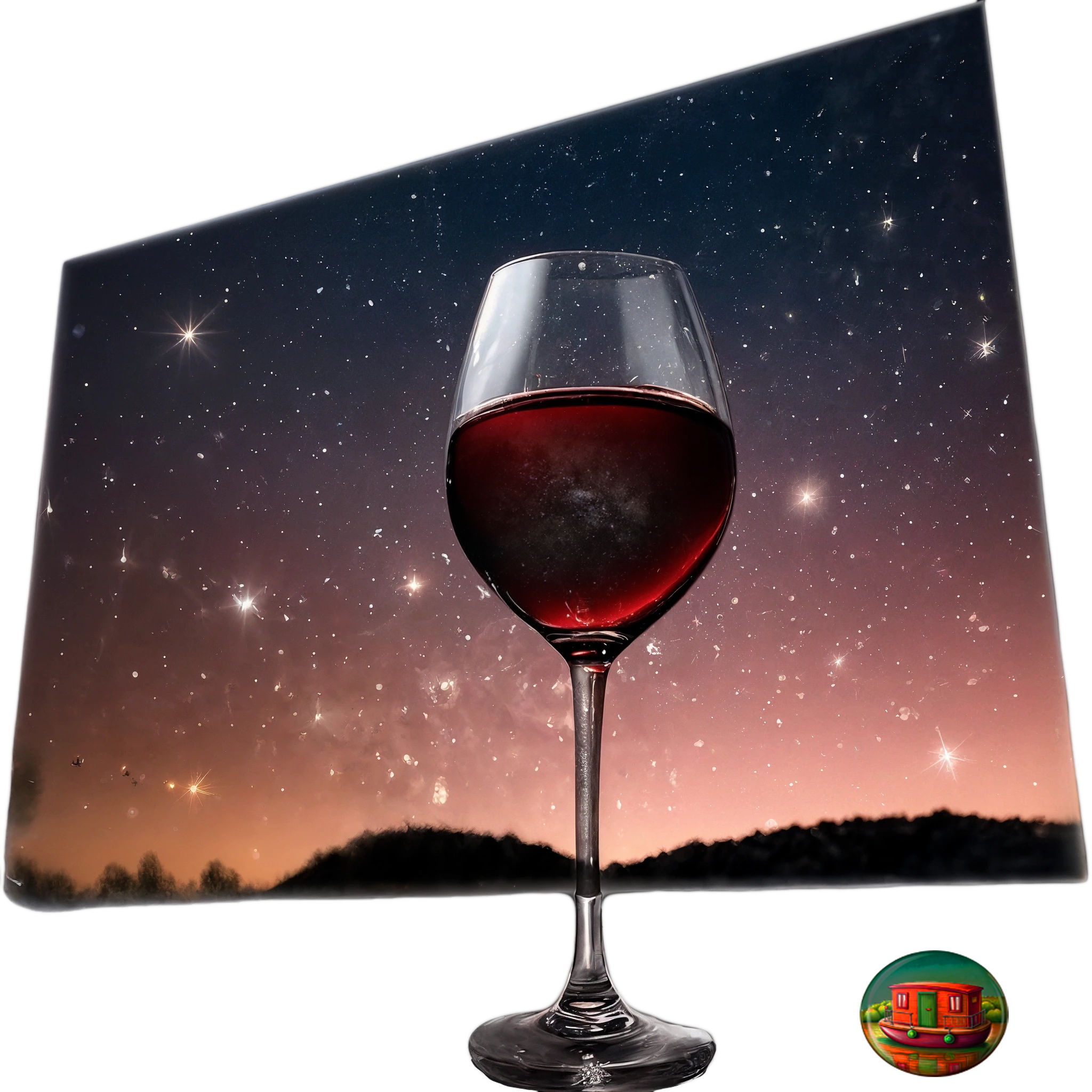
“Sometimes I imagine,” and with that, Norbu leans back and looks thoughtfully at the rest of the red wine in his glass from below, “that before the heat death of the universe, a handful of intelligent civilizations will manage to make contact with each other and jointly initiate the greatest project in the world.”

He doesn’t say more. I should now ask what the greatest project in the world is, but now I’m being obstinate and staying silent.

After a while, he continues in a whisper, “To create a new one before the end of your own universe, so that it can give life again. So that the chain of being doesn’t break.”

Suddenly, I’m filled with awe at the thought that we could leave a message for the next universe, for the intelligent beings who will follow us: the laws of nature that help them evolve—a forward-looking measure that certainly exceeds what can be accomplished within a single legislative period and even surpasses a 739-year organ work, a ten-thousand-year Long Now clock, and the safest possible disposal of nuclear waste for hundreds of thousands of years by a wide margin.

“Of course,” my friend Norbu suddenly becomes quite sober again, ” only if the universe is a closed system. Otherwise, there are numerous other possibilities because it doesn’t necessarily have to end in heat death or a Big Crunch. But as long as we don’t know for sure…”

“… it might be better to prepare for the worst.”

“Exactly,” affirms my friend Norbu. “640 billion years until heat death is a hell of a short time to evolve to the point where we can plan a new universe and put it into action. Better get started on that right away.”

My head is spinning, not just from the wine. As I ride home later under a gloriously starry sky, I look up and ask the universe arching above me if it has a message for me. And indeed it does. I can’t hear it or see it, but I can sense something. Life is worth living.