Korridorium

A daily dose of corridors in prose

Tag: nous

74/398

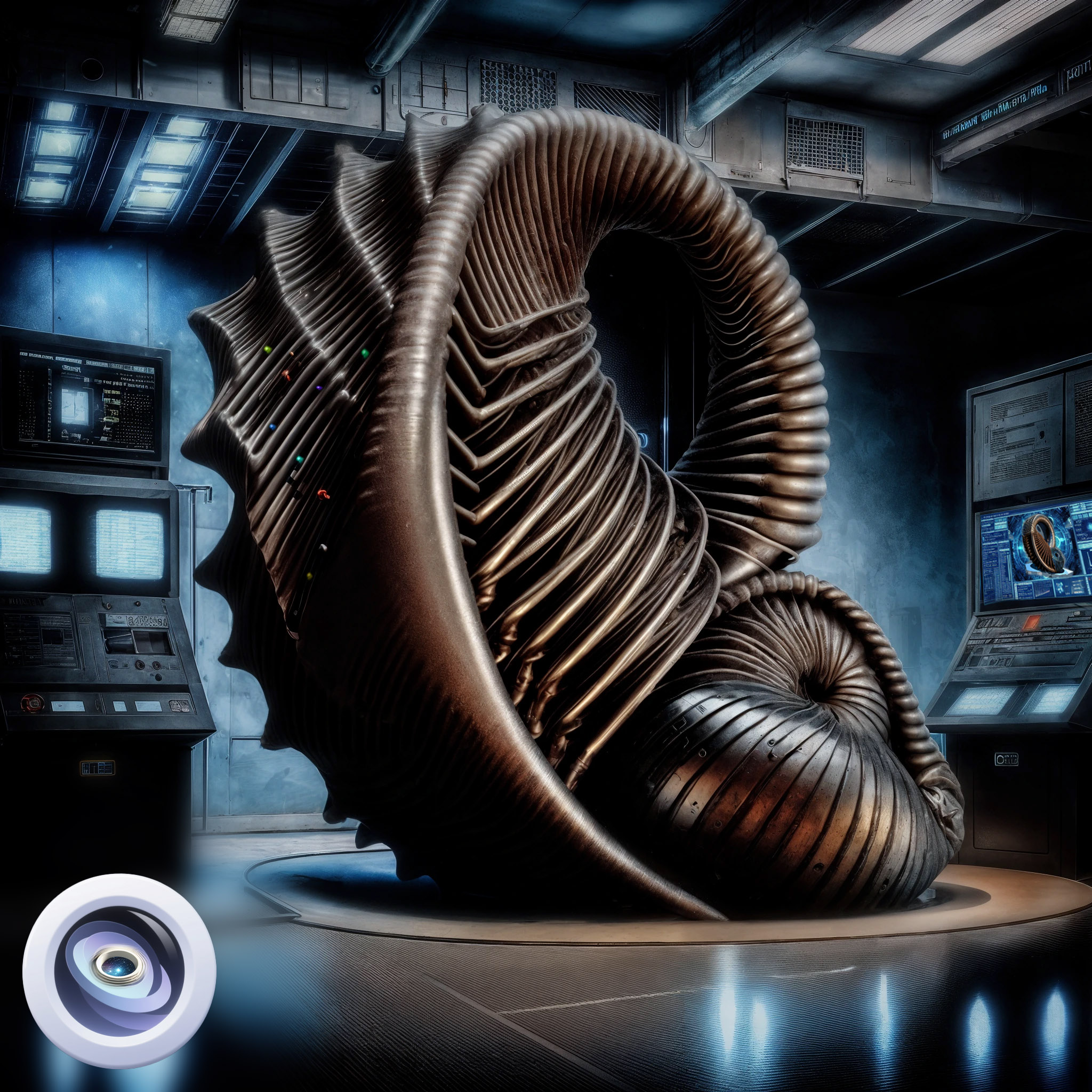
The cover art shows a massive, coiled metallic form within a shadowy high-tech chamber, complete with banks of monitors and control stations. In the lower left, a digital button presents a circular aperture, offering a descent into the star-strewn heavens.

♫ A Modicum of Sense ♫


74/398

LogoSwitch language

I enter the corridor to find the right door: the door that will take me back to the “Snail Shell.” That’s what we called the convoluted magnetic chamber, which our supercomputer had calculated for us. After two years of construction alongside my students, the chamber was nearly complete: a strangely twisted and self-folded structure of gleaming metal adorned with hundreds of magnets, designed to prevent any matter generated in the vacuum chamber from coming into contact with anything. As the magnetic chamber hung in the spacious laboratory, it resembled a work of art from another world. Almost ethereally beautiful, yet also unsettlingly alien, as if this form should not exist.

I cannot adequately describe it. The Snail Shell held an ever-increasing fascination for me. Eventually, I convinced myself that I absolutely had to inspect the welds before sealing the chamber, and one night, I secretly crawled inside.

But not back out.

Instead, I find myself in the Trieste. As a child, this world record had left an indelible impression on me. I instantly recognize the submersible; the descriptions from my childhood must have etched themselves deep into my memory back then. I also recognize Piccard, and in doing so, I know whose head I’m stuck in and through whose eyes I see it all: those of his fellow traveler, Don Walsh—I am accompanying Jacques Piccard on a journey to one of the deepest points in the world’s oceans, the Mariana Trench.

It is cramped and stuffy; the metal hull groans heavily under the immense external pressure. The water, into which spotlights shine, looks cloudy. A universe of impenetrable blackness surrounds us.

I am a ghost, squatting inside Walsh’s head. Walsh seems oblivious to my presence. I keep drifting away, as if I were a foreign object that doesn’t belong here—which, in a way, is true. The experience reaches me like a radio signal clouded by heavy static. And then, recurring headaches wash over me, which is strange because I no longer have a head of my own. Walsh appears to notice nothing of the ghost or the pain inside his head.

In broken English, Piccard explains that we could die down here if we settle onto a wreck, get entangled, and cannot resurface. However, we land gently. A flatfish in front of our tiny window feels disturbed, stirs from the mud, and swims away. There is life down here. In eternal darkness, with the weight of almost eleven kilometers of water above! Piccard writes in his logbook. Then we release our ballast and begin to ascend.

I don’t understand any of this. How did I get here? How can I suddenly end up in a different time, in the head of a stranger?

Is it a dream, or am I perhaps actually dead, suffocated in the Snail Shell? But do you experience headaches and blackouts when you’re dead? Clear thinking is a challenge right now, but I believe this is all happening solely within my consciousness. I’m not a time traveler, but a ghost traveler. And somehow, I must find a way back to the Snail Shell, the magnetic chamber whose convoluted form—crafted only by mathematics and a powerful computer—has sent me into the Trieste. I must return!

We resurface. Champagne is poured to celebrate the record journey. Walsh urgently needs to use the head. He apologizes, enters a corridor in the mothership—and suddenly, I spin away from him, adrift, upside down, shattered into countless fragments. However, like magnetic particles, these pieces reassemble. Not in the Snail Shell, but in another time, in the mind of another person, another childhood fascination…
76/398

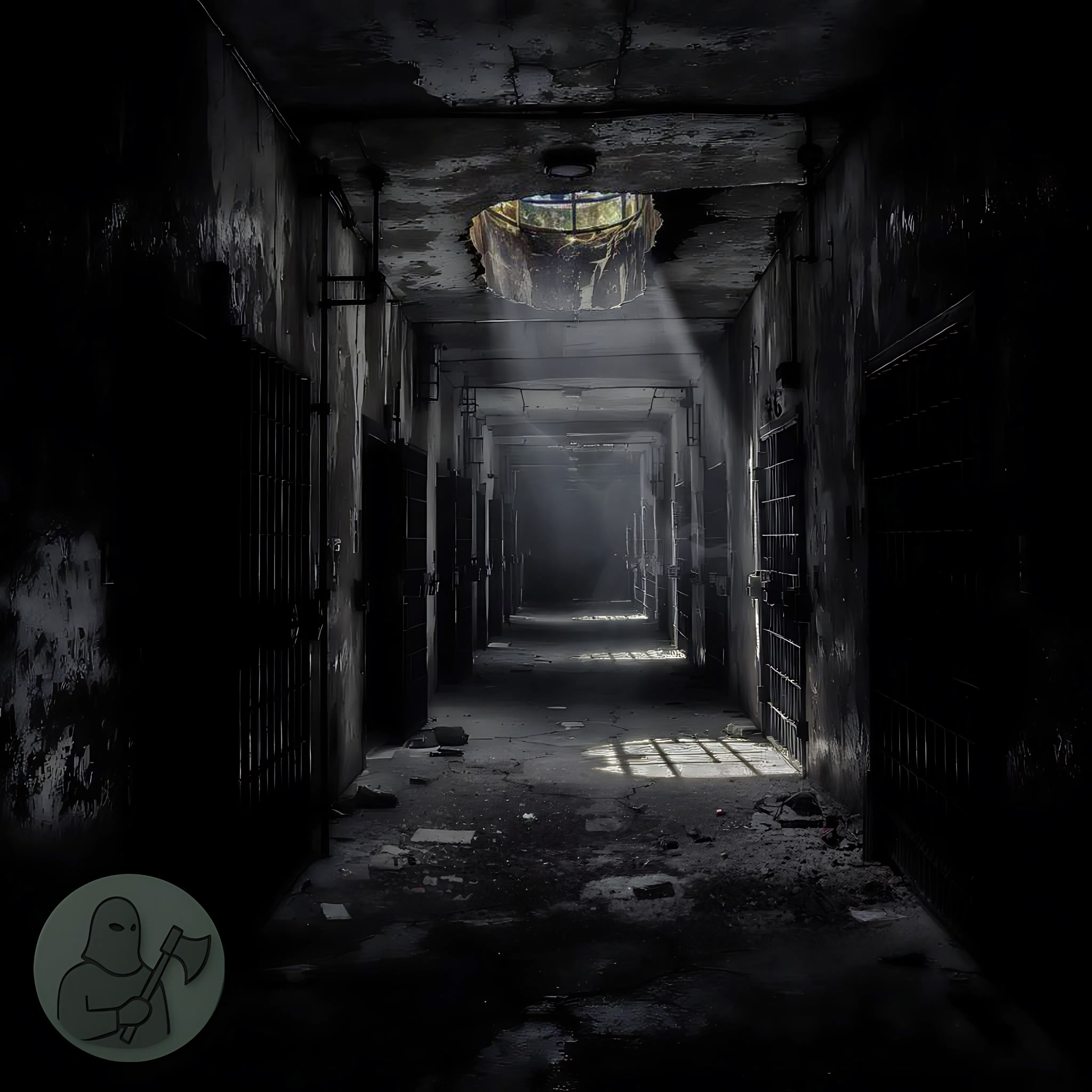
The cover art depicts a decaying, shadowy hallway lined with cells, a light-drenched opening in the ceiling where a ghostly, ethereal angel appears to hover. A digital icon in the lower left corner features an executioner with an axe.

♫ Beyond Reach ♫


76/398

LogoSwitch language

I enter the corridor. It will be my final walk. I cast a brief glance back at my cell, at the leftovers on the tray. The executioner and a clergyman—who has nothing personal to say, but only murmurs Bible verses to himself—accompany me. And my angels. Those radiant figures that no one but me can see; they came to visit me after long months in this cell, suddenly appearing, and they haven’t left me since.

I hear the soughing of their long, delicate wings and their whispers. Their hoarse, sighing whispers, of which I could never understand a word. And yet—no, at this very moment: Didn’t one of them whisper directly into my ear? Softly, barely a breath, but still intelligible? Or is it just my mind, made unreliable by long confinement, imagining it heard something—a word, a final personal one intended only for me, a message for me alone: Now!

80/398

The cover art depicts a circle of orchestra musicians, clad in black, seemingly suspended above a chasm filled with vibrant, organically formed structures.

♫ Sonochronic Contradictions ♫


80/398

LogoSwitch language

I enter the corridor—the orchestra has already begun—and hasten into the hall. To reach my seat, I must squeeze through the otherwise fully occupied second row. As I do, the music crashes against me like a jungle of incoherent tones, following no recognisable form. Must I really endure this? “Avant-garde”—that subtitle on the programme should have made me suspicious. I truly wish to leave, yet I am as if paralysed, steadily losing the sensation of my own body as the music expands. It begins to flow between the intervals of the accustomed semitones—not merely into quarter-tones, but “centitones” and “millitones.” To the untrained ear, it is torture; but for me, within me, something has shifted. I now perceive with mounting interest the various musical forms bustling within the sound.

It is astonishing: these sound-figures live and move freely through the world of tones, drifting apart and drawing near to one another. I realise with amazement that the two dimensions of this world are, on one hand, pitch, and on the other, the timbres arising from harmonic overtones. Every living creature in this sound universe possesses its own colouration, even if some are adept at camouflaging themselves.

One of these sound-creatures seems very close to me, and suddenly the realization hits: That’s me! In this world of vibrations and frequencies, I possess my own body; I am part of this acoustic habitat! When one of the sound-beings nudges me and I feel a sharp pain, I learn that I can change my musical form and move through this jungle of tones, through the dense musical vegetation. I can even absorb small sound-figures into my own form—as if I were strolling through a garden, snacking on tasty-looking apples or raspberries.

A deep growl makes my heart skip a beat: a hunter is prowling the jungle, searching for prey with its whirring sound-tentacles. I flee, but the hungry creature has already spotted me. I hide my sound-body in the musical vegetation of our habitat, but my camouflage is useless. I narrowly escape a searching tentacle by climbing higher. I am limited, however; I manage to rise a few octaves, but then the sounds begin to thin out in the high registers. The predator rumbles restlessly back and forth directly beneath me in the low registers, until a tiny melodic fragment falls from the vegetation I’m clinging to and betrays me. With a piercing arpeggio, one of its tentacles reaches me and digs deep into the sound-pattern of my flesh. The greedy growl pulls me down toward it, octave by octave…

I let out a death cry.

The music dies away. A few violins play on, but the conductor has turned towards me, and the entire audience is staring. “I am sorry,” I mumble, standing up and pushing through the row to flee the hall.

I can still hear the conductor calling out a bar number to his orchestra to resume the piece. The music rises once more. But I run on, further and further, without collecting my coat from the cloakroom—simply away from here, into the open air.

There is no music here. The street noises are refreshing, washing over my ears like a welcome downpour. Everything is a rush of cars and roaring motorcycles; in the distance, I hear a siren, and above me, an aeroplane. I come to a halt in the midst of this wonderful clamour. A roar draws closer—the deep growl of a powerful engine. A bus thunders at great speed along the street, bearing down on the spot where I stand. I face it, arms flung wide to the sky, thanking the heavens for my rescue…

81/398

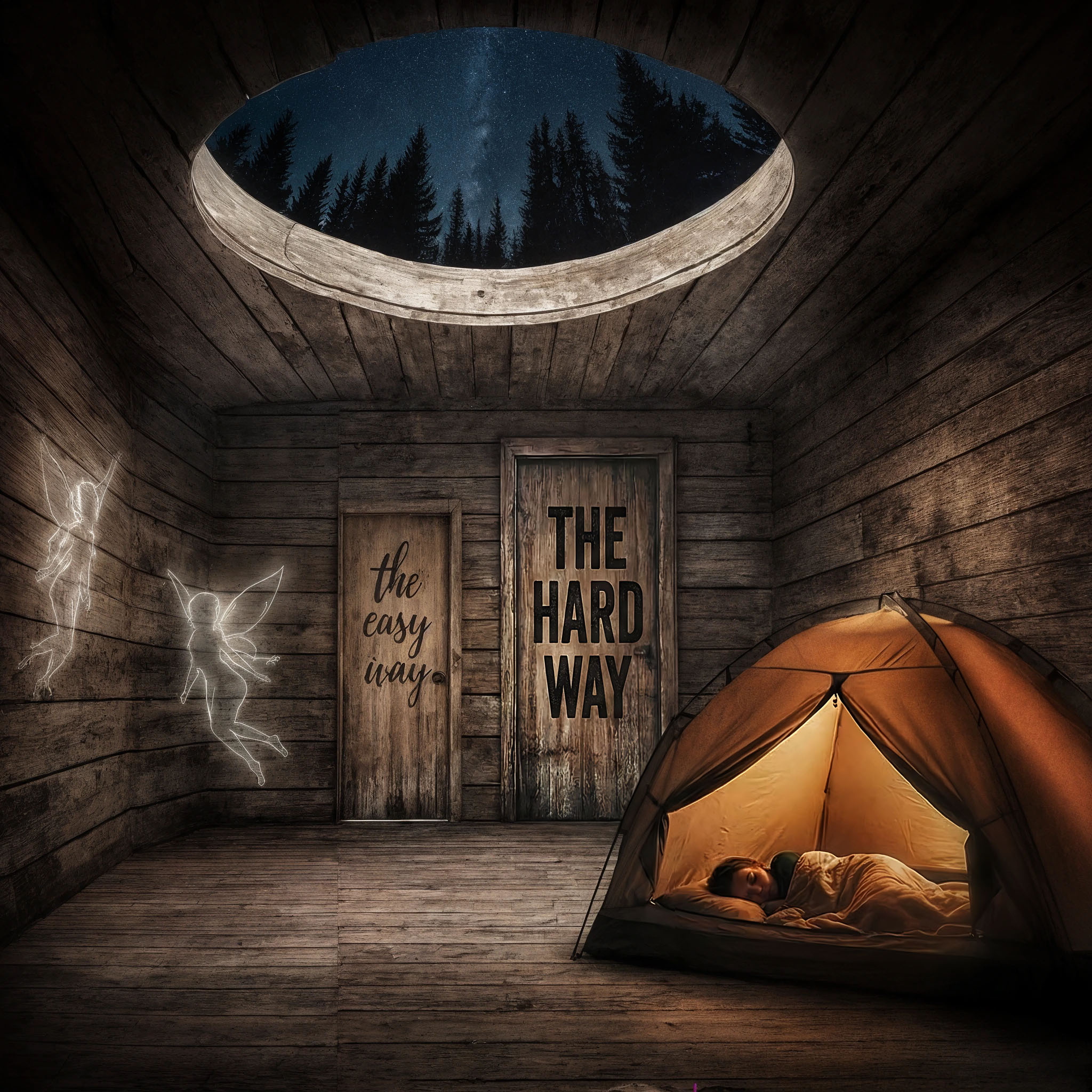
The cover art depicts a plank-constructed room with two doors, one labeled 'the easy way,' the other labeled 'THE HARD WAY,' two glowing fairies on the left wall, and a tent with a sleeping child in the right foreground under a round skylight overlooking the starry sky.

♫ Zahnfee-Walzer ♫


81/398

LogoSwitch language

I enter the corridor. It is broad and short, and at its end are two doors. The left one bears the inscription “The Easy Way,” while the right one says “The Hard Way.” Ha! You can’t scare me! I grip my sword. With my gear, my training, and my unyielding will, what could possibly stop me? I place my hand on the handle of the right door. Am I not stronger than those who are faster, faster than those who are wiser, and wiser than those who are stronger than me? The door is already slightly ajar. But then an outrageous question strikes me, challenging everything: Who do I really need to prove anything to?

It’s a decision made in an instant, yet I don’t hesitate: I choose the left door. Before I realize what’s waiting for me, I wake up in my sleeping bag. For a few moments, I’m slightly disoriented because here, in the middle of the wilderness on the Appalachian Trail, there are no corridors or doors in sight. It was a dream! A good dream. Somehow, I feel like I’ve made an important, life-altering decision. I’m proud of myself, unzip the tent, and savor the bitterly cold morning air in my lungs as I start preparing breakfast.

85/398

The cover art features four women, clad in matching red one-piece swimsuits and headbands, posing on and around a vibrant red sofa. They are each holding colorful throw pillows. A small digital icon in the bottom left corner displays an owl peeking from a woven basket.

♫ Change of Hand, Sleight of Mind ♫


85/398

LogoSwitch language

“I enter the corridor” scrolls across the screen—much like clouds forming and dissolving in a time-lapse sky—as on-screen text, just as THE CONJURER (wearing a plain red robe with a broad black cloth belt and a black hat) enters a clinically white, glaringly bright hospital corridor. He stops.

THE CONJURER

Many deem they be upon the playnest way
And yet they wander far astray
Whiche leadeth not to vertuous lyfe.

The Conjurer walks on. The doors along the sides swing open: to the sound of circus music, FOUR SCANTILY CLAD GO-GO GIRLS present items to him on velvet cushions, such as:

  • (on a beige cushion) a pacifier,
  • (on a purple cushion) a tjurunga,
  • (on a red cushion) a submachine gun,
  • (on a blue cushion) a golden laurel wreath.

The Conjurer casts a brief glance at each of the tempting offers, but then shrugs and leaves them aside. Only now is it noticeable that he carries a wicker basket on his belt, with A SMALL OWL peeking inquisitively out of its opening. While walking:

THE CONJURER

Blest is he who strayeth not from the waye
If he hath founde it for to keepe
For oft the side-path turneth deepe.

More doors swing open beside the Conjurer; FOUR MORE GO-GO GIRLS (or are they the same?) present:

  • (on an orange velvet cushion) a gaming console,
  • (on a green cushion) the Charter of Human Rights,
  • (on a yellow cushion) an ivory tower, and
  • (on a turquoise cushion) The Glass Bead Game from Hesse’s novel of the same name.

At the end of the corridor, a coral-colored curtain awaits the Jester. He pushes it aside…

THE CONJURER

(smiling)

I dread the dayes are drawing nigh,
When menne shall more newe tidings finde,
Than shall content or suit our minde.

…and then disappears behind it.

87/398

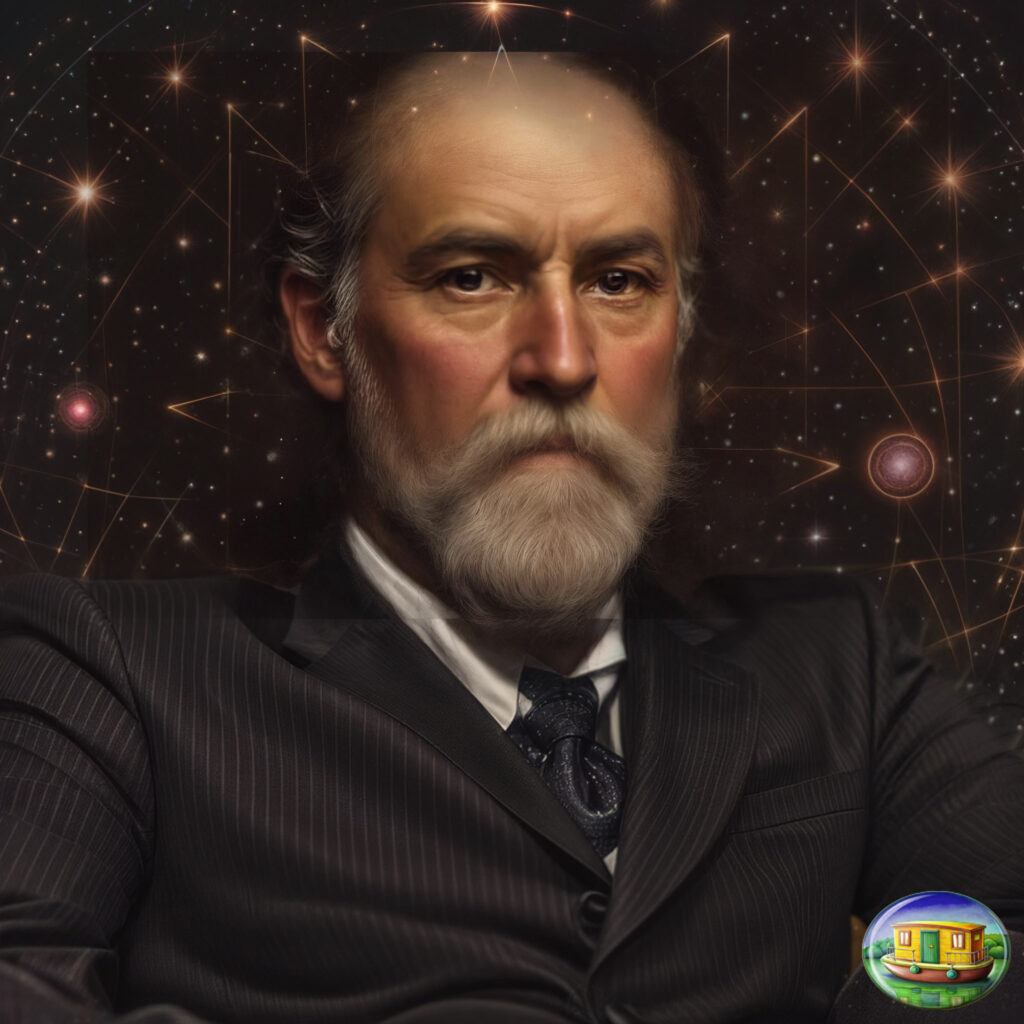
The cover art shows the portrait of an older man with a gray beard and receding hair, wearing a dark suit with a tie, against a background of shining stars and geometric lines. Tucked in the bottom right is a small plaque, depicting a houseboat.

♫ Astral Short Cuts ♫


87/398

LogoSwitch language

I enter the corridor of his houseboat and find my friend Norbu on the small terrace as expected, hunched over the laptop on his lap.

“Wikipedia!” he groans, and it sounds like a suppressed curse. I open the wine I brought along. I already know where to find the glasses.

“When you hit the outer limits, they’re all terrible ideologues.”

“What limits?” I ask.

“Well, the limits of science. Here, for example, the entry on Frederic Myers.” He points to the text on his display, but without my glasses, I can only make out a blurry logo and a photo. “Myers was one of the founders and later president of the Society for Psychical Research, which dealt with spiritualist topics. He coined the term ‘telepathy.’”

“Doesn’t ring a bell,” I say, then quickly add, “The man, I mean.”

“But the Wikipedia editors,” he continues, unfazed, “leave out his most important contribution.”

“Well,” I venture, “spiritualism and telepathy aren’t exactly standard Wikipedia topics.”

Norbu looks at me, shaking his head. “But they have to be. An encyclopedia can’t just erase a part of reality simply because the editors and authors don’t like it.”

I clink my glass against his to buy a little time. “Aren’t they all completely different authors? I mean, after all, you’re a contributor too.”

Norbu gives a pained laugh. “Sure. But there are the decision-makers, a kind of priestly caste, and it’s mostly the ideologues who’ve made it to the top. They cut out whatever doesn’t fit their agenda, using flimsy excuses and practically warlike tactics.”

I nod to show understanding. “Like telepathy.”

“And everything that evades the scientistic creed.”

Scientific creed? I let Norbu get away with the contradiction and point a finger to remind him of the old bearded man on his display, staring out at me from the deep darkness.

“After his death,” my friend Norbu explains, “mediums all over the world received strange transmissions through automatic writing, many signed ‘Myers.’”

“You mean he was reaching out from the, uh, realm of the dead?”

Norbu nods zealously. “And not just that. The texts made no sense.”

“Aha,” I say with satisfaction, “then it doesn’t need to be on Wikipedia.”

That earns me a glare from Norbu.

I take another sip of the red wine. Pretty dry. But that’s how Norbu likes it.

“Only independent observers were able to piece together the transmissions—like I said, transcripts from various mediums across the globe—and suddenly a pattern emerged. They all referenced each other.”

“Wow,” slips out of my mouth, “telepathy!”

Norbu shakes his head testily. “No, exactly not. Whoever sent these messages intended to rule out the possibility that the mediums were communicating with each other telepathically.”

“So no telepathy,” I say, frowning. What then?

“Let’s apply Occam’s razor and go with the simplest explanation: After his death, Myers came up with a way to prove the survival of the human psyche—through these scattered transmissions to different mediums that only make sense when taken together. They contained information very few living people had access to. And over roughly thirty years, that added up to more than three thousand texts. It’s just that none of it appears on Wikipedia—neither the German nor the English version. Just like there’s nothing about spiritualism in the article on ‘Automatic Writing,’ and so on and so forth.”

Norbu looks at me expectantly. But I can’t really bring myself to agree.

“Maybe that’s for the best. What you’re telling me sounds pretty, uh, unsettling. The part about the 3,000 transmissions.” I take a big gulp of wine and pour myself a refill. The longer I think about it, the more uncomfortable I feel under Myers’s gaze from his Wikipedia page.

“You’re just like them,” Norbu says, shutting his laptop in disappointment. “Whatever doesn’t fit into your neat little worldview gets kicked out.”

“Speaking of which,” I say, “up for a game?”

The distraction tactic is a resounding success: A short while later, we’re standing at Norbu’s foosball table, replaying the latest Champions League matches.

It’s only on the walk home—a bit unsteady, but in good spirits—that I remember this Myers fellow again. Strange guy. 3,000 nonsensical texts? Sounds like something from the internet age. With a blog from the afterlife, he probably would’ve achieved a lot more—and maybe even made it onto Wikipedia…

88/398

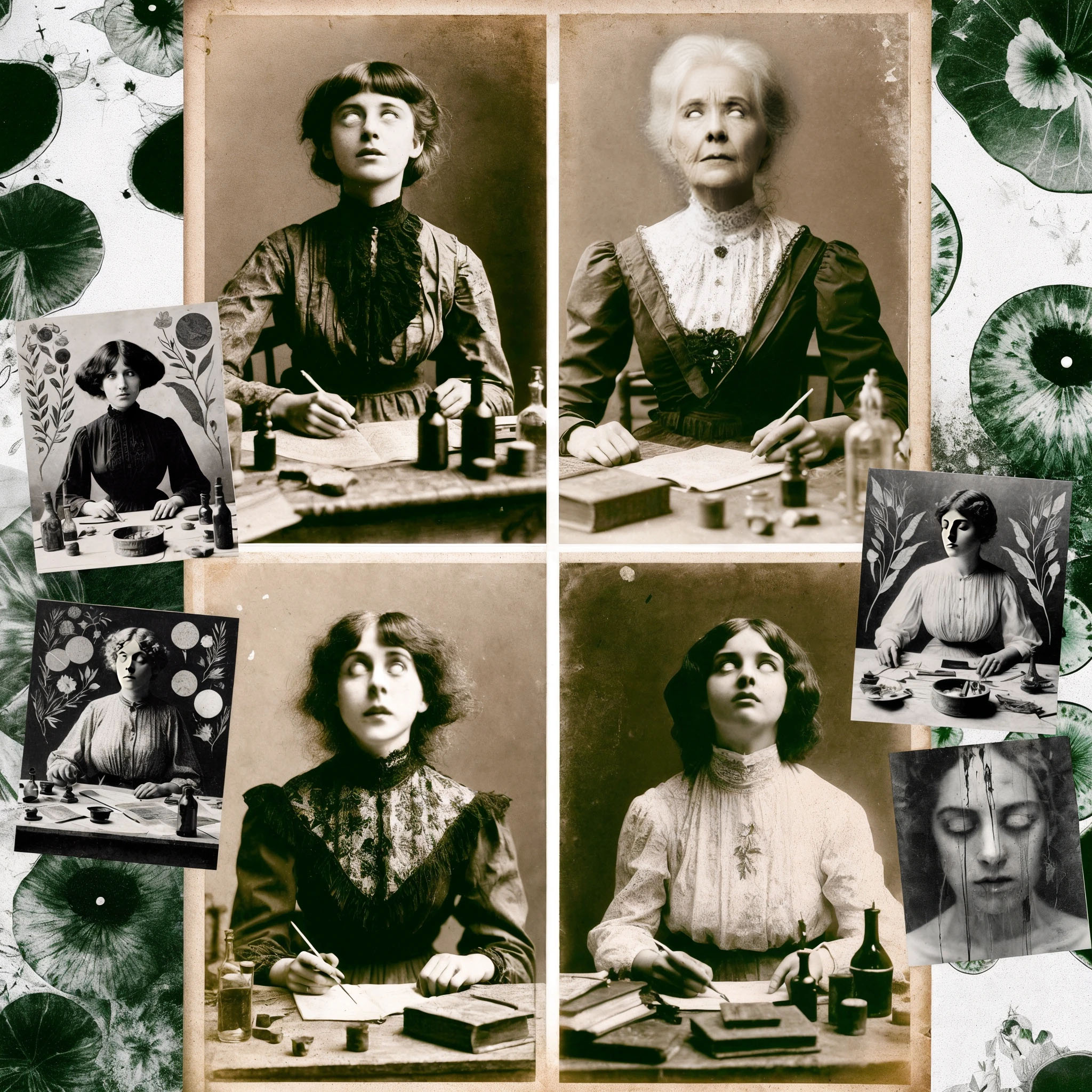
The cover art features four monochrome portraits of women in period dress, seated at desks and gazing upward, revealing only the whites of their eyes. These central portraits are encircled by smaller photographs and a backdrop of floral patterns.

♫ The Unsound Communiqué ♫


88/398

LogoSwitch language

I enter the corridor, and immediately I encounter—how shall I describe it?—a shroud of glassy frost through which vision blurs and sounds, if they penetrate at all, are only muffled. Those who sit behind this veil—whatever I attempt to shout to them for dictation, for verbatim transmission, they commit to paper only reluctantly and, at times, obtusely.

How am I to deliver the proof to you while this remains my sole means of passing on the message? I cannot possibly know how much of what I send actually reaches you. How can I convince you? My ongoing efforts are met with untold difficulties, and this sense of dreadful powerlessness weighs heavily upon me. Oh, it is a dark and cruel corridor! But I will not—I simply must not—falter in my endeavor…

94/398

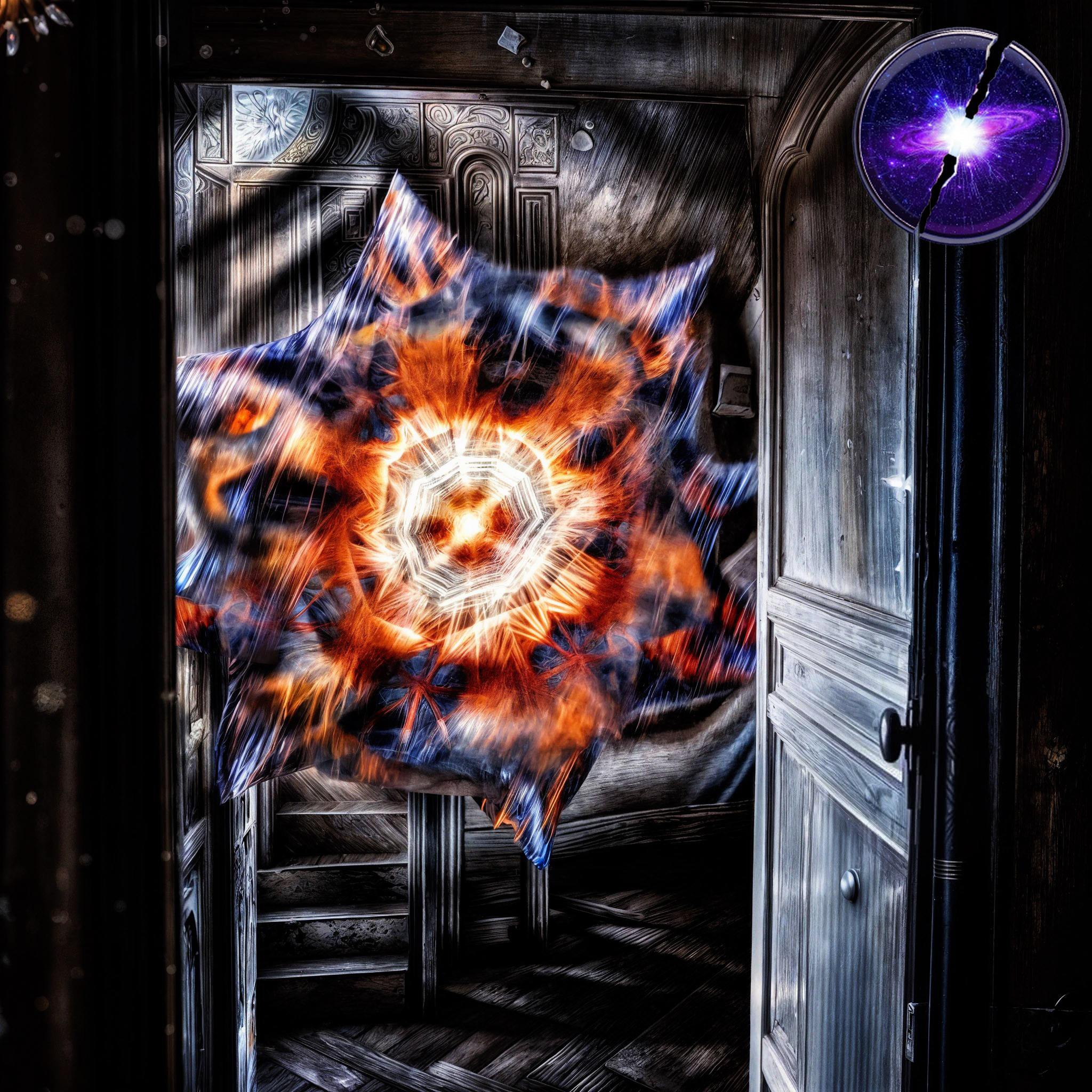
The cover art depicts an open wooden door within a shadowy interior, where a luminous, kaleidoscopic, starburst pattern hovers in the threshold. Top-right, a digital button features a galaxy icon, bisected by a fissure.

♫ Heimsókn ♫


94/398

LogoSwitch language

I enter the corridor because I heard a strange noise. At eye level, a blinding light flashes at the front door—two, three times. Is someone welding it from the outside? It flashes glaringly again, three times, like a knock, but utterly silent. Without a second thought, though I’m standing there only in my pajamas, I rip the door open.

In the shadows of the entryway stands—something. Or rather: it hovers. It looks like a three-dimensional kaleidoscope whose luminous shards constantly migrate inward, until they suddenly shift direction and flow outward from the center like molten iron.

The voice is very soft and gentle, and it feels like I’m hearing a familiar, beloved lullaby. It says, “You caused a spiral arm of the galaxy to vaporize.”

I stare at the apparition. Words fail me. I want to run away, hide, or just faint. But it’s as though my thoughts no longer find resonance within my body—no anchor to trigger a physical act. I remain stone-still before this thing.

“You built a machine,” says the voice.

A machine? Yes, there was something. But it wasn’t me. Just a dream. For weeks, I’ve been waking up at the exact same time in the middle of the night, at 2:22 a.m., and I always remember a vivid dream in which I’m some sort of engineer, obsessively building an incredibly complex machine—it fills nearly the entire warehouse I rented, using powerful Hadron lasers and a kind of miniaturized fusion reactor to manipulate gravity and rupture the space-time continuum. Dream by dream, I completed my work, even though I secretly knew the device could have uncontrollable side effects. Until last night, when I finally activated the finished machine. I can’t say what it did because the moment it started running and revved up, I woke up. That was yesterday. It was 2:22 a.m.

Even now, in the middle of the night, it could be 2:22 a.m. But this is not a dream.

“You built a machine,” the voice repeats, as I’m hypnotized by the slow flow of liquid metal and a sense that the being with its gentle singsong is about to tell me something terrible.

“Your machine pierced the dimensions of the world, shattered your planet, and dragged many, many stars and planets in the vicinity into destruction.”

“But that’s nonsense! The Earth didn’t perish just because I dreamt something!”

The kaleidoscope pattern changes, but I can’t say how. The voice now seems more stern. It says, “The world in your dream was real. As real as this one. We had hoped you would decide not to activate the machine at the last moment, but to destroy it.”

“I had no idea what it would do!” Really? No, I did. In the dream, I knew very well the risk I was taking. I just kept pushing it away.

“Many civilizations had to die,” says the voice.

Because of me? Am I supposed to be guilty? “What about you?” I ask, “You’re alive, I assume.”

“A few, like me, were hurled through perforated dimensions into parallel worlds.”

Parallel worlds: In the dream, I repeatedly suppressed the fear that my ingeniously devised machine—intended to tap into vacuum fluctuations for unlimited free energy—might unravel the fabric of time and space. And now, an entity stands before me, thrown into my world through a dimensional rift—perhaps the last survivor of an entire planetary civilization that I have on my conscience. Slowly, the staggering weight of what the entity is telling me begins to sink in.

“If you knew about it, why didn’t you prevent it?” I ask in a hoarse voice.

“You have to do that yourself,” answers the liquid kaleidoscope hovering before me in the entryway.

“How?” I ask, bewildered.

The being slowly floats upwards and fades away. It has delivered its message and now retraces its path—wherever the destination may be. “How should I do it?” I call out.

The being vanishes. I hear no more answers, but in my mind, a thought forms, saying, “Dream a new world into being.”

A profound despair seizes me. It wasn’t me! I scream internally. It was that deluded engineer!

But the being is right: I was the man in the dreams, the one who decided to take the risk. I have the deaths of humanity and a multitude of other civilizations on my conscience; I have, with my obsession and greed for fame, led billions of people to their deaths, and a substantial chunk of our Milky Way along with them. I want to push it away, deny it, blame someone else. But although they were just dreams, deep inside, I know that my visitor is correct in his accusation. I was that obsessed engineer who disregarded all the ominous premonitions and set the machine in motion.

As I close the front door, my hand trembles. I must prevent it! I think, and at the same time, I laugh bitterly: How can I prevent something that has already happened?

But couldn’t a space-time fabric that includes parallel worlds also include the possibility of turning back time? Did the kaleidoscope being perhaps speak of this when it said, “You have to do it yourself”?

If it’s true—if it’s true that through my fault, humanity and a handful of other civilizations were destroyed—then I will thwart this dreadful act at any cost! Numbers, equations, and circuits race through my mind. The long nights as an engineer have paid off. Slowly, an image solidifies in my mind: a device, a time-and-world machine with a single purpose, meant for one-time use. It will be a kind of ark. But I won’t fill it with animals or people: It will transport me to a place and time that will allow me to prevent myself from punching holes in the cosmic fabric. I will undo it, thoroughly and physically! It must be possible.

That night, I lay awake for a long time.

97/398

The cover art shows a wooden houseboat with a green door and various structures on the roof, in front of a wooded shore under a cloudy sky. A circular architectural structure can be discerned in the calm water. Tucked in the bottom right is a small plaque depicting a houseboat.

♫ Houseboat Lounge ♫


97/398

LogoSwitch language

I enter the corridor. My friend Norbu seems not to be on board, but as I stand somewhat perplexed in his living room, I suddenly hear the sound of hammering. Burglars? No, it dawns on me, probably Norbu, who is sealing a leak and making sure that his houseboat doesn’t sink.

And there he comes, toolbox in hand, and we settle in with a glass of red wine. “I found ancient records of myself,” I tell him. As a teenager, I was fascinated by Atlantis and, like a little private scholar, combed the city library for archaeological clues about the inhabitants of this sunken continent. I show Norbu cave drawings, meticulously copied from various books and adorned with scholarly comments. They come from both the Old and the New World. “Atlantis lay in between,” I explain, “and that’s why there are such peculiar similarities in symbols and depictions, long before Columbus came or the Vikings discovered America: surviving Atlanteans who fled to the surrounding continents.” The thesis still convinces me today.

My friend Norbu rubs his chin. “Has it never occurred to you that these similarities may not have required any contacts by sea?”

“You mean it’s all just a coincidence?” Disappointed, I take back my yellowed and slowly disintegrating notebook.

“No, by no means. But haven’t you also delved into shamanism…”

Yes, right, there were shamans in almost all cultures worldwide, healers in contact with the spirit world and ancestors.

“And possibly,” my friend Norbu says, “in contact with each other.“

It takes a moment for the realization to sink in. “You mean, across the oceans, from people to people? And that—telepathically?” Norbu points affirmatively to my notebook. “Hm. Shamans of the European megalithic culture exchanging thoughts with those of the Proto-Americans,” I imagine. And of course, that could also explain the similarity of the pyramids or the fact that not only the Egyptians mummified their dead but also some Native American tribes. Besides the underworld of the dead and the upper world with helpful spirits, the shamans also know the middle world—the astral counterpart to our everyday reality and its reflection in the spiritual world. On journeys to the middle world, the shamans of earlier times, detached from space and time, could have visited foreign continents and civilizations—and thus their respective colleagues.

“But maybe not,” Norbu interrupts my thoughts. “There are indications that even before the Vikings, there were contacts between Europe and both Americas. The Chinese, Romans, Greeks, Egyptians, and Phoenicians—all are said to have been there and traded with the cultures there. Perhaps even the megalithic peoples. And all of this without the need for Atlantis as a bridge.”

I probably look somewhat disappointed because Norbu adds consolingly, “But of course, your early research honors you. Who knows, they might become important again and provide new answers? Or raise new questions?”

I know my friend Norbu isn’t entirely serious, but I feel strangely affirmed nonetheless. The young, curious fourteen-year-old still within me is pleased to receive a late acknowledgment for conducting significant foundational research.

I clutch my notebook as I cycle away, deciding not to stash it back in a dusty drawer but to give it a place of honor on my shelf with the early works of great minds.

98/398

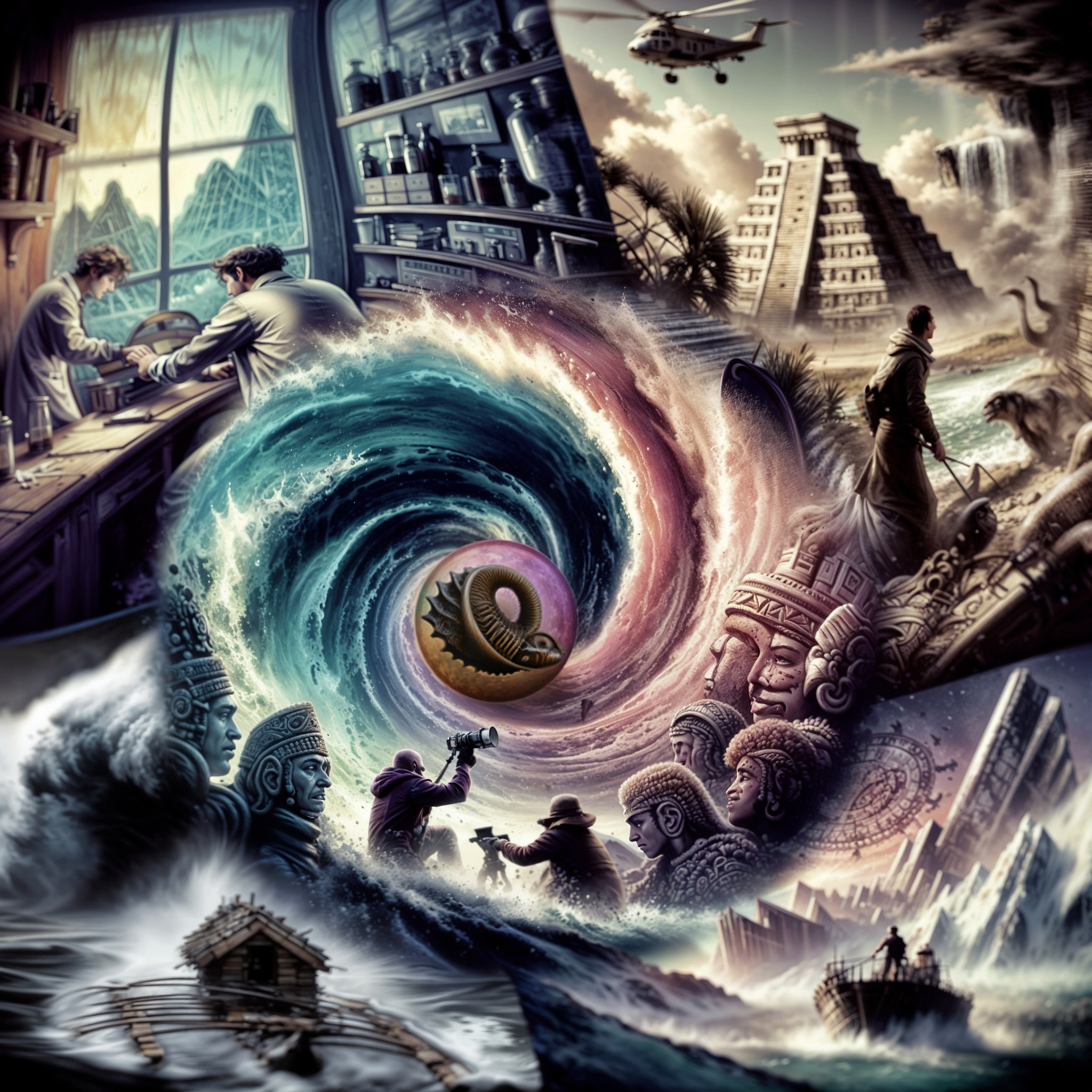
The cover art displays a surreal collage featuring researchers in a laboratory, a helicopter hovering above a Mayan pyramid, a modern boat, a Polynesian boat with a hut, and Mesoamerican statues – all swirling together around a snail-shaped structure at the center.

♫ Unearthed ♫


98/398

LogoSwitch language

I enter the corridor—although it’s not me whose body is stepping into the hallway, but a stranger in whose mind I sit undetected—relieved that the time has finally come to leave him behind. This time, it was Peter Aufschnaiter who, after a dramatic escape alongside Heinrich Harrer, reached the Tibetan capital of Lhasa on January 15, 1946, where he constructed hydroelectric power plants and sewage systems over the following years.

It’s always a corridor, a passageway, or a tunnel that leads me out of one head and into another. Somehow, this form of mental travel must have something to do with the “Snail Shell,” that intricate metallic structure that devoured so much processing time on the university’s supercomputers—and eventually me. I should never have crawled inside.

Since then, I journey through time without a physical form. It’s like a dream that keeps fading and blurring, and I’m constantly plagued by these headaches—a state of being not meant for humans. Something unnatural has happened to me. I’m trapped in foreign bodies, foreign times, foreign places—except that I almost always instantly know where I am.

Whether I’m standing in a laboratory with Marie Curie, documenting the Mayan metropolis of Uxmal with Frederick Catherwood, weathering a storm on the Kon-Tiki with Thor Heyerdahl, or reaching the South Pole with Amundsen: it’s always the heroes of my childhood and their defining moments that dictate my mysterious itinerary.

My mind always lingers in the head of one of my childhood heroes’ companions—and sometimes that means weeks or even months!—until they enter a passageway or something similar. A doorway is not enough. The corridor must apparently have a certain length. It’s then as if I lose my grip. I sway, spin, whirl, only to abruptly find myself in someone else’s head.

I drift away repeatedly, and even remembering the past is difficult for me: What other childhood heroes were there? Dinosaurs! Like so many in their youth, I was fascinated by dinosaurs. Sometimes I fear that my journey could take me to that distant past: What will happen if I end up in a place, in a life where there are no corridors, hallways, or tunnels? Is my journey over then? Am I finally truly dead when the one in whose head I’m squatting and through whose eyes I see dies? Or will I return to the “Snail Shell” and wake up there from uncontrollable, twisted childhood dreams?