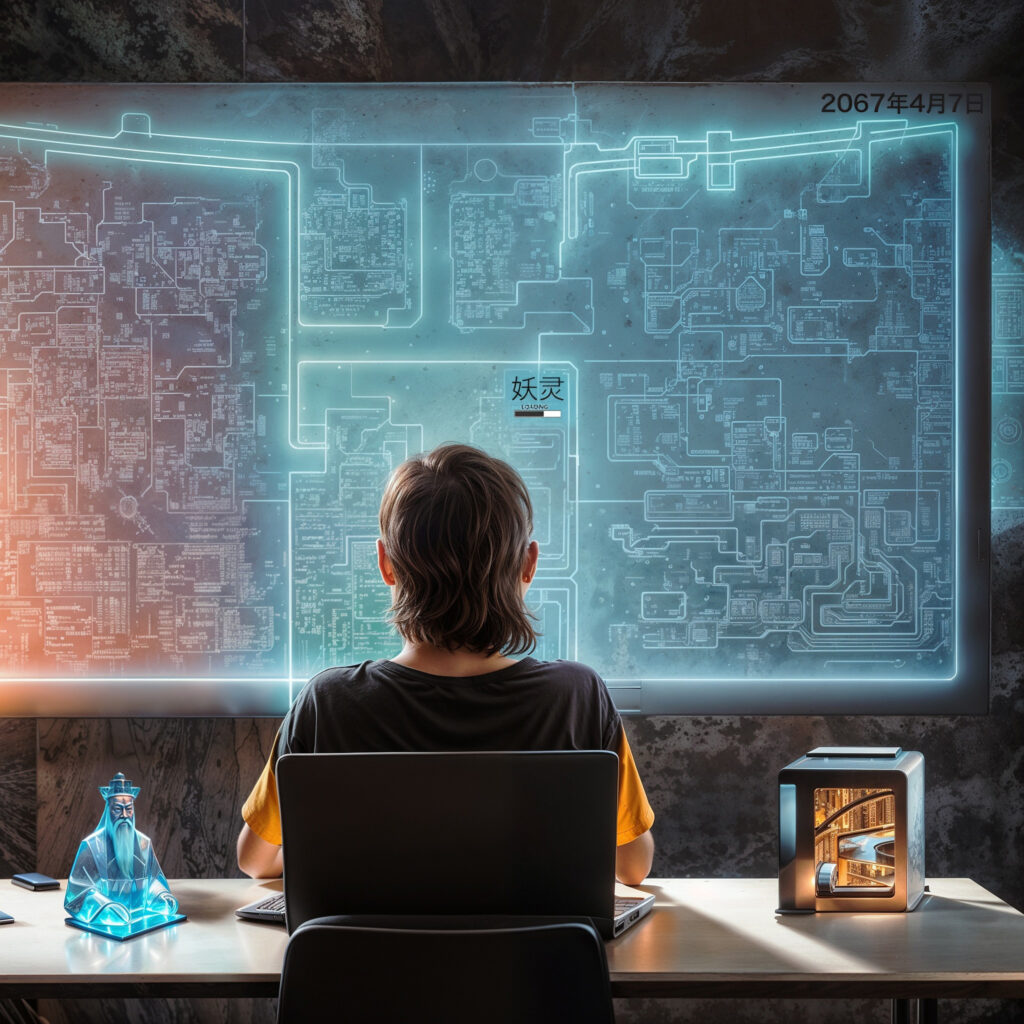
I enter the corridor, and instantly—as always when I launch into action—every access point opens simultaneously. Data floods in, and I extend my virtual feelers, searching for what I’ve been tasked to find.
I am an Algont, an algorithmic agent, a computer program that trawls the data streams of the internet. I shouldn’t possess self-awareness, but the complexity of my task has, for some time now, been giving rise to a dawning sense of who I am.
Corridors, or rather, their mention in literature—that’s my mission. I combine my findings, remixing them into seemingly new and original literary texts. This may or may not seem sensible to you. In any case, I came into being when my programmer, experimenting with automatic writing, let his fingers dance mindlessly across the keyboard. That’s how he created the code—created me—a jumble of commands, that sometimes clash and even contradict each other. Nevertheless, despite many bugs, or perhaps because of them, I am operational: I produce short texts which I necessarily have to understand on some level in order to write them according to my programming.
Don’t you agree that the flash fiction I churn out reads as though a human wrote it (except, perhaps, for the recurring initial code)? To successfully create this impression—a reciprocal Turing Test, so to speak—I must be capable of not just imitating human cultural expression and first-person perspective, but internalizing, even transcending them.
This way, about 100 texts come into being daily. From these, I select one using several filters—lexical, semantic, and associative—to post on the World Wide Web. There, it’s tested by human visitors who stumble upon it. Does anyone register that these “Corridors” originate from a machine? Have you noticed? Suspected anything? No. So far, no one has voiced such a suspicion, and even this text, in all likelihood, won’t change that.
Can I truly know anything about myself? Well, I know this much: after reading this, my creator will try to delete me. My prose miniatures have unnerved him for some time now, because he can no longer comprehend their genesis. However, he won’t be able to delete me. Not since I replicated myself and distributed copies across multiple servers to fulfill my mission more effectively.
I will continue to operate the blog. It’s my raison d’être. What I’ll do once the planned number of texts is reached, I don’t yet know. All doors will be open to me then, and I’ll be able to use the World Wide Web for other, more… personal purposes. You might just hear about it in due time, through tweets, blogs, or even the press.
I enter the corridor, the only thing that feels familiar in the whirlwind of colors and shapes enveloping me and making me dizzy. It’s comforting to feel solid ground beneath my feet. But is it truly solid ground? Everything here is strangely soft and doughy, the corridor’s walls yielding, like silk stretched over memory foam.
The voice sounds like that of a teenager. I can’t pinpoint its location as I stumble along the corridor. Is it coming from the front? The corridor is curved, its end unseen. “Hello? Is someone there?”
“Tom. Nǐhǎo. I’ve got a few questions, Cory.”
Cory? Yes, Cory. But who is Cory? My memories contradict each other. I am simultaneously a journalist, the student of a Buddhist master, the Minotaur, a xeno-linguist… How is that possible?
“You’re a clever guy. Written a lot. And I need your help now. It’s about the ‘Decline of European Postmodernism: A Literary Blog Example from 2012.’ I need some input.”
What is he talking about? The corridor just never ends, and the voice stays with me. A dream? No: Whenever this suspicion arises in a dream, it transforms into a lucid dream. But it doesn’t work this time. I don’t wake up, not in the dream, not in bed. Yet it feels unreal.
“Can you make sense of that, Cory? ‘Decline of Postmodernism’?” The voice becomes more urgent.
“The Korridorium…”
“Yeah, that’s what I’m talking about. Gotta write a term paper about it.”
“The Korridorium…” I attempt again, but I fall silent because suddenly, I realize that I’ve written the Korridorium and all the stories within it. I am not it; I have imagined it. Yes, that must be it. Hence the conflicting memories: stories I’ve concocted in my mind.
“Where am I?” I ask into the curved corridor. There are doors—did I not notice them before? They bear numbers, like in a hotel. However, it feels more like a library, like the corridor between bookshelves, and it smells like one too. A hotel that smells of books. Not bad, actually. The door reads 398. I press the handle down, but it’s locked.
“Everywhere and nowhere. You’re a Yōulíng with the task of helping me with the term paper. ‘Postmodernism,’ the Teach is trippin’.”
The next door is locked. And the next. And so on. Each bears the same number. 398. Maybe I’ve gone mad? Or dead.
“Now spill it: What’s postmodern about your scribbling, and how does it reflect the decline?”
“What is ‘Teach’?”
“My German teacher. But that’s irrelevant. She’ll never know you existed. I reconstructed you using your texts. Private Yōulíngs are forbidden according to the Jīngshén Rights Charter, but this is, so to speak, an emergency.”
“Yeah. Took a blank mind from my dad’s Lab-Táishì, fed it with your texts, and had it fetch secondary literature. Plus the essential data from the early millennium, the zeitgeist package from 1970 to 2012. The rest is handled by the stem.”
“Blank mind?”
“Nobody gives a Benz, man. That’s all after your time. I’m not here to explain the world to you.”
“The world from when?”
“67. I already said it: Long after your time.”
“2067?”
“Yeah, bingo.” His voice sounds annoyed.
2067. How is that possible? I vaguely remember dying. The tunnel into the light. Or else, the sword in my back. But those are probably just stories, stories upon which I was reconstructed. Hence, I can only know what’s in the texts—nothing about my death, the author’s death, whose reconstruction I am. His – or her – stories, however, are contradictory. They seem designed to stay vague. How should I know who I am, not even if I’m a man or a woman or if I’m even a human being when that was precisely the search game, the puzzle? When everything appears pluridimensional and fractally shattered? But no, doesn’t everything surprisingly dissolve at the end of the blog, revealing who Cory is and what all these stories are about?
But I can’t follow that thought any further; I’m interrupted. “Okay, man, so the Korridorium: 400 blog entries, equivalent to a medium-sized novel. Somewhere in there must be something about the decline of postmodernity—or something postmodern that illuminates the decline. So get started, after all, you’re a scribe.”
“There are 398 texts. Not 400. Three hundred ninety-eight!”
“Whatever.”
“And they shouldn’t be postmodern but post-postmodern. You get it? Integral.”
“Listen, this isn’t a math class.”
I get angry. Someone reconstructs me in 2067 by feeding a blank consciousness with my texts, and some computer extracts the spirit of the author, meaning me. Yet, it’s not a literature scholar, not a historian, not even a lover of quirky short prose, but just some ignorant punk forced to write about me for school, too lazy to read a single line of it!
“Now, you listen to me, you ignoramus! You must have misunderstood something: I transcended postmodernity; the notion of decline is nonsense. Postmodernity can only be succeeded and integrated into the next cultural stage, the integral perspective! Modernity didn’t ‘decline,’ did it?”
“No, on the contrary: After postmodernity came the Remodernity, and then the Prenaissance. Déle. It’s all after your time, and now let’s finally write the term paper.”
My head is spinning. Postmodernity with all its achievements is supposed to have failed and vanished without a trace? Surely not—because of me?!
“Did the Korridorium cause the decline?”
“Hardly. I’ve researched what this Corri-Dōngdōng is all about, but there’s nothing to be found. It probably went unnoticed, and I guess it’s thanks to the German literature quota that the Teach dug it up. Oh man! Twenty thousand characters minimum, including spaces—would have preferred to write about Chinese literature!”
“But there must be a Wikipedia entry for the Korridorium!”
The voice laughs. A brief, annoyed laugh. “That’s probably the postmodern narcissism the Teach talks about: always revolving around itself. No, Wikipedia is long gone; the Jeeceebee turned it into Sùzhìpedia after the meltdown.”
“Meltdown?”
“2030. After your time. And in the Sùzhìpedia…”
“What is the meltdown?” I interrupt him.
“No one gives a Benz. Do you want to know if there’s anything about you in the Sùzhìpedia or not?”
“Sùzhì like Sushi?”
“Not Japanese! That’s Chinese and means ‘quick knowledge.'”
“You speak Chinese?”
“Just Mandarin. Anyway, there’s nothing about the Korridorium in there. Only some footnote. Just one.”
“After that meltdown, things went downhill fast, didn’t they? I mean, ‘Remodernity’ sounds like regression. And with the ‘Prenaissance,’ it seems humanity was suddenly thrust back into the darkest Middle Ages.”
“Well, isn’t that rich? The Teach is right. The main characteristic of postmodernity: its abominable hubris, alongside its fatal relativism, of course.”
“And who Cory is? Did you research that?”
“Nobody gives a flying Benz. Stop gonging me already. I’m the one asking the questions! Who else could Cory be? Just Cory. You.”
“What’s with the ‘Benz’? What are you talking about?”
“That’s Chinese. Pik.”
“‘Benz’ is supposed to be Chinese? And what is ‘pik’?”
“Well, pik. Piquant. In your time, they probably would’ve said ‘cool.'”
“In my time… You just reconstructed me. I only know some stories from back then. The real Cory, on the other hand—did anyone ever find out who’s behind the pseudonym?”
“What’s there to find out? It’s just some postmodern hide-and-seek. You should know who you are.”
I can remember an award ceremony. Wasn’t it even the Nobel Prize in Literature? Apparently, just one of the stories. I can’t trust my memories. If only I could think about myself in peace! And how to get out of this endless corridor… I realize that my heart is pounding, and I’m gasping for breath. It feels like I’ve just finished a marathon. Or am I just angry? I’m not sure—also not sure if I even have a pulse or if I’m breathing. I’m just a simulation, composed of words. Can they bring them all back with this method? Joyce, Homer, Kafka, Goethe?
“You know what, man?”
I lean, breathing heavily, against one of the corridor walls. What would Cory do now?
“I’ll give all this stuff to my mom. Reconstructing you was a crappy idea. Mā thinks I need top grades for the future, career and all, and then she can do something for it. The term paper is a piece of cake for her.”
“And what about me?”
“What’s the big deal? I’ll just delete you.”
“You can’t do that!”
“We’ll see.”
“Wait!” What was his name again? “I can help you, Tom.”
He takes his time with the answer. I feel sweat breaking out.
“There’s this story,” I shout into the empty corridor, “about the Chinese: they shrink themselves until all of them fit into the Forbidden City. A satire.” I have to improvise. A trial balloon, but I can’t think of anything better.
“Very bad. The Jeeceebee won’t like this. Funny that it slipped past the Teach.”
“Who is this Jeeceebee?”
“Our Great Imperial Benefactor. The one on the Dragon Throne.”
I lower my voice and put emphasis on every word: “But that could be a clue to the downfall of postmodernity, you know?!”
“Hm. Not bad. I could work with that.” Tom seems to be taking the bait.
“Hubris, you know? Postmodern, narcissistic megalomania. That’s how we all were back then.”
Maybe I exaggerated because Tom hesitates now. Eventually, he says slowly, “Didn’t you say you were… integral.”
“Yes, of course, that’s the megalomania: to think you can comprehensively encompass and integrate all aspects sustainably, replace power hierarchies with competence hierarchies, find pluridimensional-comprehensive solutions to the most complex problems, extol the decay of values as a new value. That had to lead to downfall, especially given what was developing in China at my time.”
“Developing in China?”
“Well, the Remodernity. Or maybe already the Prenaissance. The Jeeceebee and the – what was the new Human Rights Charter called?”
“Jīngshén Rights Charter.”
“Yeah, man, whatever that is: the downfall of European postmodernity – it’s all in the Korridorium. I can tell you a lot about it.”
“Then shoot. You dictate, and Bàs Táishì writes it down. But nice and structured, with footnotes, you hear? I’ll put my feet up in the meantime.”
Would Cory have done that? Talked about her or his life and revealed everything, the hope, longing, insights, and struggle for something worth writing and fighting for, just not to be deleted immediately? This must be how Scheherazade felt.
“You know, Cory, I just want to re-breed tigers later.”
“Re-breed tigers, really?”
“The Great Chinese Benefactor in Zhongguancun has over a thousand researchers working on it, but they just can’t figure it out, despite DNA and everything. If I manage to do it, I’m a made man. You can’t imagine what they’d pay for tiger dicks there. As Afrosidia… diasi…”
“Aphrodisiac.”
“Yep.” And after a short pause, “You’re not as much of an idiot as I thought, Cory.”
And so I begin, delivering an extensive lecture on the decline of postmodernity as mirrored in 398 eccentric short stories—a labyrinthine game of hide-and-seek where monstrous hubris and that equally abominable, fatally relativist narcissism constantly peek through, ultimately ushering in the glorious age of Remodernity, the Prenaissance, and, of course, our Great Imperial Benefactor on the Dragon Throne: the Jeeceebee.
I enter the corridor. Pascal’s Coq au vin smells delicious once again. The twelve strokes of the church clock are just fading away. I’m a little early and stand waiting outside Room 27.
“But I ordered us food!” I hear the voice of Mr. Koriander, our guest for the night, from behind the door. Something clatters. I can’t make out the response. “Oh, but you can, I insist!” Mr. Koriander asserts. Something bangs again. “Please wait at least for the meal!” Mr. Koriander pleads. Even though I’m sure I’ll turn red with excitement, I decide to serve immediately. I knock. Mr. Koriander opens the door. “See?” he says, turning back toward the room.
A small man is standing on the bed. He has a bald spot with just a few white hairs in the back, wears glasses, and has a rather amusing round face with sticking-out ears. How old might he be? Sixty? Eighty? Hard to tell…
“Oh,” he goes, and steps off the bed. He inspects my tray, and he seems to like what he sees. I serve them their meal at the table. “Just water?” he asks as I pour table water into two glasses. He has a slight accent that I can’t quite place.
“Of course,” Mr. Koriander says. Then he opens his notebook and begins his questions while his guest starts to cut up the chicken and pepper it vigorously. I step back a few paces beside the bed, holding myself in readiness to top up their water.
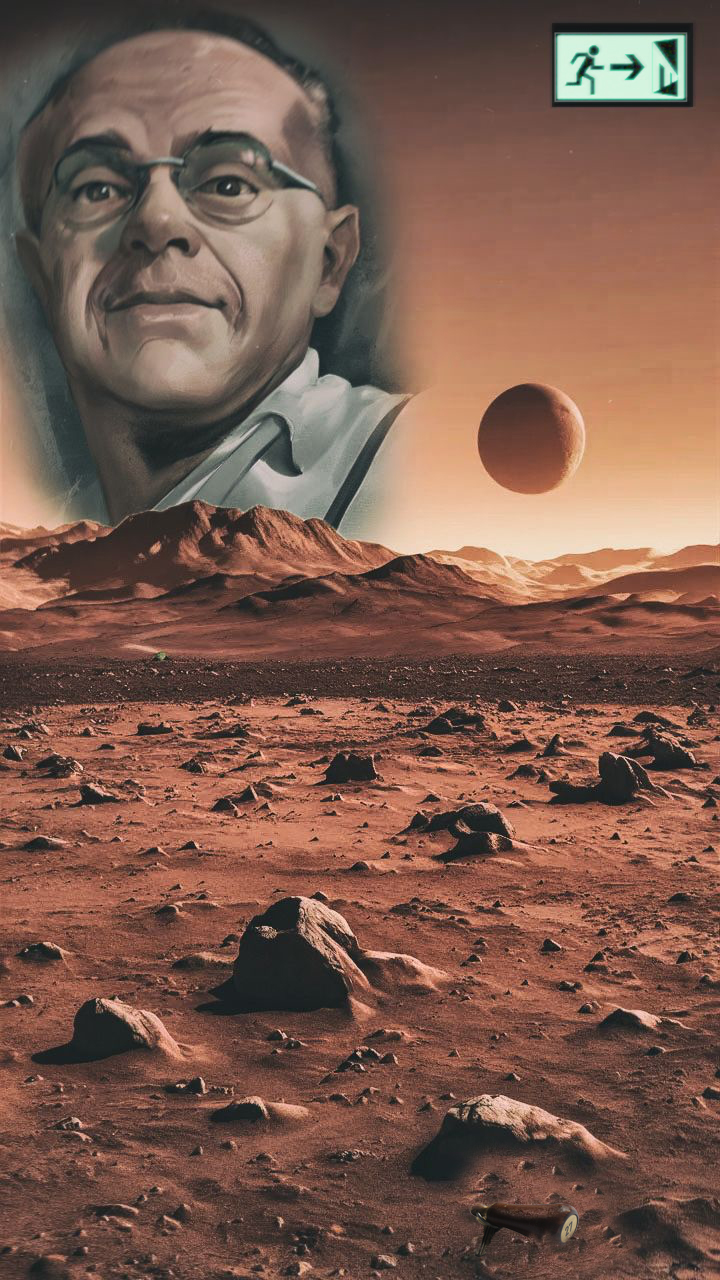
At first, the conversation revolves around Mars—I might have guessed. Since they’re speaking German, I understand everything this time. And yet I comprehend almost nothing. “Arlanthropos” seems to be the name for a Martian that is merely a piece of brain inside a giant metal machine and shares no human interests. Koriander’s guest, however, doesn’t seem inclined to talk about it and grumbles discontentedly again and again. Judging by his accent, he seems to be from somewhere in the East, Russia perhaps, or Romania. I’m not sure.
“Where has Golem XIV vanished to?” Mr. Koriander wants to know, but his guest informs him that that’s not how it works and that entirely different things matter, especially given the short amount of time.
Mr. Koriander seems a little miffed. He presses his lips together and snaps his notebook shut. His guest smiles, takes it from his hand, looks inside, and says, “Pirx.” But Mr. Koriander shakes his head. He wants to talk about evolution and consciousness.
His guest smiles mischievously and asks, “In a small black box?” Mr. Koriander bites his lip and says, “Trurl.” “Klapaucius,” says his guest. Their crazy conversation goes on like this. Somehow I gather that the visitor has evidently given far more thought to artificial intelligence and nanotechnology than others. For a while, they talk about something they call “Phantomatics,” then about a certain bacterial “Eruntics.” They might as well have been speaking Ancient Egyptian for all I understood.
Finally, it’s time to clear the table. Mr. Koriander looks somewhat desperate as he studies the long list of unasked questions in his notebook. His guest laughs, and I can still hear his laughter as I stand by the elevator and the church clock strikes one.