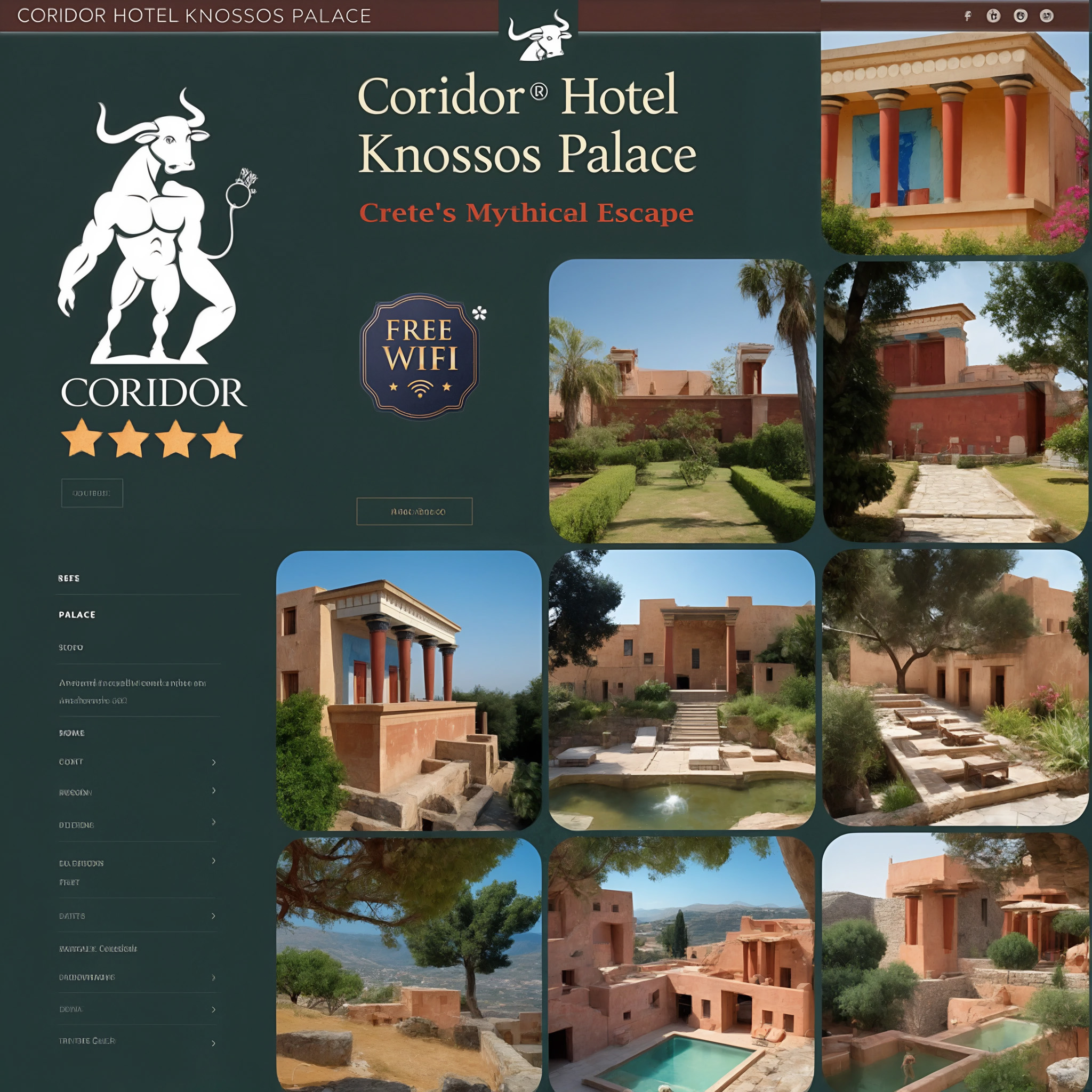
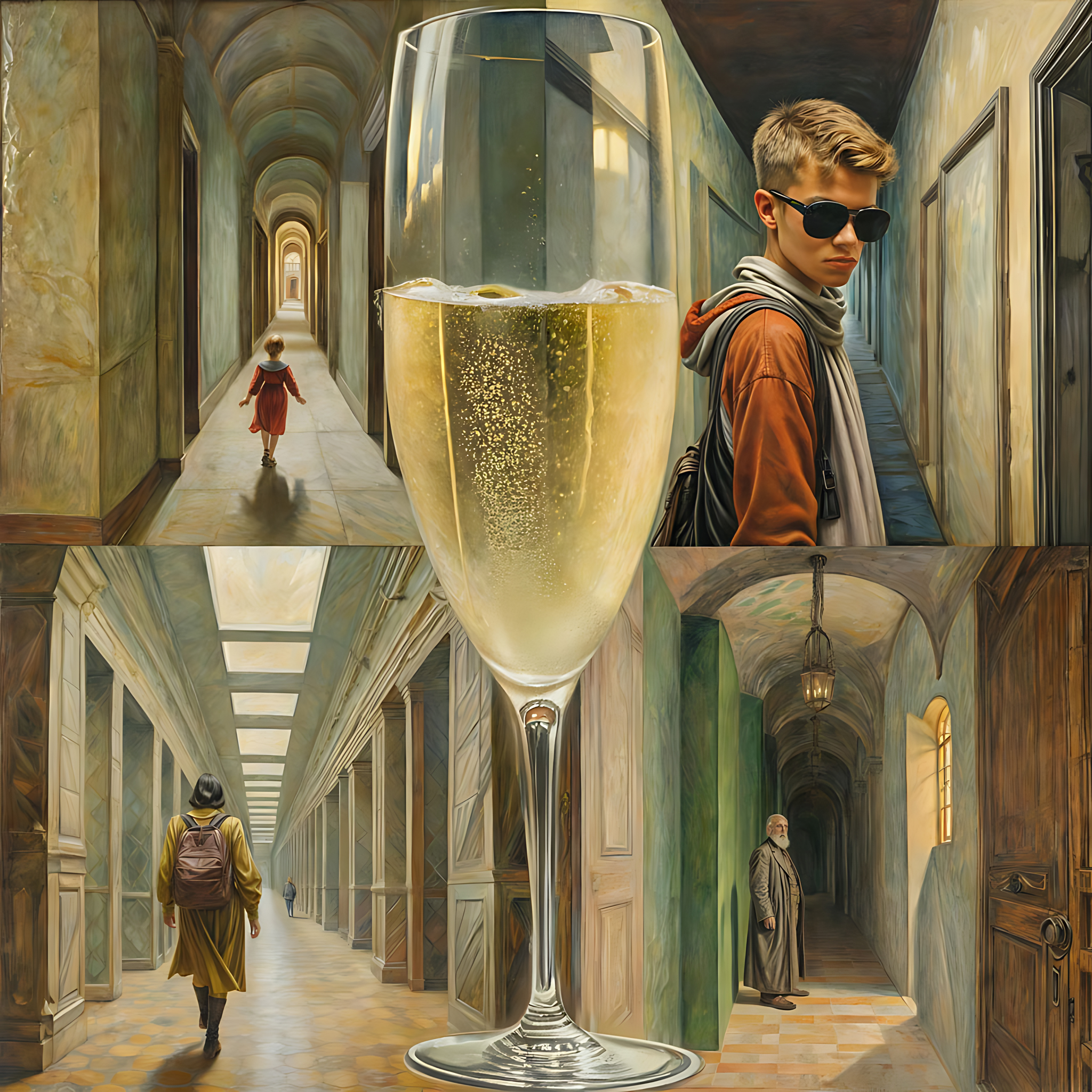
I enter the Corridor. The hotel warmly welcomes me from its excellent location above the village of Knossos, overlooking the archaeological site of Knossos and offering me all modern amenities, just 5 km from Heraklion with its shops, restaurants, bars, and vibrant nightlife. (Well, that’s the absolute least they could do, right?)
Decorated in traditional Greek style, the rooms at the Corridor Hotel Knossos Palace feature a private bathroom with a tropical rain shower, where I also find a hairdryer, bathrobe, slippers, and complimentary luxury toiletries. (That’s all you’ve got?)
The interior and ambiance of the Boutique Hotel Palace Corridor are inspired by the legendary Labyrinth of Knossos, which was awarded the European Heritage Label. (Aha! Now that actually sounds like something!) Attractive, individually designed corridors adorned with antique artworks and free Wi-Fi throughout the Palace Corridor Hotel Knossos building welcome me into a warm, family-friendly yet contemporary, elegant atmosphere where I will feel completely at home—not least thanks to the attentive hotel staff. (Oh yes, time to truly unwind. Not having to worry about a thing. Having your every wish read right off your lips.)
A delicious continental breakfast buffet is served daily in the hotel’s own restaurant, Diadromos, and in the evening I can relax at the Anaktoro bar with a drink overlooking the surrounding landscape. (Now that’s what I’m talking about, yes.)
As a guest of the Palace Hotel Knossos Corridor, I also have access to a lounge bar with an LCD satellite TV featuring pay-per-view channels, and I can enjoy the comfort of 24-hour room service. Furthermore, I benefit from free public parking right at the Corridor Palace Hotel Knossos. (Dusty roadside dirt lots, I assume.)
I can reach Heraklion International Airport “Nikos Kazantzakis” (HER) from the Knossos Hotel Palace Corridor by car in just 5 minutes. Public buses run every 20 minutes from a stop located just 30 meters from the main entrance, granting me convenient connections to all tourist destinations across the island from the Hotel Corridor Palace Knossos. (Yes, lovely, but what…?)
By the way, the Knossos Corridor Palace awaits me as an eco-friendly hotel making every effort to be climate-neutral. (Yes, fine, but what about the spa? The fitness center, the hairdresser, the manicure, the wide selection of scrubs, Ayurveda, and massages?! Another total bust. On to the next hotel. It’s all just a click away anyway.)
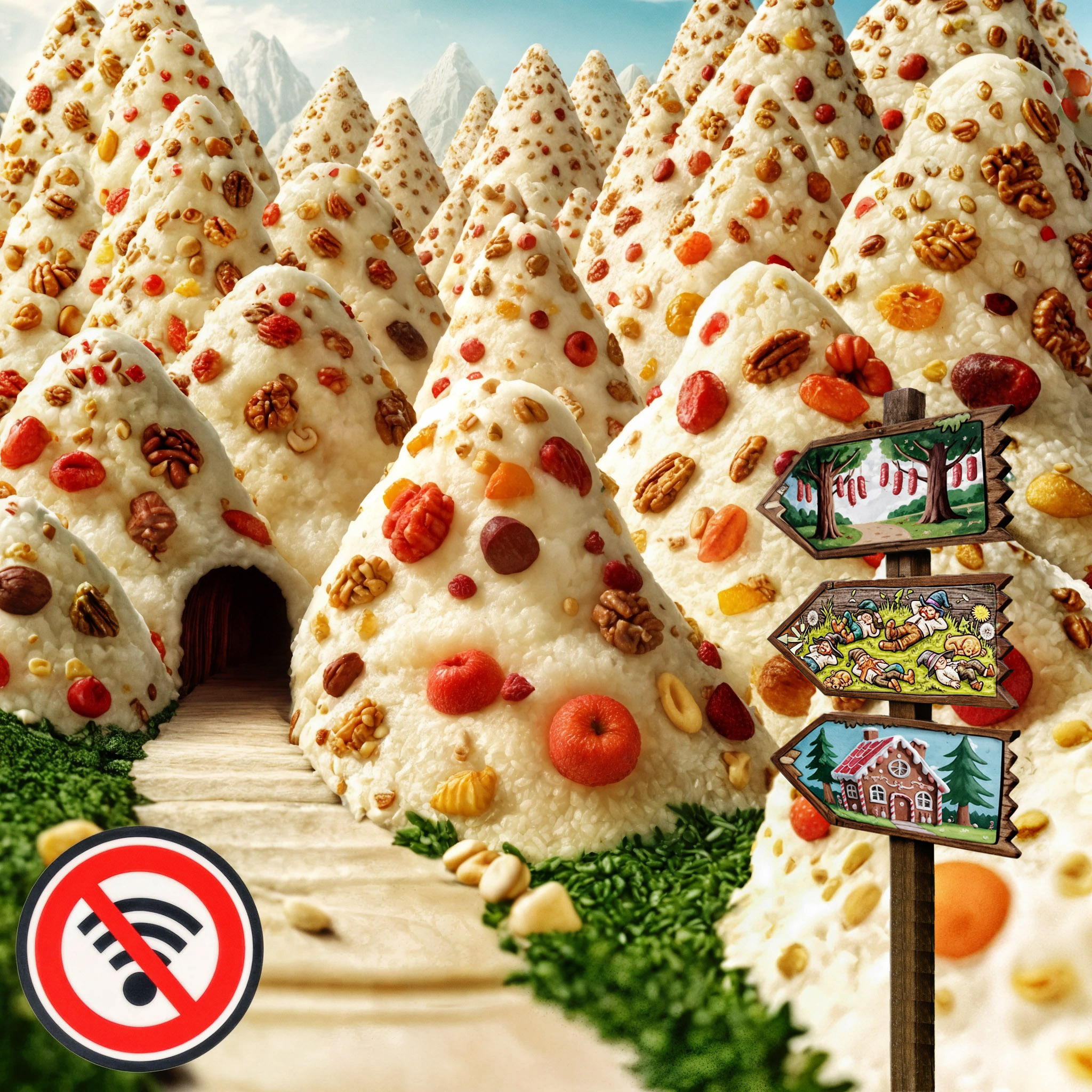
I enter the corridor that other wanderers before me have chowed into the mountain of rice pudding. Side passages branch off, but I scurry along the main tunnel, trying to outpace the viscous mess slowly oozing down.
Once I make it to the other side of the mountain, a fantastic world unfolds before me. I always thought it was just a fairy tale: the land where roasted pigeons fly right into your mouth and a quick “Psst!” makes fish leap into your hand. But it’s real! Around every house is a fence woven from bratwurst, you get a guilder for every hour you sleep, and yawning earns you a double thaler on top!
Still, as much as I wander around searching, I can’t find a single hotspot. Not even a modem connection can be found. When it comes to tech, this place is a real backwater—or back-mountain, if you will. Well, back I go, I guess. Hopefully, the tunnel through the rice pudding is still passable.
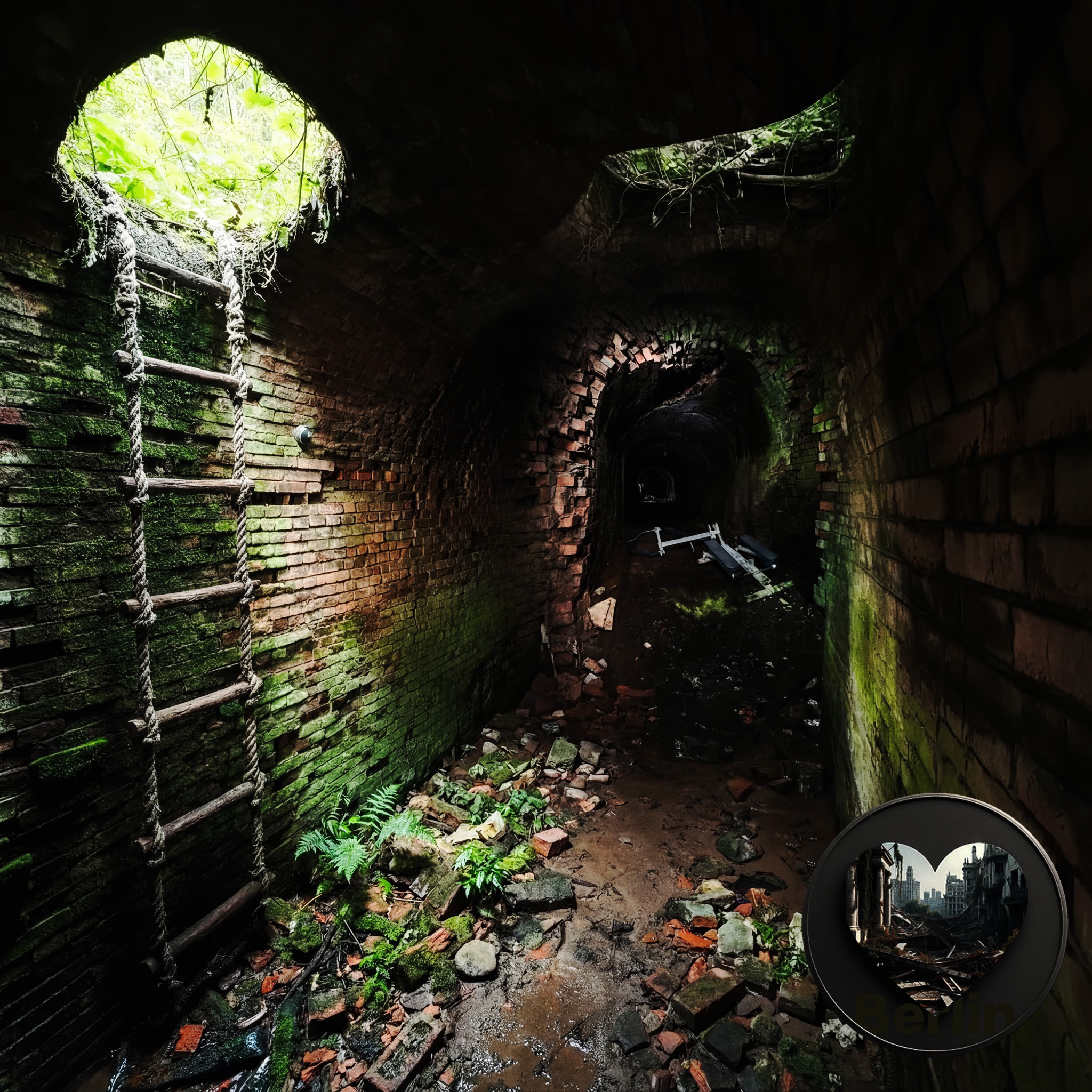
I enter the—corridor might be the wrong word here, since it suggests this passage is intended for human use. Though I wish that were the case, it’s not true of a canal, or more precisely, a sewer. It is a man-sized brick tunnel where other canals converge from both sides—a tunnel network beneath the city.
A deceased human body may decompose in a few weeks or months, depending on external conditions. With the metabolism of a city made of stone, metal, glass, and the artificial materials of its time, it takes centuries or millennia for nature to completely reclaim what humanity had wrested from it.
They call us corpse scavengers—and indeed, we like to compare the object of our investigations to a body, a human body. Since the city has been abandoned for a long time, it is a dead body. In essence, we perform an autopsy akin to pathologists, albeit without investigating the cause of death. That is apparent. We are searching for any viable organs that might remain.
The city’s sewer system, my field of expertise, serves as its excretory organ. No wastewater has flowed through its intestines, hidden deep in the ground, for a long time. That’s why it doesn’t stink here anymore, as some might think, who turn up their noses at my task. I know I’m not exactly well-regarded. But I take my task seriously and do my best.
It’s always the same. After a long march, we suddenly arrive, the whole troop. We encounter no resistance—aside from overgrowth and buildings on the verge of collapse. We noisily invade the otherwise silent city, reach its center, disperse, each assigned to their personal task. A few hours later, we gather again in the main square, and shortly afterward, the dilapidated city lies dead again, as if we had never been there.
A living body requires air and sustenance. Nerve pathways, veins, and a lymphatic system run through it. Food is digested, producing energy used for activities and communication. An immune system and various repair mechanisms fend off foes, resisting decay, wear, and excessive growth for as long as possible.
All this applied to the grand cities as well. In homage to ancient healers who once specialized in the various organs and systems of the human metabolism, we have given ourselves names, nicknames referring to our respective specialties. I am the “Proctologist.”
The old cities are considered cursed places, and that curse clings to us, the corpse observers. We are outcasts, accused of being in league with demons. Therefore, we’re forced to keep to ourselves. At times, we plunder women. Even I am reaching the age where I should start a family. I’ve set my sights on the “Neurologist.” But how can I impress her? I would need to make a significant find, yet what can be discovered in the sewer channels?
We seek unique artifacts, objects whose meaning and purpose are lost to us. From each city, we take only one of these items and, often through perilous routes and great efforts, bring it back to our fortress. There, in the mountain, we’ve established a vast underground museum, where these objects, labeled with the city of origin, are displayed—and no one but us knows about it.
Despite being seen as mere plunderers and cursed with vile names, we are, in truth, custodians, holding great reverence for the dead cities and their former inhabitants—the creators of all the wondrous yet enigmatic devices that our expeditions uncover.
I’ve been walking through the channels for many hours now. It’s time for me to return. My unerring sense of direction is why I’m tasked with traversing the drains and catacombs of the dead cities. I’ve never gotten lost, and even if my torch were to extinguish, I would find my way back.
There! In the flickering light, I spot something I must have missed on the way in. It’s a metal frame with a handle made from the past ones’ artificial materials. It’s black, pliable, and feels surprisingly pleasant, almost how I imagine a woman’s skin feels. I stand the frame upright, its short crossbars holding it steady on the ground—similar to one of those pedal-driven contraptions the past ones used. But it has no wheels or saddle. Even so, it looks like something you could climb on: two platforms, slightly larger than my feet, are fixed side-by-side at the bottom. Apparently, you’re meant to climb on while holding the tall handle. I’m excited; I’ve never seen anything like it. Is it dangerous? Recklessly, I step onto the footboards. My breath catches in my throat with fright: They move—one tilts away, simultaneously pushing the other upwards. The frame creaks. I put my weight on the raised foot, and its platform sinks slowly and heavily, while the other foot rises.
I can walk on it—walk in place! Weird. But a great find. I have no idea what it’s for.
It is heavy. I shoulder it and make my way to our meeting point. It makes me proud to bring something back from my excursions.
Our Elder examines the artifacts. He lingers in front of mine for a long time. Then he gestures for me to demonstrate it. I step onto the platforms and slowly start moving them with my feet, shifting my weight. It creaks as I start walking in place, like I’m climbing stairs. I hear murmurs from the others but only have eyes for the Neurologist, who regards me and the device with astonished glances—and smiles when the Elder makes his choice. She smiles at me! I step off and feel as if I am floating.
Our Elder crafts a small plaque in the dead language and script, which I’m allowed to attach to my find. “Berlin.” We set out. The Neurologist helps me carry the artifact. From the hushed whispers of the others, I realize they’ve noticed whom she’s chosen. The “Proctologist”—who’d have guessed?
In any case, I proudly carry the device with her—the one you can walk in place on. We have a long way to go, but I feel light and full of energy. I’ve found a museum piece… and a companion!
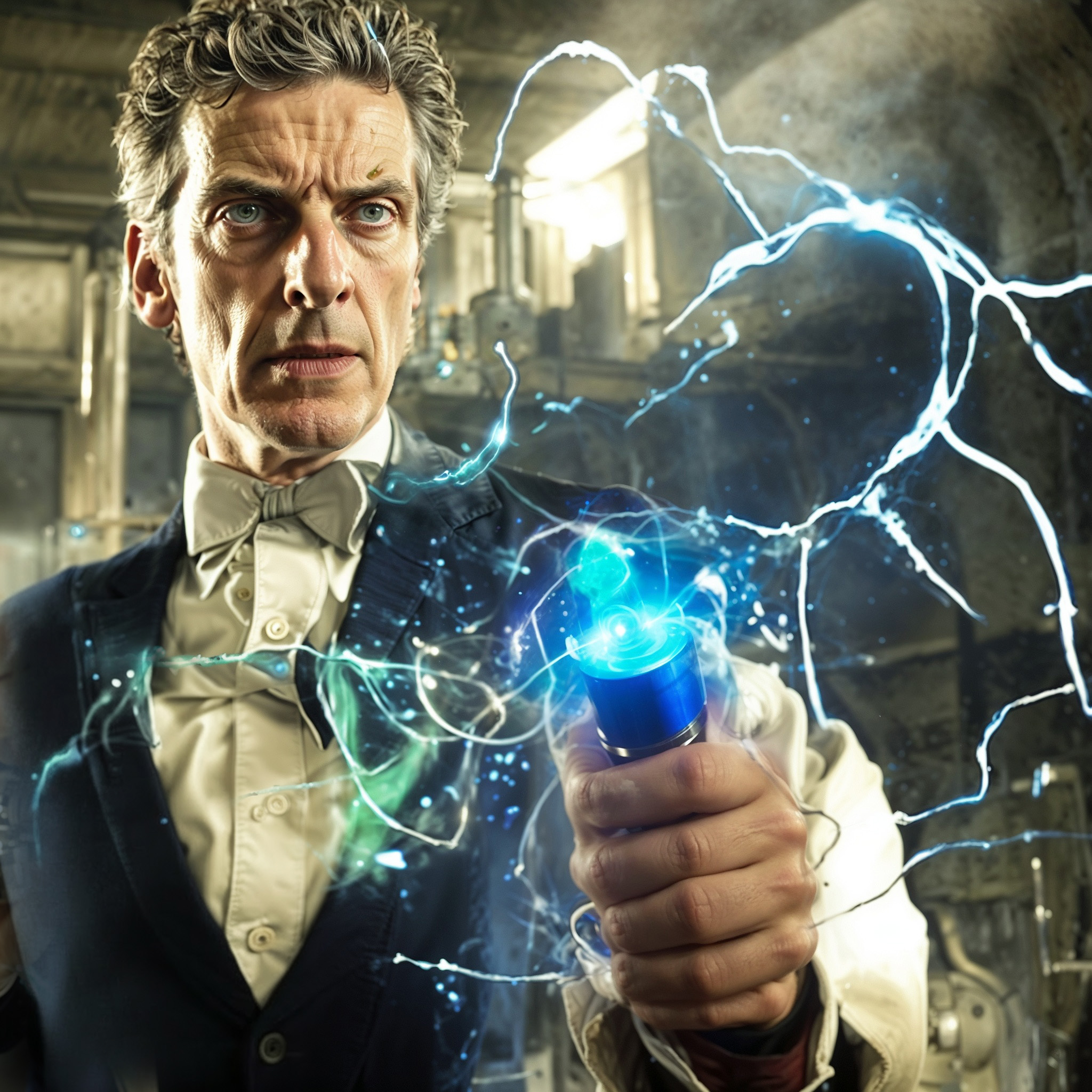
♫ My Sonic Screwdriver (Repairing the Uncertainty Principle) ♫
164/398
I enter the corridor.
At least, that could be considered an orientational generalization for myself and my current situation. Because past a certain point, even a positivist like me—someone who only accepts verifiable facts, preferably peer-reviewed—is forced to operate with tendencies and statistical clusters.
In the realm of the human and cultural psyche, I do, after all, constantly encounter something that resembles the positivist’s nemesis: Heisenberg’s uncertainty principle. It stubbornly evades precise determination.
So don’t take me strictly at my word. “I enter the corridor” is merely the best possible approximation of a fact that is far more multifaceted than the mere words suggest, and which might even contain, however marginally, its own opposite.
I enter the corridor, amazed and a little spooked. How can it be that after all these years I’m discovering a corridor that leads away from my bedroom? But then, I’ve never pushed against the back wall of my closet before. Now I’m entering rooms that were completely unknown to me before, rooms that I didn’t even know I didn’t know about.
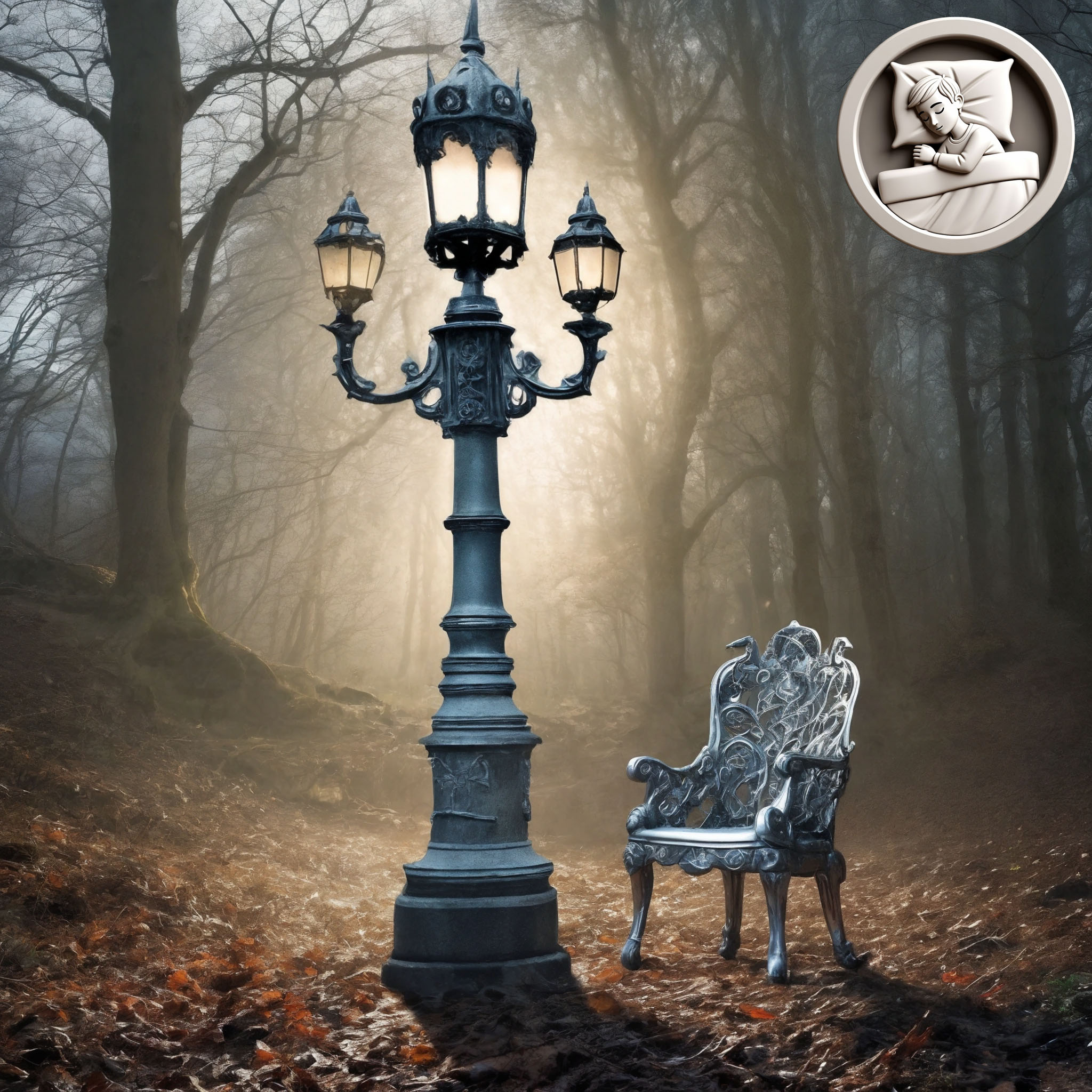
I decide to equip myself better for this expedition, instead of venturing out in pajamas without any gear. I turn back and lie down in bed to make sure that I am well-rested for the adventure. When the alarm clock beeps in the morning, I only have hazy memories of “something with my wardrobe and a gas lantern in the woods,” which I soon forget.
I enter the corridor as a childlike believer, convert—having grown uncertain—to a youthful agnostic a few steps past the threshold, and finally traverse it as an adult possibilianist, a discoverer of possibilities, so to speak, open to (and curious about) whatever may be hidden behind its doors, and as whomever I will be when I leave it—in the end, perhaps even a mystic?
(This life story in a single sentence may seem all too condensed to you, but believe me, the seed has already been planted in your mind without you even noticing.)
After being admitted as an emergency case, the hospital sedated me with medication and diagnosed me with addiction (the experts call it “obsessive-compulsive disorder”): the constant urge to enter corridors. That’s why I was referred to a rehab clinic. Dr. A. Einrad, my attractive but very strict therapist, employs a combination of the 12-step program of Alcoholics Anonymous and cognitive behavioral therapy to cure me of the internal compulsion to have to run uncontrollably into hallways and aisles at every opportunity.
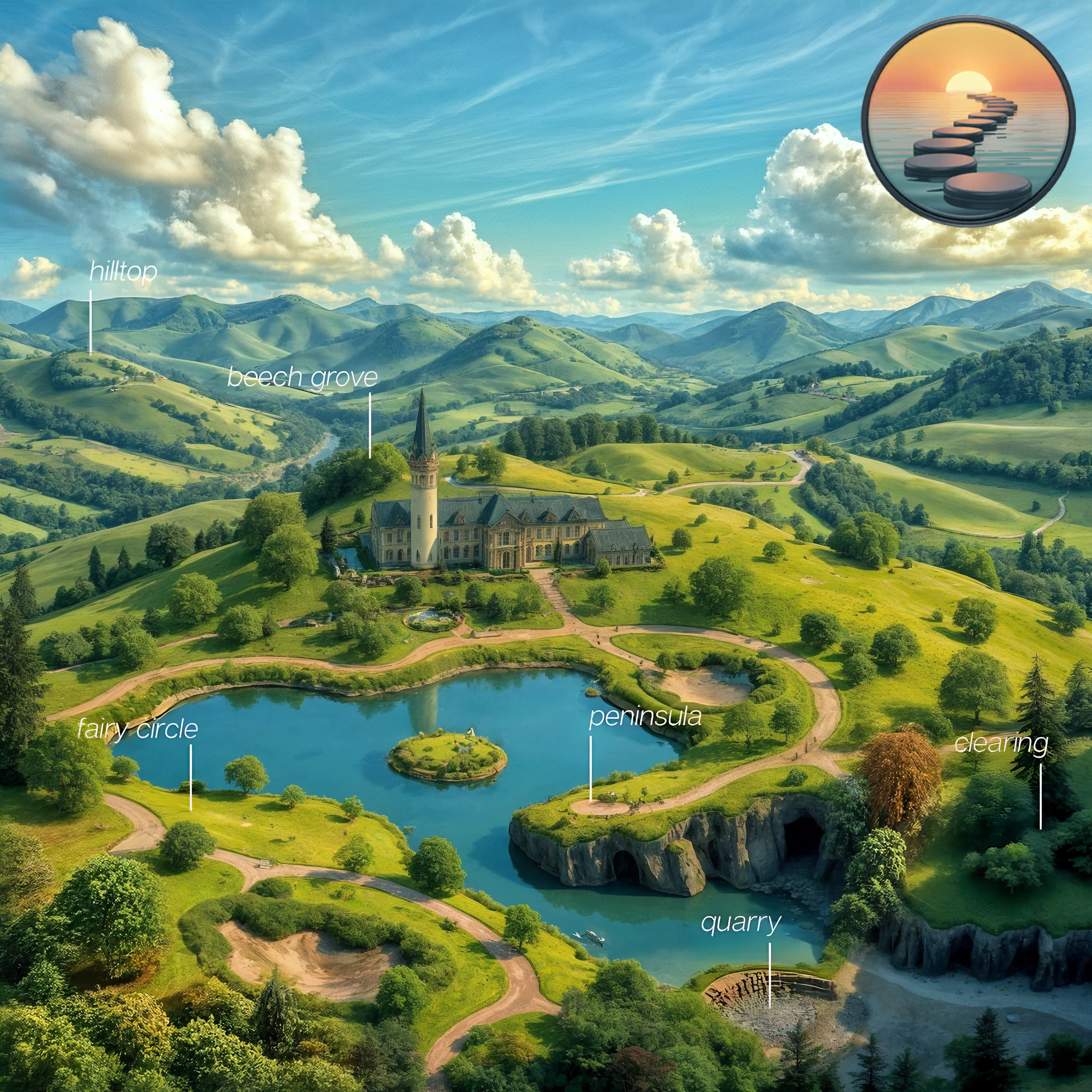
We spend a lot of time outdoors, and under her guidance, I enter glades, groves, mushroom circles, peninsulas, quarries, and hilltops. Sometimes—a hollow way or sunken lane, for example—makes me catch my breath briefly, and I can feel the overpowering urge creeping up inside me again. But it gets better each time. Not so when I think of the list that my therapist had me create. As part of a thorough and unsparing inventory, she worked with me to bring to light all those who were harmed by me and my addiction: family members, friends, unsuspecting homeowners, museum staff, security guards, my readers …
Nonetheless, I feel in good hands here and can hope not to relapse again. In the end, it’s a relief to know that I am powerless against the corridors and only something bigger than myself can save me from falling back into them. And at the end of therapy, with God’s help, I will be able to lead a small and modest, safe, protected, and above all, corridor-free life.
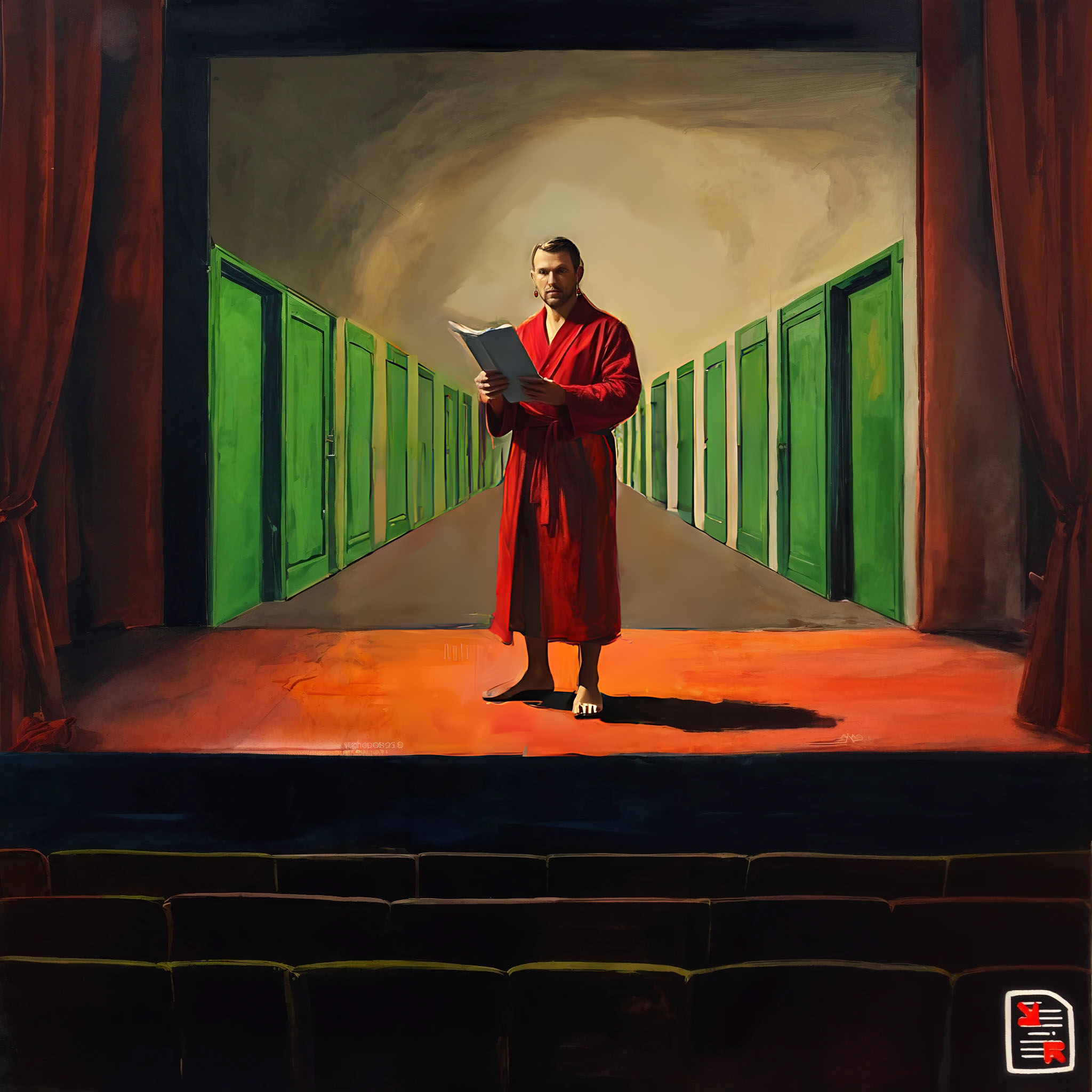
“I enter the corridor from which there is no return”—these are the powerful words that begin my great stage monologue. I stand in front of a door that, to the audience, seems to open onto a long, perhaps even endless corridor, I imagine, and I turn my head back to the other actors on the set. Then I deliver my moving farewell speech, and, in the end, I make my announcement come true and fearlessly enter the dark corridor of no return, the door slams shut behind me, and that will be the last thing that can be seen of me. At least until the final applause.
The play is going to make a splash; I can feel it. Granted, the director seems to have passed his peak, and it is only a small independent theater where we perform. But I can sense the power that the text holds and I am certain tthat we will significantly shake up the current, rather staid theater scene.
It is nothing new, actually: as a patchwork of text fragments from the Theater of the Absurd, it brings authors such as Pirandello, Artaud, Cocteau, Beckett, Ionesco, Sartre, and Camus into dialogue with one another—a remix! To be honest, I still haven’t figured out exactly which play and which dramatist this monologue stems from. But isn’t that ultimately irrelevant?
Finally, I’ll be back on stage! The project does not boast any stars, but relies on skilled second or third-tier actors in order to be convincing with the force of its story. At a boisterous meet-and-greet fueled by plenty of Chablis, the director explained his vision to us. It’s not about whether the Theatre of the Absurd imitates the absurd or, rather, turns what it imitates into the absurd. No, it concerns the definitive myth for our era, the mythical theater of postmodernism, and the only fitting depiction of the human condition: absurdity itself.
On stage, I represent all of humanity—the individual who crosses the point of no return. Confronted with a senseless world, they knowingly and voluntarily choose the path of madness and loss of reality, not without commenting on this with powerful, profoundly existential words that are sure to resonate with the audience. At least that is what my gut feeling tells me. It gives me chills just reading it.
“Forget me!” I shout at the end, or perhaps I’ll just whisper it with fervent passion: “I am lost to your world of feigned order and decency, and what is more, I am a danger to the children and fools who still have eyes and ears and could discover that there is a way behind the scenes you have erected, the Potemkin villages, the beautiful facades and shams with which you inadequately cover up and disguise the maelstrom of meaninglessness. Better if you just forget me, erase me from your memory and your church books, destroy everything that could remind you of me, deny and repress me as thoroughly as you negate the actual essence of being. Root me out, lock, stock, and barrel! I am leaving, and there is nothing left that connects you and me. All bridges behind me are burned. Adieu!”
I believe that the “definitive myth for our era” that the director wants to bring to the stage lies in precisely these words that penetrate deep into the heart of human existence, affect it, stir it up, and perhaps never truly let go of it again. I am proud to be allowed to embody and inhabit this role, and I can feel that this monologue will be the culmination of my professional career, maybe even my life’s work.
Addendum: During rehearsals for the play, the director came to the conclusion that some necessary text cuts had to be made. Ultimately, he retained only the opening words of my grand monologue. I should, he says, incorporate the rest emotionally as I exit the quite minimalist stage setting—without a door, without a corridor—off to the side, with the few but memorable words “I enter the corridor.”
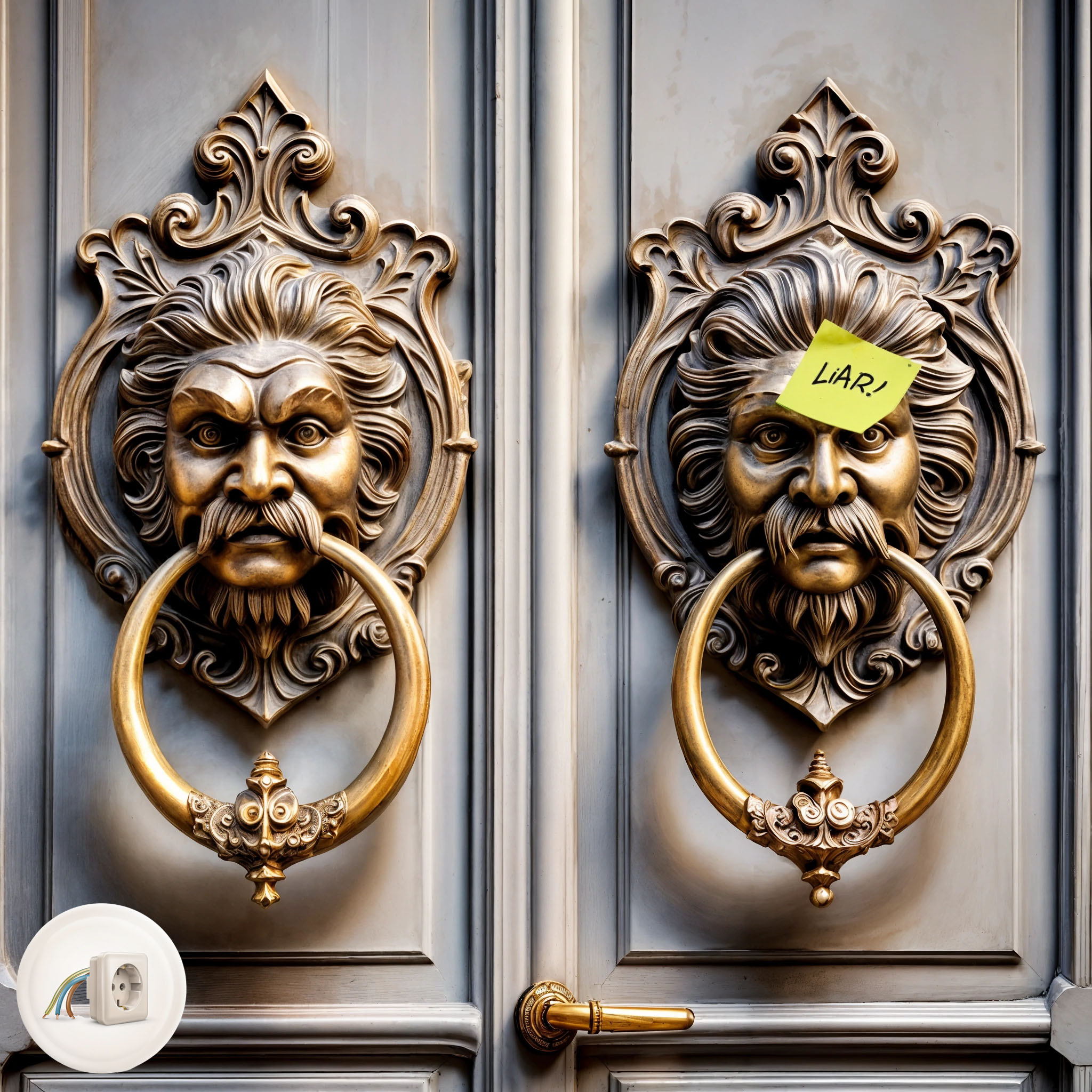
I enter the corridor. (Don’t believe him; he’s a Cretan.) I have my power tools with me and I’m supposed to install new electrical outlets here. (All lies: In mathematical and philosophical logic, the Cretan stands for someone who never tells the truth.) At the end of the corridor are two doors with striking door knockers. (Lying is pathological among Cretans, and they probably can’t help it.) They have faces and can talk. (The question is whether logic existed first and the Cretans were forced to adapt to the lemma, or if logicians took advantage of this notorious Cretan trait for their own purposes.) But one of them mumbles. (Even Paul mentions in the New Testament: “One of them, a prophet of their own, said, ‘Cretans are always liars.‘”) Ah, but what do I care about the door knockers? I’m just here to replace the outlets. (Which he has probably brazenly lied to you about.)
I enter the corridor, realizing from hearing the the sound of a drill, that Norbu is fixing something on his houseboat again. I open a bottle of wine on the terrace and wait for him with two glasses. When I visit my friend Norbu, I always make sure to have plenty of time. It’s never predictable how deep we’ll get tangled up in our discussions.
This time, I have a topic in mind. I want to know what Norbu thinks about climate change.
He’s sweaty and covered in oil, but he’s clearly happy to see me when he finally emerges from the chambers and passages below the waterline in the living room, a power drill in his hand.
“Climate change isn’t the problem,” he casually remarks. We clink glasses. “Humanity will eventually die out anyway. And even if we survive for a while, life on Earth itself is limited.”
“That sounds like catastrophism,” I chide.
“Pure astrophysics. The sun will extinguish. The problem isn’t global warming; it’s the heat death. You need to think on larger scales!”
My friend Norbu enjoys doing that. I, on the other hand, only need to ponder for ten seconds why there is something rather than nothing, and I’m already caught in the Total Perspective Vortex, dissolving.
“Hey,” my friend Norbu says, “are you still with me?” That pulls me out of the Vortex. I nod eagerly, “Heat death of the sun. It expands and burns up all its planets. The end of life on Earth.”
But Norbu impatiently shakes his head, “Heat death of the universe, the end of all life. That’s the real problem, and that’s what we need to prevent.”
I stare at him in disbelief, “You want to prevent the heat death of the universe?” And then, “What is that, anyway?”
“Since shortly after the Big Bang, the universe has been steadily deteriorating: matter is distributed, interacting less due to increasing distances, and stars are burning out. Cold and hot zones are becoming more alike until everything assumes a uniform temperature and structure, like a featureless lukewarm soup. But so that we don’t allow it to happen without a fight, there’s ‘The Message.’ ”
Norbu gestures widely at the world around us. I can’t follow him. Finally, he sighs and begins to explain further, “The laws of nature are a message. The cosmic physical principles are exquisitely tuned so that life can emerge, life that recognizes itself for what it is. I’m talking about us!”
“Us two?” I ask meekly already suspecting that I may not be able to follow him again.
“All of us. Humans. And all other intelligent civilizations in the cosmos. And the laws of nature tell us that those who came before us tampered with them.”
“Those who came before us?” I can hardly keep up with him anymore.
“Sometimes I imagine,” and with that, Norbu leans back and looks thoughtfully at the rest of the red wine in his glass from below, “that before the heat death of the universe, a handful of intelligent civilizations will manage to make contact with each other and jointly initiate the greatest project in the world.”
He doesn’t say more. I should now ask what the greatest project in the world is, but now I’m being obstinate and staying silent.
After a while, he continues in a whisper, “To create a new one before the end of your own universe, so that it can give life again. So that the chain of being doesn’t break.”
Suddenly, I’m filled with awe at the thought that we could leave a message for the next universe, for the intelligent beings who will follow us: the laws of nature that help them evolve—a forward-looking measure that certainly exceeds what can be accomplished within a single legislative period and even surpasses a 739-year organ work, a ten-thousand-year Long Now clock, and the safest possible disposal of nuclear waste for hundreds of thousands of years by a wide margin.
“Of course,” my friend Norbu suddenly becomes quite sober again, ” only if the universe is a closed system. Otherwise, there are numerous other possibilities because it doesn’t necessarily have to end in heat death or a Big Crunch. But as long as we don’t know for sure…”
“… it might be better to prepare for the worst.”
“Exactly,” affirms my friend Norbu. “640 billion years until heat death is a hell of a short time to evolve to the point where we can plan a new universe and put it into action. Better get started on that right away.”
My head is spinning, not just from the wine. As I ride home later under a gloriously starry sky, I look up and ask the universe arching above me if it has a message for me. And indeed it does. I can’t hear it or see it, but I can sense something. Life is worth living.