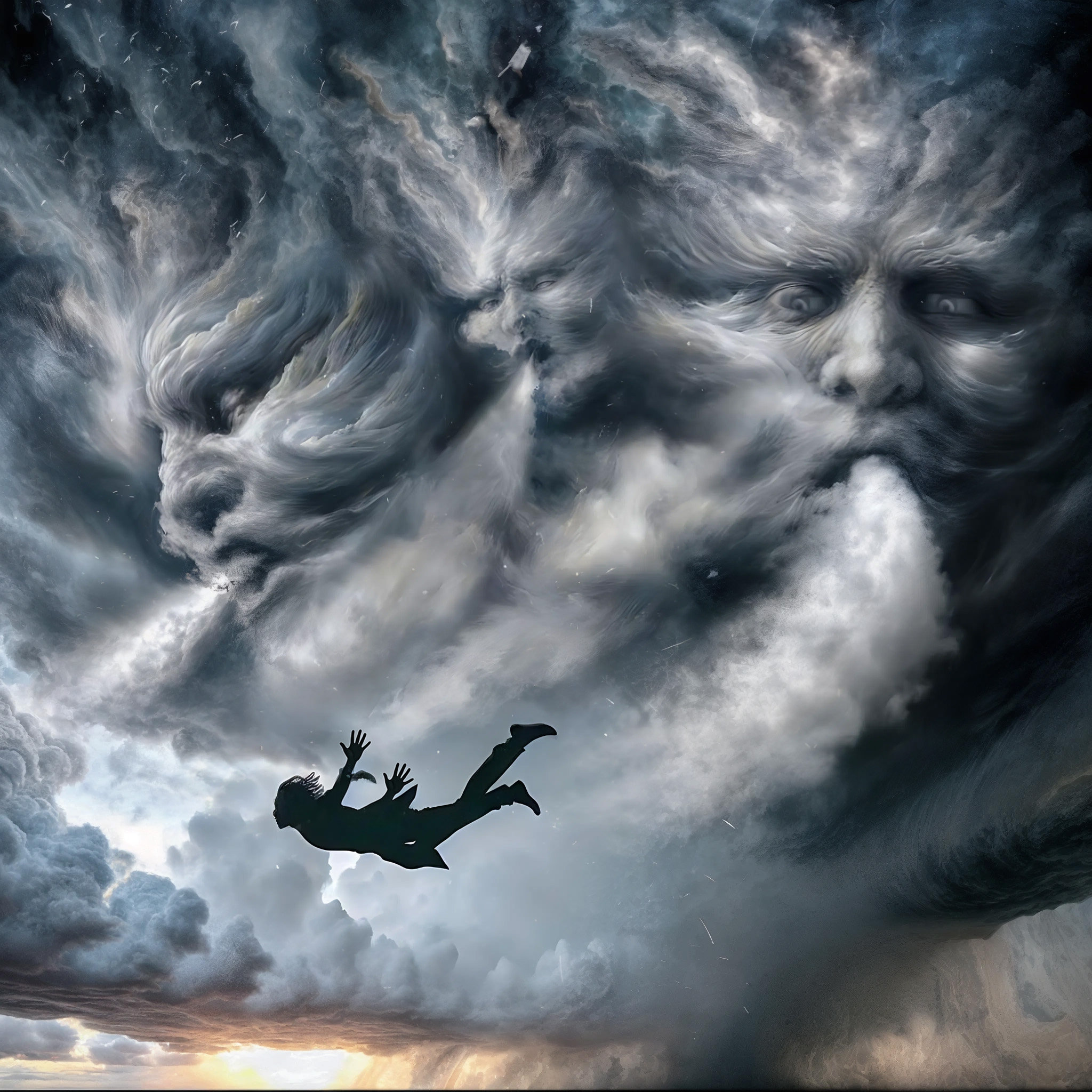
I enter the corridor. Oh, if only I’d considered it was a castle in the air! The ground gives way beneath my feet, and now the winds—led by Apheliotes, though Lips is doing his fair share—make a game of blowing me through the sky. Finally, Kaikias takes pity; he carries me away from his unruly companions and lets me sink—not exactly gently—into a harbor far to the northeast.
Reykjavík.
Not exactly my dream destination in the dead of winter. But word is it’s got a hopping nightlife.
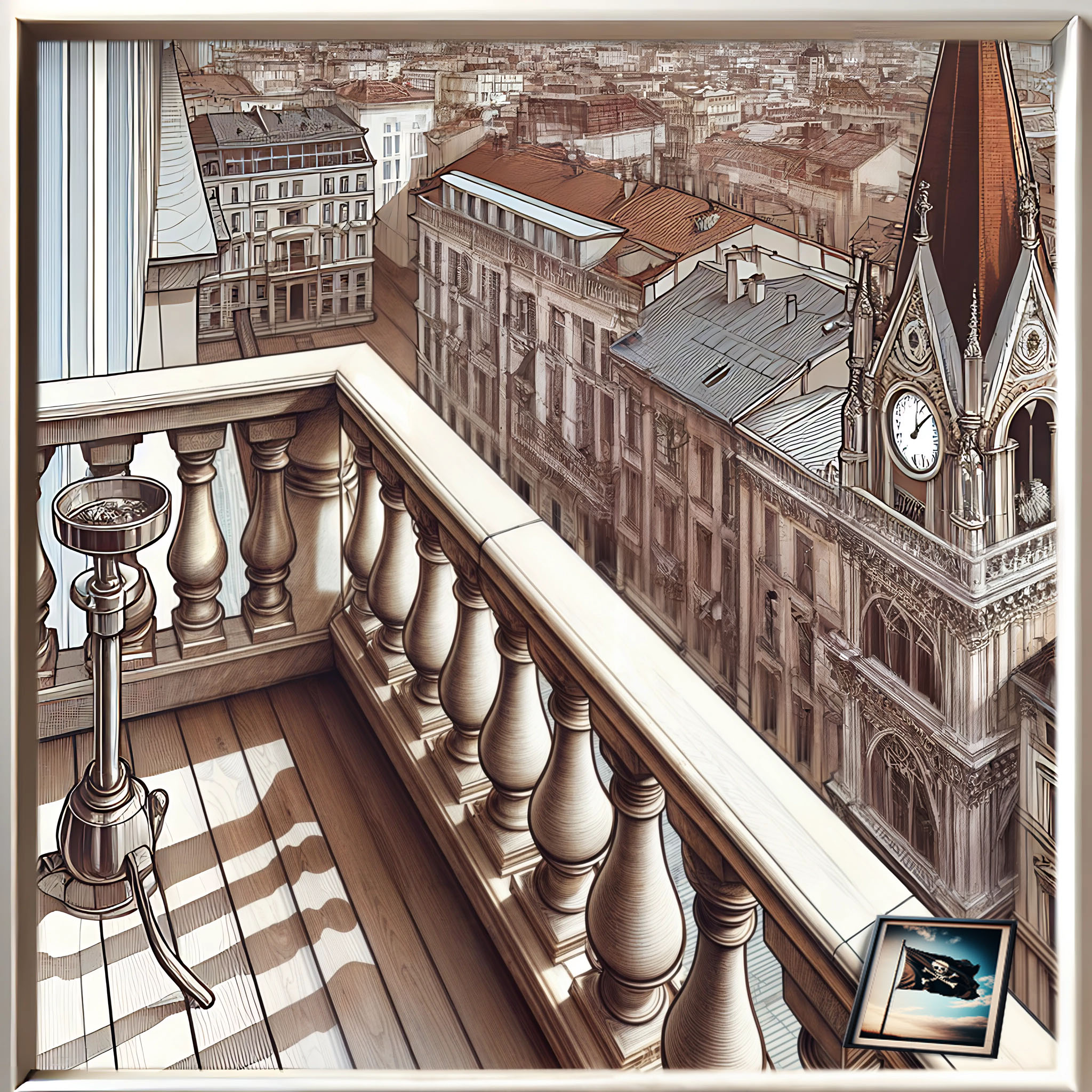
I enter the corridor at precisely eleven. Nicole is coming down the hallway. It’s our ritual: at eleven, we head to the smoking balcony, just the two of us, for a smoke and world-altering conversations for the duration of a cigarette, before retreating to our respective offices.
„How’s it going?“ I ask as I reach for a pack of cigarettes. She smokes roll-ups.
„If only it were the weekend already,“ she sighs.
„You’ve been saying that since Monday. But you’re right, of course. Got plans? A date?“ I ask, teasing.
The small smoking balcony is occupied. Outrageous! Everyone in the office knows it belongs to us at eleven. The guy promptly clears out. It’s the technician responsible for the copiers.
„Nice butt,“ I say with a melting look as he disappears around the corner.
„Way too young and inexperienced.“
„Maybe for you. You’re twenty years older than me.“
Nicole groans. „Don’t remind me. You still have all the typ—uh, doors open. For me, the ship has sailed. All the good men are taken.“
„Oh, come on, the right one will come along.“
„My mother’s been saying that for what feels like half a century.“
We laugh and take a drag from our cigarettes. Men. Our favorite topic number one.
„Have you actually booked yet?“ I ask her. Vacation. Our favorite topic number two.
„Two weeks on the Appalachian Trail. Hiking away the frustration and a few pounds.“
„That doesn’t exactly sound like a four-star hotel…“
Nicole grins. „More like zero stars. It’s like with snails. You carry your home on your back.“
„Home on your back?“ I must look a little confused, because Nicole laughs. „Well, the tent, of course.“
„And you want to meet an American millionaire out there?“
„Why a millionaire? I’m not after money. That phase is over. I’m looking for an adventurer, a pirate, or something.“
I roll my eyes. „Some rum-loving sleazeball from the Caribbean?“
Nicole laughs again. It’s too sweet when she giggles and shakes all over. „No,“ she says, once she’s caught her breath, „someone who’s actually daring.“
„Uh-huh,“ I say without much conviction.
„Like, make a move on me, for example.“ It takes me a moment to catch on, and then we both cackle. „Do you actually believe,“ she asks me next, „in love at first sight?“
„Sure,“ I say, „I’ve experienced it. More than once.“
„What?“ Nicole seems surprised.
„Kellan Lutz,“ I say. Nicole furrows her brow and shakes her head: never heard of him. „Twilight,“ I add, and then again „The movie.“ Nicole’s eyes widen in horror. Before she can say anything, I drop „Jörn Schlönvoigt“ on her. Once again, she looks surprised. „Aha. Have you been hiding something from me? That sounds more like a guy in your league…“
I wrinkle my nose briefly to let her know she can skip the league talk—feeling quite capable of handling Kellan Lutz myself—and explain: „GZSZ, my favorite soap.“ Nicole’s face falls completely. That alone made it worth it. We laugh.
„I’m not talking about actors, Lisa,“ she puts on record, „and not about staring at a screen or gazing into the idiot box…“
„He sings, too,“ I interrupt.
Nicole groans. Even worse! „I’m talking about running into a total stranger somewhere, for just a single moment, and there’s a spark. And it’s so powerful that all your fuses blow—and his, too!“
„Supposed to happen, yeah,“ I say as Nicole looks at me expectantly. „Why do you ask? Has that ever happened to you?“
Nicole nods. „It was in the theater lobby. I was drunk, to put it mildly—pretty plastered,“ she says, grinning. We extinguish our cigarettes in unison. Part of the ritual.
„Drunk? And him?“ I ask.
„He was a life-size cardboard cutout of Bruce Willis.“
Again, it takes me a second to process. As we part ways in front of my office to head back to work, we are still howling with laughter.
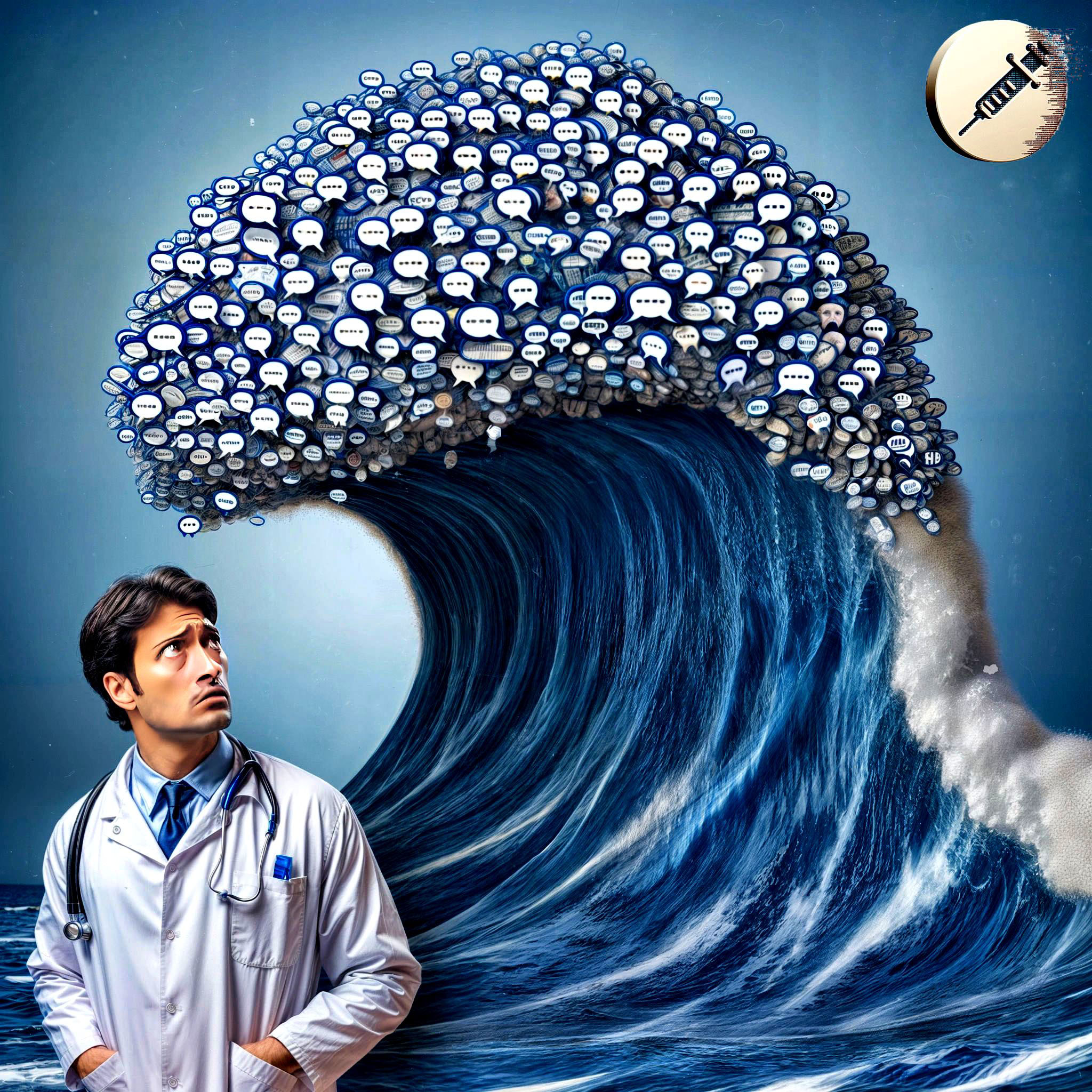
I enter the corridor and hurry along to the seminar room. Three other SPs are already sitting in front of the door. I’m running late. John P. is among them, grinning at me. „You’re up first. The professor’s already back in.“ As always, I enjoy his cute British accent. „Thought I’d have to do the ‚covert depression‘ for you!“ He briefly gestures to the door to the seminar room, behind which, as usual, there are about twenty students waiting for us.
I nod briefly to my fellow simulated patients and join them.
To expose the psychosomatics in their eighth semester real-life scenarios they will encounter after their training, their professors arrange encounters with „simulation patients“ at the beginning of each year. That’s us, the SPs. With carefully crafted and meticulously rehearsed roles, we engage with the aspiring doctors, and since they have never dealt with real patients before, few of them are up to the task. For most, we represent a humbling yet formative experience.
I portray various roles for those specializing in somatic medicine, including hysterectomy, salmonella, a family member of an Alzheimer’s patient, and a cancer-stricken, unwittingly doomed mother of multiple children. But I particularly enjoy the roles involving psychosomatics, such as mania and depression, such as today’s „covert“ case or the one with „somatoform pain disorder.“ They pose a greater acting challenge.
„Also an actress and unemployed?“ the blonde with frayed hair next to me asks. She extends her hand. „I’m Lara, hello. Uh, ‚Frau Edna Gierke,‘ of course.“ Ah, so the three of them are playing the family with the teenager who has stopped taking his insulin injections: the father unemployed, the mother a meter maid. I’ve had that pleasure before. Today, a pimply twenty-year-old with glasses who sweats and nervously fidgets in his chair plays the teenager.
„Frau Karsten,“ I introduce myself to them with my character’s name. Around forty, slightly overweight, formerly employed at Deutsche Telekom before her primary diagnosis, she deals very rationally with her illness, etc.
The door to the seminar room opens. A medical student in a white coat steps into the corridor. „Frau Karsten?“ he asks briskly, as if this were his waiting room. In reality, he is incredibly nervous: this is his first patient interaction. He won’t forget it anytime soon!
I jump up and pull out an envelope. „Doctor, it’s good that you’re seeing me right away, look, Doctor, just look, here!“ I let him peek inside the envelope. As expected, the student reacts in bewilderment. There’s a clump of hair inside, which I’ve been collecting for weeks in the drain of my shower for this purpose. „I just showed it to Herr and Frau Gierke,“ I unabashedly fib, „I’m losing my hair!“ My three colleagues nod, but I don’t pay much attention to them. My voice becomes shrill, and I clutch my doctor’s arm. „This must be a bad sign, right? Doctor? What do you think? You’re the expert. I don’t want to go bald!“ The student is initially at a loss for words, then stammers, „Please, uh, come in, Frau uh, Karsten.“
I follow him obediently but turn around one last time and wink at John P. We’re seasoned pros in this business and immediately noticed that this white-coated newbie is about to thoroughly screw up the first patient interview of his career.
I enter the corridor because I heard a strange noise. At eye level, a blinding light flashes at the front door—two, three times. Is someone welding it from the outside? It flashes glaringly again, three times, like a knock, but utterly silent. Without a second thought, though I’m standing there only in my pajamas, I rip the door open.
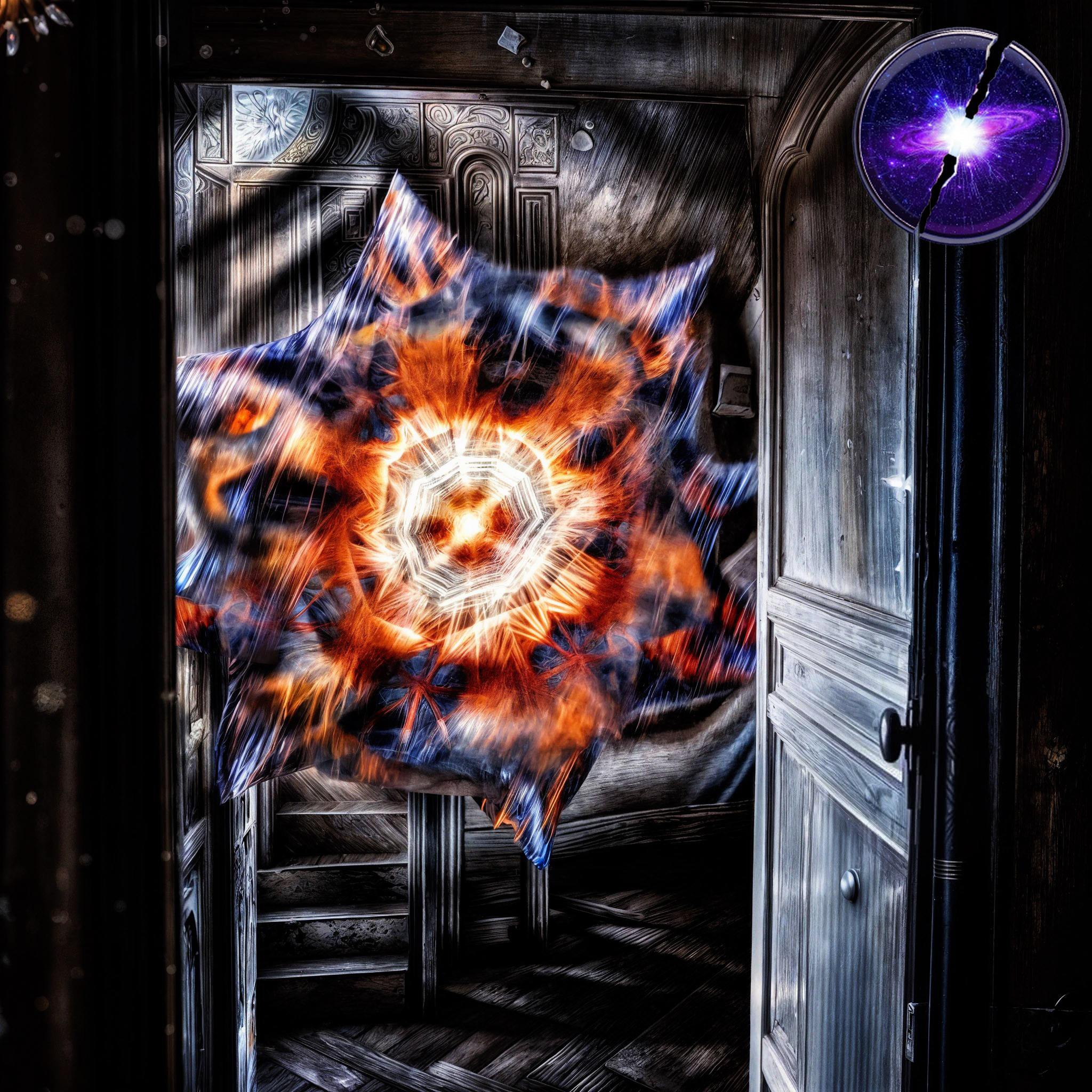
In the shadows of the entryway stands—something. Or rather: it hovers. It looks like a three-dimensional kaleidoscope whose luminous shards constantly migrate inward, until they suddenly shift direction and flow outward from the center like molten iron.
The voice is very soft and gentle, and it feels like I’m hearing a familiar, beloved lullaby. It says, „You caused a spiral arm of the galaxy to vaporize.“
I stare at the apparition. Words fail me. I want to run away, hide, or just faint. But it’s as though my thoughts no longer find resonance within my body—no anchor to trigger a physical act. I remain stone-still before this thing.
„You built a machine,“ says the voice.
A machine? Yes, there was something. But it wasn’t me. Just a dream. For weeks, I’ve been waking up at the exact same time in the middle of the night, at 2:22 a.m., and I always remember a vivid dream in which I’m some sort of engineer, obsessively building an incredibly complex machine—it fills nearly the entire warehouse I rented, using powerful Hadron lasers and a kind of miniaturized fusion reactor to manipulate gravity and rupture the space-time continuum. Dream by dream, I completed my work, even though I secretly knew the device could have uncontrollable side effects. Until last night, when I finally activated the finished machine. I can’t say what it did because the moment it started running and revved up, I woke up. That was yesterday. It was 2:22 a.m.
Even now, in the middle of the night, it could be 2:22 a.m. But this is not a dream.
„You built a machine,“ the voice repeats, as I’m hypnotized by the slow flow of liquid metal and a sense that the being with its gentle singsong is about to tell me something terrible.
„Your machine pierced the dimensions of the world, shattered your planet, and dragged many, many stars and planets in the vicinity into destruction.“
„But that’s nonsense! The Earth didn’t perish just because I dreamt something!“
The kaleidoscope pattern changes, but I can’t say how. The voice now seems more stern. It says, „The world in your dream was real. As real as this one. We had hoped you would decide not to activate the machine at the last moment, but to destroy it.“
„I had no idea what it would do!“ Really? No, I did. In the dream, I knew very well the risk I was taking. I just kept pushing it away.
„Many civilizations had to die,“ says the voice.
Because of me? Am I supposed to be guilty? „What about you?“ I ask, „You’re alive, I assume.“
„A few, like me, were hurled through perforated dimensions into parallel worlds.“
Parallel worlds: In the dream, I repeatedly suppressed the fear that my ingeniously devised machine—intended to tap into vacuum fluctuations for unlimited free energy—might unravel the fabric of time and space. And now, an entity stands before me, thrown into my world through a dimensional rift—perhaps the last survivor of an entire planetary civilization that I have on my conscience. Slowly, the staggering weight of what the entity is telling me begins to sink in.
„If you knew about it, why didn’t you prevent it?“ I ask in a hoarse voice.
„You have to do that yourself,“ answers the liquid kaleidoscope hovering before me in the entryway.
„How?“ I ask, bewildered.
The being slowly floats upwards and fades away. It has delivered its message and now retraces its path—wherever the destination may be. „How should I do it?“ I call out.
The being vanishes. I hear no more answers, but in my mind, a thought forms, saying, „Dream a new world into being.“
A profound despair seizes me. It wasn’t me! I scream internally. It was that deluded engineer!
But the being is right: I was the man in the dreams, the one who decided to take the risk. I have the deaths of humanity and a multitude of other civilizations on my conscience; I have, with my obsession and greed for fame, led billions of people to their deaths, and a substantial chunk of our Milky Way along with them. I want to push it away, deny it, blame someone else. But although they were just dreams, deep inside, I know that my visitor is correct in his accusation. I was that obsessed engineer who disregarded all the ominous premonitions and set the machine in motion.
As I close the front door, my hand trembles. I must prevent it! I think, and at the same time, I laugh bitterly: How can I prevent something that has already happened?
But couldn’t a space-time fabric that includes parallel worlds also include the possibility of turning back time? Did the kaleidoscope being perhaps speak of this when it said, „You have to do it yourself“?
If it’s true—if it’s true that through my fault, humanity and a handful of other civilizations were destroyed—then I will thwart this dreadful act at any cost! Numbers, equations, and circuits race through my mind. The long nights as an engineer have paid off. Slowly, an image solidifies in my mind: a device, a time-and-world machine with a single purpose, meant for one-time use. It will be a kind of ark. But I won’t fill it with animals or people: It will transport me to a place and time that will allow me to prevent myself from punching holes in the cosmic fabric. I will undo it, thoroughly and physically! It must be possible.
I enter the corridor. I can’t help it. I must do it. It has become an internal compulsion, an addiction. Something inside me that I cannot control, cannot conquer, drives me to enter more and more, ever further corridors. I can’t fight it. I let it happen—now—without resistance. Am I ashamed of it? No. Do I feel weak? No. It’s a blessing and a curse. I enter the corridor.
I enter the corridor, a bouquet of flowers in hand. I spend ten minutes waving them at the institute’s webcam (which is actually aimed at the coffee machine). The camera only broadcasts an image to the world six times an hour, and unfortunately, it doesn’t indicate when. But I’m determined to be in the shot. I start off smiling, but after just a few minutes, I feel like I’m merely wearing a grimace. (I cannot confirm that a forced smile is physiologically supposed to induce feelings of happiness.)
Anyway, all that matters is that this way—two continents away—you receive my promised little Valentine’s greeting right on time.
I enter the corridor. My friend Norbu seems not to be on board, but as I stand somewhat perplexed in his living room, I suddenly hear the sound of hammering. Burglars? No, it dawns on me, probably Norbu, who is sealing a leak and making sure that his houseboat doesn’t sink.
And there he comes, toolbox in hand, and we settle in with a glass of red wine. „I found ancient records of myself,“ I tell him. As a teenager, I was fascinated by Atlantis and, like a little private scholar, combed the city library for archaeological clues about the inhabitants of this sunken continent. I show Norbu cave drawings, meticulously copied from various books and adorned with scholarly comments. They come from both the Old and the New World. „Atlantis lay in between,“ I explain, „and that’s why there are such peculiar similarities in symbols and depictions, long before Columbus came or the Vikings discovered America: surviving Atlanteans who fled to the surrounding continents.“ The thesis still convinces me today.
My friend Norbu rubs his chin. „Has it never occurred to you that these similarities may not have required any contacts by sea?“
„You mean it’s all just a coincidence?“ Disappointed, I take back my yellowed and slowly disintegrating notebook.
„No, by no means. But haven’t you also delved into shamanism…“
Yes, right, there were shamans in almost all cultures worldwide, healers in contact with the spirit world and ancestors.
„And possibly,“ my friend Norbu says, „in contact with each other.“
It takes a moment for the realization to sink in. „You mean, across the oceans, from people to people? And that—telepathically?“ Norbu points affirmatively to my notebook. „Hm. Shamans of the European megalithic culture exchanging thoughts with those of the Proto-Americans,“ I imagine. And of course, that could also explain the similarity of the pyramids or the fact that not only the Egyptians mummified their dead but also some Native American tribes. Besides the underworld of the dead and the upper world with helpful spirits, the shamans also know the middle world—the astral counterpart to our everyday reality and its reflection in the spiritual world. On journeys to the middle world, the shamans of earlier times, detached from space and time, could have visited foreign continents and civilizations—and thus their respective colleagues.
„But maybe not,“ Norbu interrupts my thoughts. „There are indications that even before the Vikings, there were contacts between Europe and both Americas. The Chinese, Romans, Greeks, Egyptians, and Phoenicians—all are said to have been there and traded with the cultures there. Perhaps even the megalithic peoples. And all of this without the need for Atlantis as a bridge.“
I probably look somewhat disappointed because Norbu adds consolingly, „But of course, your early research honors you. Who knows, they might become important again and provide new answers? Or raise new questions?“
I know my friend Norbu isn’t entirely serious, but I feel strangely affirmed nonetheless. The young, curious fourteen-year-old still within me is pleased to receive a late acknowledgment for conducting significant foundational research.
I clutch my notebook as I cycle away, deciding not to stash it back in a dusty drawer but to give it a place of honor on my shelf with the early works of great minds.
I enter the corridor—although it’s not me whose body is stepping into the hallway, but a stranger in whose mind I sit undetected—relieved that the time has finally come to leave him behind. This time, it was Peter Aufschnaiter who, after a dramatic escape alongside Heinrich Harrer, reached the Tibetan capital of Lhasa on January 15, 1946, where he constructed hydroelectric power plants and sewage systems over the following years.
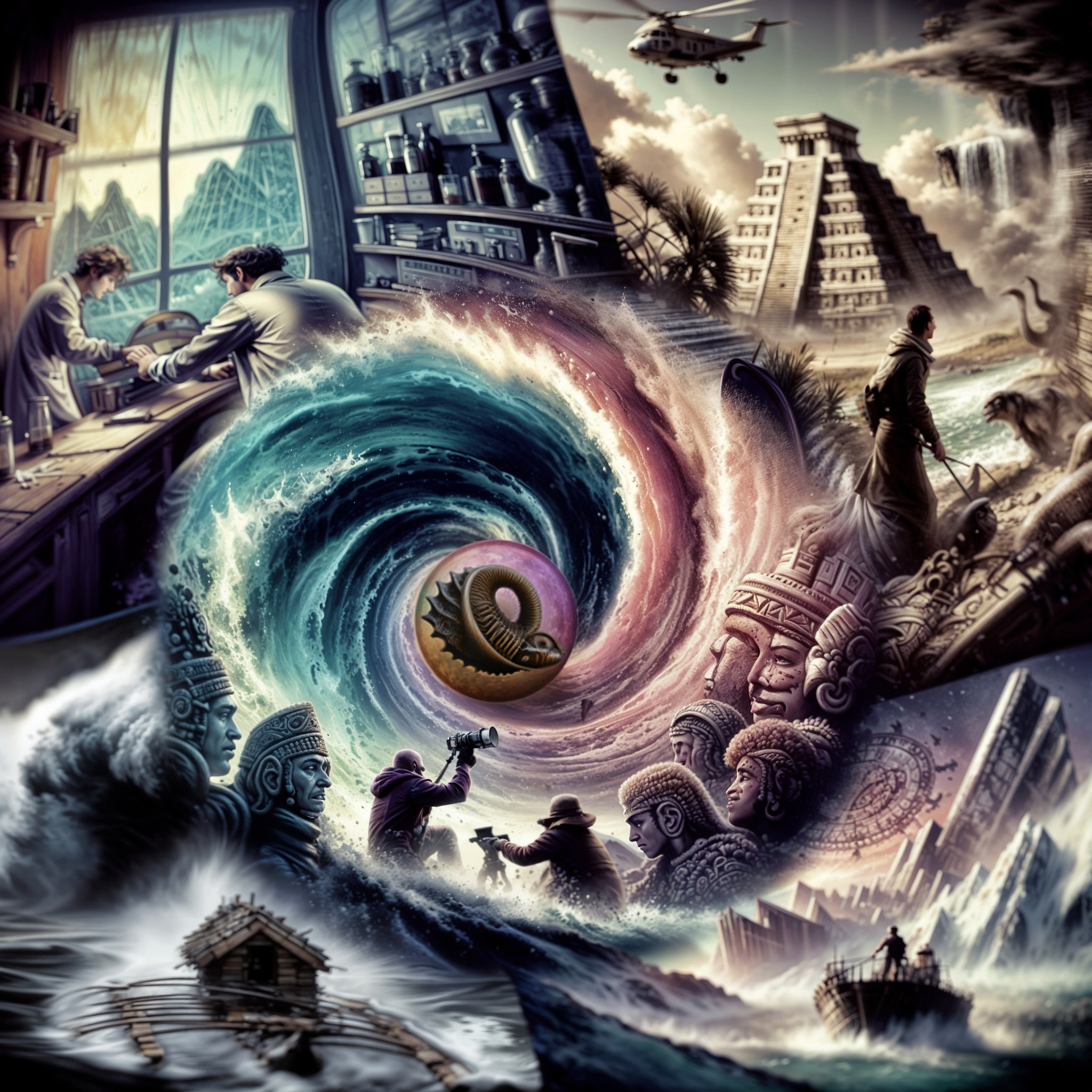
It’s always a corridor, a passageway, or a tunnel that leads me out of one head and into another. Somehow, this form of mental travel must have something to do with the „Snail Shell,“ that intricate metallic structure that devoured so much processing time on the university’s supercomputers—and eventually me. I should never have crawled inside.
Since then, I journey through time without a physical form. It’s like a dream that keeps fading and blurring, and I’m constantly plagued by these headaches—a state of being not meant for humans. Something unnatural has happened to me. I’m trapped in foreign bodies, foreign times, foreign places—except that I almost always instantly know where I am.
Whether I’m standing in a laboratory with Marie Curie, documenting the Mayan metropolis of Uxmal with Frederick Catherwood, weathering a storm on the Kon-Tiki with Thor Heyerdahl, or reaching the South Pole with Amundsen: it’s always the heroes of my childhood and their defining moments that dictate my mysterious itinerary.
My mind always lingers in the head of one of my childhood heroes‘ companions—and sometimes that means weeks or even months!—until they enter a passageway or something similar. A doorway is not enough. The corridor must apparently have a certain length. It’s then as if I lose my grip. I sway, spin, whirl, only to abruptly find myself in someone else’s head.
I drift away repeatedly, and even remembering the past is difficult for me: What other childhood heroes were there? Dinosaurs! Like so many in their youth, I was fascinated by dinosaurs. Sometimes I fear that my journey could take me to that distant past: What will happen if I end up in a place, in a life where there are no corridors, hallways, or tunnels? Is my journey over then? Am I finally truly dead when the one in whose head I’m squatting and through whose eyes I see dies? Or will I return to the „Snail Shell“ and wake up there from uncontrollable, twisted childhood dreams?
I enter the corridor. Now, I ask you: Has any human entered this corridor ever before me? In such a way? With such grace, yet simultaneously so down-to-earth? So flawlessly executed? I’m a born corridor-enterer, I dare say. The world, the world of corridors, the corridors of the world have been waiting for me. Now they lie at my feet, begging me to enter them, or even—most sublime of all pleasures—to be traversed from end to end.
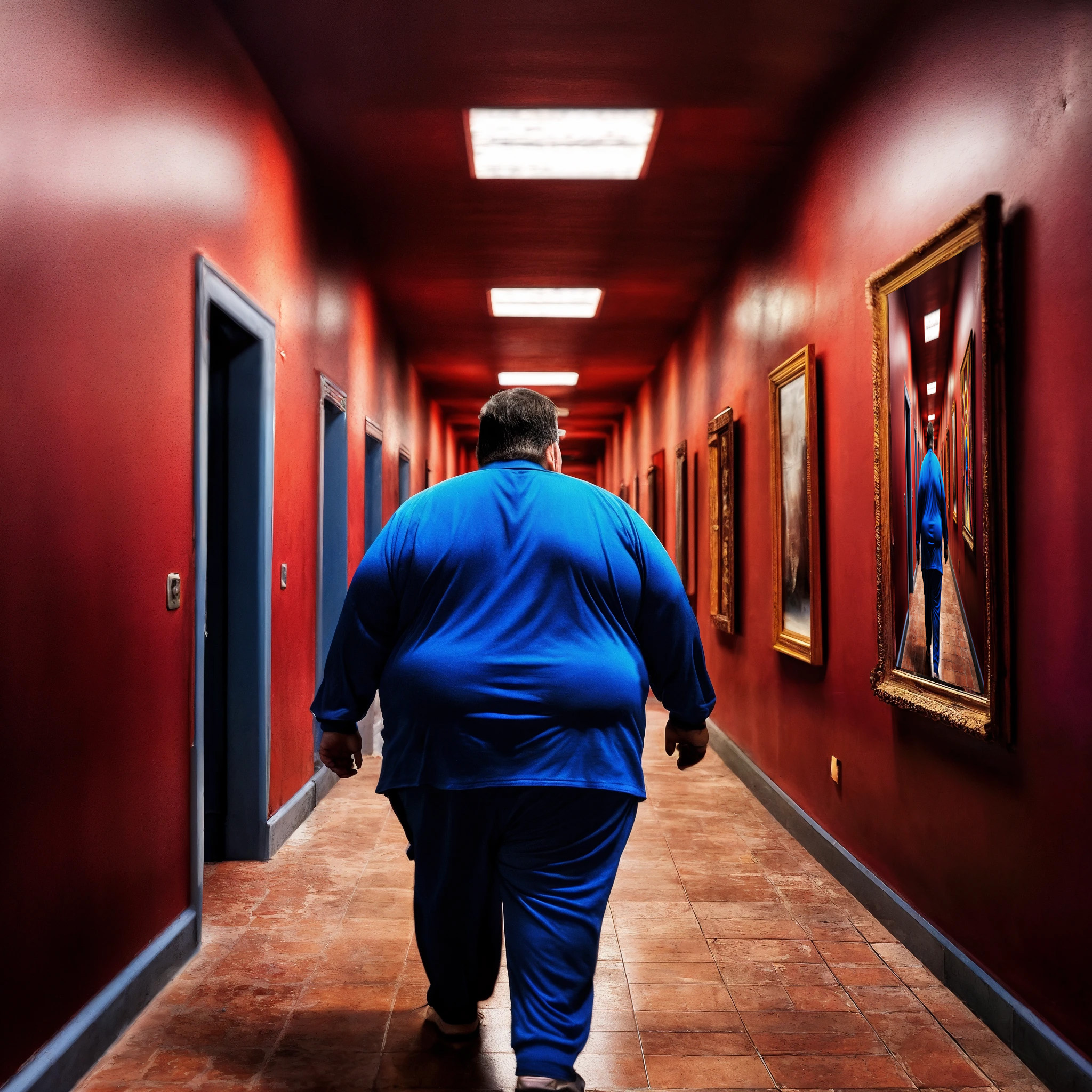
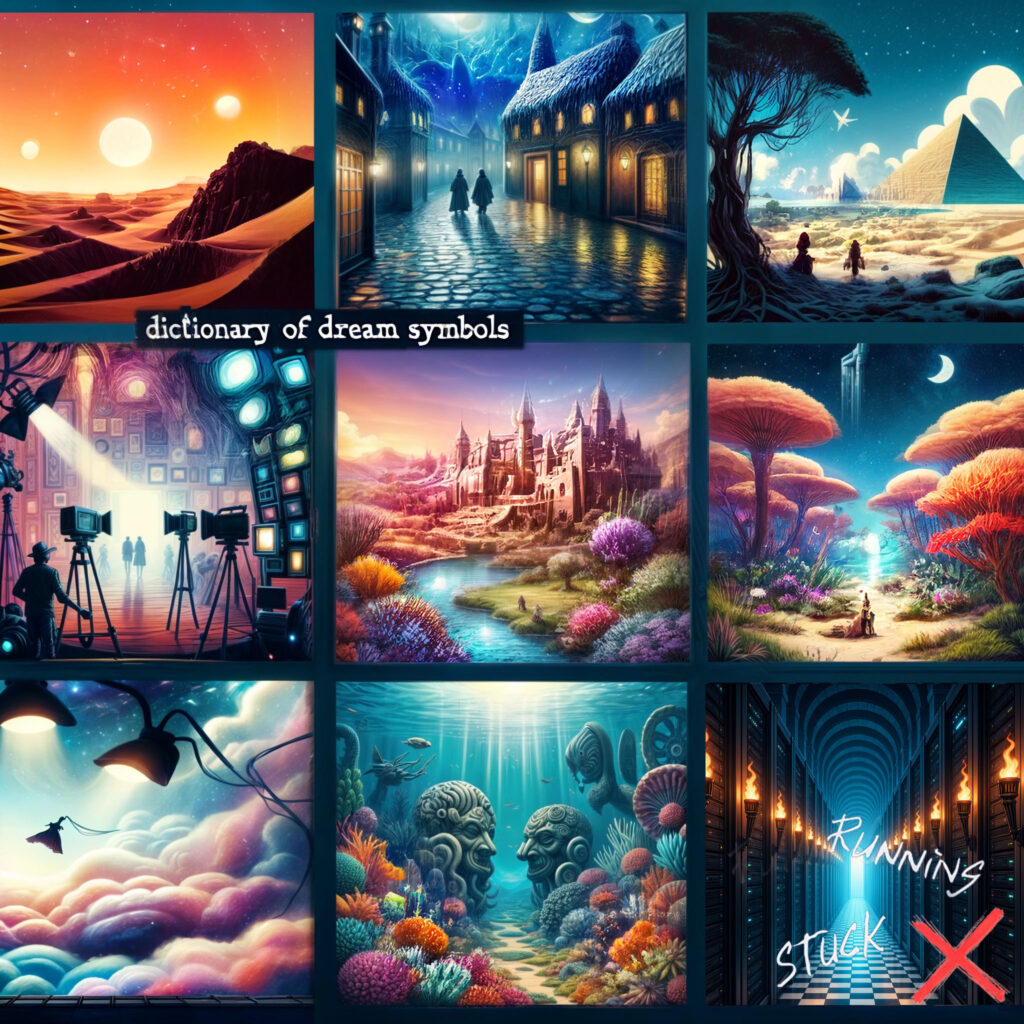
„I enter the corridor,“ you write, dear S., „and although I run with all my might, I never reach the other end, though I long for it so much. What is this meant to tell me?“
Dear S., we all know such dreams in which an unknown force prevents us from reaching our goals. A corridor could represent our life path, the side doors or passageways symbolize possible or already missed opportunities, and the desired end of the corridor might signify our greatest wish, our „golden dream“ that guides us through life.
But do we ever reach it?
A corridor in a dream without doors could mean that external circumstances or other people are forcing you to follow a certain path, leaving you with no alternatives.
A corridor with many doors that are locked might convey the message to you: Stay focused on your current path and do not deviate from it.
And a corridor where you simply can’t seem to make progress might symbolize a period in your life where everything feels stagnant.
Your dream, dear S., seems to be saying to you: No matter how hard you try, you will never reach your goal.
So, is it hopeless for you? Is your dream self telling you to finally give up because you don’t stand a chance? I think not. On the contrary, I believe that your dream self is trying to show you a way to achieve your goals even despite all your futile efforts.
You try to run. But perhaps your dream corridor gets longer and longer the faster you run. Or it’s like in Lewis Carroll’s Alice Through the Looking Glass:
„ ‚Well, in our country,‘ said Alice, still panting a little, ‚you generally get somewhere else if you run very fast for a long time as we have been doing.‘ ‚A slow sort of country!‘ said the Queen. ‚Now, here, you see, it takes all the running you can do, to keep in the same place. If you want to get somewhere else, you must run at least twice as fast as that!‘ “
So, running twice as fast? That would be bad advice. Your dream seems to signal to me: Pause; take a break; linger for a while.
Dreams are full of magic: Perhaps your dream corridor will shorten, and the other end will come within reach, so that you only need to stroll leisurely, or perhaps even take a single small step!
It’s worth a try—in both life and dreams, isn’t it?
In any case, thank you very much, dear S., for your question. Similar dream experiences affect many people, and often the interpretation and solution is similar to yours. Keep us updated, and write again if a shift in mindset leads to new and completely different dream experiences.