I enter the corridor between the cells. A great honor! How I have asked, begged, and prayed to have the chance of speaking with the old master poets, to seek their advice, to benefit from their wisdom! Finally, after lengthy negotiations, I am granted admission to the Akasha Palace. Here, not only are their timeless works are safeguarded, but also their personalities from that time remain in perpetual protective custody. Nothing fades, not even the spirit of our ancestors who stand ready to answer us—if we can find the way to them.
I have been allowed into the corridor of poets—there isn’t one for short prose writers—and for those who weren’t confined to poetry alone, their cells are said to open onto other corridors: tragedies, epic poems, comedies, choral odes, astrological treatises…
But this is just a speculation, not a certainty. The keepers here aren’t very forthcoming. In any case, it seems that the criterion for admission to the inmates is the kiss of a muse. Here, perhaps, it was Euterpe’s. I read names on the nameplates on the doors, names like Milton, Dante, Bolo, Orpheus, Neidhart, Brant, Shiki, Bukowski, Vergil, Yeats, Tyrtaios, Tao Yuanming, and many others I have never heard of. Euterpe was diligent. Or was it Erato?
Who should I ask here? I don’t have much time. I am allowed to ask one of the poets behind the heavy wooden doors a question. For years, decades, I have been able to contemplate this one question. I know it inside and out. It is the question, the key to the answer behind all answers.
The guard already looks impatient. From Bukowski’s cell, a howl seems to come, but maybe it’s the wind of time trapped in these endless, twisting corridors. My gaze falls on the nameplate Rumi. Yes! He will be the one! He will know the answer and gladly tell me. Internally, I rejoice as I slide the small wooden panel in the door to the side. Yes, who could give me better information than the Persian master poet and visionary of mystical love and spiritual ecstasy!
“Jalaluddin?” I call into the darkness of his cell. Dimly, I see a man wearing a turbaned dervish cap, spinning in place with outstretched arms. He radiates an infinite serenity, beyond all description, and at the same time, an unspeakable joy shimmers out from him in spirals, piercing deep into my heart.
don’t know if I stood there for a single breath or an eternity. The hand of the guard pushes the small wooden hatch to Rumi’s cell shut. He guides me back. When I finally stand outside again and the guard has closed the gates of the palace behind me, I begin to spin, slowly on my axis, with outstretched arms.
I enter the corridor. Large-format black-and-white photos of rhinoceroses hang on the walls between the doors—snapshots from my last trip to Africa. For a moment, I stand there, hesitant. What was I here for again? Well, actually, it’s irrelevant which of the doors in the corridor I choose or whether I go any further—at least for a follower of the Many-Worlds Theory like me, who assumes that every decision made creates as many parallel realities as there are possible alternative decisions.
Now I remember: I want to go to the smoking lounge—the right door. But that’s only here. An alter ego of mine in another, otherwise entirely identical world is now opening the left door and entering the billiard room. Another version of me simply walks all the way to the door to the garden, creating a new world that is otherwise identical to this one in every last detail. Just as a parallel reality splits off from mine when one of us, on a whim, turns around and goes back to the kitchen for another (or third or fourth…) shot of bitters.
You see where I’m going with this?
Whatever I do—ultimately, in the form of countless incarnations inhabiting just as many parallel worlds, I do everything. Even a banal act like entering a corridor already creates a multitude of worlds. And this is not philosophical nonsense but simply the consequence that physicists draw from sophisticated experiments.
Somewhere in the multiverse, color photos of rhinoceroses adorn this corridor. Or photos of giraffes. Or unicorns. Or maybe they are old silent film posters.
Somewhere, I am a burglar in this corridor. Or a visitor. The bill collector. Or the cleaning lady.
Somewhere, my children are romping through the halls. There was a civil war, and my house has burned down to its foundations. Everything is desolate because a plague has depopulated the country. My family and friends and I are joyfully celebrating because hunger has finally been eradicated from the planet.
It’s pretty crazy, the horizons that open up. Unfortunately, I only know this in theory—my feeling is that only one version of myself lives and breathes, namely this one, and even that I’m not always entirely sure of. And even about that, I’m not always sure. Currently, I’m feeling a bit irritable because of my stomach trouble. And it doesn’t help to know that somewhere else in the multiverse—unreachable but just as real as you and me—a parallel-world counterpart of mine is in love, feeling butterflies in their stomach, ready to embrace the world. To name just one of presumably countless other realities…
And if you now believe that, in the face of these imagination-defying prospects, it would be completely irrelevant how we make our decisions or even how we feel: you’d be mistaken! This is mine alone, my very own thing, and no matter how it’s fashioned elsewhere, no parallel version of me, no matter where they may be, is having this precise experience. Admittedly, I’ve been dealt a bad hand with this upset stomach. But that will pass. How about you?
What’s clear is that whatever I write (and whatever you are reading or having read to you right now), eventually, in the form of a parallel version of myself, I’m also somewhere writing the opposite. Or a version that fits in 140 characters. Or perhaps even a more gripping, emotional version that sends my readers’ hearts racing and prompts a renowned Hollywood producer to think that this should be made into a feature-length film.
So you can rest assured: somewhere in the multiverse of quantum physicists, there is a parallel world where this text or an alternative version or interpretation of it deeply touches something inside you, inspiring you to shape this—this—world in your own unique way and perhaps even make it a better one.
(You can believe me or not. It makes no difference to me or to you, because, indeed, ultimately both apply.)
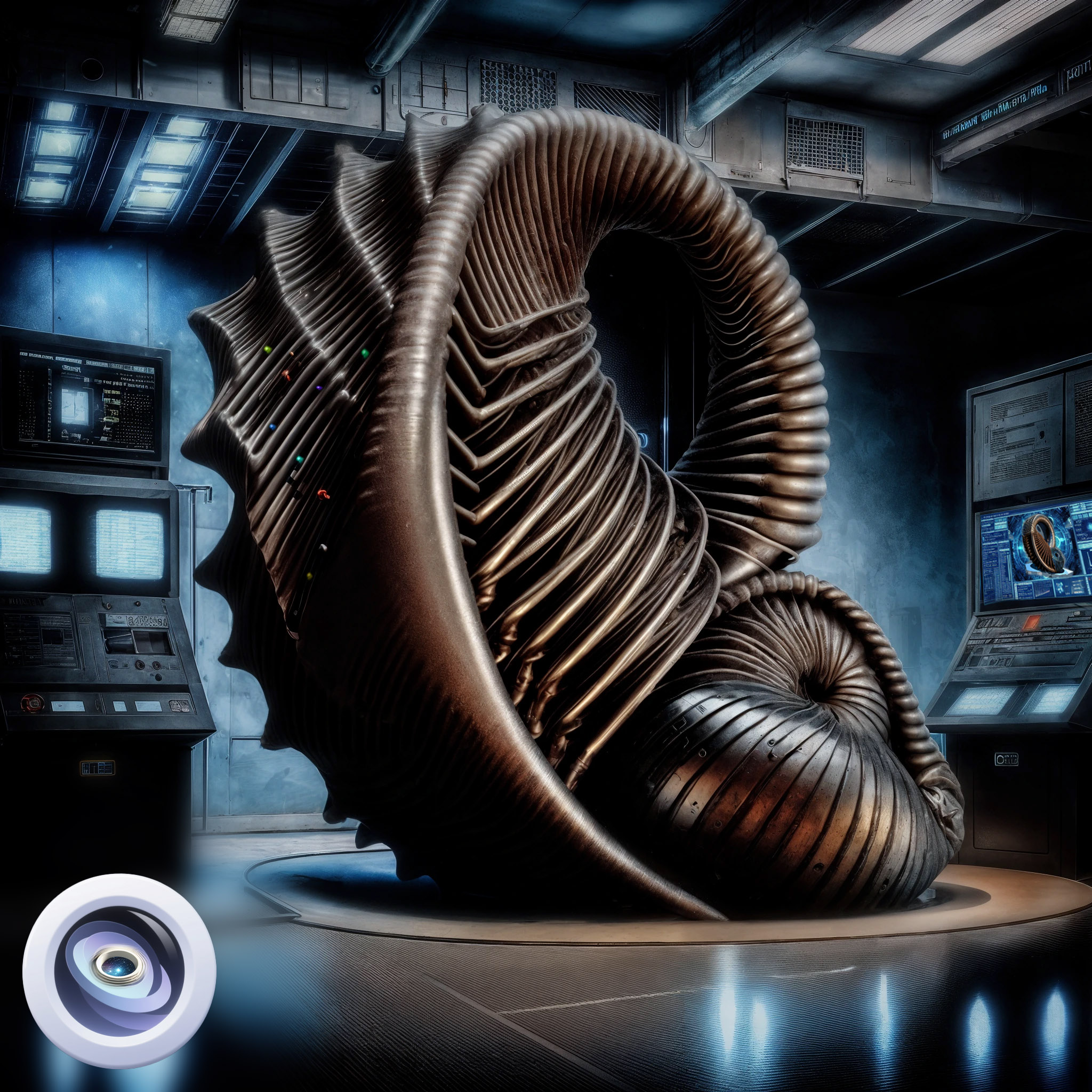
I enter the corridor to find the right door: the door that will take me back to the “Snail Shell.” That’s what we called the convoluted magnetic chamber, which our supercomputer had calculated for us. After two years of construction alongside my students, the chamber was nearly complete: a strangely twisted and self-folded structure of gleaming metal adorned with hundreds of magnets, designed to prevent any matter generated in the vacuum chamber from coming into contact with anything. As the magnetic chamber hung in the spacious laboratory, it resembled a work of art from another world. Almost ethereally beautiful, yet also unsettlingly alien, as if this form should not exist.
I cannot adequately describe it. The Snail Shell held an ever-increasing fascination for me. Eventually, I convinced myself that I absolutely had to inspect the welds before sealing the chamber, and one night, I secretly crawled inside.
But not back out.
Instead, I find myself in the Trieste. As a child, this world record had left an indelible impression on me. I instantly recognize the submersible; the descriptions from my childhood must have etched themselves deep into my memory back then. I also recognize Piccard, and in doing so, I know whose head I’m stuck in and through whose eyes I see it all: those of his fellow traveler, Don Walsh—I am accompanying Jacques Piccard on a journey to one of the deepest points in the world’s oceans, the Mariana Trench.
It is cramped and stuffy; the metal hull groans heavily under the immense external pressure. The water, into which spotlights shine, looks cloudy. A universe of impenetrable blackness surrounds us.
I am a ghost, squatting inside Walsh’s head. Walsh seems oblivious to my presence. I keep drifting away, as if I were a foreign object that doesn’t belong here—which, in a way, is true. The experience reaches me like a radio signal clouded by heavy static. And then, recurring headaches wash over me, which is strange because I no longer have a head of my own. Walsh appears to notice nothing of the ghost or the pain inside his head.
In broken English, Piccard explains that we could die down here if we settle onto a wreck, get entangled, and cannot resurface. However, we land gently. A flatfish in front of our tiny window feels disturbed, stirs from the mud, and swims away. There is life down here. In eternal darkness, with the weight of almost eleven kilometers of water above! Piccard writes in his logbook. Then we release our ballast and begin to ascend.
I don’t understand any of this. How did I get here? How can I suddenly end up in a different time, in the head of a stranger?
Is it a dream, or am I perhaps actually dead, suffocated in the Snail Shell? But do you experience headaches and blackouts when you’re dead? Clear thinking is a challenge right now, but I believe this is all happening solely within my consciousness. I’m not a time traveler, but a ghost traveler. And somehow, I must find a way back to the Snail Shell, the magnetic chamber whose convoluted form—crafted only by mathematics and a powerful computer—has sent me into the Trieste. I must return!
We resurface. Champagne is poured to celebrate the record journey. Walsh urgently needs to use the head. He apologizes, enters a corridor in the mothership—and suddenly, I spin away from him, adrift, upside down, shattered into countless fragments. However, like magnetic particles, these pieces reassemble. Not in the Snail Shell, but in another time, in the mind of another person, another childhood fascination…
“I enter the corridor” scrolls across the screen—much like clouds forming and dissolving in a time-lapse sky—as on-screen text, just as THE CONJURER (wearing a plain red robe with a broad black cloth belt and a black hat) enters a clinically white, glaringly bright hospital corridor. He stops.
THE CONJURER
Many deem they be upon the playnest way And yet they wander far astray Whiche leadeth not to vertuous lyfe.
The Conjurer walks on. The doors along the sides swing open: to the sound of circus music, FOUR SCANTILY CLAD GO-GO GIRLS present items to him on velvet cushions, such as:
(on a beige cushion) a pacifier,
(on a purplecushion) a tjurunga,
(on a red cushion) a submachine gun,
(on a blue cushion) a golden laurel wreath.
The Conjurer casts a brief glance at each of the tempting offers, but then shrugs and leaves them aside. Only now is it noticeable that he carries a wicker basket on his belt, with A SMALL OWL peeking inquisitively out of its opening. While walking:
THE CONJURER
Blest is he who strayeth not from the waye If he hath founde it for to keepe For oft the side-path turneth deepe.
More doors swing open beside the Conjurer; FOUR MORE GO-GO GIRLS (or are they the same?) present:
(on an orange velvet cushion) a gaming console,
(on a green cushion) the Charter of Human Rights,
(on a yellow cushion) an ivory tower, and
(on a turquoise cushion) The Glass Bead Game from Hesse’s novel of the same name.
At the end of the corridor, a coral-colored curtain awaits the Jester. He pushes it aside…
THE CONJURER
(smiling)
I dread the dayes are drawing nigh, When menne shall more newe tidings finde, Than shall content or suit our minde.
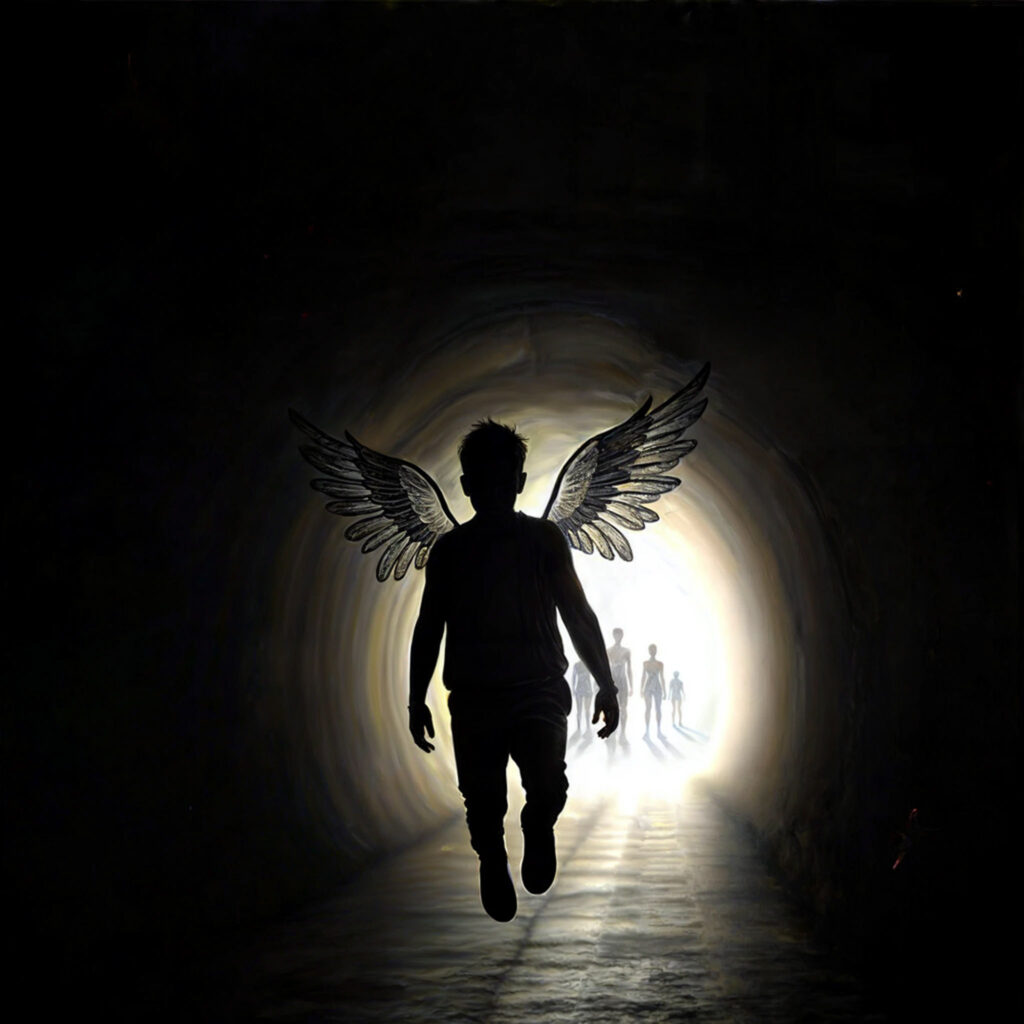
I enter the corridor—or rather, I float in, still flapping my wings somewhat awkwardly. The corridor is round, like a borehole. I can’t make out any doors. At the end, an unearthly radiance awaits, filling me with a deep, sweet longing. I flutter, trying to move faster. Shimmering outlines in the glow ahead remind me of friends and lovers I’ve long forgotten. I hurry forward. And yet—should I not look back one more time? Have I perhaps left something unfinished?
And how!
Idreana!
In all these corridors, behind the countless doors, I still haven’t found her! I turn around, even though it’s difficult, back toward the beginning of the tunnel. The alluring, shimmering light behind me fades, and I can sense the disappointment of those waiting for me there.
I enter the corridor of his houseboat and find my friend Norbu on the small terrace as expected, hunched over the laptop on his lap.
“Wikipedia!” he groans, and it sounds like a suppressed curse. I open the wine I brought along. I already know where to find the glasses.
“When you hit the outer limits, they’re all terrible ideologues.”
“What limits?” I ask.
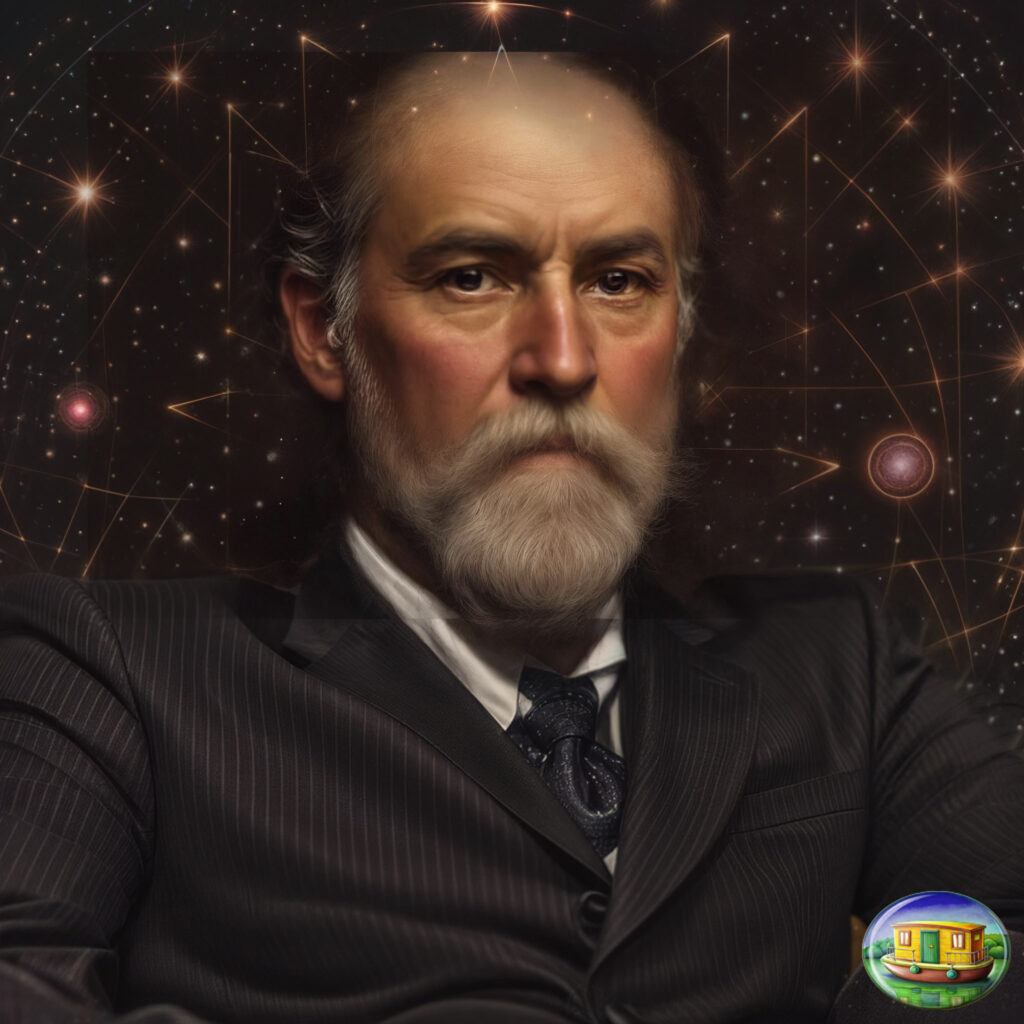
“Well, the limits of science. Here, for example, the entry on Frederic Myers.” He points to the text on his display, but without my glasses, I can only make out a blurry logo and a photo. “Myers was one of the founders and later president of the Society for Psychical Research, which dealt with spiritualist topics. He coined the term ‘telepathy.’”
“Doesn’t ring a bell,” I say, then quickly add, “The man, I mean.”
“But the Wikipedia editors,” he continues, unfazed, “leave out his most important contribution.”
“Well,” I venture, “spiritualism and telepathy aren’t exactly standard Wikipedia topics.”
Norbu looks at me, shaking his head. “But they have to be. An encyclopedia can’t just erase a part of reality simply because the editors and authors don’t like it.”
I clink my glass against his to buy a little time. “Aren’t they all completely different authors? I mean, after all, you’re a contributor too.”
Norbu gives a pained laugh. “Sure. But there are the decision-makers, a kind of priestly caste, and it’s mostly the ideologues who’ve made it to the top. They cut out whatever doesn’t fit their agenda, using flimsy excuses and practically warlike tactics.”
I nod to show understanding. “Like telepathy.”
“And everything that evades the scientistic creed.”
Scientific creed? I let Norbu get away with the contradiction and point a finger to remind him of the old bearded man on his display, staring out at me from the deep darkness.
“After his death,” my friend Norbu explains, “mediums all over the world received strange transmissions through automatic writing, many signed ‘Myers.’”
“You mean he was reaching out from the, uh, realm of the dead?”
Norbu nods zealously. “And not just that. The texts made no sense.”
“Aha,” I say with satisfaction, “then it doesn’t need to be on Wikipedia.”
That earns me a glare from Norbu.
I take another sip of the red wine. Pretty dry. But that’s how Norbu likes it.
“Only independent observers were able to piece together the transmissions—like I said, transcripts from various mediums across the globe—and suddenly a pattern emerged. They all referenced each other.”
“Wow,” slips out of my mouth, “telepathy!”
Norbu shakes his head testily. “No, exactly not. Whoever sent these messages intended to rule out the possibility that the mediums were communicating with each other telepathically.”
“So no telepathy,” I say, frowning. What then?
“Let’s apply Occam’s razor and go with the simplest explanation: After his death, Myers came up with a way to prove the survival of the human psyche—through these scattered transmissions to different mediums that only make sense when taken together. They contained information very few living people had access to. And over roughly thirty years, that added up to more than three thousand texts. It’s just that none of it appears on Wikipedia—neither the German nor the English version. Just like there’s nothing about spiritualism in the article on ‘Automatic Writing,’ and so on and so forth.”
Norbu looks at me expectantly. But I can’t really bring myself to agree.
“Maybe that’s for the best. What you’re telling me sounds pretty, uh, unsettling. The part about the 3,000 transmissions.” I take a big gulp of wine and pour myself a refill. The longer I think about it, the more uncomfortable I feel under Myers’s gaze from his Wikipedia page.
“You’re just like them,” Norbu says, shutting his laptop in disappointment. “Whatever doesn’t fit into your neat little worldview gets kicked out.”
“Speaking of which,” I say, “up for a game?”
The distraction tactic is a resounding success: A short while later, we’re standing at Norbu’s foosball table, replaying the latest Champions League matches.
It’s only on the walk home—a bit unsteady, but in good spirits—that I remember this Myers fellow again. Strange guy. 3,000 nonsensical texts? Sounds like something from the internet age. With a blog from the afterlife, he probably would’ve achieved a lot more—and maybe even made it onto Wikipedia…
I enter the corridor, and immediately I encounter—how shall I describe it?—a shroud of glassy frost through which vision blurs and sounds, if they penetrate at all, are only muffled. Those who sit behind this veil—whatever I attempt to shout to them for dictation, for verbatim transmission, they commit to paper only reluctantly and, at times, obtusely.
How am I to deliver the proof to you while this remains my sole means of passing on the message? I cannot possibly know how much of what I send actually reaches you. How can I convince you? My ongoing efforts are met with untold difficulties, and this sense of dreadful powerlessness weighs heavily upon me. Oh, it is a dark and cruel corridor! But I will not—I simply must not—falter in my endeavor…
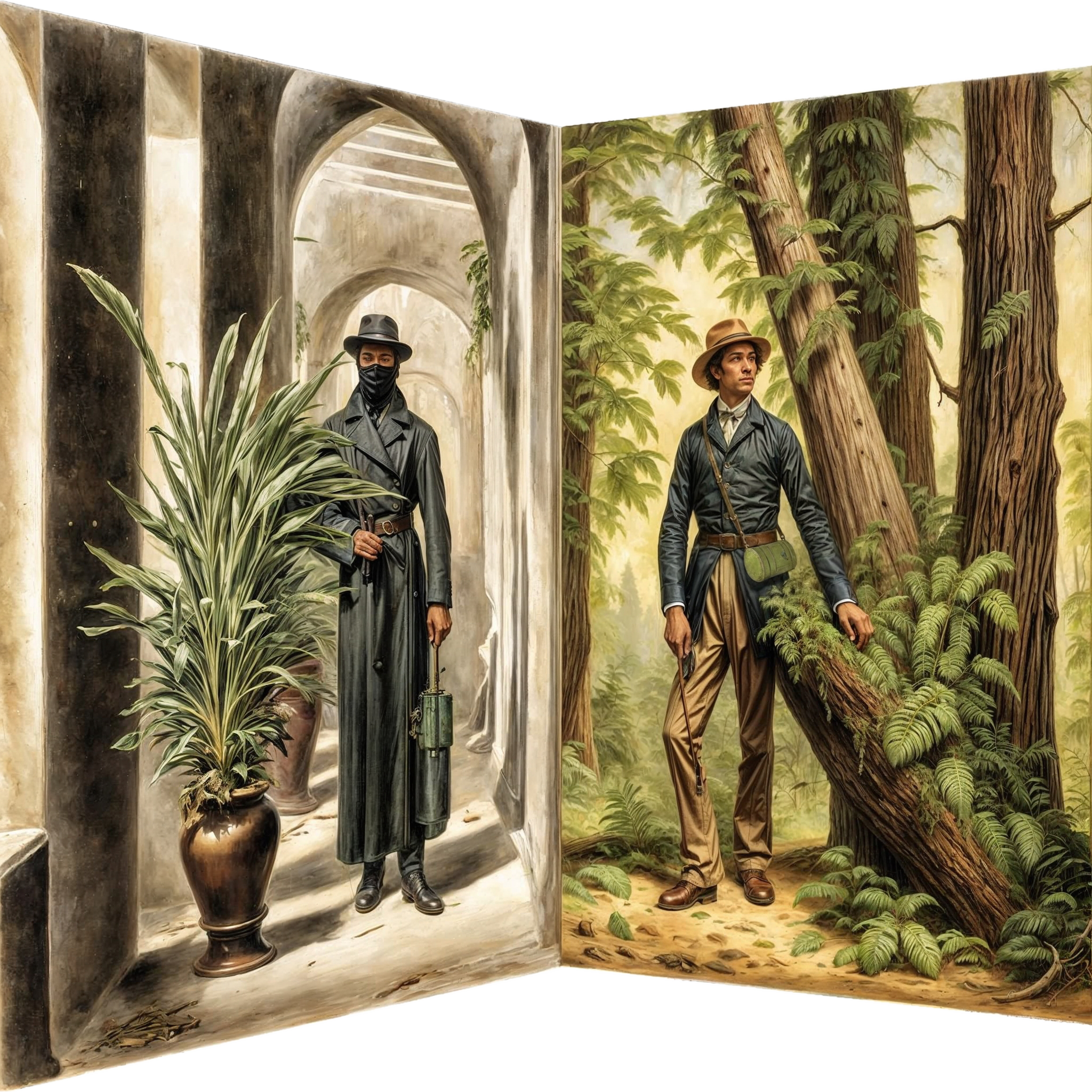
I enter the corridor—my mirror-self, a forest. I walk past the many doors—my mirror-self observes a woodpecker. I cautiously press down on a door handle, but the door is locked—my mirror-self runs his hand along the bark of an oak. I scratch where my nose itches under the stocking mask—my mirror-self listens to the rustling of leaves in the light breeze blowing through the treetops. I hide behind a shoulder-high plant in the corridor as a door opens, a bureaucrat steps out, opens a window, and lights a cigarette—my mirror-self hears footsteps approaching. I sneak past the smoker and slip through the open door into his empty office—my mirror-self takes his approaching lover into his arms. I plant the explosive device under the desk and set the timer for two minutes—my mirror-self finds a soft bed of moss for himself and his Eandria.
I enter the corridor because I heard a strange noise. At eye level, a blinding light flashes at the front door—two, three times. Is someone welding it from the outside? It flashes glaringly again, three times, like a knock, but utterly silent. Without a second thought, though I’m standing there only in my pajamas, I rip the door open.
In the shadows of the entryway stands—something. Or rather: it hovers. It looks like a three-dimensional kaleidoscope whose luminous shards constantly migrate inward, until they suddenly shift direction and flow outward from the center like molten iron.
The voice is very soft and gentle, and it feels like I’m hearing a familiar, beloved lullaby. It says, “You caused a spiral arm of the galaxy to vaporize.”
I stare at the apparition. Words fail me. I want to run away, hide, or just faint. But it’s as though my thoughts no longer find resonance within my body—no anchor to trigger a physical act. I remain stone-still before this thing.
“You built a machine,” says the voice.
A machine? Yes, there was something. But it wasn’t me. Just a dream. For weeks, I’ve been waking up at the exact same time in the middle of the night, at 2:22 a.m., and I always remember a vivid dream in which I’m some sort of engineer, obsessively building an incredibly complex machine—it fills nearly the entire warehouse I rented, using powerful Hadron lasers and a kind of miniaturized fusion reactor to manipulate gravity and rupture the space-time continuum. Dream by dream, I completed my work, even though I secretly knew the device could have uncontrollable side effects. Until last night, when I finally activated the finished machine. I can’t say what it did because the moment it started running and revved up, I woke up. That was yesterday. It was 2:22 a.m.
Even now, in the middle of the night, it could be 2:22 a.m. But this is not a dream.
“You built a machine,” the voice repeats, as I’m hypnotized by the slow flow of liquid metal and a sense that the being with its gentle singsong is about to tell me something terrible.
“Your machine pierced the dimensions of the world, shattered your planet, and dragged many, many stars and planets in the vicinity into destruction.”
“But that’s nonsense! The Earth didn’t perish just because I dreamt something!”
The kaleidoscope pattern changes, but I can’t say how. The voice now seems more stern. It says, “The world in your dream was real. As real as this one. We had hoped you would decide not to activate the machine at the last moment, but to destroy it.”
“I had no idea what it would do!” Really? No, I did. In the dream, I knew very well the risk I was taking. I just kept pushing it away.
“Many civilizations had to die,” says the voice.
Because of me? Am I supposed to be guilty? “What about you?” I ask, “You’re alive, I assume.”
“A few, like me, were hurled through perforated dimensions into parallel worlds.”
Parallel worlds: In the dream, I repeatedly suppressed the fear that my ingeniously devised machine—intended to tap into vacuum fluctuations for unlimited free energy—might unravel the fabric of time and space. And now, an entity stands before me, thrown into my world through a dimensional rift—perhaps the last survivor of an entire planetary civilization that I have on my conscience. Slowly, the staggering weight of what the entity is telling me begins to sink in.
“If you knew about it, why didn’t you prevent it?” I ask in a hoarse voice.
“You have to do that yourself,” answers the liquid kaleidoscope hovering before me in the entryway.
“How?” I ask, bewildered.
The being slowly floats upwards and fades away. It has delivered its message and now retraces its path—wherever the destination may be. “How should I do it?” I call out.
The being vanishes. I hear no more answers, but in my mind, a thought forms, saying, “Dream a new world into being.”
A profound despair seizes me. It wasn’t me! I scream internally. It was that deluded engineer!
But the being is right: I was the man in the dreams, the one who decided to take the risk. I have the deaths of humanity and a multitude of other civilizations on my conscience; I have, with my obsession and greed for fame, led billions of people to their deaths, and a substantial chunk of our Milky Way along with them. I want to push it away, deny it, blame someone else. But although they were just dreams, deep inside, I know that my visitor is correct in his accusation. I was that obsessed engineer who disregarded all the ominous premonitions and set the machine in motion.
As I close the front door, my hand trembles. I must prevent it! I think, and at the same time, I laugh bitterly: How can I prevent something that has already happened?
But couldn’t a space-time fabric that includes parallel worlds also include the possibility of turning back time? Did the kaleidoscope being perhaps speak of this when it said, “You have to do it yourself”?
If it’s true—if it’s true that through my fault, humanity and a handful of other civilizations were destroyed—then I will thwart this dreadful act at any cost! Numbers, equations, and circuits race through my mind. The long nights as an engineer have paid off. Slowly, an image solidifies in my mind: a device, a time-and-world machine with a single purpose, meant for one-time use. It will be a kind of ark. But I won’t fill it with animals or people: It will transport me to a place and time that will allow me to prevent myself from punching holes in the cosmic fabric. I will undo it, thoroughly and physically! It must be possible.
I enter the corridor—although it’s not me whose body is stepping into the hallway, but a stranger in whose mind I sit undetected—relieved that the time has finally come to leave him behind. This time, it was Peter Aufschnaiter who, after a dramatic escape alongside Heinrich Harrer, reached the Tibetan capital of Lhasa on January 15, 1946, where he constructed hydroelectric power plants and sewage systems over the following years.
It’s always a corridor, a passageway, or a tunnel that leads me out of one head and into another. Somehow, this form of mental travel must have something to do with the “Snail Shell,” that intricate metallic structure that devoured so much processing time on the university’s supercomputers—and eventually me. I should never have crawled inside.
Since then, I journey through time without a physical form. It’s like a dream that keeps fading and blurring, and I’m constantly plagued by these headaches—a state of being not meant for humans. Something unnatural has happened to me. I’m trapped in foreign bodies, foreign times, foreign places—except that I almost always instantly know where I am.
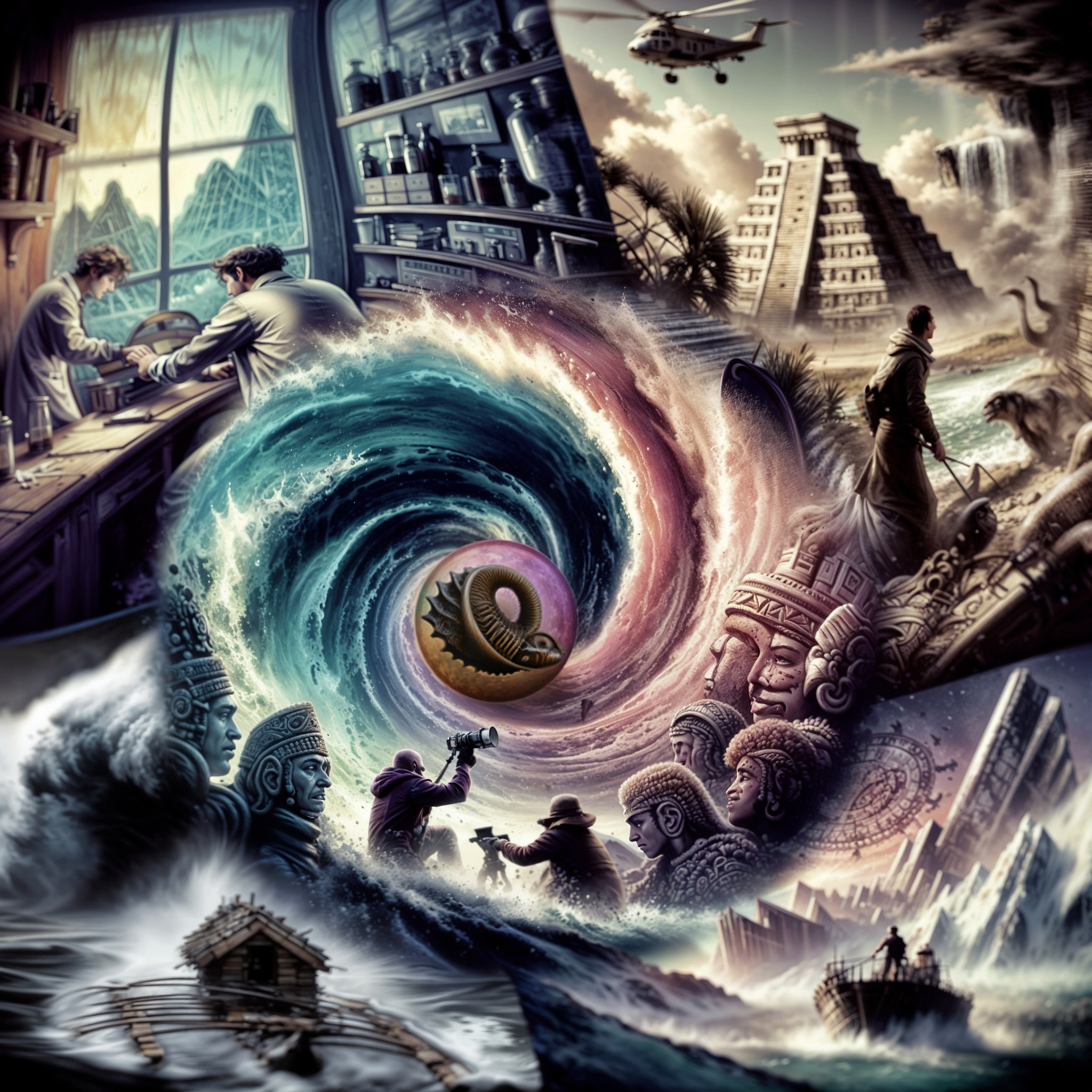
Whether I’m standing in a laboratory with Marie Curie, documenting the Mayan metropolis of Uxmal with Frederick Catherwood, weathering a storm on the Kon-Tiki with Thor Heyerdahl, or reaching the South Pole with Amundsen: it’s always the heroes of my childhood and their defining moments that dictate my mysterious itinerary.
My mind always lingers in the head of one of my childhood heroes’ companions—and sometimes that means weeks or even months!—until they enter a passageway or something similar. A doorway is not enough. The corridor must apparently have a certain length. It’s then as if I lose my grip. I sway, spin, whirl, only to abruptly find myself in someone else’s head.
I drift away repeatedly, and even remembering the past is difficult for me: What other childhood heroes were there? Dinosaurs! Like so many in their youth, I was fascinated by dinosaurs. Sometimes I fear that my journey could take me to that distant past: What will happen if I end up in a place, in a life where there are no corridors, hallways, or tunnels? Is my journey over then? Am I finally truly dead when the one in whose head I’m squatting and through whose eyes I see dies? Or will I return to the “Snail Shell” and wake up there from uncontrollable, twisted childhood dreams?