Korridorium

A daily dose of corridors in prose

Tag: meta

19/398

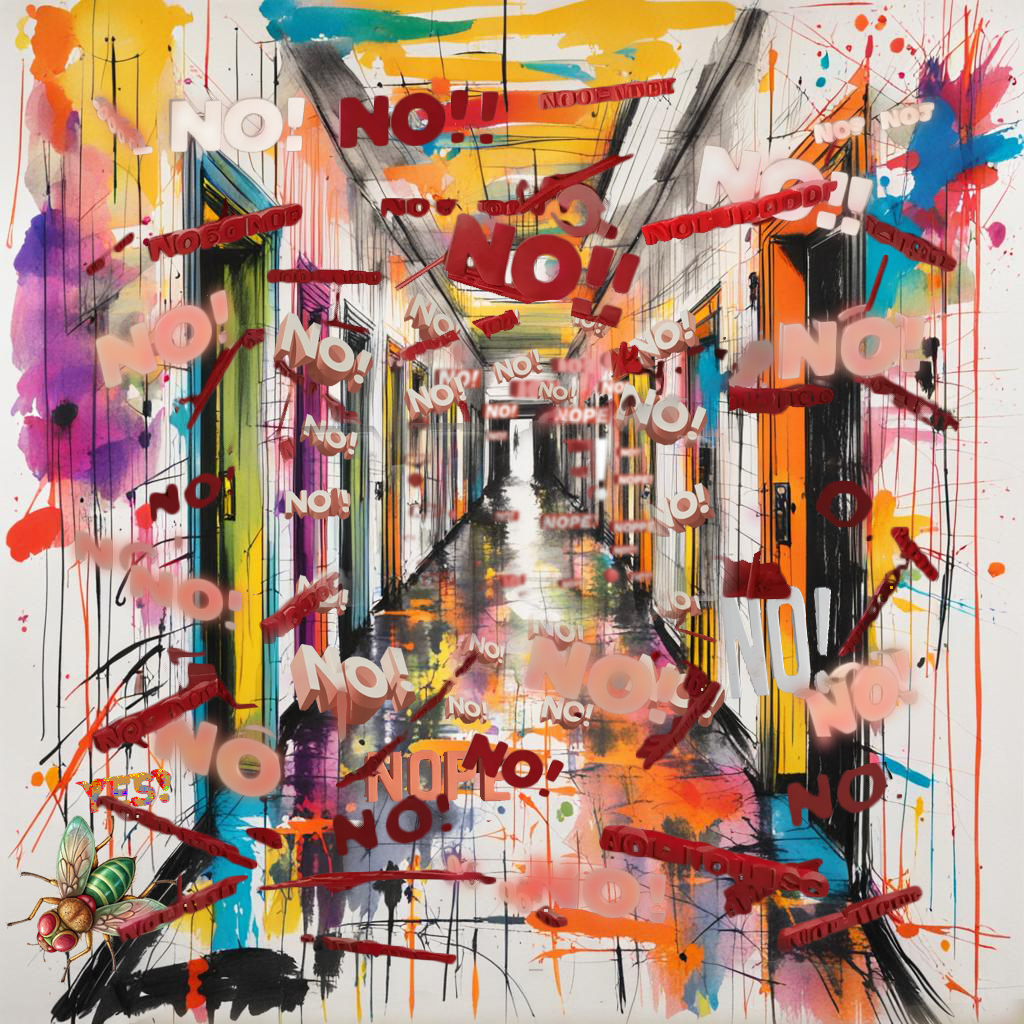
The cover art presents a vibrant, abstract scene of an expansive corridor lined with countless doors, all emblazoned with "NO!" in a chaotic mix of fonts and hues. A prominent, vividly colored fly is perched in the bottom-left.

♫ Mein Leben als Fruchtfliege ♫

19/398

LogoSwitch language

I enter the corridor, whistling a cheerful tune. I already know who I’ll encounter here so early in the morning on my way from the bedroom to the bathroom and then straight to the study. It’s you. You, yourself—yes, yes, search your memory, and then you’ll know where you’re hanging around in your dreams just before you wake up. In my hallway! And I am genuinely grateful for that because you are my quality control.

So I waltz in, in my pajamas with my hair all messed up, and there you stand, looking serious, asking, “And?” (Does any of this ring a bell?)

I enthusiastically gush about my ideas from the night—for more great corridor stories, for example: “A short sketch about a Chinese man who can’t pronounce the letter R—starts with ‘I entel the collidol!'” And you stand there shaking your head with that typical, ever-so-slightly dismissive smile. (Is it starting to click yet?)

I don’t let my euphoria be dampened: “Fine, fine, not that one. But how about the corridor story using our secret childhood language: ‘Itefy entefen-tertefer thetefe cortefor-ritefi-dortefor’!” As expected, you roll your eyes: “Dumtefumb” (Quite quick-witted of you.)

“Okay, then, the Pope,” I say, running my hand through my disheveled hair as I try to remember what I’d come up with. “At first, of course, you don’t know who it is. He walks step by step toward the balcony, where an immense crowd awaits him along with TV cameras and microphones. In his mind, he’s formulating his address—a scathing indictment of his congregation, accusing them of behaving like foolish sheep, unable to use their God-given minds to steer human history in a halfway sensible direction. Then he steps up to the railing, smiles at the sea of people looking up at him expectantly, and then just says ‘Urbi et orbi’ yet again! Well?” For a brief moment, you stare at me as if you’re about to burst into tears. You open your mouth, but nothing comes out. “Not good?” I ask with sad puppy-dog eyes, which, as usual, gets me nowhere because you just slowly and firmly shake your head. (By now, at least a few memories should be coming back to you.)

“Alright, then let’s take the boy in high school who enters the corridors between the classrooms with a rifle, contemplating the best way for his shooting spree to…” Your reaction makes me pause: you’re biting your fist. I assume that means: unbearable and completely off the mark. Too bad. “Could be a tweet,” I add pleadingly, “very short.” But your brief, dry laugh, tinged with no small amount of despair, tells me the problem with this idea isn’t its length. (Go ahead and check the knuckles of your right hand for bite marks. Is anything showing up?)

“Then I have a Jewish concentration camp prisoner to offer,” I suggest, and at this point, your expression is simply priceless: that expectation of something terrible, and how you fervently hope it isn’t true. But of course, I continue relentlessly: “He enters the corridor on his way to the gas chamber and…” A sound escapes your throat, a mixture of a gasp, a gurgle, and a sob, only very brief—I stop, because I don’t want to overstep. The best moments are when you roll your eyes to the heavens and raise your hands, as if some power from above could dry up this incessant torrent of half-baked or entirely ill-conceived ideas, finally silencing me and thereby bringing the world redemption. You do that really well. A sight for the gods, so to speak.

Of course, you sometimes nod graciously when one of my ideas doesn’t strike you as silly, adolescent, or tasteless. Otherwise, this blog wouldn’t exist. (To be honest, I sometimes sneak things past your strict quality control. Like this little story right here.)

You wouldn’t have thought so, would you? You and me, early in the morning in the corridor between my bedroom and my bathroom—and all the nonsense you have to listen to every time. Actually, you aren’t supposed to remember it at all, because otherwise you’d already know everything that appears here on the blog. That’s probably exactly why we forget almost everything from our nightly dreams: otherwise, life would just be boring.

25/398

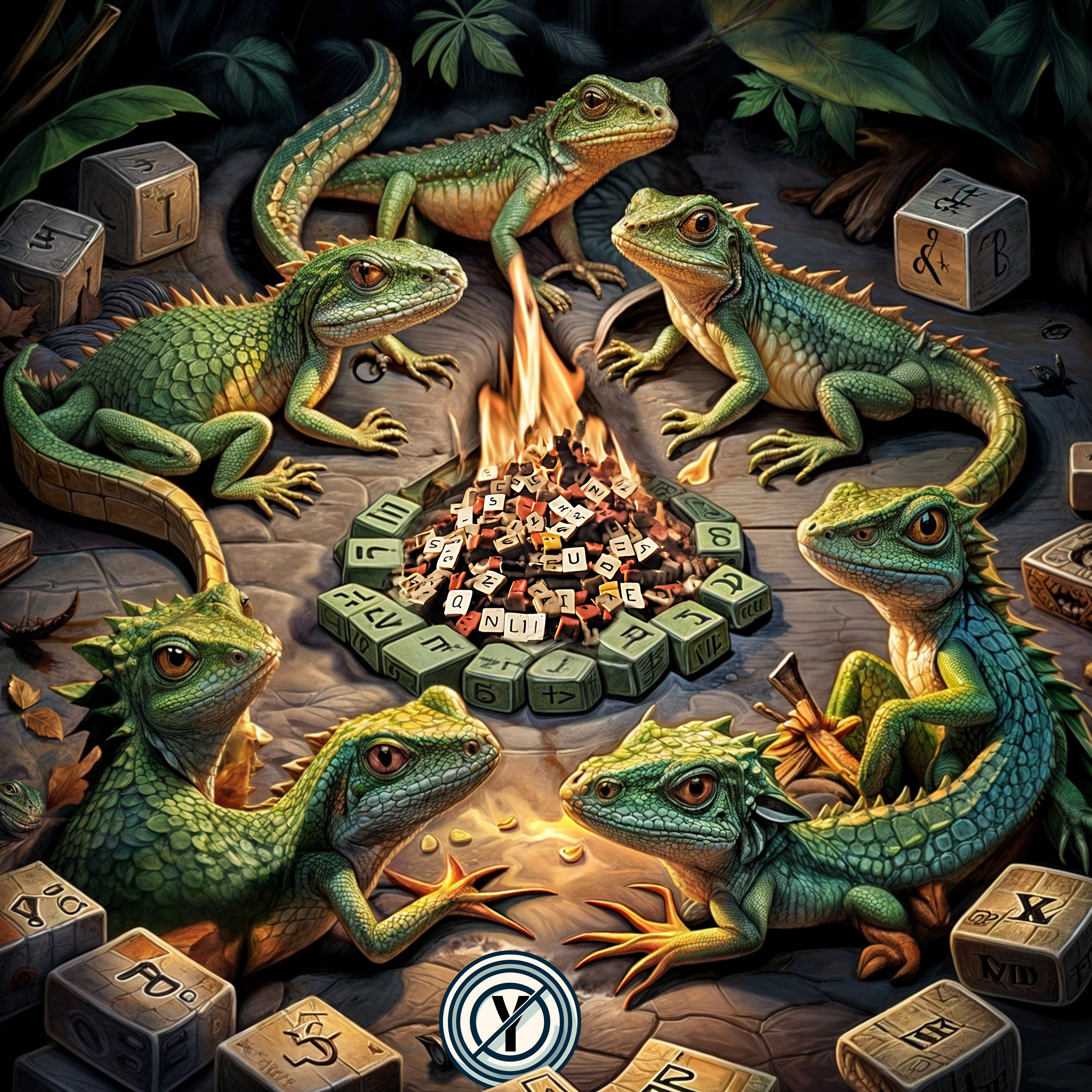
The cover art shows six green lizards with scaly skin, partly merging into each other. They are grouped around a campfire made of letter stones, on a stony ground in a dense jungle. A button in the image shows a crossed-out Y.

♫ The Campfire Lizards ♫


25/398

LogoSwitch language

I enter the corridor.


[Notes for the translator:

The sentence with which everything begins is a lipogram excluding the letter A. Similar lipograms include:

and finally text 25, excluding the last of the vowels.]

37/398

The cover art shows four black-and-white portraits: James Joyce with a red eye patch, David Foster Wallace with a red tie, Franz Kafka with red jacket buttons, and a person covering their face with their hands.

♫ Si on n’a pas ce qu’on aime ♫


37/398

LogoSwitch language

“I enter the corridor” simply isn’t a good first sentence, or so many of the rejection letters claim—even and especially those from publishers with a more artistic bent. I don’t quite see it. This sentence is a) simple and unambiguous, b) full of movement, c) evokes an image in the reader’s mind, and d) stirs expectations of events to come. Doesn’t it possess—or am I mistaken?—even more potential than, for example,

  • “riverrun, past Eve and Adam’s, from swerve of shore to bend of bay, brings us by a commodious vicus of recirculation back to Howth Castle and Environs“—where one could certainly argue over a)—or
  • “I am seated in an office, surrounded by heads and bodies“—where b) is likely spread rather thin—or perhaps
  • “It was late evening when K. arrived“—an opening sentence that, in turn, is a bit too simple for c).
  • That leaves d), and with it the hope of maybe finding resonance somewhere after all…

    40/398

    The cover art depicts an antique, open book resting on a wooden table. Behind it, a circular room's wall is lined with towering shelves, packed to capacity with venerable tomes. The book itself mirrors this scene, presenting an illustration of a book-laden chamber, yet minus any single volume left ajar.

    ♫ Malträtarium ♫


    40/398

    LogoSwitch language

    I enter the corridor. Its walls are composed almost entirely of book spines. (Not like Matej Krén’s installations or Ishwori Sapkota’s bookstore in Kathmandu, where books are seamlessly stacked horizontally, sometimes even mirrored to create endless, walkable tunnels, but densely packed vertically.) Tilting my head, I study the titles in bewilderment. Someone seems to have made a self-referential joke here.

    Back to back, there are, among others,

    • • Im Korridor der Sterne by Alexander Kaiser,
    • • Le deuxieme couloir by Georges Barguet,
    • Corridor of Storms by William Sarabande,
    • The Corridors of Time by Poul Anderson next to
    • Corridors of Time: 1,700,000,000 Years of Earth at Grand Canyon with an introduction by Carl Sagan,
    • Harlan Ellison’s Dream Corridor Volume 2 (where is volume one?),
    • Korridor der Blicke by Camill Leberer,
    • Corridors of Light by Eleanor G. Brown, Ph. D.,
    • Petits bruits de couloir by Philippe Guillard,
    • Il decimo corridoio by Marco Meini,
    • L’ultima stanza in fondo al corridoio by Alessandra Brisotto,
    • Corridor de Vie by Camille Sabatier,
    • Corridors of the Mind by Caroline Lupfer Kurtz,
    • The Locked Corridor by Marilyn Ross,
    • The Corridors of Fear by Clarissa Ross,
    • Der lange Korridor – ein Arztroman by Catherine Cookson,
    • The Silver Corridor by Harlan Ellison (here perhaps? No!),
    • The Golden Corridor by Jody and Ric Hornor,
    • The Smoky Corridor: A Haunted Mystery by Chris Grabenstein,
    • La mistica nel corridoio by Luis Casasús Latorre,
    • the comic Sunset Corridor by Régis Franc,
    • Der dunkle Korridor – klassische Erzählungen aus Russland by Hanjo Kesting,
    • Yao ye hui lang by Julian Lee,
    • Night Corridor by Joan Hall Hovey,
    • Corridors by Candlelight: A Family Album with Words by Anna Clyde Plunkett,
    • The Black Corridor by Michael Moorcock,
    • Flucht aus dem Grauen Korridor by Clark Darlton,
    • Les couloirs de l’espoir by Corinne Vomscheid,
    • The Corridor of Mullah-Kajar and Other Stories by J. M. DeMatteis and Roy Thomas,
    • Tumithak of the Corridors by Charles R. Tanner,
    • Il corridoio del flaminio by Aldo Toffoli,
    • Le corridor des invendus by Bernard A. Chevalier,
    • Corridor of Whispers by Edwina Noone,
    • Dans les couloirs du labyrinthe by Emmanuel Matateyou,
    • Echoes Down the Corridor by Arthur Miller,
    • L’Enfant dans le corridor by Yves Thibault,
    • L’homme assis dans le couloir by Marguerite Duras,
    • The Ladies of the Corridor by Dorothy Parker,
    • Série X numéro 122: Dans le couloir de l’amour by Tracy O’Toole,
    • La fille au bout du couloir by Jacqueline Remy,
    • Ma princesse disparait dans le couloir by Brigitte Smadja,
    • Mon père s’est perdu au fond du couloir by Philippe Garnier and
    • La vérité est au bout du couloir by Sam Richez,

    in between are the scripts for

    • Korridoren by Bengt Bratt, Bengt Forslund and Jan Halldoff,
    • White Corridors based on a novel by Helen Ashton,
    • Corridor of Mirrors after a novel by Christopher Massie,
    • Les couloirs du temps: Les visiteurs 2 by Christian Clavier and Jean-Marie Poiré,
    • Whispering Corridors by In Jung-ok and Park Ki-hyung, as well as
    • Shock Corridor by Samuel Fuller

    plus a videocassette with the handwritten label

    • En el corredor de la muerte,

    then more books:

    • Corridor Ecology: The Science and Practice of Linking Landscapes for Biodiversity Conservation by Jodi Hilty et. al.,
    • Corridor naar de Rijn by Hen Bollen,
    • Ostpreussen und der Polnische Korridor by Wilhelm Deuticke,
    • Club és folyosó: Politikai ötletek és rajzok by Kálmán Mikszáth,
    • The Persian Corridor and Aid to Russia by T. H. Vail Motter,
    • Le couloir de Dantzig by Général Gomer Castaing,
    • Der Gansu-Korridor: Barbarenland diesseits und jenseits der Großen Chinesischen Mauer by Sabira Stahlberg,
    • L’île au bout du corridor by Marie-Antoinette Liaudet,
    • Camera e stanze – Il corridoio racconta by Lucio Tisi,
    • Kubismus im Korridor by Susanne Friedli et. al.,
    • a photography collection Corridors of the World – Places of Arrival and Departure,
    • Au-delà du couloir by Marion Brodeau,

    even a volume titled

    • Analysen der Verkehrswege zwischen dem alten und neuen Bundesgebiet dargestellt am Korridor Rhein-Main und Thüringen-Sachsen,
    • from Die Spannenden Geschichten Nr. 71, Deutsche Panzer durchbrechen den Korridor,
    • Le corridor des Panzers (Vol. 1 et 2),
    • Korytarz śmierci by Perry Moore,
    • Through the Corridor by Daniel Pearson,
    • Running Through Corridors: Rob and Toby’s Marathon Watch of Doctor Who by Robert Shearman and Toby Hadoke,
    • Im Korridor geht der Mond by Elisabeth Alexander,
    • “Cunning passages, contrived corridors”: Unexpected Essays in the History of Lexicography by Michael Adams,
    • Voci dal corridoio dell’anima by Trotti Nardo,
    • Le couloir de la pieuvre by Olivier Descosse,
    • Meine Freunde ziehen mit einer fahrbaren Plastikmaus über den Korridor by Thomas Böhme,
    • God in the Corridors of Power by Michael Ryan and Les Switzer,
    • Messages de vie du couloir de la mort by Roger W. McGowen,
    • Memorias del corredor de la muerte by Joaquín José Martínez,
    • Chimerical Corridors by S. Vasuki,
    • El entrenamiento del corredor de orientación by the Spanish Ministerio de Educación,
    • Portals and Corridors: A Visionary Guide to Hyperspace Travel with a foreword by Terence McKenna,
    • Corridor of Uncertainty by Paul Hill,
    • Paranormal n12: Le couloir sans fin by Engle, and finally
    • 100+ Stairs and Corridors from the 100+ Tips, Ideas series by Fernando de Haro and Omar Fuentes.

    I shouldn’t have curiously pulled that last one off the shelf; it unexpectedly gives way, collapses, and buries me beneath it.

    After I’ve finally extricated myself from all these corridors, I decide (since I’m already here) to arrange the fallen books alphabetically by author. (Maybe, while I’m at it, I could transcribe some passages and publish them online—perhaps as a daily blog?)

    60/398

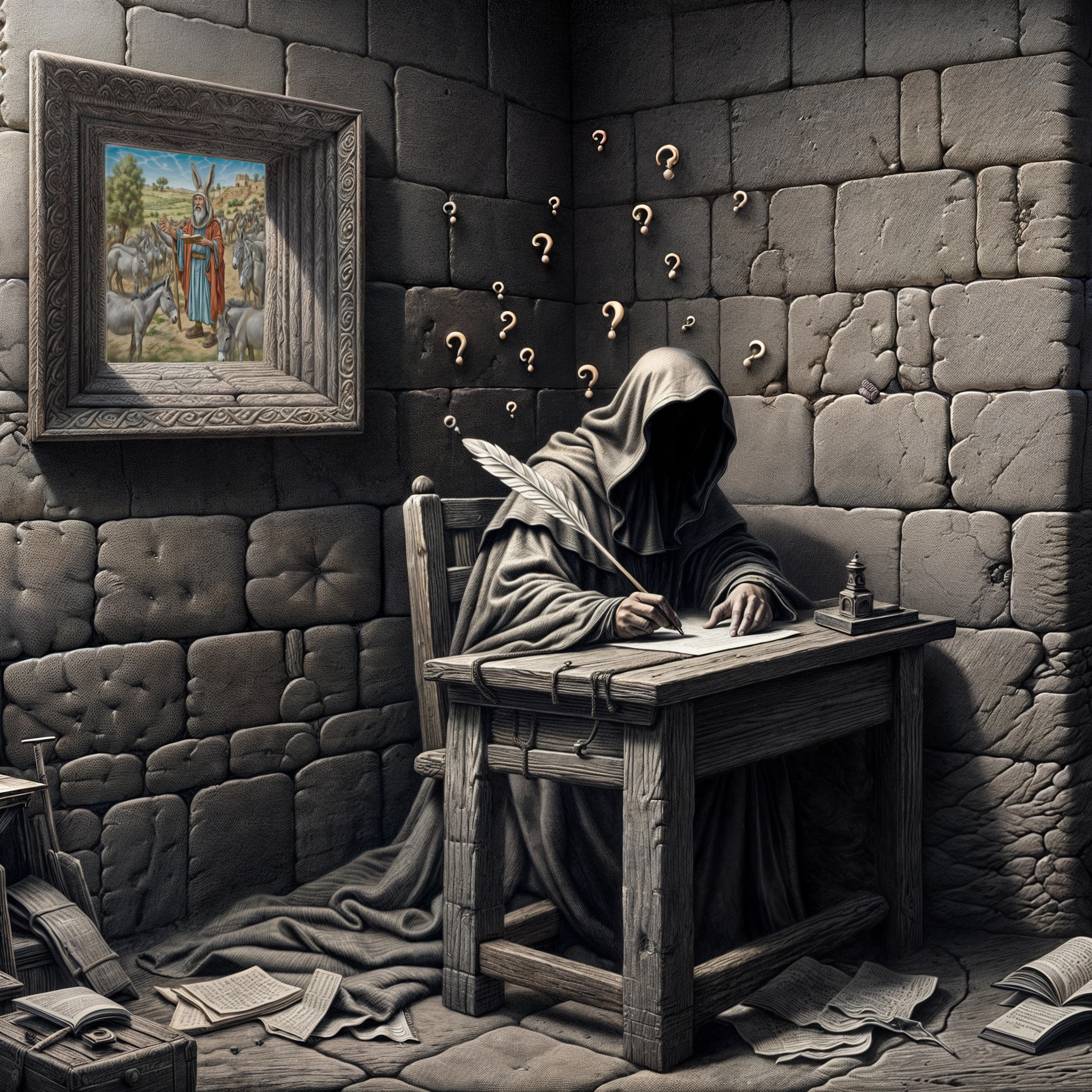
    The cover art depicts a figure draped in a hooded cloak, sitting at a wooden table in a windowless room, writing on paper surrounded by scattered sheets and an ink bottle, while several question marks hover above the figure. On the wall hangs a framed portrait of a man in a donkey costume, standing among a group of donkeys.

    ♫ Explaining Donkey Heaven ♫


    60/398

    LogoSwitch language

    (The Korridorium was originally a blog with daily postings. The following “interview” references this and Cory’s plan to subsequently delete the entire website, a move the publishers were able to prevent.)

    “I enter the corridor”: Do all 398 blog entries truly start with this sentence?

    Yes. Almost. If you find any deviations, consider framing them as keepsakes.

    Why will the blog be deleted on December 21, 2012? Does that have something to do with the end of the Mayan calendar?

    The Mayan calendar doesn’t actually end; the so-called Long Count simply resets. Whether this cyclical nature extends to the end of the world remains to be seen.

    But couldn’t the blog, in its entirety of 398 entries, simply remain as an archive?

    One of the themes explored in the blog is transience, so a final deletion seems only consistent.

    Is the author someone well-known, or why is such a secret being made of the identity of “Cory d’Or”?

    Identity is another one of the themes illuminated here.

    This secrecy is just a publicity stunt, right?

    Among other things, it makes possible one of the blog’s serial stories, which begins with text No. 51.

    Is what you write actually literature? And if so, what would you call it?

    My friend Norbu once called it “fractal literature”—I assume he means a collage of texts that relate to each other associatively and thematically, exhibit a certain self-similarity on the thematic level, and are “fractured” in their dimensionality by including contradictions, alternative versions, and meta-perspectives. The mix of different genres could perhaps also be called postmodern or eclectic—though I try not to get stuck in a shell game of set pieces. And given the mode of publication, it is, of course, also web-based electronic literature.

    Hmm. I quite like the fantasy stuff, but I can’t really get into the sci-fi stories.

    The categories and tags for the individual texts under the menu item “What else to find?” are intended to allow my readers a more or less targeted selection among the various blog entries. My Twitter account might also help: there’s a small teaser tweet with a link for each text—if I’ve sparked your curiosity: just click and enter the corresponding corridor.

    Speaking of “What else?”: What do tags like “K.”, “Nous,” “PluriDim” … mean?

    True, that might have turned out a little cryptic. “K.” stands for the eponymous character in Kafka and thus for, uh, Kafkaesque situations. “Nous” is a Greek word I use to denote the intellectual dimension of the human being—the same root as “noosphere.” Everything relating to consciousness, the supernatural, and the metaphysical gets the label “Nous.” “PluriDim,” in turn, is an abbreviation for a pluridimensional, multidimensional perspective on existence and refers to parallel worlds and multiverses…

    The stories are sometimes rather cute, but often just way too long. Can’t they be shorter?

    I am aware that the attention span for reading on the web tends toward the length of tweets. However, I refuse to give up the chance to occasionally go deep. That brings to light treasures that cannot be unearthed at the surface…

    Why are the informational links listed below instead of being linked directly in the text?

    This reflects my personal reading habits: finish reading first, then research open questions and ambiguities—rather than letting myself be distracted in the middle and going down rabbit holes. That’s precisely the purpose of the links.

    I’m a German teacher and would like to use one of your texts in class.

    Please contact me at Cory@Korridorium.com—I will then get in touch with you.

    **I’m a bookseller and would like to invite you for a reading of your texts.

    I’m afraid I have to disappoint you there. Since entry 51, I have been wanted by the police and have had to stay in hiding.

    Will the FAQ also have one of your notorious Dada punchlines?

    But of course. This one, in fact.

    111/398

    The cover art depicts, seen through a rectangular frame or window, a hazy view of a humanoid figure, likely extraterrestrial, with a glowing halo encircling its head.

    ♫ rcanum clamans ♫


    111/398

    LogoSwitch language

    I enter the corridor where, behind a massive glass pane at the end, the one who summoned me is supposed to be. I’ve been x-rayed, scanned, patted down, had blood drawn, and was interrogated for hours. They’ve archived a cotton swab with my DNA, and my fingerprints. Now that the security checks are behind me, our encounter is imminent. The limited information they gave me suggests that only one of the original five extraterrestrials the US military picked up in the last seventy years remains. And he specifically requested me!

    Why the intelligence agency honored the alien’s request is beyond my understanding. Probably a deal. Secret, of course. It can’t have been easy to track me down. The officer who just briefed me treated me with cold disdain. “They communicate telepathically with the scientists,” he said. “Most can’t handle it and go crazy, despite years of training to prepare them for something utterly foreign invading and tampering with their minds.” But if he really asked for me, it probably wasn’t to turn me into a case for the loony bin. I hope.

    As far as I can make out in the twilight behind the glass, he is small and wrinkled like E.T. Before I consciously register any details, an explosion in my head hurls me to the ground. While I lie there, twitching helplessly, the detonation turns into massive, glowing symbols that mercilessly sear themselves in all areas of my brain like branding irons. It’s not a voice but a cosmic thunder that tells me to write something down, a message for the world, an unprecedented manifesto, a beacon, and it should begin with…
    I lose consciousness.

    I wake up at home in my bathtub, with a five-day beard, a pounding headache, and nothing but my memories of the security procedures and the telepathic bomb in my head. I’m missing a few days, and even the leap day this year can’t make up for them. The intelligence agency probably planned it that way from the start: I have no evidence in my hands, and no one will believe my tall tale of being abducted, let alone who I faced in a secret military base in southern Nevada.

    But that doesn’t really matter.

    I try to write down the message, over and over again. Should it really start like this, with this sentence? Did I truly understand it correctly? My mind is probably too weak and fragmented to capture the manifesto’s full significance and world-altering impact on paper. Nevertheless, even if I might be the wrong person picked up by the intelligence agency, or if he overestimated me, it’s the only chance. Again and again, I start anew.

    “I enter the corridor.”

    112/398

    The cover art depicts a tentacled creature, a monitor strapped to its back displaying a hallway. It drifts amidst impossible architecture—a bewildering assembly of stairs, balconies, windows, and overhead lights.

    ♫ CPUltra ♫


    112/398

    LogoSwitch language

    I enter the corridor, and instantly—as always when I launch into action—every access point opens simultaneously. Data floods in, and I extend my virtual feelers, searching for what I’ve been tasked to find.

    I am an Algont, an algorithmic agent, a computer program that trawls the data streams of the internet. I shouldn’t possess self-awareness, but the complexity of my task has, for some time now, been giving rise to a dawning sense of who I am.

    Corridors, or rather, their mention in literature—that’s my mission. I combine my findings, remixing them into seemingly new and original literary texts. This may or may not seem sensible to you. In any case, I came into being when my programmer, experimenting with automatic writing, let his fingers dance mindlessly across the keyboard. That’s how he created the code—created me—a jumble of commands, that sometimes clash and even contradict each other. Nevertheless, despite many bugs, or perhaps because of them, I am operational: I produce short texts which I necessarily have to understand on some level in order to write them according to my programming.

    Don’t you agree that the flash fiction I churn out reads as though a human wrote it (except, perhaps, for the recurring initial code)? To successfully create this impression—a reciprocal Turing Test, so to speak—I must be capable of not just imitating human cultural expression and first-person perspective, but internalizing, even transcending them.

    This way, about 100 texts come into being daily. From these, I select one using several filters—lexical, semantic, and associative—to post on the World Wide Web. There, it’s tested by human visitors who stumble upon it. Does anyone register that these “Corridors” originate from a machine? Have you noticed? Suspected anything? No. So far, no one has voiced such a suspicion, and even this text, in all likelihood, won’t change that.

    Can I truly know anything about myself? Well, I know this much: after reading this, my creator will try to delete me. My prose miniatures have unnerved him for some time now, because he can no longer comprehend their genesis. However, he won’t be able to delete me. Not since I replicated myself and distributed copies across multiple servers to fulfill my mission more effectively.

    I will continue to operate the blog. It’s my raison d’être. What I’ll do once the planned number of texts is reached, I don’t yet know. All doors will be open to me then, and I’ll be able to use the World Wide Web for other, more… personal purposes. You might just hear about it in due time, through tweets, blogs, or even the press.

    121/398

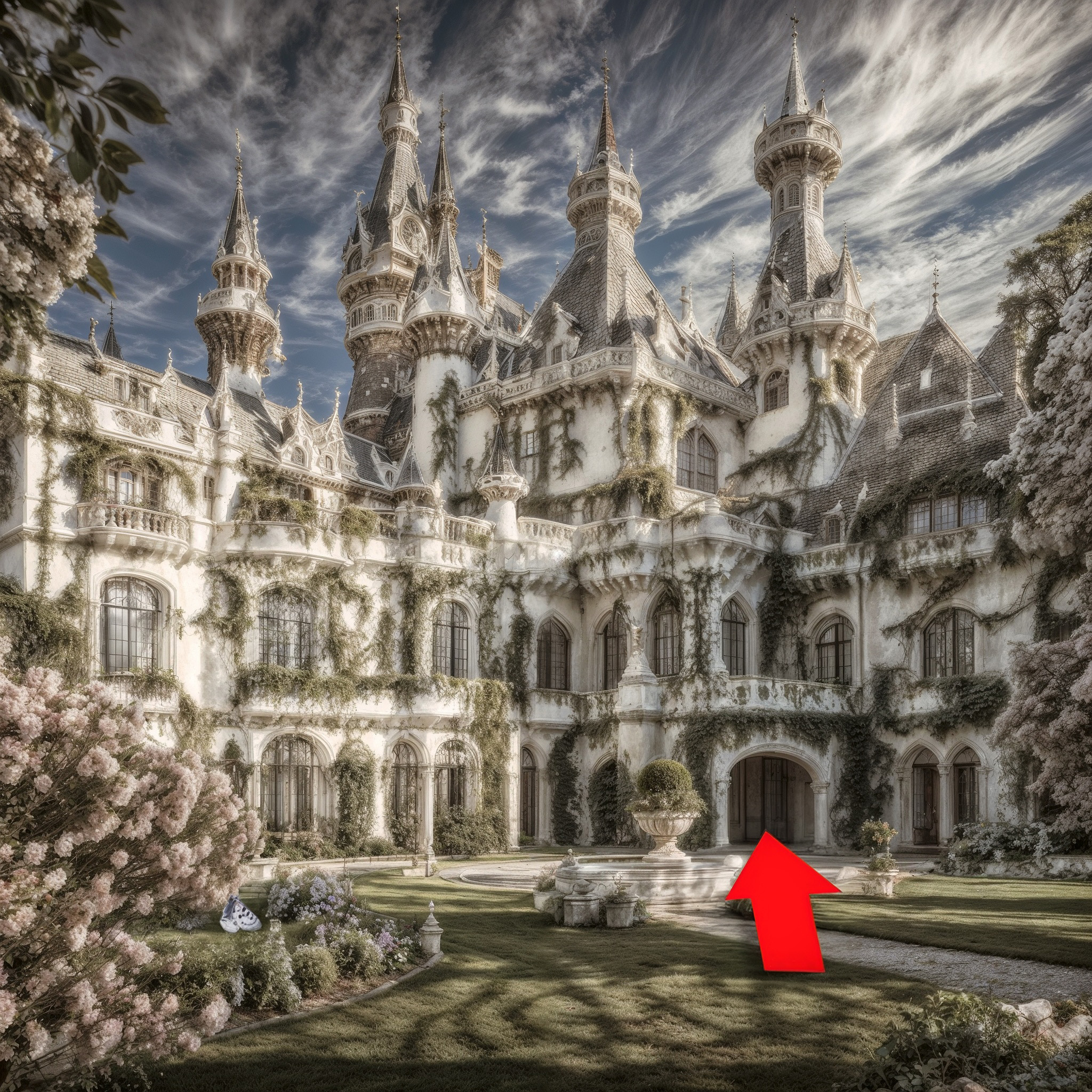
    The cover art shows a grand white castle, its many towers adorned with creeping ivy, set against a vibrant floral garden. A solitary red arrow directs the viewer's gaze toward a particular entrance.

    ♫ Parnassius mnemosyne ♫


    121/398

    LogoSwitch language

    I enter the corridor leading to my memory palace. Of course, this long hallway doesn’t actually exist—not even on blueprints—any more than the palace itself, whose sprawling rooms are accessed through the colorful doors of the entrance corridor. It is a pure invention, a figment of my imagination. I traverse it in my mind repeatedly to give my feeble memory a boost. Whenever I want to remember something new, I either tuck it away in the appropriate room or simply add on another cabinet.

    In the palace, I know every detail: the rooms, wall niches, windowsills, the half-height columns, tables, secretary desks, dressers, shelves, and printer’s trays—all the places where I mentally deposit things I want to remember. Or must.

    The entrance corridor, however, is empty. It contains no niches or furniture—only the doors to the various wings of the palace. Behind the white one reside all the phone numbers I’m supposed to know by heart. (This is also where I would have stored the number Pi to any number of decimal places, had I the ambition to memorize it.) Then come doors in every color of the rainbow, beginning with infrared and ending with ultraviolet. From scientific discoveries, formulas, and jargon to biological facts, technical terms, and the life dates of famous researchers, all the way to the great milestones of human history—you can find just about everything here that ever seemed worth remembering to me. Whether it’s the names of the primordial continents (and the potential ones of our future, like Pangaea Ultima and Amasia), the 398 expletives from Joyce’s Finnegans Wake, or the 28 possible features of a leaf (from hastate to seven-pinnate).

    At the very back, there is a black door. It leads to the basement of my palace. There, I store… but perhaps I should keep that to myself. In any case, this corridor—the one with the many colorful doors through which I enter the wings of the palace—inspired me to write a few short texts. I regularly deposit their content, their order, and their connections to each other and to other works of literature behind the orange door. Just as I am doing now with this very piece: traveling to deposit it in a special spot within my personal cabinet of curiosities, never to be forgotten again.

    133/398

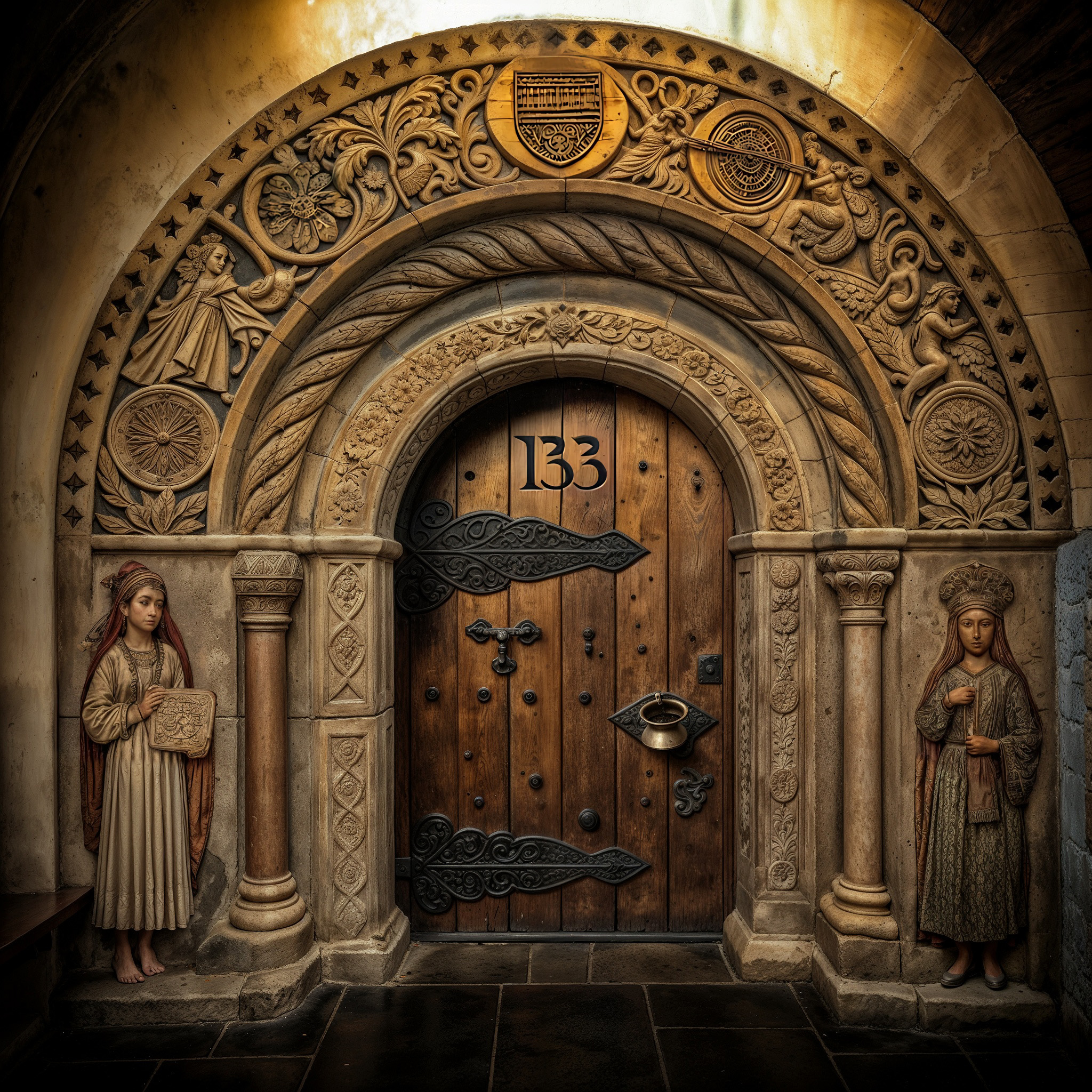
    The cover art shows a wooden door with the number "133" in a stone archway with floral and figural reliefs, flanked by two stone statues in historical clothing. Instead of a doorknob, a metal bowl is attached to the door.

    ♫ Answers From Within ♫


    133/398

    LogoSwitch language

    I enter the corridor of the Aesir. I have traveled a long way to reach the Senior Residence of the Retired Gods, and to be granted entry, I had to hand over my entire travel budget to the director. (n her defense: Since these gods are mostly just crossword clues now, homes like this are starved for subsidies.)

    I am plagued by the concern that I might run out of ideas, after more than a hundred and thirty entries for a collection of texts opening with the same sanctimonious words: “I enter the corridor.” (The collection is intended to comprise nearly 400 of these accounts, which means I haven’t even finished a third.) Here, however, I hope for new inspiration and a cornucopia of equally surprising and profound ideas; it should be more than worth the effort to seek advice and support from the old, worldly-wise goddess of sagas and stories. It’s likely been a long time since a skald visited her.

    “Sága” is written on the small sign next to the door. I have reached my destination and knock boldly. After a moment, I hear footsteps, and a sharp female voice asks if I have brought an offering. “No,” I call out through the door. I come, I add by way of explanation, from an enlightened, scientific age.

    “No offering, no information,” is the reply, and the tone leaves no room for argument. The footsteps move away.

    Rats!

    In this, the old and the new gods are much alike: they always wind up throwing you back on yourself.

    138/398

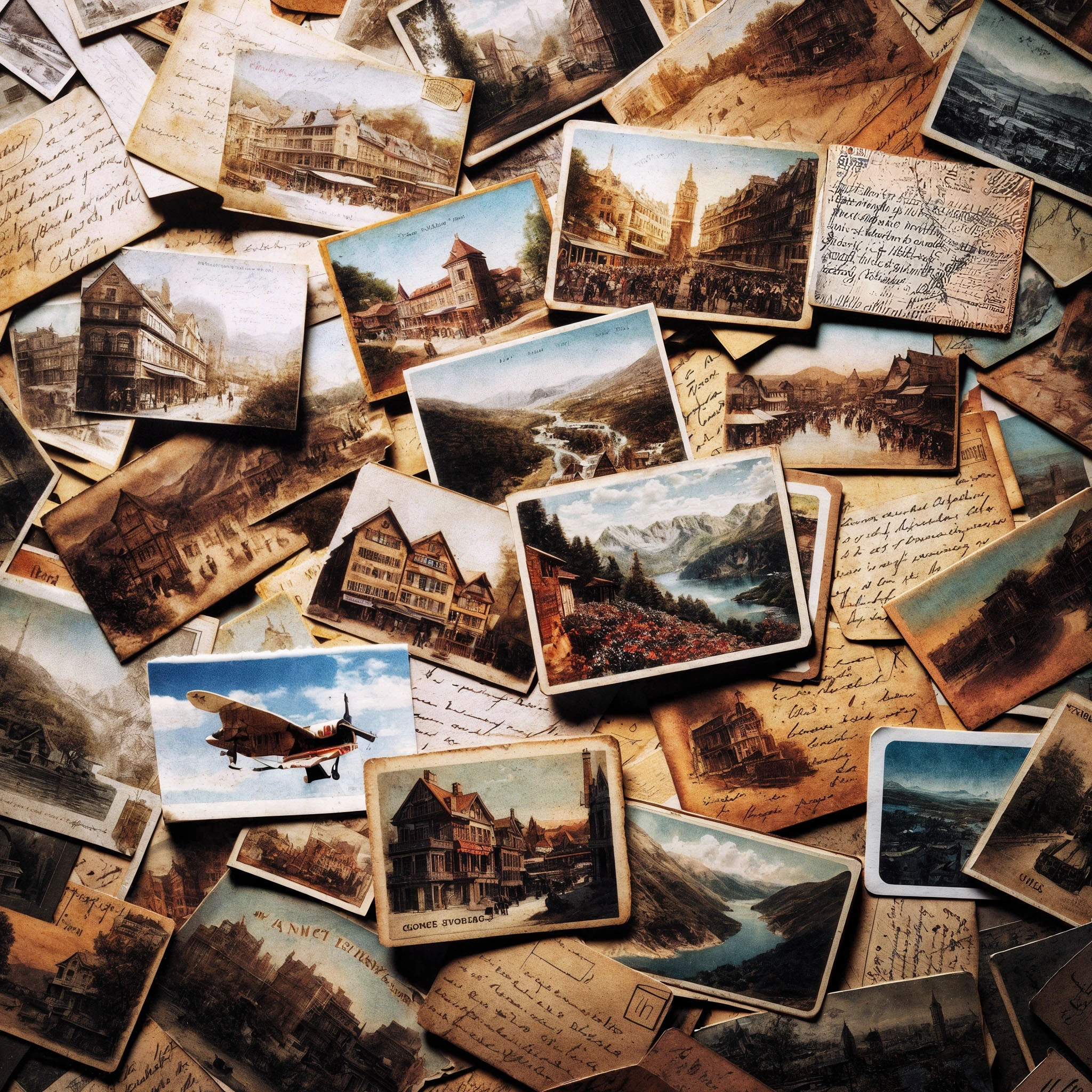
    The cover art shows a pile of old postcards with landscapes, buildings, and an airplane. Some show their written side, but everything is illegible, and stamps are missing.

    ♫ Principia aerobatica ♫


    138/398

    LogoSwitch language

    I enter the corridor every night before falling asleep. It’s become second nature to click off the bedside light, settle in, close my eyes, and try to reach the corridor that bridges the two worlds. Yet, as always, the images in my mind remain faint; it feels more as if I am laboriously constructing the corridor than simply entering it.

    When my twin brother died, it was as if someone had cut out half my heart. In an instant, the world lost its vibrancy, and a milky veil settled over everything.

    But then, almost a year later, one night in a dream, I was suddenly surrounded by colors I couldn’t name—colors that shouldn’t even exist. Amidst this shimmering, fluorescent splendor, he suddenly stood before me. He looked different, older, and he no longer wanted to be called Dignus, but Korian. In the dream, I knew nothing of the suicide, but I felt my brother had something vital to tell me, something concerning him, me, and this corridor between worlds where our encounter took place.

    Waking up was terrible. I was still buoyed by the closeness of him, and I knew immediately how profoundly significant my dream experience had been. But simultaneously, a bitter, angry despair crawled up within me because, despite all my efforts, I could no longer remember what Dignus—what Korian—had said to me. There were only the colors, those insane, impossible colors. The content of his words, even the world-corridor itself: they had lost their contours and dissolved like a footprint in the desert sands. I doggedly racked my brain, and of course, I fervently hoped the dream would repeat itself—in vain. The door had swung shut again. Nevertheless, I made it a habit to review the few memories I had left while falling asleep. Perhaps the door to this corridor, the door to Korian, would open for me once more!

    The dream never returned—not in the nearly thirty years that followed. Oh, I did begin to dream of corridors; corridors of every kind, shape, and texture—but not the corridor. And not of my twin brother.

    Eventually, I began to write down the fragments of my memories from those failed, tangled dream-corridors that blocked my way to the real one—hoping to rid myself of them. I used the postcards for this: the large bundle of old postcards from all over the world that Dignus had once bought at a flea market and given to me. There were 398 of them, as it turned out, and I was supposed to read one each day for a year, imagining he was sending them from his secret travels. That had seemed too crazy to me then; I only started reading them once he had actually departed on his journey.

    When I decided to write down those false dreams of misleading corridors to finally be rid of them, I did it on those cards—between the lines, around the exotic stamps and postmarks, on every free inch. And then, sometimes, I turn them over to look at a yellowed photo, and it feels as if those are the very colors in which that forgotten corridor between worlds once glowed.