45/398
♫ The Trailblazer’s Red-Letter Day ♫
45/398

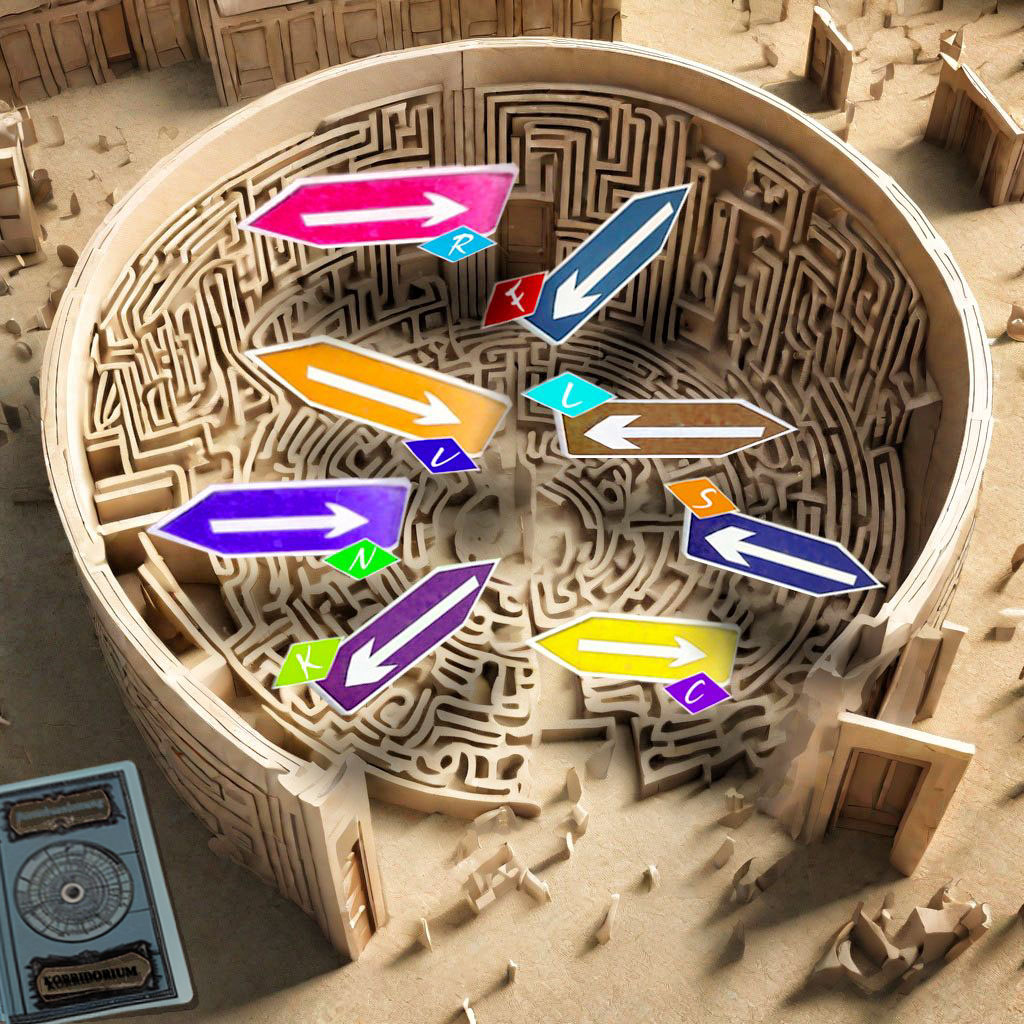
“I enter the corridor”—today, as a visitor to the Korridorium, you can say that with total confidence. This time, friendly hostesses approach you to lead you to one of the many doors. Behind them, more corridors await—and more doors—but those you’ll have to push open yourself.
Another visitor has entered with you: a man in a suit, clutching a briefcase and looking a bit dazed. “I have no idea what I’m even doing here!” he tells you. A banner hangs above three bistro tables where the hostesses wait; it reads: “What else to find?“ One of them is already attending to the man. “Yes, it’s quite easy to get lost here,” she says. “If you’re looking for something specific and don’t have much time, you should head through that narrow door up front.” You notice it’s labeled “Vignette.” “Or here”—the friendly young lady points out a tiny, almost miniature door labeled “Fract“—”for the very short attention span. Some pieces are no longer than a tweet—140 characters or less,” she continues.
“I’m interested in constellations,” says the man with the briefcase, straightening his glasses.
“Then this might be the right door for you.” The man frowns at the sign: “Lists.” Yet, it seems to suit him; he shrugs, gives the lady a brief, thankful nod, and decisively turns the handle.
In the meantime, another hostess has noticed you. “How can I help you today?” she asks with a smile.
“Are there stories here with plots and characters? You know, actual short stories?”
“Oh, yes,” the hostess responds, gesturing toward a glass door labeled “Story“ and the three behind it: “Classic,” “Fantasy,” and “Sci-Fi.”
“What about classic fantasy?” you ask, furrowing your brow.
“Oh, yes—that could be misleading, right,” the young lady says. “All short stories without magic and futuristic elements, without bells and whistles, so to speak—that’s what ‘classic’ stands for here.”
She starts to explain how difficult it was to find the right keywords, but you get distracted. A visitor carrying—strangely enough—an open umbrella printed with the words “(B)right as rain,” is asking a hostess for “spiritual texts.” She is directed toward the doors labeled “Nous“ and “Kōan.” “Nous” covers everything involving consciousness, she’s told, while “Kōan” represents Eastern wisdom in the broadest sense. “And what about, uh… love stories?” the woman asks softly, as if she’s a little embarrassed. There is a door for that too, further down the hall. Unsurprisingly, it’s labeled “Romance.”
Before you can turn back to your own hostess, a boy in a hoodie rolls in on a skateboard. He shoots a disdainful look at the corridor from under his hood. A hostess is on him in an instant. “Cory?” he asks. The hostess shakes her head, smiling. “But you might find the answer behind this door.” She points to one labeled “Cory?“ and then indicates the one next to it: “Meta.” “You might find more clues there. In any case, that’s where all the explanations about the Korridorium itself are kept.”
This gives you an idea. You ask the helpful young lady about stories involving parallel worlds—you’ve heard they are a recurring theme here.
“Oh, yes,” your hostess smiles, “there’s a door for those, too. Please, follow me.” The door in question, labeled “PluriDim,” is at the very end of the corridor. “I’m told it stands for ‘Pluridimensional’—multi-dimensional perspectives.”
Intrigued, you read the sign on the door next to it: “Paraphernalia“?
“Oh, yes,” the young lady nods. “That’s where we put everything that didn’t fit anywhere else—even things too strange for ‘Kafkaesque’ or ‘Surrealist.'” She points to the door directly across from “Paraphernalia.” “Kafka,” she says, “is simply ‘K.’—but due to space constraints, he’s been grouped with Surrealism.” The door reads: “K. / Dada.”
Better not subject myself to that, you think, masking the thought with a polite smile. “But what if I’m specifically looking for things involving labyrinths and the Minotaur?”
“Oh, yes,” the hostess says eagerly. “I should have realized. I saw the horns, of course, and knew immediately what a distinguished guest we had today.”
You snort a bit through your nostrils; people usually expect that sort of thing from you. Although you meant it to be friendly, the hostess takes a cautious step back.
“Here,” she says, sounding slightly intimidated. “This would be the door of your choice.” It bears the label: “Myth.”
“But that can also mean a lie—as in, ‘Oh, that’s just a myth!'” you point out critically.
“Oh, yes,” the hostess says, swallowing hard. “But it’s certainly not used in that sense here.”
“Well, I should hope not!” you retort, and swing the door open.