Korridorium

A daily dose of corridors in prose

Tag: meme

28/398

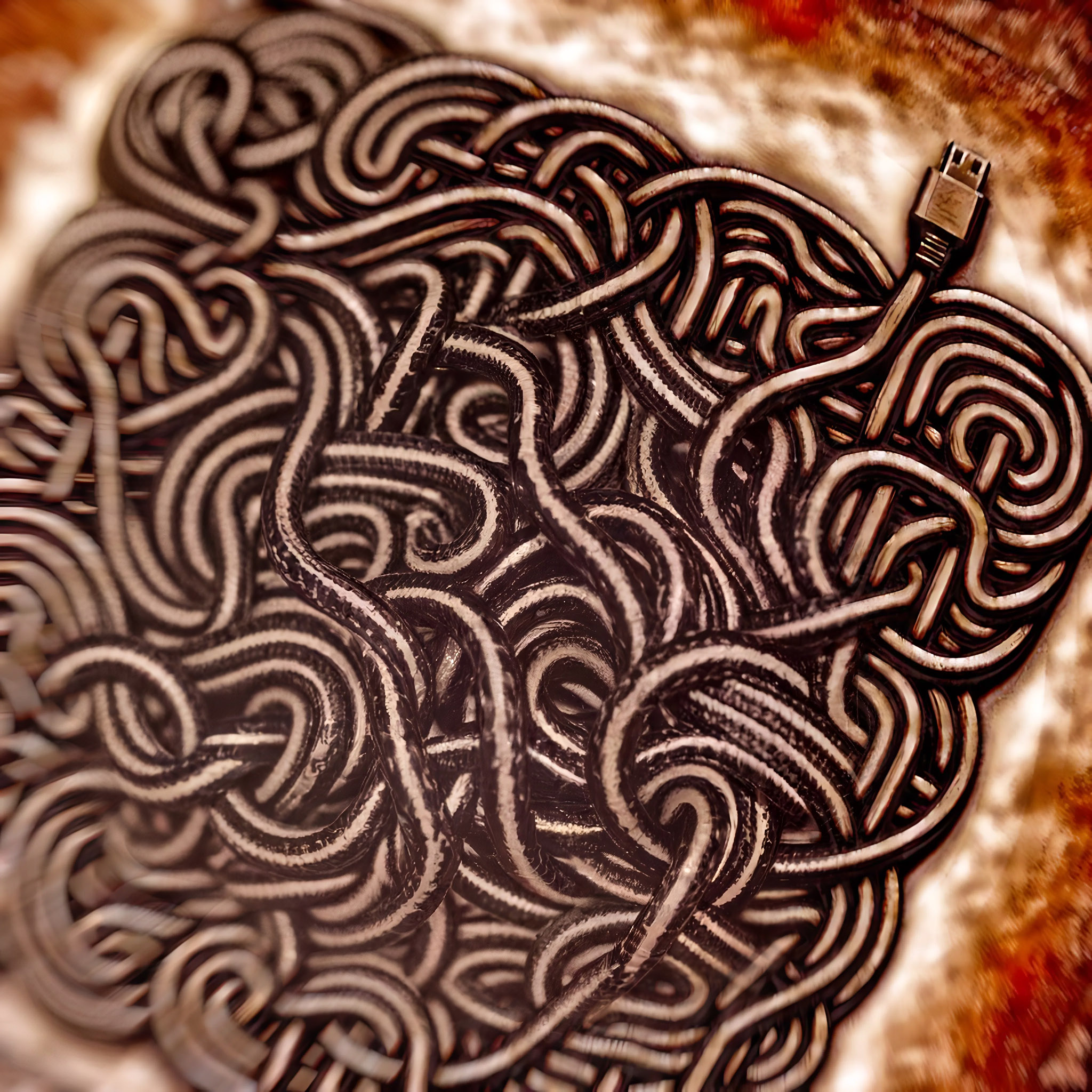
The cover art depicts a tangle of black cables, a USB plug peeking out from the right side against a pale backdrop.

♫ Infinity Shuffle ♫


28/398

LogoSwitch language

I enter the corridor and immediately jot it down in my journal: “I enter the corridor.” Since I started using a tablet instead of a notebook and pen, I can record what I do and experience—how I spend my day—much more directly and in real-time. I can also share everything important as a tweet right away. Before going to sleep, I can retrace my daily routine on my Twitter account, divided into small fragments.

What did I come in here for? Oh, right, I’m looking for the tablet’s charging cable. It says so right here: “I’ve misplaced the tablet charger. Maybe it’s in the kitchen.” I can’t find it anywhere in the kitchen. “But in the kitchen, I can’t find it…” But now the tablet makes a strange electronic noise, dropping in pitch, like a disappointed “Oohch.” I’d love to note and tweet that, since I’m hearing it for the first time and it obviously needs to be documented, but now the thing won’t accept input on the virtual keyboard; instead, it saves the text as a last-resort emergency measure and shuts down.

What now?! How am I supposed to write this down? In the kitchen, there’s a roll of paper towels, and in a drawer, I find a pen next to some tealights. I need to record all of this! But the pen won’t write on the paper towel. I lick it, shake it, the whole nine yards, but it just won’t work. All of this is at risk of being lost because I can’t write it down. My eyes fall on the cutting board. Could I carve something into it with a knife? At least some keywords? So much has happened already. Prepping paper towels, licking the pen, considering the cutting board… How am I supposed to remember all of this? And on top of that, trying to memorize the act of memorizing! I need to find that cable; that much is clear. All my thoughts, the excitement, my actions—just when things are finally getting dramatic and life is really popping off, I can’t write it down, let alone tweet it!

I finally discover the charger while searching for a pen and paper in the bedroom, plugged into the outlet by the nightstand. With fingers already trembling slightly, I plug it in, and the tablet comes back to life.

I type as fast as I can to catch up with my life again.
29/398

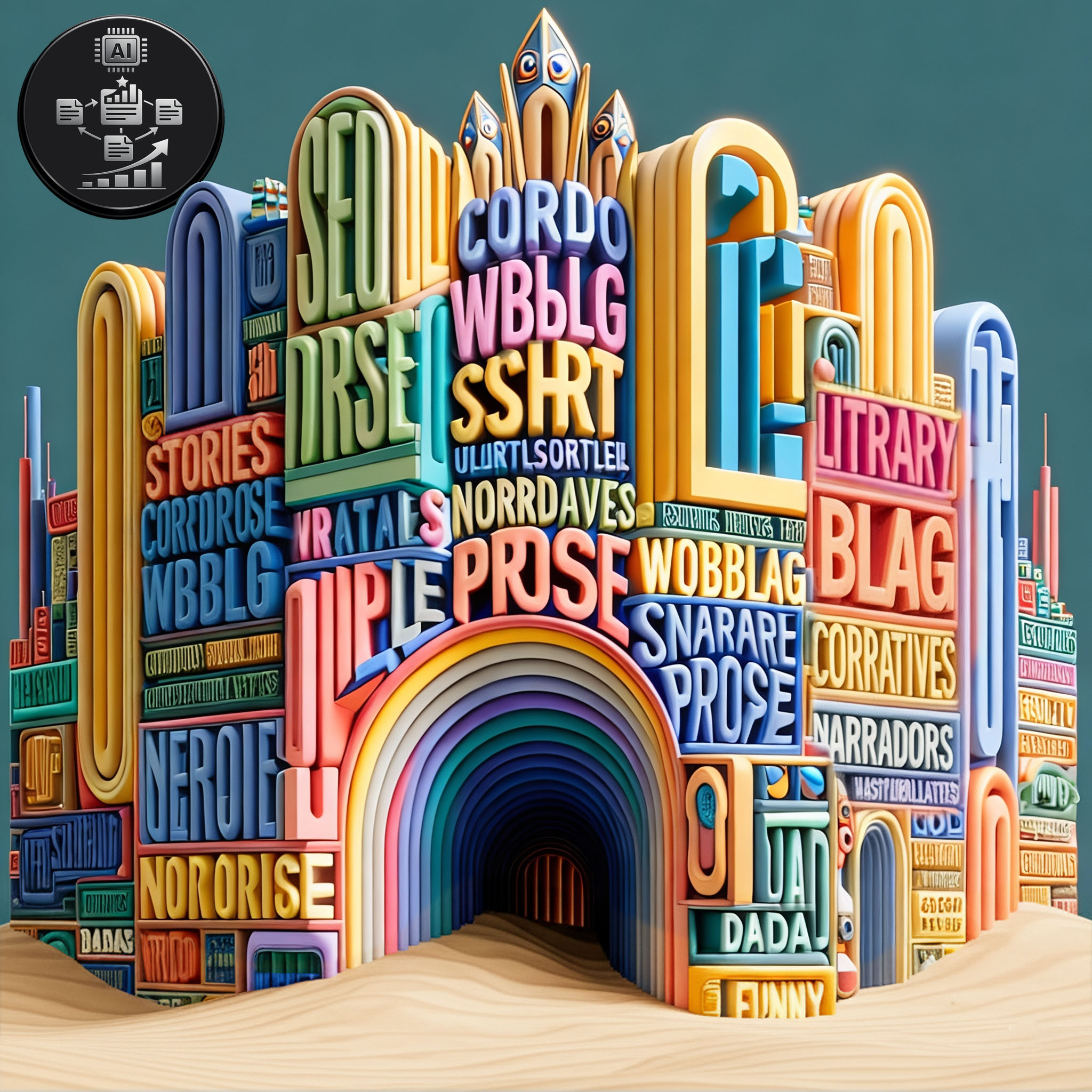
The cover art depicts vibrant, architecturally sculpted letters and words, weaving into an intricate, arched formation with a central dark tunnel, all set against a sandy foundation. In the top-left corner: a digital button adorned with an AI chip icon and business charts.

♫ GameLAN-Party ♫


29/398

LogoSwitch language

I enter the corridor—the one designed to boost my short prose blog’s Google ranking, plunging right into a search engine-optimized, or SEO, copy. This text aims not so much at its readers but primarily at Google’s search ranking algorithm, seeking to feign being informative by focusing on crucial keywords like “corridor” and “short prose.” In reality, its sole purpose is to repeatedly and subtly insert and vary the search-relevant keywords (such as “short prose” and “corridor“) throughout its content. The goal is to trick Google and its mystery-shrouded ranking algorithm into believing it’s a vital contribution to the field (e.g., corridor short prose or short prose corridors), thus earning a high PageRank and a coveted spot at the top of Google’s search results.

However, we mustn’t succumb to a narrow corridor or tunnel vision: Attention-grabbing websites shouldn’t overdo the “corridor” keyword in their text, and definitely shouldn’t resort to repeating key phrases (e.g., “short prose, shortest prose, ultra-short prose“) in white text on a white background at the bottom of the page ad nauseam. This is no longer even considered advertising poetry or prose but simply shortsighted, because Google now penalizes that with devaluation and relegation to the lower, forgotten reaches of its search results corridor.

In short: “Prose” of this kind is counterproductive and plays into the hands of the competition. In other words, the corridor is long, the prose short. Or, to put it even more blandly: Here you will find what you’re looking for and can finally follow your destiny (of which you probably had no inkling) and enter the short prose Korridorium.

43/398

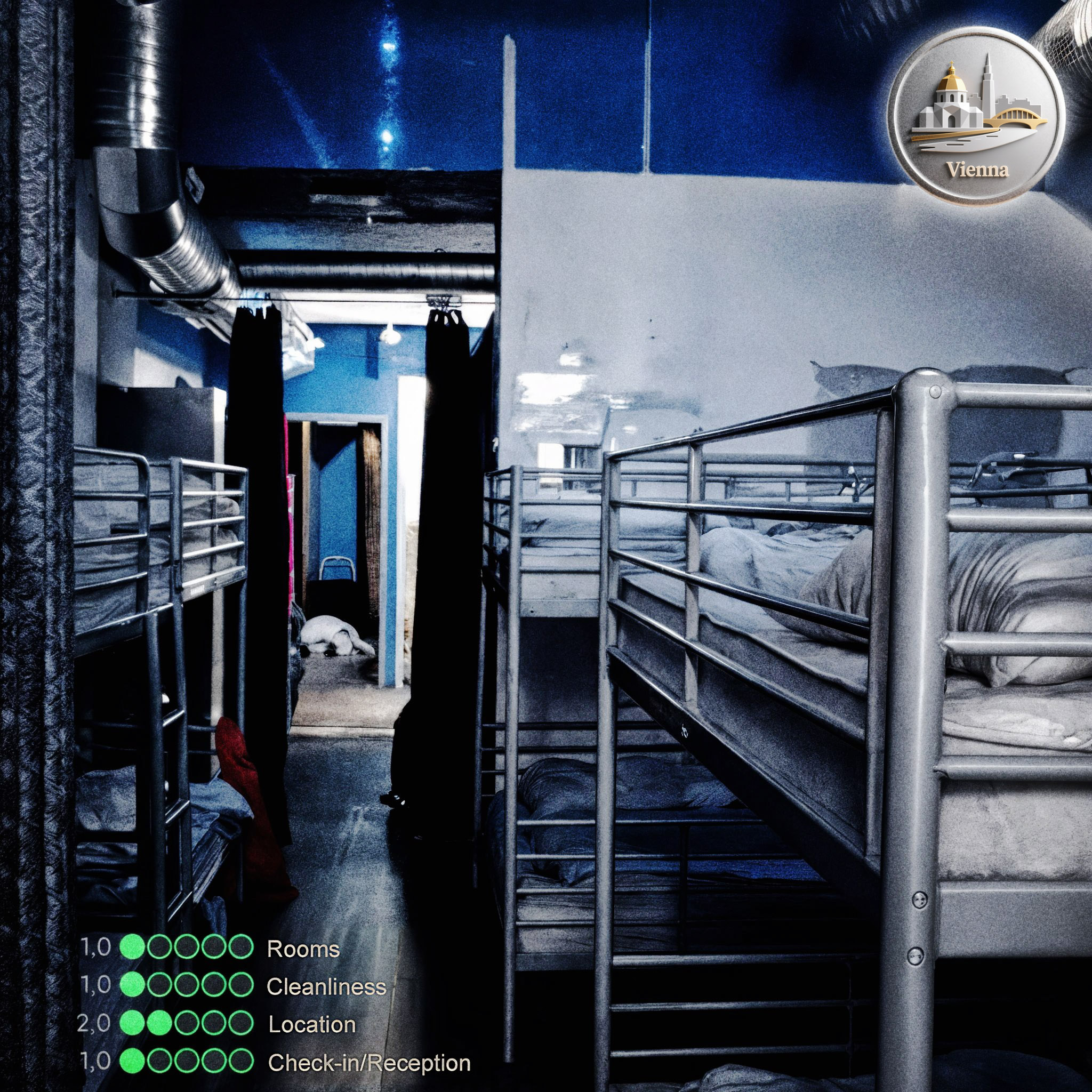
The cover art depicts a hostel dorm furnished with metal bunk beds. A digital badge highlights a "Vienna" scene. Meanwhile, a review snippet flags poor marks for "Rooms," "Cleanliness," and similar categories.

♫ Sneak Peak ♫


43/398

LogoSwitch language

“I enter the corridor hostel at about midnite. If not for the late night, we would have moved to another hostel right away. The hostel is very run down (feeling of eerie) and luckily tow guys who happened to stay there came to help us with the luggage. And worst, we could not even found our room no! And when I went to use the bathroom, the doorknob dropped off and I was nearly locked inside.”

1 out of 5 stars Rooms
1 out of 5 stars Cleanliness
2 out of 5 stars Location
1 out of 5 stars Check-in/Reception

This guest review of Hotel “Blue Corridor Hostel” at Siebensterngasse 15, Vienna, Austria was helpful / unhelpful to you (currently disabled).

Enable/disable automatic translation (currently enabled).

58/398

The cover art depicts a green padlock without a key in its packaging, printed with the texts 'THE EMP PRO/TEC', 'INTERNET-SECURE', 'FOOLPROOF', and 'The doydoor padluck'. The lock itself is printed with binary code.

♫ Wicked Leaks (It’s easy / it’s not!) ♫


58/398

LogoSwitch language

* ***** *** *********

  • Password check via pc112.eu: “Your password ‘I enter the corridor.’ is insecure!”«
  • Via PasswordChecks.com: “Medium! It will take about 8 months and 6 days for a computer to crack your password ‘I enter the corridor.’!”
  • DNSchecker.org: “Strong“
  • The Passwordmeter: »Score: 100%, Complexity: Very Strong«
  • Security.org: “It would take longer to crack your password ‘I enter the corridor.’ than the universe has existed. This should be sufficiently secure for any attack. It would take a computer about 500,000,000,000,000,000,000 years to crack your password.”
  • 60/398

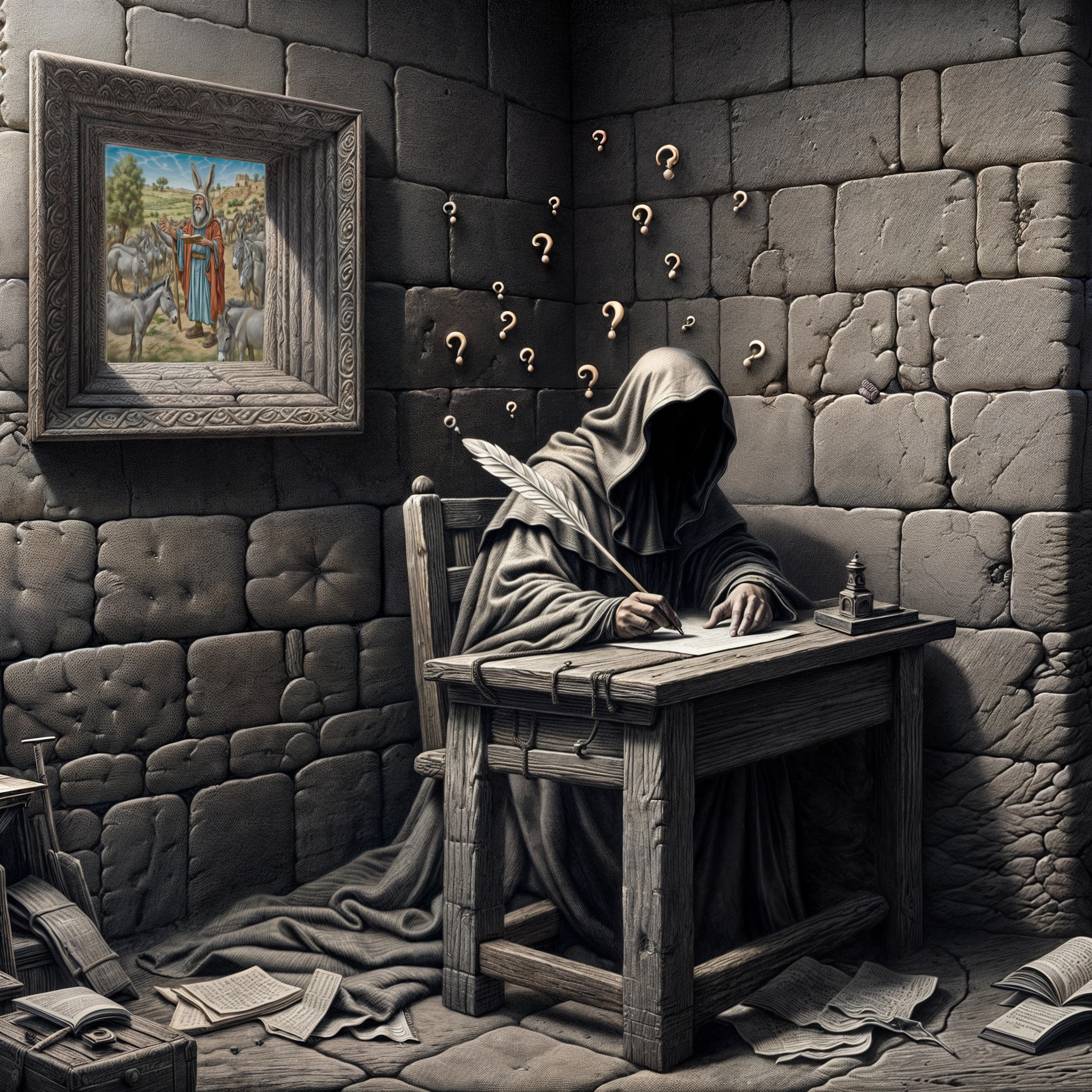
    The cover art depicts a figure draped in a hooded cloak, sitting at a wooden table in a windowless room, writing on paper surrounded by scattered sheets and an ink bottle, while several question marks hover above the figure. On the wall hangs a framed portrait of a man in a donkey costume, standing among a group of donkeys.

    ♫ Explaining Donkey Heaven ♫


    60/398

    LogoSwitch language

    (The Korridorium was originally a blog with daily postings. The following “interview” references this and Cory’s plan to subsequently delete the entire website, a move the publishers were able to prevent.)

    “I enter the corridor”: Do all 398 blog entries truly start with this sentence?

    Yes. Almost. If you find any deviations, consider framing them as keepsakes.

    Why will the blog be deleted on December 21, 2012? Does that have something to do with the end of the Mayan calendar?

    The Mayan calendar doesn’t actually end; the so-called Long Count simply resets. Whether this cyclical nature extends to the end of the world remains to be seen.

    But couldn’t the blog, in its entirety of 398 entries, simply remain as an archive?

    One of the themes explored in the blog is transience, so a final deletion seems only consistent.

    Is the author someone well-known, or why is such a secret being made of the identity of “Cory d’Or”?

    Identity is another one of the themes illuminated here.

    This secrecy is just a publicity stunt, right?

    Among other things, it makes possible one of the blog’s serial stories, which begins with text No. 51.

    Is what you write actually literature? And if so, what would you call it?

    My friend Norbu once called it “fractal literature”—I assume he means a collage of texts that relate to each other associatively and thematically, exhibit a certain self-similarity on the thematic level, and are “fractured” in their dimensionality by including contradictions, alternative versions, and meta-perspectives. The mix of different genres could perhaps also be called postmodern or eclectic—though I try not to get stuck in a shell game of set pieces. And given the mode of publication, it is, of course, also web-based electronic literature.

    Hmm. I quite like the fantasy stuff, but I can’t really get into the sci-fi stories.

    The categories and tags for the individual texts under the menu item “What else to find?” are intended to allow my readers a more or less targeted selection among the various blog entries. My Twitter account might also help: there’s a small teaser tweet with a link for each text—if I’ve sparked your curiosity: just click and enter the corresponding corridor.

    Speaking of “What else?”: What do tags like “K.”, “Nous,” “PluriDim” … mean?

    True, that might have turned out a little cryptic. “K.” stands for the eponymous character in Kafka and thus for, uh, Kafkaesque situations. “Nous” is a Greek word I use to denote the intellectual dimension of the human being—the same root as “noosphere.” Everything relating to consciousness, the supernatural, and the metaphysical gets the label “Nous.” “PluriDim,” in turn, is an abbreviation for a pluridimensional, multidimensional perspective on existence and refers to parallel worlds and multiverses…

    The stories are sometimes rather cute, but often just way too long. Can’t they be shorter?

    I am aware that the attention span for reading on the web tends toward the length of tweets. However, I refuse to give up the chance to occasionally go deep. That brings to light treasures that cannot be unearthed at the surface…

    Why are the informational links listed below instead of being linked directly in the text?

    This reflects my personal reading habits: finish reading first, then research open questions and ambiguities—rather than letting myself be distracted in the middle and going down rabbit holes. That’s precisely the purpose of the links.

    I’m a German teacher and would like to use one of your texts in class.

    Please contact me at Cory@Korridorium.com—I will then get in touch with you.

    **I’m a bookseller and would like to invite you for a reading of your texts.

    I’m afraid I have to disappoint you there. Since entry 51, I have been wanted by the police and have had to stay in hiding.

    Will the FAQ also have one of your notorious Dada punchlines?

    But of course. This one, in fact.

    67/398

    The cover art shows an adjustable operating table with a cardboard box on it, surrounded by surgical instruments placed on the floor and an operating light above.

    ♫ Joyrite ♫


    67/398

    LogoSwitch language

    I enter the corridor and, with a practiced hand, switch on the small video camera clipped to my headband. Of course, I start narrating right away—chattering is, after all, part of the trade. I open the apartment door, and the delivery guy—a new one, not the usual—immediately eyes the camera suspiciously. He’s puzzled that I seem to be happily talking to myself. Let him think I’m on a headset with a friend. What am I supposed to tell the man? That I’m making a striptease video? Because my specialty is: uncut unboxing videos. They start with the delivery—I’m currently scribbling my signature on the chunky delivery-service touchpad with the gray display that always seems too small for my name. And I only use one of my three first names at that.

    The door clicks shut behind me. I carry the package through the hallway to my “Peepshow Room,” scrutinizing it from all angles and providing a verbose commentary. Nothing should distract my viewers from the unveiling that awaits! That’s why I moved my bed to the living room a while ago and emptied the bedroom of everything except my large “operating table.” I set the package down here. My tools are already laid out to the side: scissors and a box cutter.

    Now, it’s time to dissect. If there’s an imprint or a logo on the box, I naturally bring that into the light first, before I strip the object of desire of its layers, one by one, and penetrate to the contents. The key is to keep talking to keep the viewers hooked.

    Finally, it lies exposed and seductively gleaming before me, a trendy lifestyle product, something from the category of brand new + slick design + early adopter appeal—whether it’s a smartphone, VR headset, or AI gadget. That’s what my video channel subscribers expect, I owe it to them, and that’s precisely what they get, uncut and with voice-over commentary. I free every item from its packaging, bring it into the light, showcase it from all angles, and share my thoughts. Is it sleek in design, does it fit the modern lifestyle, does it feel good in the hand, is it a must-have? My videos need to have that same appeal somehow. There seems to be a certain erotic charge in the unveiling and assessment of brand-new must-haves for some. The view counts speak for themselves.

    Finally, it lies exposed and seductively gleaming before me—a trendy lifestyle product, something from the category of brand new + killer design + early-adopter appeal—whether it’s a smartphone, an action cam, or high-end headphones. That’s what my subscribers expect; I owe it to them, and that’s exactly what they get: uncut and with voice-over commentary. I free every single item from its packaging, down to the batteries if there are any, bring them into the light, present them from all sides, and add my two cents. Is the design sexy? Does it fit the modern lifestyle? Does it feel good in the hand? Is it a must-have? My videos have to have that same appeal somehow. For some, there seems to be a certain erotica in the unveiling and assessment of brand-new “must-haves.” The view counts speak for themselves.

    From the comments, I know that for many, it’s simply the ultimate thrill: with the ring of the doorbell, an internet order materializes at the door. And if they can’t afford the hip new gear because their account is maxed out, my unboxing videos serve as a form of substitute gratification—or, of course, as inspiration for their next purchase.

    I can’t explain the high subscriber count and the enthusiastic comments any other way. Among the latter, as always on the internet, there’s plenty of nonsense—like the constant question of what I actually do with all these gadgets.

    The truth is, I can’t actually afford the consumer electronics and designer tech that arrives here two or three times a week. But that’s what online return policies are for. Once I’ve turned off the camera, I neatly pack everything back into the box, seal it with the brown tape I keep ready under the table, and send the device back to the retailer the very next day. It goes back without a single trace of use. By then, of course, the video has long since gone live.

    96/398

    The cover art features a square "xcoffee" window, set against a softly focused portrait of a man holding what appears to be a bouquet before a coffee maker.

    ♫ Tjotjog ♫


    96/398

    LogoSwitch language

    I enter the corridor, a bouquet of flowers in hand. I spend ten minutes waving them at the institute’s webcam (which is actually aimed at the coffee machine). The camera only broadcasts an image to the world six times an hour, and unfortunately, it doesn’t indicate when. But I’m determined to be in the shot. I start off smiling, but after just a few minutes, I feel like I’m merely wearing a grimace. (I cannot confirm that a forced smile is physiologically supposed to induce feelings of happiness.)

    Anyway, all that matters is that this way—two continents away—you receive my promised little Valentine’s greeting right on time.

    100/398

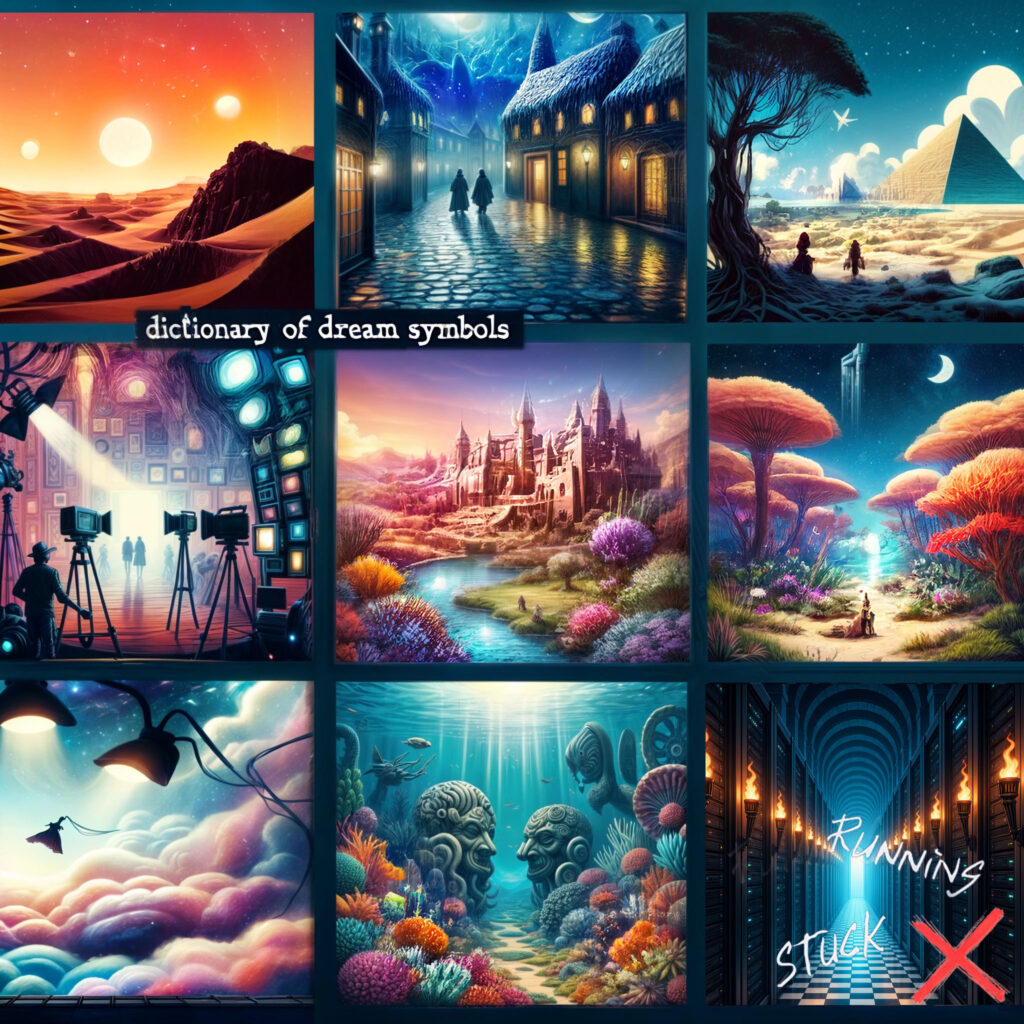
    The cover art shows nine square scenes with dream and fantasy motifs and the inscription "dictionary of dream symbols". Visible are: desert landscape with sun, snowy alley with two figures, pyramid landscape, film studio, fairytale castle on a river, forest with large mushrooms, sky with clouds and lamps, underwater world with two large statues, and a long corridor with the lettering 'RUNNING STUCK' and a red X.

    ♫ Heimkoma ♫


    100/398

    LogoSwitch language

    “I enter the corridor,” you write, dear S., “and although I run with all my might, I never reach the other end, though I long for it so much. What is this meant to tell me?”

    Dear S., we all know such dreams in which an unknown force prevents us from reaching our goals. A corridor could represent our life path, the side doors or passageways symbolize possible or already missed opportunities, and the desired end of the corridor might signify our greatest wish, our “golden dream” that guides us through life.

    But do we ever reach it?

    A corridor in a dream without doors could mean that external circumstances or other people are forcing you to follow a certain path, leaving you with no alternatives.

    A corridor with many doors that are locked might convey the message to you: Stay focused on your current path and do not deviate from it.

    And a corridor where you simply can’t seem to make progress might symbolize a period in your life where everything feels stagnant.

    Your dream, dear S., seems to be saying to you: No matter how hard you try, you will never reach your goal.

    So, is it hopeless for you? Is your dream self telling you to finally give up because you don’t stand a chance? I  think not. On the contrary, I believe that your dream self is trying to show you a way to achieve your goals even despite all your futile efforts.

    You try to run. But perhaps your dream corridor gets longer and longer the faster you run. Or it’s like in Lewis Carroll’s Alice Through the Looking Glass:

    “‘Well, in our country,’ said Alice, still panting a little, ‘you generally get somewhere else if you run very fast for a long time as we have been doing.’ ‘A slow sort of country!’ said the Queen. ‘Now, here, you see, it takes all the running you can do, to keep in the same place. If you want to get somewhere else, you must run at least twice as fast as that!'”

    So, running twice as fast? That would be bad advice. Your dream seems to signal to me: Pause; take a break; linger for a while.

    Dreams are full of magic: Perhaps your dream corridor will shorten, and the other end will come within reach, so that you only need to stroll leisurely, or perhaps even take a single small step!

    It’s worth a try—in both life and dreams, isn’t it?

    In any case, thank you very much, dear S., for your question. Similar dream experiences affect many people, and often the interpretation and solution is similar to yours. Keep us updated, and write again if a shift in mindset leads to new and completely different dream experiences.


       – C. d’Or (Online dream interpretation and more: www.Korridorium.com)

    134/398

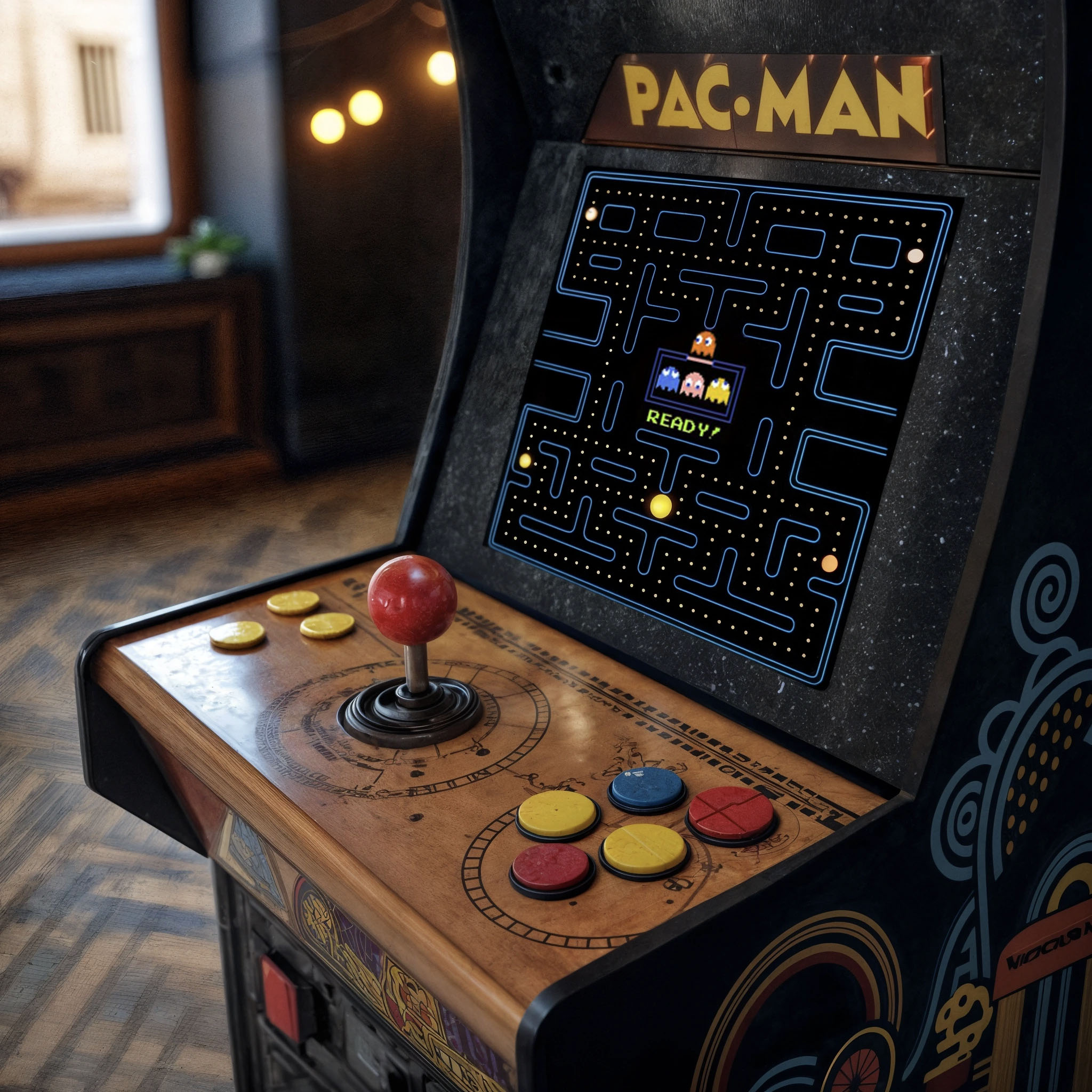
    The cover art features an arcade cabinet, its screen alive with Pac-Man, complete with a bold red joystick and a cluster of colorful buttons on the console.
    Screenshot

    ♫ Level 256 ♫


    134/398

    LogoSwitch language

    I enter the corridor, right, and chomp the dots (10 Pts) on my way, down, to a cherry left, but the ghosts are already, down, getting, right, menacingly close, up, before I reach the life-saving, up right, power pellet (50 Pts), now becoming the hunter myself, up left, chasing the flashing blue ghosts, up, to banish them, right, succeeding with one, up: banished! (200 Pts), down, before the other three change, left, and I can see that I caught back, the orange ghost—it’s Pokey—continuing to chomp dots (10 Pts) on my way down, but suddenly, I am ruthlessly pursued by Shadow and Speedy, back, back, right, and finally back back overrun by Speedy right where, of all places, I initially entered the maze.

    Two lives remain.

    I enter the corridor.

    155/398

    ♫ Glue Trapped ♫


    155/398

    LogoSwitch language

    “I Enter the Corridor” is the title of a collection of texts with which an alleged author—male or female, though likely a whole collective of malicious subversives—is attempting to spread a dangerous intellectual virus via the internet.

    Consciously, after the repetitive “I enter the corridor,” the reader’s mind perceives only a more or less well-constructed short story, which often loses itself in incomprehensibility or nonsense and usually lacks a proper punchline. This is likely intentional, because subliminally, the mind absorbs something else entirely during the reading process: The mantra-like repetition of “I enter the corridor” creates a progressively narrowing tunnel vision. Readers become particularly susceptible to messages below the threshold of consciousness, conveyed through hidden archetypal keywords.

    On the surface, the message of the “I Enter the Corridor” texts appears to be an ironic, postmodern play with tropes. In reality, however, anti-capitalist and anti-scientistic ideas—so-called “pluridimensional” and thus essentially occult ideologies—are surreptitiously transmitted, subjecting readers to a form of insidious brainwashing. “I Enter the Corridor” imperceptibly opens the door to a menacing ideology, Corridorism, which ultimately leads to paranoia and the delusion that conspiracies are everywhere, and which, in all likelihood, ends in a complete shattering of the nerves.