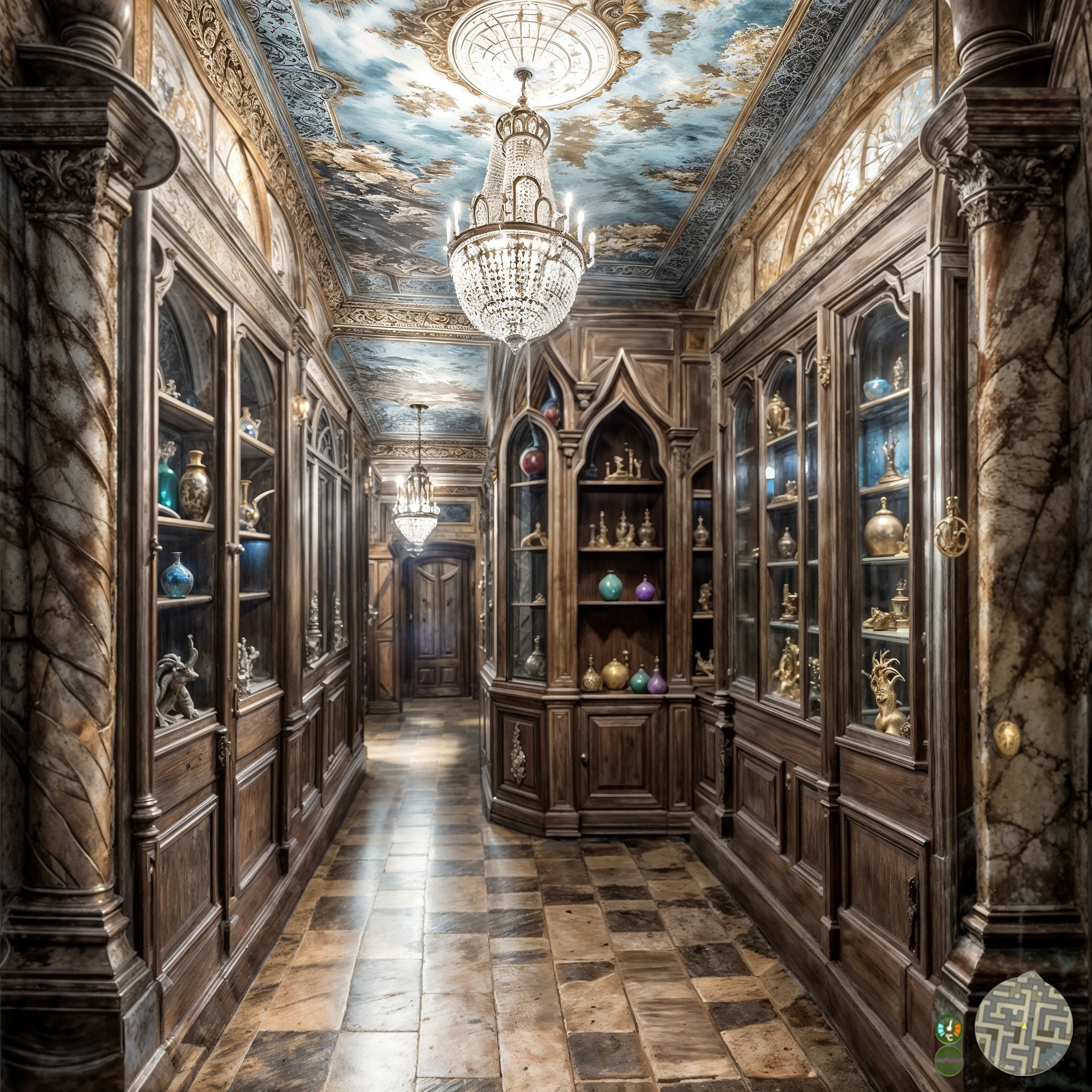
“‘I enter the corridor’—why this sentence? What makes it so special?” I was sitting across from Cory d’Or in a Viennese coffeehouse. The reply to my email inquiry had arrived promptly, and to my surprise, I didn’t have to travel to Berlin or another German city for the interview; I could conduct it right around the corner at my favorite café. The second surprise: Cory is a young woman. Of course, Cory d’Or isn’t her real name. She won’t reveal her true one. In contrast to her eloquent short prose, which sometimes calls to mind Fantastic Realism, Cory expresses herself laboriously, constantly correcting herself and getting tangled in contradictions. And yet, I’d come up with some really lovely questions: “What do you want to achieve with this blog? Is there a specific intention behind it, or is it just a game with words, connotations, topoi?” She wrings her hands, runs her fingers through her hair, searches for the right words. I keep asking, tentatively: “Where do all these ideas come from? Are there real-life models for the characters that keep reappearing?” Cory nods, starts to speak, shakes her head, bites her lip. Before she can give me a single usable answer, she cuts the interview short and instead—accompanied by animated gestures—reads me passages from the typescript of her new novel, which she has given the working title No Corridor on Earth.
I enter the corridor, at the end of which the throne room is located. Dressed as a servant, I blend in. Satisfied, I run my hand over the belt hidden under my clothes, which makes me look fatter than I am. All homemade. The time has come. Suddenly, I hear the Muezzin. Here? Now? Bewildered, I pause. I don’t want to jeopardize my chance at the 72 virgins at the last moment. So, I unroll my prayer mat in a window alcove and kneel down facing east. In that exact moment, I realize it was a trap. The voice is on a recording. I already see the palace guards running towards me. I jump up, wanting to run, but somehow, in my excitement, I must have hit the detonator. Before the roar of the explosion reaches my ears, I’m nothing but small fragments. I’ve failed. May the Prophet have mercy on me.
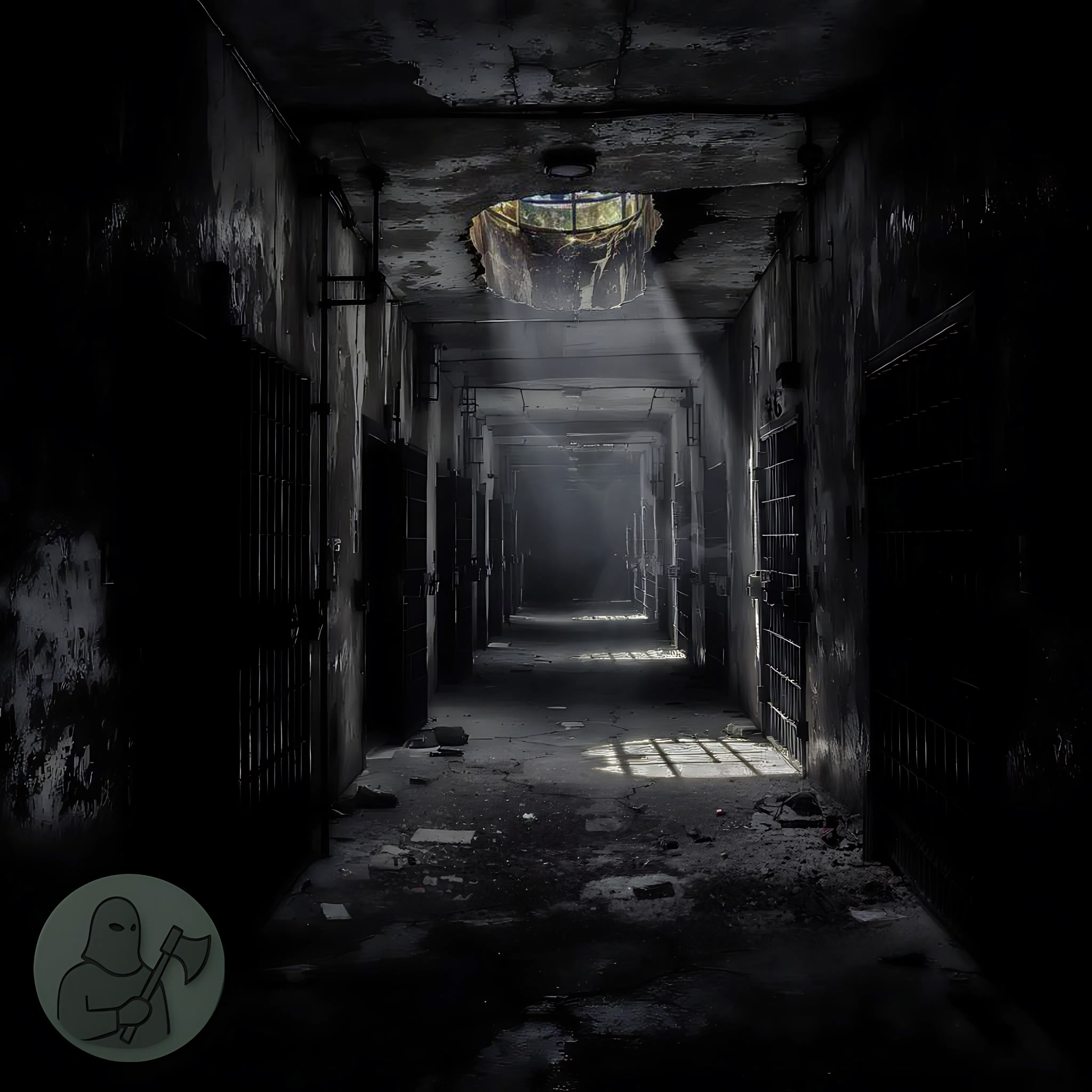
I enter the corridor. It’s down here in the basement that they’ve housed the hopeless cases. Dull noises seep through the doors, and I hear screams and heart-wrenching crying behind a door with peeling paint. This is where I’m meant to be. These people need comfort and encouragement, and that’s what I’ve firmly resolved to do: from now on, to tell only cheerful and uplifting stories and spread merriment wherever I go.
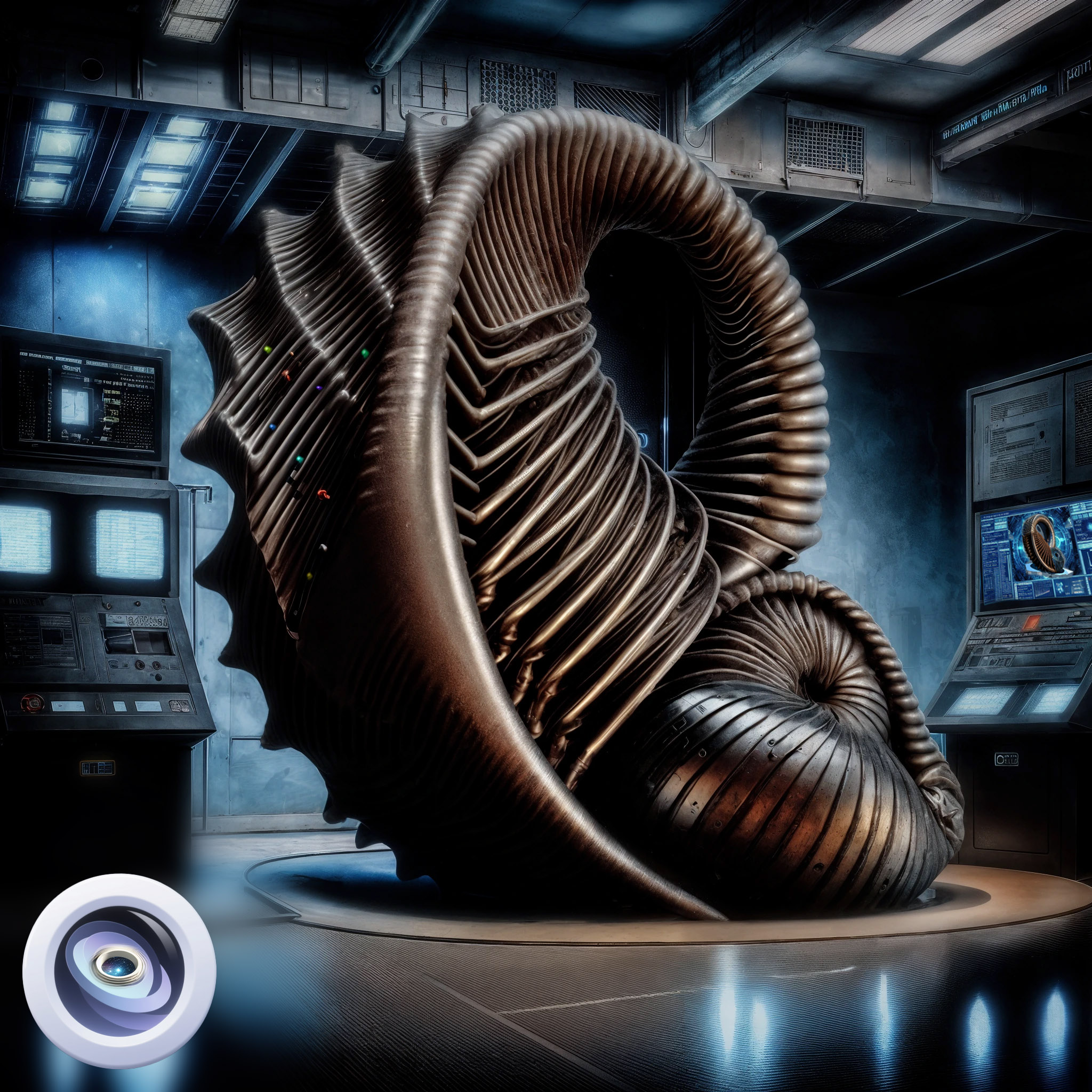
I enter the corridor to find the right door: the door that will take me back to the „Snail Shell.“ That’s what we called the convoluted magnetic chamber, which our supercomputer had calculated for us. After two years of construction alongside my students, the chamber was nearly complete: a strangely twisted and self-folded structure of gleaming metal adorned with hundreds of magnets, designed to prevent any matter generated in the vacuum chamber from coming into contact with anything. As the magnetic chamber hung in the spacious laboratory, it resembled a work of art from another world. Almost ethereally beautiful, yet also unsettlingly alien, as if this form should not exist.
I cannot adequately describe it. The Snail Shell held an ever-increasing fascination for me. Eventually, I convinced myself that I absolutely had to inspect the welds before sealing the chamber, and one night, I secretly crawled inside.
But not back out.
Instead, I find myself in the Trieste. As a child, this world record had left an indelible impression on me. I instantly recognize the submersible; the descriptions from my childhood must have etched themselves deep into my memory back then. I also recognize Piccard, and in doing so, I know whose head I’m stuck in and through whose eyes I see it all: those of his fellow traveler, Don Walsh—I am accompanying Jacques Piccard on a journey to one of the deepest points in the world’s oceans, the Mariana Trench.
It is cramped and stuffy; the metal hull groans heavily under the immense external pressure. The water, into which spotlights shine, looks cloudy. A universe of impenetrable blackness surrounds us.
I am a ghost, squatting inside Walsh’s head. Walsh seems oblivious to my presence. I keep drifting away, as if I were a foreign object that doesn’t belong here—which, in a way, is true. The experience reaches me like a radio signal clouded by heavy static. And then, recurring headaches wash over me, which is strange because I no longer have a head of my own. Walsh appears to notice nothing of the ghost or the pain inside his head.
In broken English, Piccard explains that we could die down here if we settle onto a wreck, get entangled, and cannot resurface. However, we land gently. A flatfish in front of our tiny window feels disturbed, stirs from the mud, and swims away. There is life down here. In eternal darkness, with the weight of almost eleven kilometers of water above! Piccard writes in his logbook. Then we release our ballast and begin to ascend.
I don’t understand any of this. How did I get here? How can I suddenly end up in a different time, in the head of a stranger?
Is it a dream, or am I perhaps actually dead, suffocated in the Snail Shell? But do you experience headaches and blackouts when you’re dead? Clear thinking is a challenge right now, but I believe this is all happening solely within my consciousness. I’m not a time traveler, but a ghost traveler. And somehow, I must find a way back to the Snail Shell, the magnetic chamber whose convoluted form—crafted only by mathematics and a powerful computer—has sent me into the Trieste. I must return!
We resurface. Champagne is poured to celebrate the record journey. Walsh urgently needs to use the head. He apologizes, enters a corridor in the mothership—and suddenly, I spin away from him, adrift, upside down, shattered into countless fragments. However, like magnetic particles, these pieces reassemble. Not in the Snail Shell, but in another time, in the mind of another person, another childhood fascination…
I enter the corridor to open the front door: The Jehovah’s Witnesses are back to proselytize; I saw them through the window. Last time, I slammed the door on them. How can anyone be so simple-minded and take the bit about the 144,000 who get into paradise literally?
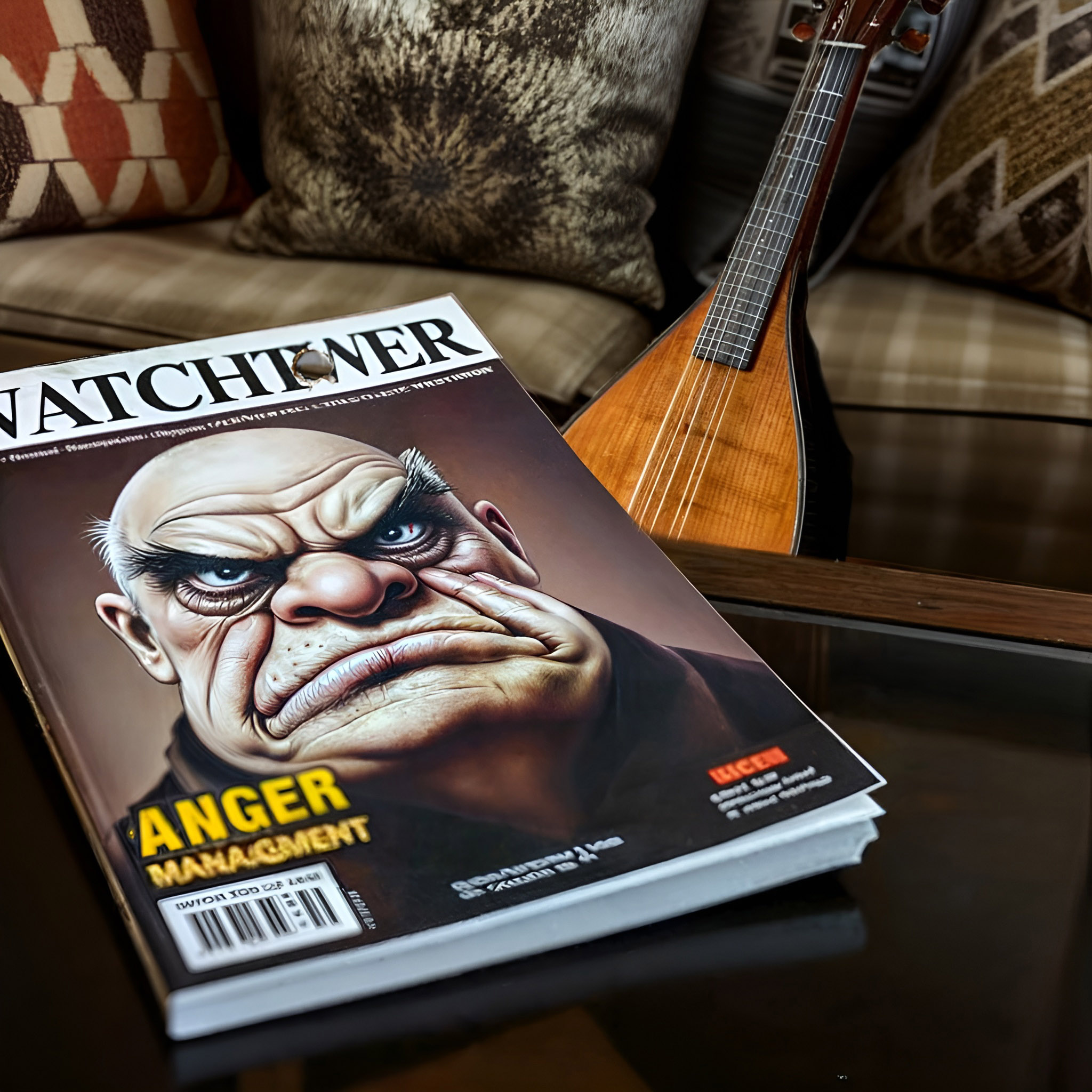
People are always trying to sell me something at my door, and I always send them packing to hell. The two women with their Watchtower and Bible did make me feel somewhat sorry afterward, though. This time, I want to make amends. After all, I pride myself on being civilized, and at least the Jehovah’s Witnesses actually believe what they’re saying – unlike the vacuum cleaner guys, the frozen food people, the mobile phone contract sellers, and the magazine subscription hawkers who are always ringing my doorbell.
I don’t have to invite the Witnesses in, but I can at least politely explain that I appreciate their commitment to their faith and values. However, I’d prefer it if they used their own God-given reason, rather than just following what they’re told. My faith, I’ll say, to set a good example, doesn’t contradict reason; it complements it in the best possible way. And then I’ll politely send them on their way, confident that they’ll see me as someone who knows what he believes and believes what he knows. Someone who’s at peace with himself, who’s found his own truth. Yeah, that’s the ticket.
I open the door. It’s the same two women as last time. One of them is holding the Watchtower in front of her stomach like a shield.
„Leave me alone and go to hell!“ I hiss and slam the door.
What got into me? Angry with myself, I stomp back into the living room. The spirit is willing, I think, but apparently it also likes to avoid the effort.
I enter the corridor. It will be my final walk. I cast a brief glance back at my cell, at the leftovers on the tray. The executioner and a clergyman—who has nothing personal to say, but only murmurs Bible verses to himself—accompany me. And my angels. Those radiant figures that no one but me can see; they came to visit me after long months in this cell, suddenly appearing, and they haven’t left me since.
I hear the soughing of their long, delicate wings and their whispers. Their hoarse, sighing whispers, of which I could never understand a word. And yet—no, at this very moment: Didn’t one of them whisper directly into my ear? Softly, barely a breath, but still intelligible? Or is it just my mind, made unreliable by long confinement, imagining it heard something—a word, a final personal one intended only for me, a message for me alone: Now!
I enter the corridor. How nice of you to join me. However, I wonder what brings you here. What are you hoping for from this corridor? That it will take you somewhere? That it will open doors and possibilities for you? New perspectives, insights, perhaps? Or do you even expect something from me? That I will guide you into unseen worlds and reveal things to you, secret, numinous, unspeakable things—with the pleasant anticipation of a thrill and a shiver of awe in the face of the unbelievable?
Very well. In that case, I won’t keep you any longer. I’ll gladly turn back and go my own way. Go ahead, don’t be shy: Enter the corridor yourself.
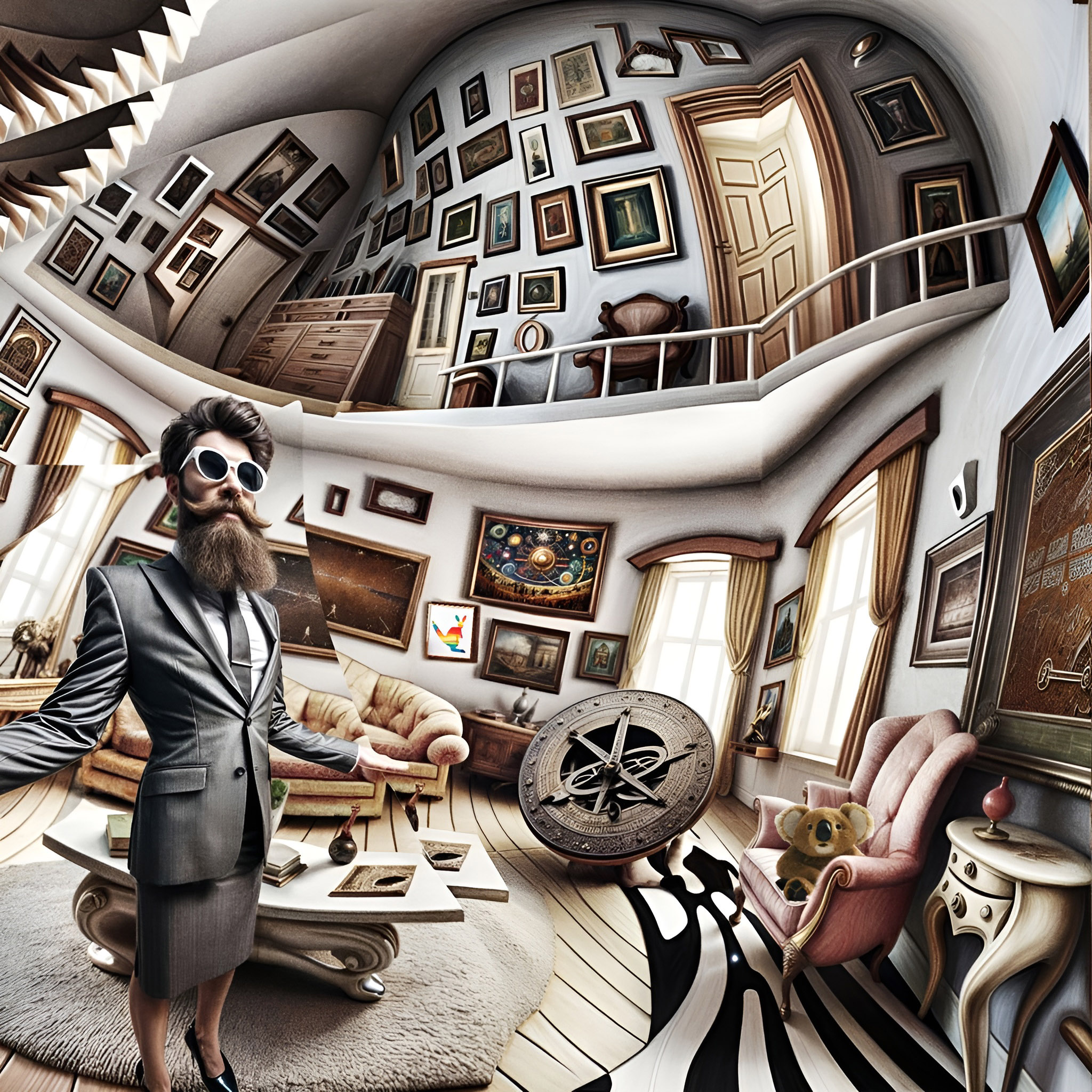
I enter the corridor on all fours, feeling incredibly dizzy and nauseated. Everything in this house sways and tilts; one loses their bearings entirely. Had I realized beforehand what awaited me in the „Villa Obscura,“ I would have given it a wide berth.
The twins, on the other hand, seem to be having the time of their lives—as they do with everything here at the amusement park. I can hear my two offspring squealing with delight in the next room. After the skewed angles and grotesque geometry of a cabinet worthy of Dr. Caligari, after water that seemingly flows uphill, and a forcedly cheerful host who—given the way he stood in the room—was quite literally a slanted character: what other dizzying, seasickness-inducing attractions are in store for me? I prefer things to be orderly, arranged at right angles, and behaving exactly as expected. Fortunately, the whole world isn’t as chaotic, lopsided, and warped as the „Villa Obscura,“ otherwise it would be even more difficult to govern than it already is.
I’d like nothing more than to just close my eyes and stay lying here in the hallway. And yet, I promised those two I’d take them on the roller coaster later…
I enter the corridor—the orchestra has already begun—and hasten into the hall. To reach my seat, I must squeeze through the otherwise fully occupied second row. As I do, the music crashes against me like a jungle of incoherent tones, following no recognisable form. Must I really endure this? „Avant-garde“—that subtitle on the programme should have made me suspicious. I truly wish to leave, yet I am as if paralysed, steadily losing the sensation of my own body as the music expands. It begins to flow between the intervals of the accustomed semitones—not merely into quarter-tones, but „centitones“ and „millitones.“ To the untrained ear, it is torture; but for me, within me, something has shifted. I now perceive with mounting interest the various musical forms bustling within the sound.
It is astonishing: these sound-figures live and move freely through the world of tones, drifting apart and drawing near to one another. I realise with amazement that the two dimensions of this world are, on one hand, pitch, and on the other, the timbres arising from harmonic overtones. Every living creature in this sound universe possesses its own colouration, even if some are adept at camouflaging themselves.
One of these sound-creatures seems very close to me, and suddenly the realization hits: That’s me! In this world of vibrations and frequencies, I possess my own body; I am part of this acoustic habitat! When one of the sound-beings nudges me and I feel a sharp pain, I learn that I can change my musical form and move through this jungle of tones, through the dense musical vegetation. I can even absorb small sound-figures into my own form—as if I were strolling through a garden, snacking on tasty-looking apples or raspberries.
A deep growl makes my heart skip a beat: a hunter is prowling the jungle, searching for prey with its whirring sound-tentacles. I flee, but the hungry creature has already spotted me. I hide my sound-body in the musical vegetation of our habitat, but my camouflage is useless. I narrowly escape a searching tentacle by climbing higher. I am limited, however; I manage to rise a few octaves, but then the sounds begin to thin out in the high registers. The predator rumbles restlessly back and forth directly beneath me in the low registers, until a tiny melodic fragment falls from the vegetation I’m clinging to and betrays me. With a piercing arpeggio, one of its tentacles reaches me and digs deep into the sound-pattern of my flesh. The greedy growl pulls me down toward it, octave by octave…
I let out a death cry.
The music dies away. A few violins play on, but the conductor has turned towards me, and the entire audience is staring. „I am sorry,“ I mumble, standing up and pushing through the row to flee the hall.
I can still hear the conductor calling out a bar number to his orchestra to resume the piece. The music rises once more. But I run on, further and further, without collecting my coat from the cloakroom—simply away from here, into the open air.
There is no music here. The street noises are refreshing, washing over my ears like a welcome downpour. Everything is a rush of cars and roaring motorcycles; in the distance, I hear a siren, and above me, an aeroplane. I come to a halt in the midst of this wonderful clamour. A roar draws closer—the deep growl of a powerful engine. A bus thunders at great speed along the street, bearing down on the spot where I stand. I face it, arms flung wide to the sky, thanking the heavens for my rescue…
Based on Olaf Stapledon’s „A World of Sound“ (1936).